Modern marketers are caught in a frustrating bind. On one side, you have more data than ever before. On the other, the data you actually need, the kind that spans platforms and connects audience behavior across channels, is increasingly locked away behind privacy walls, platform restrictions, and regulatory guardrails.
You know your customers interact with your brand across Google, Meta, LinkedIn, and your own website before they ever convert. But piecing together that cross-platform picture has become genuinely difficult. Raw data sharing is off the table. Third-party cookies are largely gone. And every major platform has built walls around its first-party data to protect both user privacy and its own competitive position.
This is exactly the problem that data clean rooms were designed to solve. A data clean room lets two or more parties analyze overlapping datasets together, without either side ever seeing the other's raw user records. It is privacy-safe collaboration infrastructure, and it is becoming an increasingly important part of the modern marketing measurement conversation.
By the end of this article, you will understand what a data clean room actually is, how it works in practice, the specific use cases where it delivers real value, and how it fits alongside the attribution stack that most B2B SaaS teams need to build first. Let's start with the shift that made all of this necessary.
The Privacy Wall That Changed How Marketers Access Data
For years, the digital advertising ecosystem ran on third-party cookies. These small tracking files allowed advertisers, agencies, and ad tech platforms to follow users across websites, build behavioral profiles, and measure campaign performance across channels. It was imperfect, but it worked well enough to give marketers a reasonably connected view of the customer journey.
That infrastructure has been systematically dismantled. Apple's App Tracking Transparency framework dramatically reduced mobile tracking signals. Major browsers have moved away from third-party cookie support. Privacy regulations have raised the bar for how user data can be collected, stored, and used. The result is a fragmented data landscape where the signals marketers once relied on are either degraded or gone entirely.
At the same time, the major platforms have doubled down on their walled gardens. Google, Meta, and Amazon each hold enormous amounts of first-party data about their users. They use that data to power their own ad targeting and measurement products, but they do not let advertisers export raw user-level data. You can see aggregated performance reports inside their dashboards, but you cannot take the underlying audience data and combine it freely with data from another platform.
This creates a real measurement problem. Imagine you are a B2B SaaS company running campaigns on both Google and LinkedIn. You want to know how much audience overlap exists between the two. Are you reaching the same decision-makers twice, or are these genuinely distinct audiences? You also want to understand which combination of exposures tends to precede a conversion. These are legitimate, valuable questions. But answering them requires combining audience data from two platforms that each refuse to share raw user records.
The same challenge applies when working with publishers, data partners, or even your own CRM data. You might want to match your customer list against a publisher's audience to understand reach and frequency, or connect ad exposure data from multiple sources to your conversion outcomes. Without a neutral, privacy-safe environment to do that matching, you are left making decisions based on incomplete, siloed data. Understanding data-driven vs data-informed decision making becomes especially important in this context.
This is the gap that data clean rooms fill. They provide the infrastructure for cross-partner data collaboration without requiring either party to expose individual user records to the other.
Inside the Secure Environment: How Clean Rooms Actually Work
A data clean room is a secure, privacy-preserving environment where two or more parties can run queries and analysis on combined datasets, without either party ever seeing the other's raw, individual-level user data. The output is aggregated or anonymized results, not raw records.
Here is how the mechanics work in practice. Both parties upload their data to the clean room environment, typically using hashed or encrypted identifiers. Email addresses are the most common identifier, usually hashed using a standard algorithm so that the actual email address is never exposed, but matching is still possible. Other pseudonymous identifiers can also be used depending on the platform.
Once both datasets are inside the clean room, SQL-like queries are executed on the combined data within the secure environment. The queries run on the matched records, but neither party can access or export the other's underlying data. Only the results of those queries, aggregated summaries, are returned to the requesting party.
There is an important safeguard built into this process: minimum threshold requirements. Most clean room environments will only return results if the query output meets a minimum user count, often somewhere around 50 or more matched records. This prevents a party from constructing narrow queries designed to reverse-engineer individual user identities from aggregated results. If your query would return data about fewer than the threshold number of users, the clean room suppresses the result entirely.
This is the key distinction between a data clean room and traditional data sharing or a standard data warehouse. In a traditional data share, raw records move from one party to another. In a data warehouse, your own data is centralized for analysis. A clean room enforces data minimization by design: raw records never leave the secure environment, and results are only surfaced at an aggregate level that prevents re-identification. Teams exploring how to set up a data lake for marketing attribution will recognize many of these same principles around data governance and access control.
Major platforms have built their own clean room products. Google's Ads Data Hub, Meta's Advanced Analytics environment, and Amazon Marketing Cloud each allow advertisers to run queries against platform data combined with their own first-party data. Independent clean room platforms like Snowflake Data Clean Rooms, InfoSum, LiveRamp Safe Haven, and Habu offer more flexible, multi-party environments that are not tied to a single walled garden.
The practical implication is that clean rooms are not a single tool but a category of infrastructure. The right environment depends on which data partners you are working with and what questions you are trying to answer.
The Three Use Cases Where Clean Rooms Deliver Real Value
Not every marketing question needs a data clean room. But there are three specific scenarios where they are genuinely the right tool for the job.
Audience overlap and reach analysis: This is often the first use case marketers explore. By matching your CRM or first-party customer data against a platform's or publisher's audience, you can understand how much of your existing customer base is already being reached by your campaigns. You can also identify where untapped audiences exist. If you discover that a large portion of your target accounts are active on a platform you have been underinvesting in, that is a meaningful strategic insight. Conversely, if you find heavy overlap between two campaigns, you can reduce redundant spend and improve overall reach efficiency.
Cross-platform attribution and measurement: Clean rooms allow marketers to connect ad exposure data from multiple platforms to conversion outcomes in a way that respects each platform's data restrictions. You can run deduplicated reach and frequency analysis across channels, understanding how many unique users were exposed to your campaigns and how many times. You can also explore multi-touch attribution across channels at an aggregate level, examining which combinations of platform exposures tend to precede conversions. This kind of cross-platform measurement is simply not possible through standard platform dashboards, which each report their own conversions in isolation.
Audience activation and suppression: Clean room match results can be used to improve the efficiency of your ad spend without exposing individual customer records. Suppression is a common application: by matching your existing customer list against a platform's audience, you can build suppression lists that exclude current customers from acquisition campaigns. You are no longer paying to re-acquire people who already converted. Similarly, clean room match results can inform lookalike seed audiences, helping platforms identify new users who resemble your best customers based on the matched data, without you ever handing over raw customer records.
Each of these use cases shares a common thread: they answer questions about audiences and reach at the aggregate level, questions that cannot be answered by looking at a single platform's dashboard in isolation but also cannot be answered by directly sharing raw data between parties.
How Data Clean Rooms Fit Into a B2B Attribution Stack
Understanding what a clean room does is one thing. Knowing where it fits in your actual measurement infrastructure is another, especially for B2B SaaS companies where the customer journey is long, multi-touch, and often involves a small, well-defined addressable market.
The first thing to understand is that clean rooms are most valuable when you already have a strong first-party data foundation. Without clean, enriched data flowing from your CRM, ad platforms, and website, a clean room has little to analyze. The quality of the insights you get out is directly proportional to the quality of the data you bring in. Hashed email addresses that do not match across systems, CRM records with missing fields, or inconsistent event tracking will all degrade the value of any clean room analysis.
The second thing to understand is that clean rooms and attribution platforms answer fundamentally different questions. A clean room answers aggregate questions: How much overlap exists between my Google and LinkedIn audiences? How many unique users were exposed to my campaign across platforms? Which publisher audiences show the highest conversion correlation at a cohort level? These are important strategic questions, but they operate at the campaign and audience level.
An attribution platform answers granular questions: Which specific touchpoints did this lead interact with before converting? Which campaigns are driving pipeline? What is the revenue return on my ad spend across channels at the individual conversion level? These questions require tracking individual customer journeys from the first ad click through to closed-won revenue. Reviewing the best marketing attribution tools for B2B SaaS can help teams identify the right platform for this layer of measurement.
Think of them as two complementary layers in your measurement stack. Clean rooms handle privacy-safe cross-partner analysis at the aggregate level. Attribution platforms like Cometly handle end-to-end tracking at the touchpoint level, connecting ad spend to pipeline and revenue across the full customer journey. A growth team that has both is genuinely well-equipped. But for most B2B SaaS companies, the attribution layer comes first, because it informs the daily optimization decisions that drive growth.
Without knowing which campaigns, channels, and ads are actually driving pipeline, you are optimizing in the dark. Clean room insights about audience overlap are valuable context, but they do not tell you whether your LinkedIn campaigns are generating qualified pipeline or whether your Google spend is converting at a positive ROI. That is what attribution gives you.
Limitations and Honest Trade-offs to Understand Before You Start
Data clean rooms are a genuine innovation in privacy-preserving measurement, but they come with real constraints that are worth understanding before you invest significant resources in implementation.
Minimum threshold requirements can limit actionability for smaller B2B audiences: The same safeguard that prevents re-identification, the minimum user count threshold, can also prevent you from getting useful results if your audience is small. B2B SaaS companies often operate in narrow verticals with limited total addressable markets. If your matched audience in a clean room query falls below the threshold, the result is suppressed entirely. For enterprise-focused SaaS companies with tight ICP definitions, this can be a genuine constraint that limits the practical value of clean room analysis.
Setup and maintenance complexity is real: Most clean room environments require meaningful data engineering resources to configure and maintain. You need to understand how to write effective queries, how to structure your data for upload, and how to govern the clean room relationship with your data partner. Ongoing data quality monitoring is essential. This is not a plug-and-play analytics tool. It requires technical investment, and that investment needs to be justified by the scale and complexity of your measurement needs. Teams evaluating their options should explore the best software for tracking marketing attribution to understand where clean rooms fit relative to other measurement investments.
Clean rooms are not built for real-time, granular optimization: By design, clean rooms produce aggregate outputs from periodic analysis. They are not the right tool for daily campaign optimization decisions. If you need to know which ad creative is performing best this week, which keywords are driving the most qualified leads, or how your cost per pipeline opportunity has shifted since you changed your bidding strategy, a clean room cannot answer those questions. That kind of granular, real-time insight requires a dedicated attribution platform. Tracking digital marketing performance metrics in real time is where purpose-built attribution tools deliver their greatest advantage.
The honest framing is this: data clean rooms are a powerful tool for a specific set of strategic measurement questions. They are not a replacement for the granular attribution and analytics infrastructure that growth teams need for day-to-day decision making. Knowing this distinction helps you invest in the right tools at the right stage of your measurement maturity.
Building the Data Foundation That Makes Everything Work
Whether you are thinking about clean room analysis, multi-touch attribution, or both, the quality of your first-party data is the variable that determines how much value you can extract. Weak data in means weak insights out, regardless of how sophisticated the analysis environment is.
For B2B SaaS teams, building that foundation means investing in server-side tracking and Conversion API integrations. Server-side tracking ensures that conversion events are captured accurately even when browser-based tracking is degraded by ad blockers or browser restrictions. Conversion API integrations with platforms like Meta and Google send enriched, server-side event data directly to the ad platforms, improving the signal quality they use for optimization and attribution. CRM data hygiene, consistent field population, accurate lead source tracking, and clean account and contact records, ensures that the first-party data you bring into any analysis environment is reliable.
For most B2B SaaS marketing teams, the most immediate and highest-leverage priority is establishing a single source of truth for attribution across all paid channels. Before you can benefit from clean room analysis, you need to know which campaigns are driving pipeline and revenue at the touchpoint level. Adopting data-driven marketing strategies from the outset ensures that the first-party data foundation you build will support both attribution today and more advanced analysis tomorrow. That is the foundation everything else is built on.
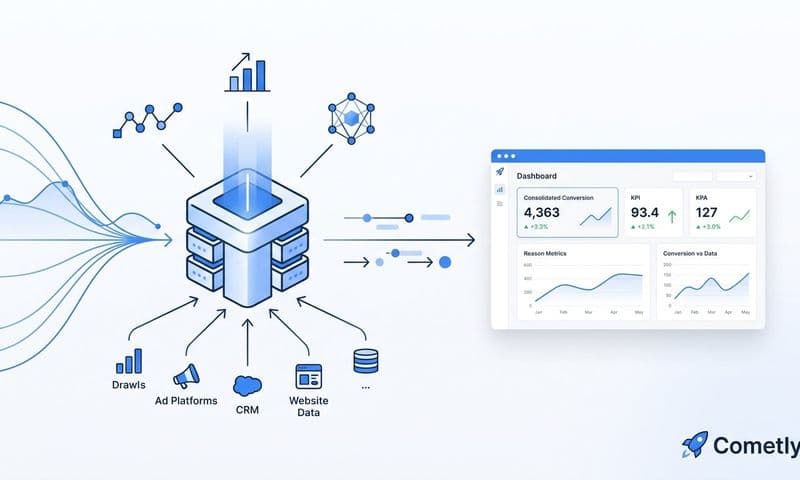
This is where Cometly fits into the picture. Cometly is the attribution layer that captures every touchpoint from the first ad click through to CRM events and closed-won revenue. It connects your ad platforms, CRM, and website to track the complete customer journey in real time, giving you a clear view of which channels, campaigns, and ads are actually driving results. With server-side conversion tracking and Conversion API integrations built in, Cometly also feeds enriched conversion data back to ad platforms, improving their targeting and optimization algorithms. The result is a first-party data foundation that powers both accurate attribution today and more sophisticated clean room analysis as your measurement program matures.
The Bottom Line on Data Clean Rooms
Data clean rooms represent a meaningful step forward in privacy-preserving measurement. They give marketers a legitimate path to cross-partner audience analysis and aggregate measurement in a world where raw data sharing is no longer viable. For teams working at scale across multiple platforms and data partners, they can answer strategic questions that simply cannot be answered any other way.
But they are not a starting point. They are a layer of sophistication that requires a strong first-party data foundation, meaningful audience volume, and technical resources to implement well. For most B2B SaaS marketing teams, the higher-leverage investment is building accurate multi-touch attribution first: knowing which touchpoints drive pipeline, which campaigns generate revenue, and how your ad spend is performing across every channel in real time.
Once that foundation is in place, clean room analysis becomes a powerful complement, adding cross-platform reach insights and aggregate measurement that enriches your strategic decision making without compromising user privacy.
If you are ready to build that attribution foundation, Get your free demo of Cometly today. See how it connects every ad click to pipeline and revenue, captures every touchpoint in real time, and gives your growth team the accurate, complete data it needs to scale with confidence.