Picture this: your marketing team walks into the monthly performance review with confidence. You've got dashboards open, numbers ready, and a story to tell. Google Ads says the campaign drove 140 conversions. GA4 shows 89 goal completions. Your CRM has 47 new leads attributed to paid search. And your revenue team is looking at a closed-won report that doesn't connect to any of it.
Which number is right? The honest answer is: probably none of them, at least not in isolation.
This is the reality for most B2B SaaS marketing teams today. You're running sophisticated campaigns across multiple channels, investing in tools that each promise clarity, and somehow ending up with more confusion than when you started. The problem isn't that your team lacks skill or your tools lack features. The problem is that your data sources aren't talking to each other, and that silence is costing you real money.
Disconnected marketing data sources are one of the most underestimated strategic problems in B2B SaaS. They don't announce themselves loudly. Instead, they quietly distort your understanding of what's working, push budget toward the wrong channels, and create friction between marketing and sales that never quite gets resolved. This article breaks down what data fragmentation actually is, why it happens, what it costs, and how to build the connected data foundation your growth strategy actually needs.
The Data Fragmentation Problem Every Marketing Team Faces
Disconnected marketing data sources describes a specific and frustrating state: your ad platforms, CRM, website analytics tools, and revenue systems each hold isolated pieces of the customer journey, and none of them share a common data layer. Every tool captures what it can see, from its own vantage point, using its own logic. The result is a set of partial pictures that don't add up to a coherent whole.
Think of it like a relay race where each runner has a different stopwatch, and no one agrees on when the race actually started. Each platform is technically measuring something real. But without a shared reference point, you can't compare the numbers or trust the totals.
The modern B2B SaaS marketing stack has grown complex enough to make this problem structural rather than accidental. A typical growth team might run paid search through Google Ads, paid social through Meta and LinkedIn, track leads in HubSpot or Salesforce, monitor website behavior in GA4, and report revenue through Stripe or their finance system. Each of these tools does its job reasonably well. What they don't do is hand off data cleanly to each other.
The symptoms show up in ways that feel familiar to anyone who has spent time in B2B marketing. Conversion numbers are inconsistent depending on which platform you check. A closed deal that came in last quarter can't be traced back to the campaign that started the conversation. Your monthly report looks different depending on whether you pull it from your CRM or your ad dashboard. And when leadership asks which channel is driving the most revenue, the honest answer is: you're not sure.
These aren't edge cases or minor reporting quirks. They are the predictable outcome of building a marketing stack without a shared data foundation. Each tool optimizes for its own reporting, captures what it can track, and presents results in a way that makes its own contribution look as strong as possible. When you try to reconcile those reports at the end of the month, the numbers simply don't line up.
The deeper issue is that the customer journey doesn't respect platform boundaries. A prospect might see a LinkedIn ad, search for your product on Google three days later, read a blog post, and then book a demo after clicking a retargeting ad on Meta. That journey lives across four platforms. Without a unified data layer, each platform claims a piece of the credit, and no single view shows you the full path from first touch to closed revenue.
Why Marketing Data Gets Siloed in the First Place
Understanding why data fragmentation happens is important, because the causes are structural. This isn't a problem you can solve by asking your team to be more careful with their spreadsheets.
Point-solution sprawl: Most marketing stacks are built incrementally. You adopt Google Ads because it's the obvious place to run search campaigns. You add HubSpot because your sales team needs a CRM. You install GA4 because you need website analytics. Each tool is chosen for its specific job, and each is genuinely good at that job. But when these tools are adopted without a plan for how data will flow between them, you end up with natural silos. The tools don't integrate deeply enough to share a unified customer record, so each one operates in its own data universe.
Attribution window mismatches: This is one of the most concrete and damaging causes of fragmented reporting. Google Ads, Meta Ads, and LinkedIn Ads each apply their own attribution logic and lookback windows by default. A prospect who clicks a Google Ad and then converts after seeing a Meta retargeting ad a week later might be counted as a conversion by both platforms simultaneously. Neither platform is lying, exactly. They're each applying their own rules. But the combined effect is that your total reported conversions across platforms can appear much higher than the number of actual customers you acquired. When you're making budget decisions based on those inflated totals, you're working from a distorted picture.
First-party data gaps: Browser privacy changes have made pixel-based tracking increasingly unreliable. Safari's Intelligent Tracking Prevention and Firefox's enhanced tracking protection limit how long cookies persist and how cross-site data can be collected. Ad blockers intercept tracking scripts before they fire. The result is that a meaningful portion of real customer touchpoints never get recorded by browser-based pixels. Each platform's dataset becomes less complete, and when incomplete datasets are compared against each other, the discrepancies compound.
The industry response to these tracking gaps has been server-side tracking via Conversion APIs. Meta's Conversion API, Google's Enhanced Conversions, and similar tools allow you to send conversion signals directly from your server rather than relying on browser pixels. This approach bypasses the privacy restrictions that degrade pixel-based tracking and delivers more complete, more accurate data to your ad platforms. But implementing server-side tracking requires deliberate investment, and many teams haven't made that transition yet.
The combination of these three forces, tool sprawl without integration, conflicting attribution windows, and degraded pixel tracking, creates a data environment where fragmentation is the default state. You have to actively build against it. Most teams haven't, which is why disconnected marketing data sources remain such a widespread problem.
The Real Business Cost of Fragmented Marketing Data
Data fragmentation isn't just an analytics inconvenience. It has direct business consequences that show up in your budget, your pipeline, and your ability to grow efficiently.
Budget misallocation: When you don't have a unified view of which channels are actually driving revenue, you tend to make budget decisions based on whichever platform's self-reported numbers look most convincing. Last-click attribution, which is still the default in many tools, gives all the credit to the final touchpoint before conversion. This systematically over-rewards bottom-of-funnel channels like branded search while starving top-of-funnel channels like display and paid social that initiate the customer journey. You end up cutting the channels that create demand and doubling down on the channels that merely capture it. Over time, that misallocation erodes your pipeline.
Broken pipeline visibility: In B2B SaaS, the gap between marketing-reported MQLs and sales-reported pipeline is one of the most persistent organizational friction points. Marketing looks at lead volume and cost per lead. Sales looks at pipeline stage and deal velocity. Without a shared attribution layer that connects ad spend to CRM pipeline stages and closed-won revenue, neither team can answer the question that actually matters: which campaigns are generating revenue, not just leads? This misalignment leads to budget arguments that are really just disagreements about which partial dataset to trust.
Slow decision cycles: Speed matters in campaign optimization. When a campaign is underperforming, you want to identify it quickly, understand why, and reallocate budget before you've wasted another week of spend. But when every reporting question requires pulling data from three or four tools, reconciling discrepancies, and manually building a picture that none of the tools provide on their own, the process becomes slow and labor-intensive. By the time your team agrees on what the data is saying, the window to act has often passed.
There's also a compounding effect worth naming. Fragmented data doesn't just cause individual bad decisions. It erodes confidence in data generally. When your team has been burned enough times by numbers that turned out to be inconsistent, they start second-guessing every report. That skepticism slows down decision-making further and can push teams back toward gut-feel judgments that data-driven marketing strategies were supposed to replace.
For B2B SaaS companies specifically, where sales cycles are long and deal values are high, these costs are amplified. A misattributed conversion isn't just a reporting error. It's potentially thousands of dollars in misallocated budget and a missed opportunity to understand what's actually working in a complex, multi-touch buying journey.
How Unified Attribution Bridges the Gap Between Your Data Sources
The solution to disconnected marketing data sources isn't to pick one tool and ignore the others. It's to build an attribution layer that sits above your individual tools and creates a coherent, connected view of the full customer journey.
Multi-touch attribution is the framework that makes this possible. Rather than assigning all the credit for a conversion to a single touchpoint, multi-touch attribution distributes credit across every interaction a prospect had before converting. This means a prospect who saw a LinkedIn ad, clicked a Google search ad, and then booked a demo after a retargeting campaign gets their journey represented accurately. Each touchpoint gets appropriate credit based on the attribution model you apply, whether that's linear, time-decay, position-based, or data-driven. The result is a much more honest picture of which channels are contributing to your pipeline and which are genuinely driving closed revenue.
But multi-touch attribution is only as good as the data it runs on. If your tracking is incomplete because browser pixels are being blocked or restricted, your attribution model will have gaps. This is where server-side tracking and Conversion API integration become foundational. By sending conversion signals directly from your server to ad platforms like Meta, Google, and LinkedIn, you capture touchpoints that browser-based tracking would miss. Your attribution model gets a more complete dataset to work with, and your ad platforms receive better signals that improve their targeting and optimization algorithms.
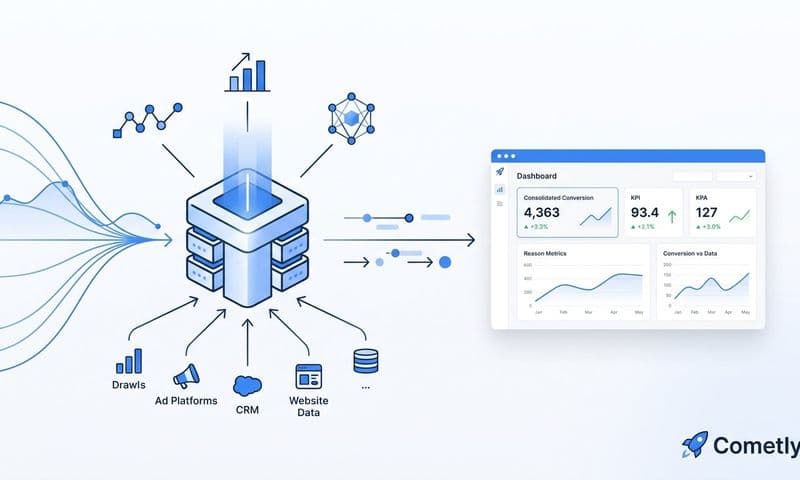
The concept of a single source of truth is what ties this together operationally. A single source of truth means one platform that ingests data from your ad channels, your CRM, and your revenue systems, and presents it in a unified, consistent view. When marketing and sales both look at the same data, the arguments about whose numbers are right disappear. Budget decisions get tied to revenue impact rather than platform-reported conversions. And when leadership asks which channel is driving growth, you can answer with confidence because the answer comes from a connected dataset rather than a patchwork of siloed reports.
This unified view also changes what's possible analytically. You can see the full customer journey from first ad click through lead capture to closed-won revenue. You can compare how different attribution models change your understanding of channel performance. You can identify which campaigns are generating pipeline value, not just lead volume. These are the insights that drive efficient growth, and they're only available when your data sources are connected.
Building a Connected Marketing Data Stack
Knowing that unified attribution is the answer is one thing. Building the data infrastructure to support it is another. Here's a practical framework for getting there.
Audit your current data sources: Start by mapping every tool in your stack. Document what data each one captures, what events it tracks, and what happens to that data after it's collected. Then identify the handoff points between systems where data gets lost or transformed in ways that create inconsistencies. Common breakdowns include lead source data that doesn't carry through from your ad platform into your CRM, conversion events that are tracked differently across platforms, and revenue data that lives in a finance system with no connection to your marketing stack. You can't fix what you haven't mapped.
Prioritize first-party data collection: Move away from reliance on browser pixels wherever possible. Implement server-side event tracking so that conversion events are captured and sent directly from your server rather than depending on a user's browser to fire a pixel. Enrich your conversion events with CRM data so that when you send signals back to Meta or Google, you're sending meaningful, deduplicated information about actual customers rather than anonymous browser events. This improves the quality of the data your ad platforms use for optimization, which in turn improves targeting efficiency and reduces wasted spend.
Choose an attribution platform built for integration: The right marketing campaign attribution solution isn't just a reporting tool. It's the connective layer between your ad channels, your CRM, and your revenue data. Look for a platform that natively integrates with the tools you already use, supports multiple attribution models so you can compare different views of performance, and connects ad spend data to pipeline stages and closed-won revenue rather than stopping at the lead level. The ability to see which campaigns are generating revenue, not just which ones are generating clicks, is what separates a useful attribution platform from a more sophisticated version of the fragmented reporting you're already dealing with.
Building a connected data stack takes deliberate effort, but the payoff is a marketing operation that can make faster, more confident decisions because everyone is working from the same reliable numbers.
From Fragmented Reports to Revenue-Driven Decisions
When your marketing data is unified, the operational changes are significant and immediate. Marketing and sales stop arguing about whose numbers are right because they're both looking at the same pipeline metrics. Budget conversations shift from defending platform-reported conversions to evaluating revenue impact. Campaign optimization happens faster because the data you need to make a decision is in one place rather than spread across four tools that don't agree with each other.
Here's where it gets particularly powerful for growth teams: AI-powered analysis only works when the underlying data is clean and connected. Ad platform AI, including Meta's Advantage+ and Google's Performance Max, relies on the quality of the conversion signals you send back to optimize targeting. If your conversion data is incomplete because pixels are being blocked, or if you're sending duplicate signals because the same conversion is being tracked in multiple places, the platform's AI is working with degraded inputs. Better data quality means better algorithmic targeting, which means more efficient spend and stronger results over time.
The same principle applies to your own analytics. When your data is connected across ad platforms, CRM, and revenue systems, you can use data analytics in marketing to surface which ads and channels are genuinely driving revenue versus which ones are simply claiming credit. That distinction matters enormously when you're deciding where to scale and where to pull back.
This is exactly the problem Cometly is built to solve. Cometly connects your ad platforms, CRM, and revenue data into a single attribution layer, giving B2B SaaS marketing teams a complete view of every customer journey from first ad click to closed-won revenue. With multi-touch attribution, server-side conversion tracking, and native integrations across 70+ platforms including Stripe, HubSpot, and Salesforce, Cometly eliminates the data silos that lead to misattributed spend and misaligned teams. You can capture every touchpoint, understand what's really driving revenue, and feed better conversion signals back to your ad platforms so their AI can optimize more effectively.
Putting It All Together
Disconnected marketing data sources aren't just an analytics headache. They are a strategic liability that leads to wasted budget, misaligned teams, and growth opportunities that slip through the cracks because no one could see the full picture clearly enough to act on it.
The path forward is clear, even if it requires deliberate investment. Start by auditing your stack and understanding where your data breaks down. Close the tracking gaps with server-side event tracking and Conversion API integration. And adopt an attribution platform that connects your ad channels, CRM, and revenue data into a single source of truth so that every budget decision, every optimization call, and every conversation between marketing and sales is grounded in the same reliable numbers.
When your data is connected, you stop guessing and start growing with confidence. You can see which campaigns are generating pipeline, which channels are closing revenue, and where to invest next. That clarity is what separates teams that scale efficiently from teams that keep running the same fragmented reports and wondering why the numbers never quite add up.
Ready to stop guessing and start seeing exactly which ads and channels are driving your revenue? Get your free demo and see how Cometly connects your marketing data sources into a single source of truth for pipeline and revenue attribution.