You're running paid campaigns across Meta, Google, TikTok, LinkedIn, and more. Your team is managing a significant budget, your CFO wants proof that it's working, and every platform is telling a different story about which ads are driving revenue. Sound familiar?
This is the reality for enterprise marketing teams today. Data isn't the problem. You have more of it than ever. The problem is fragmentation. When attribution data lives inside individual ad platforms, each one claims credit for the same conversions, your reported revenue looks inflated, and the actual decisions you're making about where to invest are based on noise rather than signal.
An enterprise marketing analytics platform is the infrastructure built to solve exactly this. It's not a fancier dashboard or a more colorful report. It's the connective layer that unifies your ad platforms, CRM, and website data into a single, coherent view of what's actually driving revenue across your entire funnel.
In this article, we'll break down what enterprise marketing analytics platforms actually do, how they differ from the basic tools most teams are already using, which capabilities matter most at scale, and what to evaluate when choosing one for your organization. If you're responsible for significant ad spend and you're not fully confident in your attribution data, this is worth your time.
Beyond Basic Analytics: What Enterprise-Grade Platforms Actually Do
Let's start with a distinction that matters. Native ad dashboards, basic web analytics tools, and even most mid-market analytics platforms are built to answer one question: what happened inside this channel? They're designed to report on their own data, within their own ecosystem, using their own attribution logic.
An enterprise marketing analytics platform is built to answer a fundamentally different question: what is actually driving revenue across all of your channels, and how do you know?
The core differentiators are scale, cross-channel data unification, and attribution depth. At the enterprise level, you're not tracking a handful of campaigns. You're managing dozens or hundreds of active campaigns simultaneously, across multiple platforms, targeting different audiences at different stages of the funnel. The volume of data and the number of potential interaction points between a prospect and a conversion make basic tools structurally inadequate.
Here's what enterprise-grade platforms actually do at a functional level:
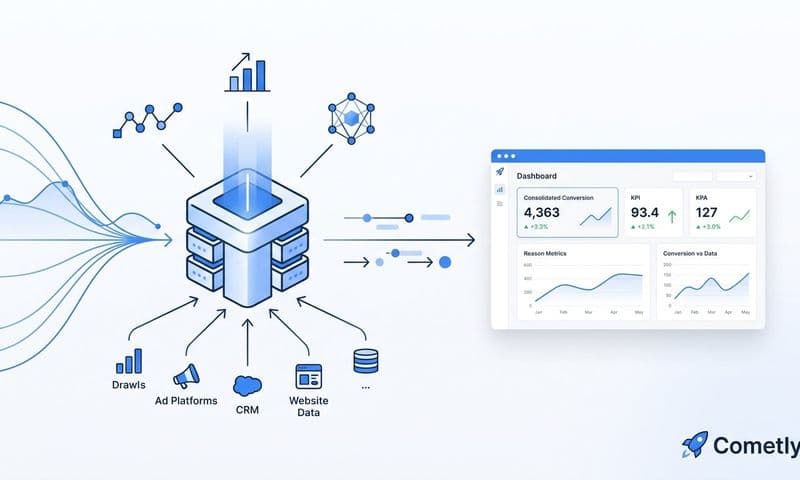
Connect every data source into a unified customer journey: This means pulling in ad platform data from Meta, Google, TikTok, and LinkedIn alongside CRM events, website behavior, and offline conversions. The goal is a single timeline for each customer that shows every touchpoint from first exposure to closed revenue.
Apply consistent attribution logic across all channels: Instead of letting each platform self-report using its own methodology (which always favors that platform), a unified platform applies attribution models consistently across all sources. This eliminates the double-counting problem that inflates reported revenue in siloed setups.
Surface insights at the speed decisions require: Enterprise teams can't wait days for reports to process. Real-time or near-real-time data access is a baseline requirement, not a premium feature.
Who are these platforms actually built for? Marketing teams managing meaningful ad spend across multiple channels. Agencies handling attribution and reporting across multiple clients. Growth-focused organizations that need to tie every dollar back to revenue and make budget decisions with confidence rather than guesswork.
If your team is still stitching together reports from individual platform dashboards and calling it attribution, you're working harder than you need to and making decisions on incomplete information.
The Attribution Problem That Grows With Your Business
Here's the uncomfortable truth about attribution: it doesn't get easier as your business grows. It gets exponentially harder. Every new channel you add, every additional campaign you launch, and every touchpoint you introduce between a prospect and a conversion compounds the complexity of understanding what's actually working.
Think about what a typical enterprise buyer journey looks like today. A prospect might see a display ad, click a paid social post two weeks later, search for your brand name organically, receive a retargeting ad, click an email, and then convert through a direct visit. That's six touchpoints across at least four different channels. Last-click attribution credits the direct visit. First-click credits the display ad. Neither tells you the full story.
The specific pain points enterprise teams encounter are well-documented and interconnected:
iOS tracking limitations: Apple's App Tracking Transparency framework significantly reduced the signal quality available to ad platforms, particularly Meta. When users opt out of tracking, conversion events become harder to attribute, and platform-reported results become less reliable. For enterprise teams spending heavily on paid social, this creates real blind spots.
Last-click attribution misrepresenting multi-touch journeys: Most default attribution settings in ad platforms use last-click or last-touch logic. This systematically over-credits bottom-funnel channels like branded search and direct, while undervaluing the awareness and consideration channels that actually initiated the journey. At scale, this leads to chronic underinvestment in the channels doing the heaviest lifting.
Siloed platform data creating conflicting reports: When Meta says a campaign drove 500 conversions and Google says it drove 400, and your actual CRM shows 600 total new customers for the period, you have a data integrity problem. Each platform is applying its own attribution window and its own logic, making cross-channel comparison meaningless without a neutral, unified layer.
Delayed conversion data slowing optimization: Ad platform algorithms need conversion signals to optimize effectively. When conversion data is delayed, incomplete, or degraded by tracking limitations, the algorithms optimize for the wrong things. This is a direct performance cost, not just a reporting inconvenience.
The business consequences are real. Budgets get misallocated toward channels that look good in their own dashboards but aren't actually driving incremental revenue. High-performing channels get cut because their contribution isn't visible in last-click reports. And ad platform algorithms receive poor-quality signals, which means they can't optimize effectively, which means your cost per acquisition drifts higher over time.
Getting attribution right at the enterprise level isn't a reporting exercise. It's a revenue protection strategy. Understanding the full scope of attribution challenges in marketing analytics is the first step toward solving them.
Core Capabilities That Define a True Enterprise Analytics Platform
Not all platforms marketed as "enterprise" are actually built for enterprise-level attribution complexity. There are three capabilities that separate the real solutions from the ones that just look good in a demo.
Multi-Touch Attribution Across Every Channel
True multi-touch attribution means the platform can assign credit accurately across paid search, paid social, organic, email, direct, and any other channel in your mix, using models that reflect actual buyer behavior rather than default last-click logic.
This requires more than just supporting multiple attribution models. It requires the ability to compare them side by side. First-touch attribution tells you which channels are best at generating awareness and initiating journeys. Last-touch tells you which channels close deals. Linear and time-decay models tell you different things about how credit should be distributed across the middle of the funnel. Data-driven models use your actual conversion data to weight touchpoints algorithmically.
No single model is universally correct. The value is in being able to see how different models change the story, and making budget decisions informed by that full picture rather than a single methodology that may not match your actual sales cycle. Reviewing the top enterprise marketing attribution software platforms can help you understand how leading solutions handle this complexity.
Server-Side Tracking and Conversion API Integration
Browser-based tracking is no longer a reliable foundation for enterprise attribution. Ad blockers, iOS privacy changes, and the ongoing deprecation of third-party cookies have all eroded the signal quality that traditional pixel-based tracking depends on.
Server-side tracking routes conversion data through a secure server before sending it to ad platforms, bypassing browser-level restrictions entirely. This maintains data accuracy in environments where client-side tracking would fail or return incomplete data.
Conversion API integrations, including Meta CAPI, Google Enhanced Conversions, and TikTok Events API, allow platforms to receive conversion data directly rather than relying on browser signals. This improves match rates between your conversion events and the ad platform's user data, which directly improves the quality of the signals the algorithm uses to optimize your campaigns.
This isn't just a technical nicety. It's a performance lever. Better conversion signals mean better algorithmic optimization, which means lower cost per acquisition over time.
AI-Powered Analysis and Recommendations
The shift from descriptive analytics to prescriptive intelligence is one of the most meaningful evolutions in enterprise marketing platforms. Descriptive analytics tells you what happened. Prescriptive analytics tells you what to do next.
AI-powered features in a mature enterprise platform can surface anomalies before they become expensive problems, identify which creative and audience combinations are generating the highest-quality conversions, flag budget allocations that are underperforming relative to their potential, and recommend reallocation in real time rather than waiting for a weekly reporting cycle.
For enterprise teams managing large, complex campaign portfolios, AI marketing analytics capabilities are the difference between reactive optimization and proactive performance management.
How Enterprise Platforms Connect the Dots Across Your Entire Stack
The integration layer is where enterprise platforms either prove their value or fall short. Connecting to a few ad platforms and displaying their data in a unified dashboard is table stakes. The real capability is creating a coherent customer journey view that spans your entire marketing and sales stack.
A true enterprise platform connects ad platforms including Meta, Google, TikTok, and LinkedIn alongside your CRM and your website data. This matters because the customer journey doesn't end at the click. It continues through your website, into your CRM pipeline, and ultimately to a closed deal or a completed transaction. If your attribution platform can only see the ad click but not what happened afterward, you're still missing most of the story.
For B2B organizations in particular, this CRM integration is critical. Sales cycles can span months and involve multiple stakeholders. The touchpoints that influenced a deal might have occurred long before a lead entered the CRM, and the deal itself might close offline. An enterprise platform that handles offline conversion imports and account-level attribution can connect those dots in a way that purely digital analytics tools cannot.
Here's where the concept of bidirectional data flow becomes important. Most marketers think about analytics as a one-way process: data flows in, reports come out. But the most sophisticated enterprise platforms also push data back out, specifically enriched conversion events back to ad platforms.
When Meta or Google receives better conversion signals from your attribution platform, their machine learning algorithms can optimize more effectively for high-value conversions rather than proxy events like clicks or page views. This creates a compounding improvement in campaign performance over time. You're not just getting better reports. You're actively improving the performance of your ad spend by feeding the algorithms better data.
The analytics dashboard layer then becomes the place where all of this unified data becomes actionable. Cross-channel comparison becomes meaningful because every channel is measured using the same attribution logic. Funnel analysis becomes possible because you can see where prospects are dropping off across the full journey, not just within a single channel. Cohort-level insights become available because you can group customers by acquisition source and compare their downstream value.
None of this is possible when your data lives in separate platform silos. The integration layer is what makes enterprise analytics genuinely enterprise-grade.
What to Look for When Evaluating Enterprise Marketing Analytics Platforms
Evaluating enterprise platforms is a serious investment of time and resources, so it's worth being precise about what actually matters versus what looks impressive in a product demo. Here are the criteria that should drive your decision.
Data accuracy and tracking reliability: This is the foundation everything else depends on. Prioritize platforms that offer server-side tracking and have built-in solutions for the iOS tracking limitations and cookie deprecation challenges that make browser-based attribution increasingly unreliable at scale. Ask vendors specifically how they handle these scenarios and what their match rates look like in practice. A platform with beautiful visualizations built on degraded data is worse than no platform at all, because it creates false confidence.
Attribution model flexibility: You need the ability to compare first-touch, last-touch, linear, time-decay, and ideally custom or data-driven models side by side. Being locked into a single methodology is a significant limitation, because different models reveal different truths about your marketing mix. Your paid social team and your SEO team will tell very different stories about channel performance depending on which model is applied. The ability to see all of them simultaneously is what enables informed budget decisions rather than internal debates based on conflicting reports.
Speed to insight and ease of use: Enterprise does not have to mean complex. In fact, one of the most important things to evaluate is whether the platform surfaces actionable recommendations without requiring a data science team to interpret the output. If your performance marketers can't derive clear next steps from the platform without significant technical support, the platform isn't doing its job. Look for AI-powered features that translate data into recommendations, not just visualizations that require expert interpretation.
Integration depth and breadth: Evaluate not just which platforms the tool connects to today, but how deeply those integrations work. A surface-level integration that pulls in spend data is very different from a deep integration that handles conversion sync, offline events, and CRM pipeline data. Ask for specifics about how each integration works and what data is actually passed in both directions.
Scalability and support: Consider whether the platform is built to handle your current data volume and your anticipated growth. Enterprise teams often have complex organizational structures, multiple brands or business units, and specific requirements around data governance. When choosing a marketing analytics platform, evaluate whether it can accommodate your structure, and what level of support is available when you need it.
Building a Data-Driven Marketing Operation That Scales
Getting attribution right at scale creates a compounding advantage that's worth understanding clearly. Accurate data feeds better decisions. Better decisions improve ad performance. Improved ad performance generates more revenue from the same budget. And as performance improves, you have both the confidence and the justification to invest more, which amplifies the effect further.
The inverse is also true. Poor attribution data leads to misallocated budgets, which underperforms, which creates pressure to cut spend or shift strategy based on incomplete information. The cost of bad attribution isn't just a reporting problem. It's a performance drag that compounds over time.
This is the use case Cometly is built for. Cometly is a marketing attribution and analytics platform that connects your ad platforms, CRM, and website data to give you real-time visibility into what's actually driving revenue across your entire funnel. It captures every touchpoint from ad click to CRM event, applies consistent attribution logic across all channels, and surfaces AI-powered recommendations that tell you not just what happened but what to do next.
Cometly's server-side tracking and Conversion Sync capabilities feed enriched conversion data back to Meta, Google, and other ad platforms, improving the quality of the signals their algorithms use to optimize your campaigns. Over time, this means better targeting, lower cost per acquisition, and more efficient use of your budget.
For marketing teams and agencies managing significant ad spend across multiple channels, Cometly provides the clarity and confidence to make faster, more accurate decisions without needing a data science team to interpret the output.
If you're ready to move beyond fragmented reports and build a marketing operation grounded in accurate, unified attribution data, Get your free demo and see how Cometly can bring clarity to your cross-channel marketing performance.
The Bottom Line on Enterprise Marketing Analytics
Enterprise marketing analytics isn't about collecting more data. Every platform you're already using is generating plenty of that. It's about connecting the right data, applying consistent attribution logic across all of it, and translating the output into decisions you can act on with confidence.
If your current setup involves stitching together reports from individual ad platforms, reconciling conflicting conversion numbers, or making budget decisions based on last-click attribution because it's the default, it's worth auditing whether your tools can actually handle the scale and complexity your business demands.
The gap between what basic analytics tools can tell you and what a true enterprise attribution platform can tell you is the gap between guessing and knowing. At the budget levels enterprise teams operate at, that gap is expensive.
Start by asking one honest question: do you actually know which channels are driving revenue, or do you know which channels are claiming credit? If those two things aren't the same, it's time to look at your attribution infrastructure.
Get your free demo of Cometly today and start building the attribution foundation your marketing operation deserves.