Facebook is not just a consumer platform. For B2B SaaS companies, it has become a serious channel for reaching decision-makers, building brand awareness, and generating qualified pipeline. The challenge is that most B2B teams approach Facebook ads the same way B2C brands do, and that rarely works.
B2B buying cycles are longer, audiences are more specific, and the path from ad click to closed deal involves multiple touchpoints across weeks or months. A campaign that looks like it is performing based on cost per lead can quietly be draining budget on leads that never close. That disconnect between ad metrics and revenue is where most B2B Facebook strategies fall apart.
This guide is built specifically for B2B marketers who want to run Facebook ads that actually connect to revenue, not just impressions or clicks. You will learn how to define your audience, structure your campaigns, choose the right ad formats, set up conversion tracking properly, and measure what actually matters.
Each step is designed to move you from setup to optimization with a clear understanding of what to do and why it works in a B2B context. Whether you are running your first B2B campaign or looking to improve results from existing efforts, this framework gives you a repeatable system you can apply immediately.
Think of this as the guide that treats Facebook ads for B2B as a revenue problem, not a traffic problem. Let's get into it.
Step 1: Define Your B2B Audience Before You Touch the Ads Manager
The most common mistake B2B marketers make on Facebook is jumping straight into the Ads Manager and building audiences on the fly. Targeting decisions made without a clear ideal customer profile almost always result in broad, low-quality reach that costs money and produces little pipeline.
Start by documenting your ideal customer profile before you open a single campaign. This means getting specific about company size, industry, annual revenue range, and the job titles and seniority levels of the people who actually influence and make purchasing decisions. The more precise your ICP, the more intentional your targeting will be.
Here is something many B2B marketers overlook: in SaaS, you are rarely selling to one person. A buying committee might include a VP of Marketing who experiences the problem, a Director of Operations who evaluates the solution, and a CFO who approves the budget. Each of those personas has different motivations, different objections, and different content needs. Your audience strategy needs to account for all of them.
Pull data from your existing customer base to find patterns. Look at your closed-won deals from the past twelve months and ask: what industries do they come from, what company sizes closed fastest, what job titles were involved in the decision? Those patterns become the foundation of your Facebook targeting.
One important reality to set expectations around: Facebook's native B2B targeting is more limited than LinkedIn's. You will not find the same depth of job title or company-level filters. This is why audience quality on Facebook depends heavily on layering custom audiences built from your own data with lookalike audiences and interest-based filters. The platform's strength is reach and retargeting, not precision prospecting from scratch.
Audience segments to define before launch: Build at least two to three distinct audience segments you can test against each other. For example, you might test a CRM-based custom audience of past leads against a lookalike audience built from closed-won customers, and a cold interest-based audience layered with job title filters.
Your success indicator for this step: you have a written ICP document with at least two to three distinct audience segments mapped out and ready to build in the Ads Manager. Do not move forward until that document exists.
Step 2: Build Your Campaign Structure Around the B2B Buying Journey
B2B buyers do not convert on first exposure. They research, compare, consult colleagues, and revisit your brand multiple times before they ever fill out a demo request. Your campaign structure needs to reflect that reality, not fight against it.
The most effective approach is to organize campaigns by funnel stage: awareness, consideration, and conversion. Each stage serves a different purpose and requires a different strategy, budget allocation, and success metric.
Awareness campaigns are designed to introduce your brand to cold audiences who match your ICP. At this stage, you are not asking for anything. You are educating, building recognition, and planting the seed. Objectives like reach, video views, or brand awareness work well here. Budget allocation at this stage tends to be higher because you are building the pool of future retargeting audiences.
Consideration campaigns target people who have already had some exposure to your brand, whether through a website visit, video view, or engagement with a previous ad. Here you are deepening the relationship and differentiating your solution. Lead generation and traffic objectives work well at this stage, and your content should help buyers understand why your approach is different.
Conversion campaigns are tightly focused on getting a specific action from people who are already familiar with your brand and are actively evaluating options. These audiences are smaller and your budget can be more concentrated. The goal is to remove friction and make it easy to take the next step, whether that is booking a demo, starting a free trial, or requesting a proposal.
A common mistake is mixing cold audiences and warm retargeting into the same campaign. This creates audience overlap, muddies your data, and makes it nearly impossible to understand what is actually driving performance. Keep them separate from day one.
Also consider a fourth layer that many B2B teams miss: existing pipeline nurture. If someone is already in your CRM as an active opportunity, they should be in a separate nurture audience that reinforces your brand while your sales team works the deal. This is one of the highest-ROI uses of Facebook ads in B2B because the audience is small and the impact on deal velocity can be meaningful. Pairing this with a strong lead generation strategy for B2B SaaS ensures your pipeline stays full at every stage.
Your success indicator: you have at least three distinct campaign structures mapped to funnel stages, with separate audience pools, objectives, and budgets defined for each before you launch a single ad.
Step 3: Set Up Targeting Using Custom Audiences, Lookalikes, and Interest Layers
With your ICP defined and your campaign structure mapped, it is time to build the actual audiences inside Meta. This is where the precision work happens, and it is also where B2B advertisers have the most leverage over their results.
Start with custom audiences built from your CRM data. Upload your contact list to create audiences of existing leads, customers, and churned accounts. These serve two purposes: retargeting people who already know you, and exclusion lists that prevent you from wasting cold audience budget on people who are already in your funnel or who have already converted.
Next, build lookalike audiences from your highest-value customer segments. Not all customers are equal, so be strategic about the seed audience you use. A lookalike built from customers with the shortest sales cycles, highest lifetime value, or best retention rates will typically outperform a lookalike built from your entire customer list. The quality of the seed audience directly determines the quality of the lookalike.
Website custom audiences are another powerful tool for B2B retargeting. You can create audiences based on specific page visits, which lets you segment by intent level. Someone who visited your pricing page is much further along in their evaluation than someone who read a blog post. Build separate audiences for high-intent pages like pricing, demo request, and feature comparison pages, and treat them differently in your campaigns.
Interest and behavior targeting requires a careful approach on Facebook. The interest categories available in Meta are broad and not always reliable for B2B targeting. Rather than relying on interests alone, layer them with additional filters when possible. Use them as a starting point for cold prospecting, but expect that custom and lookalike audiences will generally produce higher quality leads. Understanding marketing strategies for B2B SaaS companies can help you determine which audience layers deserve the most investment.
Exclusion lists matter more than most teams realize. At minimum, exclude your current customers from all prospecting campaigns. You might also exclude recent form fills, active trial users, and anyone who has converted in the last thirty to sixty days. Every dollar spent showing ads to people who are already customers or already in your funnel is a dollar that could have reached a new potential buyer.
Your success indicator: you have at least one custom audience built from CRM data, one lookalike audience built from a high-value customer segment, and one interest-based cold audience ready to test against each other in separate ad sets.
Step 4: Create Ad Creative and Copy That Speaks to B2B Decision-Makers
Here is where many B2B Facebook campaigns lose the plot. Marketers spend weeks perfecting their targeting and campaign structure, then launch ads that lead with product features, vague value propositions, or generic brand messaging that could apply to any company in any industry.
B2B decision-makers are busy, skeptical, and drowning in vendor outreach. Your ad has about two seconds to earn their attention. The only way to do that is to lead with a specific business problem or outcome that resonates immediately.
Instead of "Introducing the all-in-one marketing platform," try something like "Most B2B teams are optimizing for leads that never close. Here's how to fix that." The first is about you. The second is about them. That distinction is everything in B2B creative.
Social proof carries significant weight in B2B advertising because buyers are risk-averse and rely heavily on peer validation. Customer logos, review platform badges from sites like G2 or Capterra, and specific outcomes from real customers all help build credibility. Be careful about fabricating or exaggerating claims here. Specific and honest beats impressive and vague every time.
When it comes to ad formats, think about what each one does best. Single image ads are clean, fast-loading, and effective for direct response offers with a clear call to action. Video ads give you more time to explain a complex product or build an emotional connection, which is particularly useful for awareness campaigns. Carousel ads let you walk through a multi-step value proposition, which works well when you want to highlight multiple use cases or outcomes.
Match your creative to the funnel stage. An awareness ad should educate and create curiosity, not push for a demo. A consideration ad should differentiate your approach and address common objections. A conversion ad should remove friction with a clear, specific call to action and a compelling reason to act now.
Copy principles that work in B2B: Be direct and specific. Avoid vague language like "transform your business" or "unlock your potential." Describe the exact problem you solve, the specific type of company you help, and what happens after they take the next step. Short, punchy headlines work well in the feed. Longer copy can work in the primary text for consideration and conversion ads where the reader is already interested.
Your success indicator: you have at least two to three creative variants per ad set ready to test, with distinct hooks, formats, and messaging angles. Do not launch with a single creative and expect to learn anything meaningful from the results.
Step 5: Configure Conversion Tracking with the Meta Conversion API
Getting your creative and targeting right means nothing if your conversion tracking is broken or unreliable. In B2B, where every lead matters and the cost per acquisition is high, inaccurate data leads to bad optimization decisions that compound over time.
Start with the Meta Pixel installed on your website. This is the baseline layer of tracking that captures browser-side events like page views, form submissions, and button clicks. It is straightforward to set up and gives you a foundation to work from. However, browser-based tracking alone is increasingly unreliable.
iOS privacy changes and widespread ad blocker adoption have significantly reduced the reliability of pixel-only tracking. In many cases, a meaningful portion of conversions that happen in the real world are never reported back to Meta, which means the algorithm is optimizing on incomplete data. That leads to underperformance that is hard to diagnose because your dashboard looks like it is working.
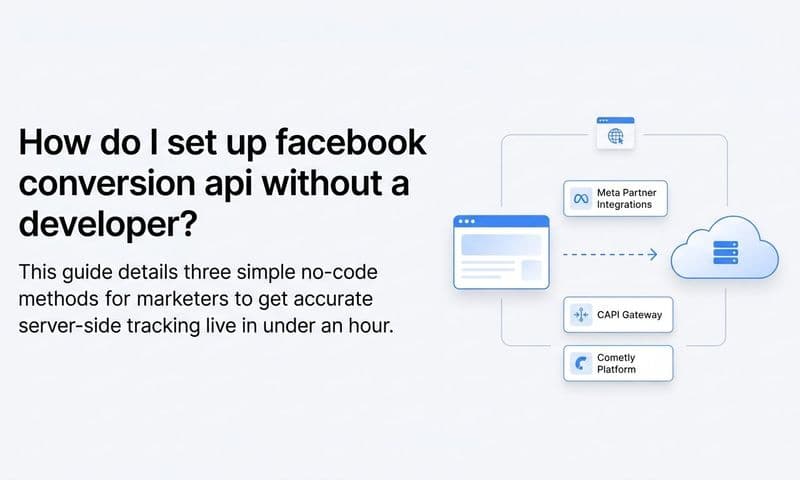
The solution is the Meta Conversion API, commonly called CAPI. Rather than relying on the browser to send conversion data to Meta, CAPI sends events directly from your server to Meta's servers. This bypasses browser limitations entirely and gives Meta a much more complete and accurate picture of what is happening after someone clicks your ad. Setting up Facebook conversion tracking correctly from the start is one of the highest-leverage steps you can take to improve campaign performance.
For B2B specifically, the events you want to track go beyond a generic "lead" event. Set up distinct events for demo requests, free trial signups, and high-intent page visits. If you can connect your CRM, you can also pass downstream events like marketing qualified leads, sales qualified leads, and opportunities back to Meta. This is where the real optimization power comes from: teaching Meta's algorithm to find people who are likely to become revenue, not just people who are likely to fill out a form.
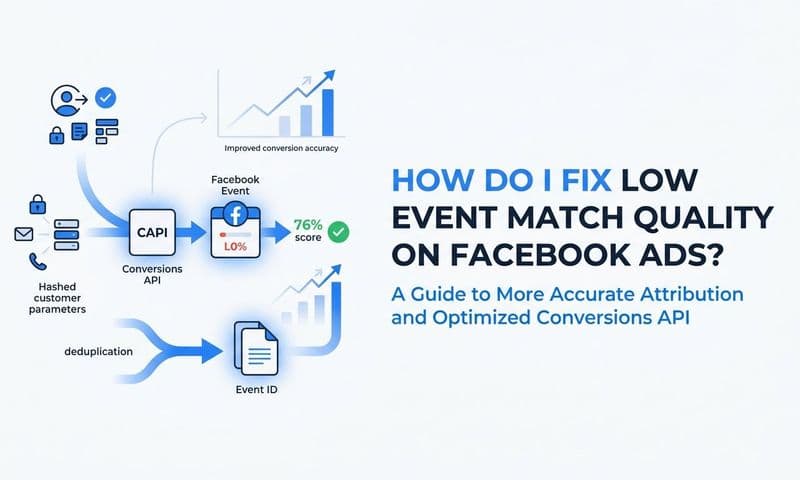
When you run both the Pixel and CAPI simultaneously, you need to implement event deduplication. Without it, the same conversion will be counted twice, once from the browser and once from the server, which inflates your reported results and distorts your optimization signals. Meta provides a deduplication key system to handle this, and it should be configured before you start sending events from both sources.
Monitor your Facebook Event Match Quality scores inside Meta's Events Manager. This metric scores how well your conversion data is matching to Facebook user profiles on a scale of zero to ten. Higher match quality means Meta can more accurately attribute conversions to the right people and optimize your campaigns more effectively. Aim for a score above six to ensure your data is working as hard as it should be.
Your success indicator: your Event Match Quality score is above six out of ten, your CAPI events are firing correctly, and you have confirmed there are no deduplication errors by checking your event counts in Events Manager.
Step 6: Connect Facebook Ad Data to Pipeline and Revenue Attribution
This is the step that separates B2B teams who are guessing from those who are scaling with confidence. Facebook's native reporting tells you how many clicks, impressions, and conversions your campaigns generated. What it cannot tell you is which of those leads became qualified opportunities, which ones closed, and what revenue can be attributed to your ad spend.
For B2B SaaS companies with sales cycles measured in weeks or months, that gap between ad metrics and revenue outcomes is where most budget gets wasted. A campaign with a low cost per lead might look like a winner in Ads Manager while quietly filling your CRM with leads that never progress past the first sales call.
The solution is a multi-touch attribution platform that connects your Facebook ad data to your CRM pipeline stages and revenue. This gives you a complete picture of what each campaign is actually contributing to your business, from the first ad impression through to closed-won revenue.
With proper attribution in place, you can calculate your true cost per acquisition, understand your return on ad spend at the revenue level, and identify which specific campaigns and ad sets are driving the highest quality leads. You stop optimizing for form fills and start optimizing for pipeline.
Comparing attribution models also becomes important at this stage. First-touch attribution gives full credit to the Facebook ad that introduced a buyer to your brand. Last-touch gives all credit to the final interaction before conversion. Linear attribution distributes credit across every touchpoint in the journey. Each model tells a different story, and understanding how Facebook contributes across the full buying journey helps you make smarter budget allocation decisions.
Build a B2B marketing dashboard that surfaces Facebook performance alongside your other channels. When you can see pipeline influenced, opportunities created, and revenue attributed by channel in a single view, budget decisions become much clearer. You are no longer choosing between channels based on gut feel or cost per lead. You are making decisions based on which channels are actually moving revenue.
Cometly is built specifically for this use case. It connects your Facebook ad data, CRM events, and website activity into a single attribution view so you can track the full customer journey from first click to closed deal. The platform supports multi-touch attribution models and surfaces which campaigns are driving real pipeline, not just top-of-funnel volume.
Your success indicator: you can open your attribution platform and see which specific Facebook campaigns are driving pipeline and revenue, with enough detail to make budget decisions based on downstream outcomes rather than form fill volume.
Step 7: Optimize Campaigns Using Data, Not Gut Feel
Once your campaigns are live and your tracking is in place, the temptation is to start making changes immediately. Resist it. B2B campaigns need more time and more data before optimization decisions are meaningful, and making changes too early is one of the most common ways to kill a campaign that would have performed.
Facebook's algorithm goes through a learning phase when a new campaign or ad set launches. During this period, the system is testing delivery across different audiences and placements to find the combinations that drive the best results. Making significant changes to budget, targeting, or creative while a campaign is still in the learning phase resets that process and extends the time before you get reliable data.
Give your campaigns enough runway. In B2B, where sales cycles can span weeks or months, a two-week optimization window is often not enough to understand which campaigns are driving quality pipeline. Build your optimization cadence around the length of your sales cycle, not the speed of your impatience.
When you do optimize, focus on the right metrics. Cost per lead is a starting point, but it is not the finish line in B2B. The metrics that actually matter are cost per qualified lead, pipeline influenced, and revenue attributed. A campaign with a higher cost per lead that consistently produces qualified opportunities is more valuable than a cheap lead campaign that fills your CRM with noise. Reviewing your Facebook ads performance through a revenue lens rather than a surface-metrics lens is what separates teams that scale from those that stall.
Test one variable at a time. This is a foundational principle of paid advertising that is easy to ignore when you are eager to improve results. If you change your audience, creative, and offer simultaneously, you will never know which change drove the improvement or caused the decline. Isolate your tests: test audiences first, then creative, then offer or landing page.
Use AI-driven recommendations from your attribution platform to guide budget decisions. When you can see which campaigns are driving the most pipeline and revenue, you have a clear signal for where to invest more and where to pull back. Cometly's AI-driven insights surface exactly this kind of signal, helping you identify high-performing campaigns across every channel and scale with confidence rather than guesswork.
Regularly review pipeline velocity for Facebook-sourced leads. How quickly are they moving through your sales stages compared to leads from other channels? Slower velocity might indicate a targeting or messaging mismatch. Faster velocity is a strong signal that your Facebook campaigns are reaching genuinely qualified buyers.
Your success indicator: you have a documented optimization cadence with clear rules for when to scale a campaign, when to pause it, and what single variable to test next. That document should exist before you launch, not after you are already second-guessing your results.
Putting It All Together: Your B2B Facebook Ads Launch Checklist
Running Facebook ads for B2B is not about hacking the algorithm or finding a magic audience. It is about building a disciplined system that connects ad spend to real business outcomes. Every step in this guide feeds into the next, and skipping any of them creates gaps that will show up in your results eventually.
Before you launch, run through this checklist to confirm you are ready:
1. ICP and audience segments defined with at least two to three distinct segments documented
2. Campaign structure mapped to funnel stages with separate campaigns for awareness, consideration, conversion, and pipeline nurture
3. Custom audiences built from CRM data, lookalike audiences built from high-value customer segments, and exclusion lists configured
4. Ad creative variants ready for each funnel stage, with at least two to three distinct hooks and formats per ad set
5. Meta Pixel installed and Meta Conversion API configured with deduplication enabled and Event Match Quality score above six
6. Attribution platform connected to both your ad data and CRM so you can track from first click to closed revenue
7. Optimization cadence documented with clear rules for when to scale, pause, or test new variables
The teams that win with Facebook ads for B2B are the ones who treat it as a revenue channel, not a traffic channel. That means tracking the right things, structuring campaigns around how buyers actually behave, and making decisions based on pipeline impact rather than surface-level metrics.
Cometly helps B2B SaaS teams close the loop between Facebook ad spend and revenue by tracking every touchpoint from first click to closed deal. If you want to stop guessing and start scaling with confidence, the data has to be right from the start. Get your free demo today and start capturing every touchpoint to maximize your conversions.