Your Meta ad performance looks solid on the surface. Campaigns are running, conversions are being reported, and the cost-per-result numbers seem reasonable. But underneath that dashboard view, something is quietly breaking down. Browser restrictions are blocking events. iOS privacy changes are dropping signals. Ad blockers are intercepting the data before it ever reaches Meta. And the algorithm that decides where to spend your budget is optimizing on an increasingly incomplete picture of what is actually happening.
This is the core tension facing B2B SaaS marketing teams right now. The Meta Pixel, which has been the standard tracking method for years, was built for a different era of the web. It runs in the browser, which means it is subject to every privacy restriction, cookie limitation, and ad blocker that users have adopted in growing numbers. The result is a slow, silent erosion of conversion signal quality that is difficult to see until you start digging into the data gaps.
The Meta Conversions API, commonly called CAPI, was built to address exactly this problem. It moves event tracking from the browser to your server, bypassing the browser entirely and sending data directly to Meta. But CAPI is not a simple replacement for the pixel. It has its own setup requirements, its own limitations, and its own best practices for how it should be deployed alongside the pixel rather than instead of it.
This article breaks down how each method actually works, where each one falls short, and why the most effective setup for B2B SaaS teams combines both with a dedicated attribution layer that connects ad spend to real pipeline and revenue. No jargon overload, just a clear explanation of what is at stake for your tracking accuracy and what you can do about it.
How the Meta Pixel Actually Captures Data
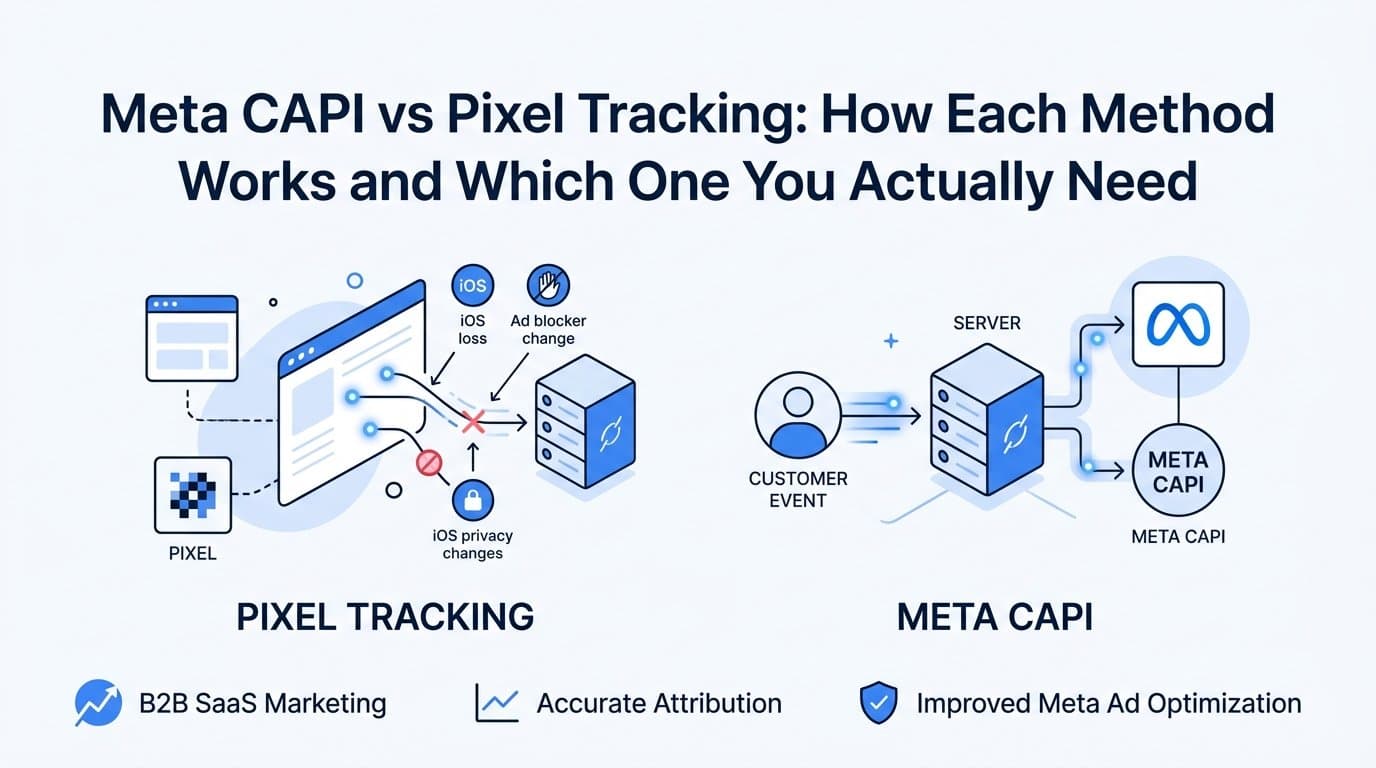
The Meta Pixel is a JavaScript snippet that you place on your website. When a visitor loads a page or completes an action, the pixel fires and sends event data from their browser directly to Meta's servers. Standard events include PageView, Lead, Purchase, and custom events you define based on actions that matter to your business.
Think of it like a relay race where the browser is the first runner. The user visits your site, the browser executes the JavaScript, and the pixel hands off the event data to Meta. The entire process happens client-side, meaning it depends entirely on the user's browser environment cooperating.
This is where the vulnerability lives. The pixel relies on cookies and browser-based identifiers to match users to Meta accounts. It has no fallback if the browser blocks the script, strips the cookie, or refuses to send the request. And increasingly, browsers are doing exactly that.
Apple's Intelligent Tracking Prevention (ITP) in Safari limits how long cookies can persist and restricts cross-site tracking. Firefox Enhanced Tracking Protection blocks known tracking scripts by default. iOS App Tracking Transparency requires users to explicitly opt in to being tracked, and the majority of users opt out. Ad blockers, which are widely used, can intercept pixel requests before they ever leave the browser.
Each of these restrictions operates independently, which means the cumulative effect on your pixel data is significant. Events are not just occasionally missed. They are systematically missed for entire segments of your audience, particularly privacy-conscious users who are often among the most valuable prospects in a B2B context.
The pixel remains easy to implement and covers many standard use cases well. If you are tracking simple e-commerce purchases or top-of-funnel page views from a broad audience, the pixel can still provide useful signal. But for B2B SaaS teams running longer sales cycles with multiple touchpoints across weeks or months, the data the pixel delivers is increasingly incomplete.
The deeper problem is that you often cannot see how incomplete it is. The pixel still reports conversions. The Events Manager still shows activity. But the numbers are a partial view, and if you are making budget decisions based on them, you are optimizing on a foundation that has more gaps than it appears to have.
What Server-Side Tracking Changes About the Equation
The Conversions API takes the browser out of the equation entirely. Instead of relying on a JavaScript snippet running in the user's browser, CAPI sends event data directly from your server to Meta's Graph API. The browser never touches the data. Ad blockers cannot intercept it. Safari's tracking restrictions cannot interfere with it. iOS privacy settings are irrelevant to it.
This is a fundamental architectural shift. The pixel depends on the client. CAPI depends on your infrastructure. And your infrastructure does not have ad blockers installed.
Here's where it gets interesting for B2B SaaS teams specifically. Because CAPI operates server-side, it can capture events that the pixel is structurally incapable of seeing. A form fill on your website is an event the pixel can track. But what happens after that form fill? The lead enters your CRM. A sales rep qualifies it. It becomes a sales-qualified lead, then an opportunity, then a closed-won deal. None of those downstream events happen in a browser. They happen in your CRM, your billing system, your product database.
CAPI creates a pathway to send those events back to Meta as conversion signals. Subscription renewals, revenue milestones, offline sales conversations, CRM stage progressions: all of these can be sent via CAPI, giving Meta's algorithm a much richer picture of what a valuable customer actually looks like and where they came from.
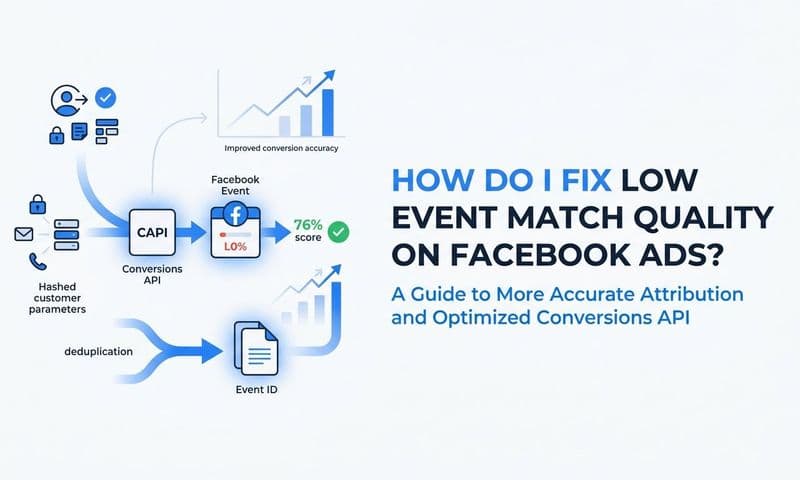
The other major advantage is first-party data matching. When you send events via CAPI, you can include hashed customer identifiers alongside the event: email addresses, phone numbers, names. Meta uses these identifiers to match the event to a user account even in cookie-restricted environments. This is what Meta calls Event Match Quality (EMQ), and it is a direct indicator of how well your conversion data can be used to optimize ad delivery.
Higher EMQ means Meta can more accurately attribute conversions to the right users and use that data to find similar high-value audiences. Pixel-only setups often have lower EMQ because they rely on browser cookies that can be blocked or expired. CAPI with hashed first-party data can significantly improve EMQ because it uses persistent identifiers that do not depend on cookies.
The tradeoff is implementation complexity. CAPI requires server-side infrastructure, developer resources, and thoughtful configuration. It is not a copy-paste snippet. But for teams serious about attribution accuracy, that investment pays off in more reliable data and better-performing campaigns.
Where Each Method Breaks Down
Understanding the failure modes of each approach is just as important as understanding how they work. Neither the pixel nor CAPI is a complete solution on its own, and the gaps in each method are different enough that they require different fixes.
Pixel-only limitations: The core problem is signal loss in privacy-restricted environments. When the pixel cannot fire or its data gets blocked, Meta receives fewer conversion signals. Fewer signals mean the ad delivery algorithm has less information to work with, which leads to under-reported conversions, inflated cost-per-result figures, and audiences that are optimized based on whoever the pixel could see rather than whoever actually converted. Over time, this creates a compounding problem where your campaigns gradually drift toward lower-quality audiences because the algorithm is learning from incomplete data.
CAPI-only limitations: Running CAPI without the pixel introduces a different kind of risk. Server-side events often have a slight delay compared to browser-side events, and without the pixel firing simultaneously, you lose the real-time browser context that Meta uses for certain types of audience matching. More critically, if you implement CAPI alongside an existing pixel setup without proper deduplication logic, the same event can be reported twice: once by the pixel and once by the server. This inflates your conversion counts upward, which makes your campaigns look more effective than they are and can cause the algorithm to over-optimize in the wrong direction.
Meta's recommended deduplication method uses a shared event_id parameter. When both the pixel and CAPI fire for the same action, they should both send the same event_id. Meta uses this ID to recognize that two reports describe the same event and counts it only once. Without this, double-counting is a real problem that many teams discover only after they start questioning why their conversion numbers suddenly spiked after implementing CAPI.
The B2B-specific gap: For B2B SaaS companies, neither method alone solves the attribution problem at the level that actually matters. A form fill is not revenue. An MQL is not a closed deal. The events that define real ROI, qualified pipeline, opportunities, and won revenue, live in a CRM, not in a browser session. Without a mechanism to send those downstream events back to Meta, you are asking the algorithm to optimize on top-of-funnel signals that may have little correlation with the customers who actually generate revenue.
The Case for Running Both in Parallel
Meta's own documentation is clear on this point: the recommended setup is not pixel or CAPI, it is pixel and CAPI running together with proper deduplication. This redundant architecture is designed so that if one method fails, the other captures the event. And when both succeed, the deduplication logic ensures the event is counted once.
The practical benefit of this setup goes beyond just data redundancy. Running both methods together maximizes your Event Match Quality score inside Meta's Events Manager. EMQ is Meta's indicator of how well the customer information sent with your events matches actual Meta user accounts. A higher EMQ score generally correlates with better ad delivery performance because Meta can more accurately attribute conversions and use that data to find similar audiences.
The pixel contributes browser-based signals, including cookie data and browsing context. CAPI contributes hashed first-party identifiers that are not dependent on cookies. Together, they give Meta more data points to match events to users, which pushes your EMQ score higher than either method could achieve alone.
Think of it like triangulating a location. One data point gives you a rough estimate. Two data points from different sources give you a much more precise fix. Meta's matching algorithm works the same way: more signal sources, better matches, better optimization.
The redundancy layer is also increasingly important as privacy restrictions continue to evolve. Browser-side tracking is under sustained pressure from platform-level privacy changes that have been rolling out for several years and show no signs of reversing. Building a parallel setup now means you have a server-side foundation in place when the next round of browser restrictions reduces pixel reliability further.
For B2B SaaS teams specifically, the parallel setup also creates the infrastructure needed to send downstream CRM events via CAPI. Once your server-side connection to Meta is established, you can extend it to send not just website events but also CRM events: lead qualification updates, opportunity stage changes, and closed-won revenue. This is where the setup moves from fixing signal loss to actively improving the quality of your optimization signals.
Connecting CAPI Data to Real Revenue Attribution
For B2B SaaS teams, fixing signal loss is only part of the story. The deeper opportunity with CAPI is what it enables on the attribution side: a direct connection between your ad spend and the revenue events that actually matter to your business.
Consider the typical B2B conversion journey. A prospect sees a Meta ad, clicks through, reads a few pages, and fills out a demo request form. The pixel fires a Lead event. Meta records the conversion. But from that point forward, the journey continues for weeks or months. The lead gets qualified, enters a sales cycle, and either closes or does not. The pixel has no visibility into any of that. It recorded the form fill and stopped there.
CAPI changes this by creating a channel through which you can send those downstream events back to Meta. When a lead becomes sales-qualified, you can send that event. When an opportunity is created, you can send that event. When a deal closes, you can send the revenue value. Meta receives these enriched signals and can use them to understand what a high-value customer actually looks like at the point of ad exposure, not just at the point of form fill.
This matters enormously for how Meta's algorithm allocates your budget. If you are only optimizing on form fills, the algorithm will find audiences that fill out forms. Some of those will convert to revenue, but many will not. If you optimize on closed-won revenue events, the algorithm learns what your actual buyers look like and directs spend toward audiences more likely to become customers, not just leads.
This is where a dedicated attribution platform becomes essential. Managing the data flow between your ad platforms, CRM, and server-side tracking manually is complex and error-prone. Platforms like Cometly are built specifically to handle this integration for B2B SaaS teams. Cometly connects your ad data, CRM events, and server-side tracking into a single attribution layer, making it possible to see which Meta campaigns drove pipeline and closed revenue, not just top-of-funnel clicks and form fills.
With Cometly, you can capture every touchpoint from the first ad click through to CRM events, and feed enriched, conversion-ready data back to Meta and other ad platforms. This improves the quality of the signals those platforms receive, which in turn improves targeting, optimization, and overall ad ROI. The result is a clearer picture of what is actually working and the confidence to scale campaigns that drive real revenue.
Choosing the Right Setup for Your Team
The right configuration depends on where your team is today, but the direction of travel is clear regardless of your starting point.
If you are just getting started: Implement the pixel now, but plan for CAPI from the beginning. The pixel is faster to deploy and will give you baseline tracking while you build out the server-side infrastructure. The key is not to treat CAPI as a future project you will get to eventually. Teams that retrofit CAPI after running pixel-only for years often discover data gaps they did not know existed, and rebuilding historical attribution is difficult. Design your tracking architecture with server-side in mind from day one.
If you are running a B2B SaaS product with a longer sales cycle: Prioritize sending downstream CRM events via CAPI as soon as your server-side connection is established. Form fills are a weak optimization signal for products with multi-month sales cycles. The sooner you give Meta's algorithm access to qualified lead and revenue events, the sooner your campaigns can optimize toward audiences that actually close rather than audiences that just convert at the top of the funnel.
If you want the most accurate and actionable setup: The combination that delivers the best results is pixel plus CAPI plus a dedicated attribution platform. The pixel handles real-time browser-side events. CAPI handles server-side events and downstream CRM data. The attribution platform deduplicates events, tracks the full customer journey across touchpoints, and connects ad spend to closed revenue in a single view. This setup eliminates the gaps that each individual method leaves on its own and gives you the data foundation needed to make confident budget decisions.
Whichever stage you are at, the most important thing is to stop treating the pixel as sufficient. It was built for a different era of web tracking, and the environment it depends on is becoming less reliable every year. Server-side tracking is not a nice-to-have. For B2B SaaS teams serious about attribution accuracy, it is the foundation that everything else builds on.
The Bottom Line on Pixel vs. CAPI
The pixel versus CAPI debate is not an either-or decision. The pixel is still useful. It is still easy to implement and still captures real signal for many standard use cases. But it is no longer sufficient on its own, and treating it as such means making budget decisions based on data that has more gaps than it appears to have.
CAPI fills the gaps the pixel cannot reach. It bypasses browser restrictions, enables first-party data matching, and creates a channel for sending downstream CRM events that represent the actual revenue impact of your campaigns. Together, pixel and CAPI form a more complete data foundation than either can provide alone.
The forward-looking reality is that privacy restrictions will continue to tighten. Browser-based tracking will become less reliable, not more. The teams that invest in server-side infrastructure and first-party data strategies now will be better positioned to maintain attribution accuracy as the landscape evolves. The teams that wait will face larger gaps and harder retrofits later.
If you are ready to implement this setup and connect every ad touchpoint to actual pipeline and revenue, Cometly makes it straightforward for B2B SaaS teams. From capturing every touchpoint to feeding enriched conversion data back to Meta and other ad platforms, Cometly gives you the single source of truth your attribution strategy needs. Get your free demo today and start building the tracking foundation that scales with your growth.