
Your ad platform says you had 50 conversions this month. Your CRM shows 20 deals closed. So which number do you trust?
This is one of the most common and costly frustrations in B2B SaaS marketing. And if you've ever stared at two dashboards showing completely different realities, you already know how paralyzing that disconnect can be. Do you scale the campaign that Meta says is crushing it? Or do you pause it because your sales team has no idea where those "conversions" are coming from?
Here's the hard truth: inaccurate conversion tracking is not a minor reporting inconvenience. It is a budget allocation problem. When your data is wrong, you end up scaling campaigns that are losing money and cutting campaigns that are actually working. The damage compounds quietly over time, and most teams don't realize how far off their numbers are until they've already made several expensive decisions based on bad data.
This article is a diagnostic guide. We'll walk through the root causes of inaccurate conversion tracking, from platform-level bias to technical misconfigurations to attribution model mismatch, and explain what you can actually do to fix each one. By the end, you'll have a clear picture of why your conversion tracking is inaccurate and a concrete path forward.
The Gap Between Ad Platform Reports and Real Business Outcomes
Let's start with something that doesn't get said enough: ad platforms are not neutral observers. Meta, Google, and TikTok each use their own attribution logic, their own default windows, and their own modeling techniques. And because they each claim credit for conversions independently, the sum of all platform-reported conversions will almost always exceed the total actual conversions your business records. This is not a bug. It's a structural feature of how these platforms are built.
Think about what ad platforms are actually counting. They're counting events, not revenue. A "conversion" in Meta Ads might be a page view on your thank-you page. A "conversion" in Google Ads might be a form fill that never turned into a qualified lead. These platforms are designed to report the best possible version of their own performance, because their business model depends on advertisers continuing to spend.
Attribution windows make this worse. Most platforms default to a 7-day click, 1-day view attribution window. That means if someone clicks your ad on Monday and converts the following Sunday after doing their own research, reading reviews, and getting buy-in from their team, the ad gets full credit. But if that same person also clicked a LinkedIn ad on Thursday? LinkedIn claims full credit too. You now have two platforms each reporting one conversion for what was actually a single deal.
This is the self-reported vs. observed data problem. Ad platforms report what they want to have happened based on their own models. Your CRM records what actually happened. The gap between those two realities is where budget gets wasted. Understanding conversion window attribution is essential before you can begin to reconcile these discrepancies.
The natural response is to trust the ad platform because the numbers are bigger and more detailed. But bigger is not the same as accurate. Until you have a neutral layer that reconciles data across all your channels, you're making decisions based on each platform's best guess about its own contribution, not the truth.
Technical Reasons Your Conversion Data Is Off
Even if you set aside platform bias entirely, there are several technical reasons why the conversion data you're collecting is unreliable. These are fixable problems, but they require knowing what to look for.
Ad blockers and browser privacy restrictions: Browser-side pixel tracking has become increasingly unreliable. Major browsers have implemented Intelligent Tracking Prevention and similar technologies that limit cookie lifespans and restrict third-party tracking. Ad blockers go further by actively suppressing pixel fires. Apple's App Tracking Transparency framework, introduced with iOS 14, significantly reduced the ability of client-side pixels to track user behavior across apps and websites. Advertisers who relied heavily on Meta's pixel saw their reported conversion data become noticeably less reliable after that change. The result is that a meaningful portion of real conversions never get recorded at all, leading to under-reporting that skews your optimization signals.
Duplicate event firing: This is one of the most common and least-discussed technical errors in conversion tracking. It happens when a tracking pixel is installed in two places simultaneously, such as directly in your website's code AND through a tag management system like Google Tag Manager. Without proper deduplication configuration, the same conversion event fires twice, inflating your reported numbers. Your platform shows 50 conversions. You actually had 25. The difference is phantom data created by your own setup.
Misconfigured conversion events: Not all conversion events are created equal, and many teams track the wrong things without realizing it. Common examples include tracking a page view on a confirmation page instead of an actual form submission event, firing a purchase event before payment is confirmed, or setting up a conversion goal that triggers on any button click rather than a specific action. These misconfigurations create false conversion signals that your ad platform then uses to optimize your campaigns. You end up training the algorithm on noise, and your targeting drifts toward users who will never actually buy.
Each of these issues compounds the others. A misconfigured event that also fires twice because of a duplicate pixel installation, on a platform that is already over-reporting due to attribution window overlap, produces numbers that are almost completely disconnected from reality. Diagnosing which layer is broken requires auditing each one separately. Following best practices for tracking conversions accurately is the most reliable way to prevent these compounding errors from taking hold.
Why B2B Buying Journeys Break Standard Tracking
Most tracking infrastructure was designed for e-commerce: someone sees an ad, clicks it, and buys something within a few hours. B2B SaaS doesn't work that way. A typical deal involves multiple stakeholders, multiple sessions across weeks or months, and a decision-making process that rarely happens in a single browser on a single device. Standard tracking setups are simply not built for this reality.
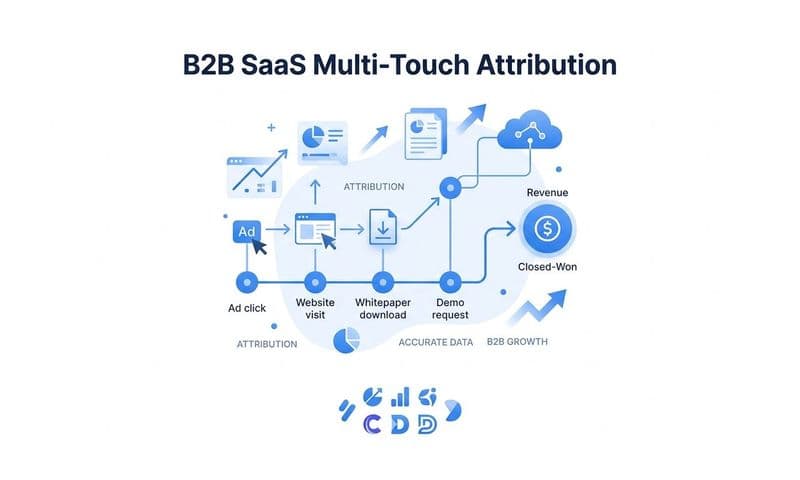
Consider a common B2B scenario. A VP of Marketing sees your LinkedIn ad on their phone during a commute. They don't click, but they remember the brand. Two weeks later, they search for your product on their work laptop and read a few blog posts. A week after that, they attend a webinar and book a demo from a follow-up email. Standard pixel tracking sees three separate anonymous sessions with no connection between them. The LinkedIn impression is invisible. The blog visits are unattributed. The email click might get credit for everything.
Cross-device behavior is one of the biggest gaps in B2B attribution. Without a way to stitch together a single user's activity across devices, you lose visibility into how the journey actually progressed. You can't see which touchpoints built awareness, which ones accelerated consideration, and which one finally triggered action. Proper cross-channel tracking implementation is what bridges these gaps and gives you a coherent view of the full journey.
Offline conversions are the other major blind spot. In B2B, some of the most important conversion events happen entirely outside the browser. A demo call that goes well. A proposal that gets signed. A deal that closes in your CRM three months after the first ad click. Without a mechanism to import these offline conversion tracking events back into your ad platforms, your campaigns get optimized on top-of-funnel signals like form fills and demo requests, not on the revenue signals that actually matter.
The practical consequence is that your ad platforms think they know what a good conversion looks like, but they're actually optimizing toward leads that may never close. You scale a campaign because it's generating demo requests, but the sales team tells you the lead quality is terrible. The tracking data and the business outcome are pointing in opposite directions.
How Attribution Models Distort What You See
Even if your tracking is technically clean, the attribution model you're using can fundamentally distort which channels appear to be working. This is a strategic problem as much as a technical one.
Last-click attribution assigns 100% of the conversion credit to the final touchpoint before a conversion occurs. On the surface, this seems logical. But in practice, it systematically over-credits retargeting campaigns and branded search, because those are almost always the last thing a prospect interacts with before converting. The awareness campaigns that introduced your brand, the content that built trust, the webinar that moved a prospect from curious to interested — none of those get any credit in a last-click model.
The result is predictable: teams that rely on last-click attribution end up defunding their top-of-funnel channels because they never appear to close deals. They double down on retargeting and branded keywords, which look incredibly efficient, but only because they're intercepting demand that was already created by the channels you stopped investing in. It's a slow-motion way to hollow out your pipeline. Reviewing the best software for tracking marketing attribution can help you find a solution that supports more sophisticated multi-touch models.
First-touch attribution has the opposite problem. It gives all the credit to the very first interaction, ignoring every nurturing touchpoint that actually moved the prospect toward a decision. This makes awareness channels look like they drive everything, while the content, email sequences, and retargeting campaigns that did the heavy lifting get erased from the story.
Neither model is inherently correct. The right attribution model depends on your sales cycle length, your channel mix, and what business question you're trying to answer. A short-cycle product might reasonably use last-click for certain decisions. A complex B2B sale with a 90-day cycle needs a multi-touch model that distributes credit across the full journey. Using the wrong model doesn't just create reporting errors. It actively causes you to make the wrong budget decisions, repeatedly, at scale.
Server-Side Tracking and First-Party Data as the Modern Fix
The good news is that the technical problems driving inaccurate conversion tracking have real solutions. The shift from client-side to server-side tracking is the most important upgrade a B2B marketing team can make right now.
Server-side tracking works by sending conversion data directly from your server to ad platforms, rather than relying on a browser-based pixel to fire. Meta's Conversions API and Google's Enhanced Conversions are the most widely used implementations of this approach. Because the data travels server-to-server, it bypasses browser restrictions, ad blockers, and iOS privacy limitations entirely. Conversions that would have been invisible to a client-side pixel get recorded accurately, giving your ad platforms better optimization signals and giving you more complete data.
First-party data enrichment takes this further. When you pass CRM identifiers, hashed email addresses, and customer data alongside your conversion events, you dramatically improve match rates between ad platform user IDs and real customers. This is especially important as third-party cookies continue to phase out. First-party data collected directly from your users becomes the foundation of accurate tracking, and passing it through server-side events is how you make it actionable across your ad platforms.
There is one critical implementation detail that many teams overlook: event deduplication. When you run both a client-side pixel and a server-side Conversion API simultaneously, which is the recommended setup for maximum coverage, you must configure deduplication to prevent the same conversion from being counted twice across both data streams. Without it, you've solved the under-reporting problem but created an over-reporting problem. Every conversion event needs a unique identifier so the ad platform knows to count it only once, regardless of whether it arrived via pixel or API. A step-by-step Conversion API implementation tutorial can walk you through exactly how to configure this correctly.
Getting server-side tracking right requires coordination between your marketing team, your developers, and your data infrastructure. It's not a one-click setup. But it is the single most impactful technical change you can make to improve the accuracy of your conversion data.
Why You Need One Unified View of Your Conversion Data
Here's the fundamental problem with relying on individual ad platform dashboards as your primary source of truth: every platform is playing for its own team. Meta attributes credit using Meta's logic. Google attributes credit using Google's logic. LinkedIn does the same. When you look at each platform's dashboard independently, you're seeing each platform's best case for why it deserves more of your budget.
Add up the conversions reported across all your platforms and compare that number to your CRM. In most cases, the platform total will be significantly higher. This is not because your platforms are lying — it's because they each genuinely believe, based on their own data and models, that they contributed to those conversions. The problem is overlap. Multiple platforms claiming credit for the same customer journey is the norm, not the exception. Understanding how to fix conversion tracking gaps across platforms is the first step toward building a reliable unified view.
The solution is a neutral, unified attribution layer that ingests data from all your ad platforms, your website, and your CRM, and produces a single deduplicated view of the customer journey. Instead of asking "what does Meta say?" and "what does Google say?" separately, you ask "what actually happened, and which channels contributed?" That's a completely different question, and it leads to completely different budget decisions.
This is exactly what Cometly is built to do. Cometly connects your ad platforms, CRM, and website events to track the full customer journey in real time, from the first ad click through to closed-won revenue. It supports multiple attribution models so you can compare how credit distributes across your channels depending on the lens you use. It includes server-side event tracking to capture conversions that client-side pixels miss. And it integrates with Stripe and CRM data so you can tie ad spend directly to pipeline and revenue, not just top-of-funnel events.
For B2B SaaS teams, this level of visibility changes how you make decisions. Instead of scaling campaigns because a platform says they're working, you scale them because you can see the actual revenue they generated. Instead of cutting a channel because it doesn't appear in last-click reports, you can see its contribution across the full journey and make an informed call.
Putting It All Together
Inaccurate conversion tracking is not one problem. It's a stack of interconnected issues that reinforce each other. Platform bias inflates numbers at the reporting layer. Technical misconfigurations like duplicate pixels and misconfigured events corrupt the data at the collection layer. B2B buying journey complexity breaks the attribution chain at the journey layer. And the wrong attribution model distorts what you see at the analysis layer.
Fixing it requires action at every level. Server-side tracking and proper event configuration address the technical problems. Multi-touch attribution models address the strategic distortion. And a unified attribution platform addresses the silo problem by giving you one neutral source of truth that reconciles data across every channel.
The teams that get this right don't just have cleaner reports. They make better decisions, allocate budget more confidently, and build campaigns on signals that actually correlate with revenue. That's the real value of accurate conversion tracking.
If your conversion data feels unreliable, the first step is understanding which layer is broken. The second step is building the infrastructure to fix it. Ready to see exactly which ads and channels are driving real revenue for your business? Get your free demo and discover how Cometly gives your team accurate, real-time conversion data across every touchpoint.