You're watching ad spend climb week over week. Orders are coming in. But when someone asks which campaign actually drove those purchases, you find yourself staring at three different dashboards giving three different answers. Sound familiar?
This is one of the most common frustrations in ecommerce marketing today. The traffic is there. The conversions are happening. But the connection between specific campaigns and actual revenue feels like a guessing game. And when you're guessing, you're not optimizing. You're just spending.
Conversion tracking is the bridge that closes that gap. It's the system that tells you not just that a sale happened, but where that customer came from, which ads they saw, and what sequence of touchpoints led them to buy. For online stores, this isn't a nice-to-have. It's the foundation of every smart budget decision you'll make.
But here's the reality: tracking conversions for online stores has become significantly more complex over the past few years. Privacy updates, browser restrictions, and cookie deprecation have all eroded the reliability of traditional tracking methods. What worked in 2019 is not what works today.
This guide will walk you through what conversion tracking actually means for ecommerce, why the landscape shifted, which methods hold up in 2026, and how to build a system that gives you real confidence in your data. Whether you're running a lean in-house team or managing campaigns for multiple clients, the principles here apply directly to how you measure and scale performance.
Why Every Dollar of Ad Spend Depends on Accurate Conversion Data
When most people think about conversions, they think about purchases. And yes, completed orders are the ultimate goal. But in an ecommerce context, a conversion is any meaningful action a visitor takes on your site that signals intent or value. Add-to-cart actions, checkout initiations, email signups, and even product page views all represent stages of engagement that matter for optimization.
Why does tracking each of these matter? Because not every visitor is ready to buy on their first visit. When you only track completed purchases, you lose visibility into where people are dropping off, which campaigns are driving high-intent behavior short of a sale, and which audiences are worth nurturing. Each micro-conversion event tells a story about your funnel.
There's also a deeper reason to track these events carefully: ad platforms like Meta, Google, and TikTok rely on your conversion data to train their machine learning models. When you send a purchase event back to Meta, you're not just logging a sale for your own records. You're giving Meta's algorithm a signal that says, "this person converted, find me more people like them." The richer and more accurate that signal, the better the algorithm performs.
This is where the real cost of poor conversion tracking shows up. When your data is incomplete, the algorithm trains on a distorted picture of your customer. It starts optimizing for the wrong behaviors, targeting the wrong audiences, and allocating budget toward campaigns that look good on the surface but aren't actually driving revenue. Understanding lost conversions from tracking gaps is essential for diagnosing these issues.
The downstream effects compound quickly. You scale a campaign that appears to have strong return on ad spend, only to discover that the attributed conversions were duplicated or misattributed. You cut a channel that was actually initiating purchase journeys because last-click attribution gave it no credit. You can't calculate true customer acquisition cost because your conversion counts don't match your actual orders.
Flying blind in paid advertising performance tracking doesn't just mean uncertainty. It means actively misallocating budget based on flawed signals. For online stores where margins matter and competition is high, that's a problem you can't afford to ignore.
The good news is that accurate conversion tracking is solvable. It requires understanding the current tracking landscape, layering the right methods together, and feeding clean data back to the platforms that need it most. That starts with understanding what changed and why.
The Tracking Landscape in 2026: What Shifted and Why It Matters
If you've noticed growing discrepancies between what your ad platforms report and what your actual orders show, you're not imagining it. The tracking environment has changed dramatically, and several forces converged to make traditional pixel-based tracking far less reliable than it once was.
The most significant turning point came with Apple's App Tracking Transparency rollout, starting with iOS 14.5. When Apple required apps to ask users for permission before tracking them across other apps and websites, a large portion of iPhone users opted out. For advertisers running campaigns on Meta, this created an immediate and lasting gap in conversion visibility. Events that previously fired reliably from browser pixels were no longer being captured for a significant share of mobile traffic. Marketers have had to explore post-iOS tracking solutions to recover that lost data.
Browser-level protections added another layer of complexity. Safari's Intelligent Tracking Prevention and Firefox's Enhanced Tracking Protection both limit how long cookies can persist and restrict cross-site tracking. This means that even users who haven't explicitly opted out of tracking may not be fully captured by traditional pixel implementations. A customer who clicks a Facebook ad in Safari and purchases two days later may never be attributed correctly if the cookie expired in the interim.
Google's evolving approach to third-party cookies in Chrome has created ongoing uncertainty. While Chrome remains widely used and has not fully deprecated third-party cookies, the direction of travel is clear: browser-based tracking is becoming less reliable, not more.
Consent regulations in various markets add yet another variable. When users decline cookie consent banners, client-side pixels fire incompletely or not at all. This is particularly relevant for stores with European or international audiences.
The cumulative effect is a persistent gap between what ad platforms report and what actually happened. You may see Meta claiming credit for 80 conversions in a week while your Shopify dashboard shows 60 orders. That discrepancy isn't just a number problem. It affects how you evaluate campaigns, how you allocate budget, and how the platform's algorithm learns.
The industry's response to these challenges has been a shift toward server-side tracking. Rather than relying solely on a JavaScript pixel firing in the user's browser, server-side tracking sends conversion data directly from your web server or backend to the ad platform's API. This approach bypasses browser restrictions and ad blockers entirely, giving you a more complete and reliable data stream. Understanding this shift is essential for anyone serious about tracking conversions for online stores in the current environment.
Core Methods for Tracking Conversions on Your Store
There is no single tracking method that captures everything. The most effective ecommerce tracking setups layer multiple approaches together so that gaps in one method are covered by another. Here's how the main methods work and where each one fits.
Platform Pixels (Meta Pixel, Google Tag, TikTok Pixel): These are JavaScript snippets that fire in the user's browser when specific actions occur on your site. They're the most common starting point for ecommerce tracking and are relatively straightforward to implement through tag managers or native integrations. The limitation is everything discussed in the previous section: browser restrictions, iOS privacy changes, and ad blockers all reduce the reliability of pixel-only tracking. They still provide value, especially for users who haven't opted out, but they should not be your only data source.
Server-Side APIs (Meta Conversions API, Google Enhanced Conversions): These methods send conversion data from your server directly to the platform, bypassing the browser entirely. Meta's Conversions API (CAPI) and Google's Enhanced Conversions allow you to pass purchase events, add-to-cart actions, and other key behaviors with greater reliability. When used alongside browser pixels, they create redundancy that improves match rates and reduces data loss. The tradeoff is that server-side implementations are more technically involved to set up and maintain.
UTM Parameters: UTM tags appended to your ad URLs allow analytics platforms like Google Analytics to identify the source, medium, and campaign associated with each visit. This is a foundational method for understanding traffic attribution at the session level. UTMs are reliable for capturing click-through data but don't capture post-click behavior on their own, and they depend on the user not clearing cookies or switching devices between click and conversion.
First-Party Data Collection: This includes any data you collect directly from your customers: email addresses at signup, purchase histories in your CRM, and behavioral data captured through your own analytics. First-party data is not subject to the same privacy restrictions as third-party tracking and becomes increasingly valuable as third-party signals erode. Implementing a robust first-party data tracking strategy is a powerful way to improve attribution accuracy.
The key insight here is that relying on any single method creates blind spots. A pixel-only setup misses a growing share of iOS and privacy-protected users. UTMs alone tell you about sessions but not about the full customer journey. Server-side tracking without pixels can miss some browser-level signals that help with audience building.
Layering these methods together creates a more complete picture. When a purchase event is captured by both the browser pixel and the Conversions API, the platform can deduplicate the events and use the richer data point. Addressing duplicated conversion tracking across platforms is critical to maintaining clean data. This redundancy is not overkill. It's how accurate ecommerce tracking actually works in practice today.
Multi-Touch Attribution: Seeing the Full Path to Purchase
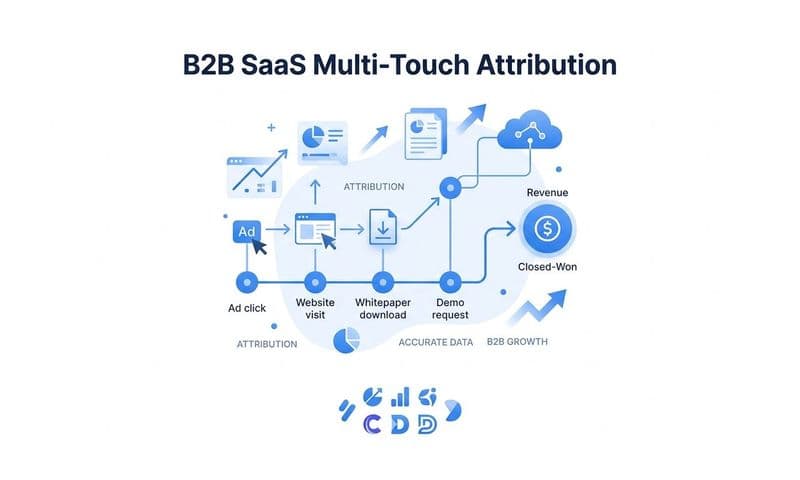
Here's a scenario that plays out constantly in ecommerce: a customer discovers your product through a TikTok ad, visits your site, leaves without buying, sees a retargeting ad on Instagram two days later, clicks a promotional email the following week, and finally completes a purchase. Which channel gets credit?
Under last-click attribution, the email gets 100% of the credit. Every other touchpoint that shaped the customer's decision is invisible in your reporting. This is the fundamental problem with last-click models for online stores, where purchase journeys routinely span multiple channels, devices, and days.
When you optimize based on last-click data, you systematically undervalue the channels doing the heavy lifting at the top and middle of the funnel. Social discovery channels like TikTok and Instagram often initiate purchase journeys but rarely close them. If your attribution model never credits them for the journeys they start, you'll cut budget from channels that are actually driving demand, and you'll over-invest in channels that are simply collecting credit at the end. This is a core challenge explored in depth with ad platforms blaming each other for conversions.
Multi-touch attribution distributes credit across all the touchpoints in a customer's journey. Different models do this in different ways.
Linear attribution gives equal credit to every touchpoint in the path. If a customer touched four channels before converting, each gets 25% of the credit. This approach is simple and avoids the extremes of first-click or last-click, though it doesn't account for the relative influence of each touchpoint.
Time-decay attribution gives more credit to touchpoints that occurred closer to the conversion. The logic is that the channels a customer engaged with most recently had the most influence on their decision. This model tends to favor retargeting and email, which typically appear late in the journey.
Position-based attribution (sometimes called U-shaped) gives the most credit to the first and last touchpoints, with the remaining credit distributed across the middle. This acknowledges that both the initial discovery and the final conversion trigger are particularly important, while still recognizing the role of mid-funnel channels.
The practical impact of switching from last-click to multi-touch attribution can be significant. Channels that appeared to have poor ROAS under last-click may reveal strong assisted conversion value under a multi-touch model. A dedicated customer journey tracking platform can help you visualize these full paths and make smarter budget decisions.
For online stores, multi-touch attribution isn't just a reporting preference. It's a more accurate representation of how customers actually buy. Understanding the full path to purchase is what allows you to invest intelligently across the entire funnel, not just at the bottom of it.
Building a Conversion Tracking System That Scales With Your Store
Understanding the methods and models is one thing. Building a system that actually works, stays accurate as your store grows, and feeds clean data back to your ad platforms is another. Here's a practical framework for getting there.
Step 1: Connect your ad platforms. Start by ensuring every platform you're running paid campaigns on has a properly configured tracking connection. This means implementing platform pixels through a tag manager, enabling server-side API connections for each platform, and verifying that key conversion events (purchases, add-to-cart, checkout initiation) are firing correctly. Use each platform's diagnostic tools to confirm events are being received and matched accurately. If you're running ads across Meta, Google, and TikTok simultaneously, understanding how to track conversions across platforms is critical.
Step 2: Integrate your ecommerce platform and CRM. Your Shopify, WooCommerce, or other ecommerce platform is the source of truth for actual orders. Your CRM holds customer data that can enrich attribution. Connecting these systems to your tracking infrastructure means you can match ad-platform conversion data against real order data, identify discrepancies, and build a more complete picture of customer value over time.
Step 3: Set up server-side tracking. As discussed, this is now a foundational requirement rather than an advanced option. Server-side tracking ensures that conversions happening on iOS devices, in privacy-protected browsers, or from users who've declined cookies are still captured and sent to your ad platforms. This directly improves the quality of data your campaigns are optimizing on.
Step 4: Validate your data regularly. Tracking setups drift over time. Site updates break tags. New checkout flows miss event triggers. Building a habit of comparing platform-reported conversions against your actual order data on a weekly basis helps you catch issues before they compound into weeks of degraded campaign performance.
The final and often overlooked step is closing the loop by feeding accurate conversion data back to the ad platforms. When Meta, Google, or TikTok receive clean, complete purchase events, their algorithms can optimize targeting and bidding more effectively on your behalf. This is not a passive benefit. It's an active input into campaign performance.
This is where platforms like Cometly become particularly valuable for ecommerce teams. Cometly unifies tracking across all your ad platforms and marketing channels, provides server-side tracking to capture conversions that browser pixels miss, and syncs enriched conversion data back to Meta, Google, and other ad channels. The result is a system where your ad platform algorithms are learning from accurate data, your attribution reflects the full customer journey, and your team has a single source of truth for performance analysis rather than reconciling conflicting reports from five different dashboards.
Metrics That Actually Tell You What Is Working
Once your tracking system is in place, the question becomes: what should you actually be measuring? Not every metric deserves equal attention. The ones that matter most for ecommerce are the ones that connect directly to revenue and efficiency.
Conversion rate by channel: This tells you what percentage of visitors from each traffic source are completing a desired action. Comparing conversion rates across channels reveals which sources are driving high-quality traffic and which are generating volume without intent. A channel with high traffic but low conversion rate often signals an audience or message mismatch.
Cost per acquisition (CPA): How much are you spending to acquire each customer or conversion through each channel? CPA is one of the most direct measures of campaign efficiency. When CPA is tracked accurately across channels, you can make clear decisions about where to increase spend and where to pull back.
Return on ad spend (ROAS): For ecommerce, ROAS is the ratio of revenue attributed to a campaign versus what you spent on it. Accurate ROAS depends entirely on accurate conversion tracking. When attribution is incomplete, ROAS figures are misleading, which is why building the right tracking foundation matters before optimizing to ROAS targets. Investing in a dedicated marketing attribution platform for ecommerce can ensure your ROAS calculations reflect reality.
Customer acquisition cost (CAC): Broader than CPA, CAC accounts for all marketing and sales costs associated with acquiring a new customer. Tracking this over time and by channel helps you understand the long-term economics of your growth strategy.
Average order value by source: Not all conversions are equal. A channel that drives lower volume but consistently higher order values may be more valuable than a high-volume, low-value source. Breaking down average order value by traffic source reveals which channels attract your best customers.
Monitoring these metrics through a unified analytics dashboard makes trends visible that would be easy to miss when looking at each platform in isolation. Leveraging the right revenue attribution tracking tools helps you spot a channel whose CPA is creeping up before it becomes a budget problem, or identify a campaign that's driving strong ROAS at low volume and has room to scale.
This is also where AI-powered analysis earns its place. When you're managing campaigns across multiple channels with thousands of data points, manual analysis will always lag behind the data. AI-driven recommendations can surface patterns in your conversion data, flag underperforming campaigns, and identify scaling opportunities faster than any manual review process. The value isn't in replacing your judgment. It's in making sure your judgment is informed by insights you might otherwise miss.
Putting It All Together
Tracking conversions for online stores is not a one-time setup task. It's an ongoing system that sits at the center of every meaningful marketing decision you make. When that system is accurate, you spend with confidence. When it's broken or incomplete, every decision downstream is compromised.
The path forward is clear. Start by understanding what you need to track and why each conversion event matters. Acknowledge the ways the tracking landscape has shifted and build your setup around server-side methods that hold up under modern privacy constraints. Layer your tracking methods so no single point of failure can blind you to what's happening. Adopt attribution models that reflect how your customers actually buy, not just who gets credit at the finish line. And build a system that feeds clean, enriched conversion data back to the ad platforms powering your growth.
Each of these steps compounds on the others. Better data leads to better algorithm performance. Better attribution leads to smarter budget decisions. Smarter budget decisions lead to more efficient growth.
If you're ready to build that system with a platform designed specifically for this challenge, Get your free demo of Cometly today. See how accurate, cross-platform conversion tracking, server-side data capture, and AI-powered recommendations can give your ecommerce team the clarity and confidence to scale campaigns that actually drive revenue.