If you're running paid campaigns for a B2B SaaS company, there's a good chance your conversion data is lying to you. Not because your team made an error, but because the tracking infrastructure most marketers rely on was built for a different era of the internet.
Browser-based pixels, the workhorses of digital advertising for the past decade, are losing their grip. Ad blockers strip them out before they fire. Safari's Intelligent Tracking Prevention limits how long they can store data. Firefox blocks third-party cookies by default. And with Google's broader push toward a cookieless web, the signal gap is only widening.
For SaaS marketing teams, this isn't just a technical inconvenience. It's a budget problem. When your ad platform thinks a campaign generated half the leads it actually did, it optimizes accordingly. Your algorithms train on bad data, your attribution models skew, and you end up cutting spend on campaigns that were actually working.
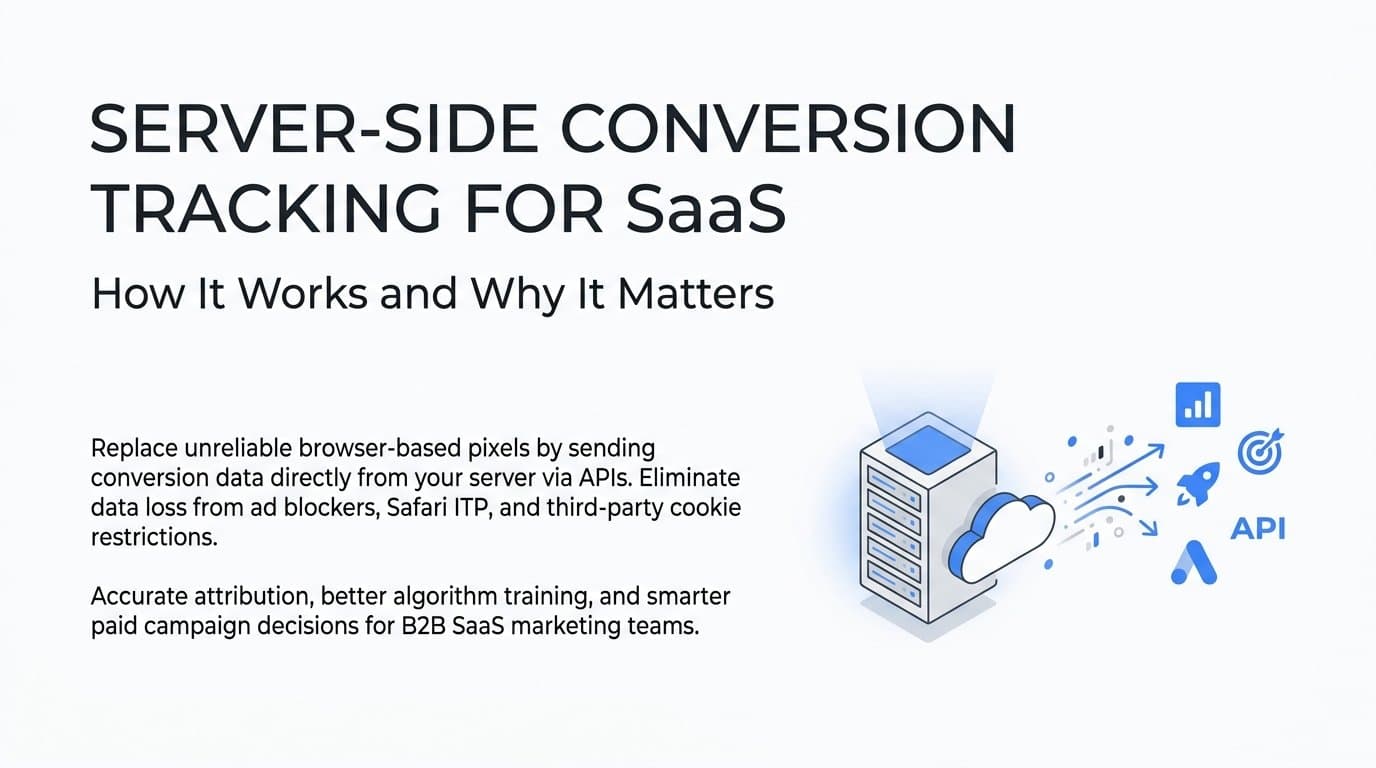
Server-side conversion tracking is the modern answer to this problem. Instead of relying on a user's browser to fire a pixel, your server sends conversion data directly to ad platforms via their APIs. The result is more complete data, better attribution, and ad algorithms that actually know what's working.
This article breaks down exactly how server-side conversion tracking works, why it matters specifically for SaaS companies with complex, multi-touch sales cycles, what a proper setup looks like, and how purpose-built attribution platforms make implementation practical without requiring a dedicated engineering team.
Why Browser-Based Tracking Is Failing SaaS Marketers
To understand why server-side tracking matters, you first need to understand how client-side pixels work and where they break down.
When a user visits your website and completes an action, like filling out a demo request form, a JavaScript pixel fires in their browser. That pixel sends data to the ad platform (Meta, Google, LinkedIn) telling it a conversion happened. The ad platform records it, attributes it to a campaign, and uses it to train its bidding algorithms.
This works well in a clean environment. But the modern browser environment is anything but clean.
Ad blockers: Browser extensions like uBlock Origin and AdBlock Plus actively prevent tracking pixels from loading. Among tech-savvy audiences, which make up a significant share of B2B SaaS buyers, ad blocker adoption is especially high. When the pixel never loads, the conversion never gets recorded.
Safari's Intelligent Tracking Prevention (ITP): Apple introduced ITP to limit cross-site tracking in Safari. ITP restricts how long first-party cookies set by JavaScript can persist, in some cases capping them at just 24 hours or less. For SaaS companies with longer consideration cycles, a prospect who clicks an ad today and converts a week later may not be attributable at all.
Firefox Enhanced Tracking Protection: Mozilla's browser blocks many third-party tracking scripts by default, further reducing the reach of pixel-based measurement.
Third-party cookie deprecation: Google has been rolling back support for third-party cookies in Chrome, the world's dominant browser. While the timeline has evolved, the direction is clear: the cookie-based tracking model is being phased out.
For SaaS companies, these limitations compound in a specific and painful way. Your buyers are often developers, IT professionals, and technical decision-makers who are more likely than average to use privacy-focused browsers or ad blockers. Your sales cycles are long, meaning attribution windows need to stretch further. And your conversion events don't end at a purchase page. They span trials, MQLs, demos, and closed-won deals, each of which needs to be tracked and attributed accurately.
The downstream impact is serious. Underreported leads make your campaigns look less effective than they are. Skewed attribution models push budget toward channels that appear to be performing well simply because they're easier to track. And perhaps most damaging: your ad platform's AI is training on incomplete signal data, which means its targeting and bidding decisions are built on a distorted view of who your best customers actually are.
This is a compounding problem. The longer a SaaS team runs on broken tracking, the more their ad platform algorithms drift away from reality. Fixing it later means not just improving data going forward, but actively retraining algorithms that have been optimizing toward the wrong signals for months.
The Mechanics of Server-Side Conversion Tracking
Server-side conversion tracking shifts where the conversion event originates. Instead of the user's browser firing a pixel, your server sends the event data directly to the ad platform's API. The user's browser is no longer the messenger, and that changes everything.
Here's the data flow in plain terms. A user clicks your ad, lands on your site, and submits a demo request. Your server captures that event. It then enriches the event with first-party data you already have, such as the user's hashed email address, a unique user ID, or other identifiers. That enriched event is then sent directly from your server to Meta's Conversion API or Google's Enhanced Conversions endpoint. No browser involvement. No pixel that can be blocked.
Because the event travels server to server, it bypasses the entire layer of browser restrictions that cause client-side pixels to fail. Ad blockers can't intercept it. ITP can't limit its cookie lifespan. Third-party cookie deprecation is irrelevant because no third-party cookies are involved.
In a SaaS context, the types of conversion events you can track this way go well beyond simple form fills. Server-side tracking is particularly valuable for capturing the full range of meaningful actions across your funnel:
Top-of-funnel events: Form submissions, demo requests, free trial signups, and content downloads. These are the events most commonly tracked via browser pixels today, and server-side tracking makes them more reliable.
Mid-funnel CRM events: MQL status updates, opportunity creation, sales-qualified lead designations. These events happen inside your CRM, not on your website, and they're invisible to browser pixels entirely. Server-side tracking is the only way to send them back to ad platforms.
Revenue events: Subscription starts, plan upgrades, and closed-won deals. When these events are sent back to Meta or Google, ad platforms can optimize campaigns toward users who actually become paying customers, not just users who filled out a form.
This is where server-side tracking becomes genuinely transformative for SaaS companies. You're not just recovering lost top-of-funnel data. You're enabling a fundamentally richer signal that connects ad activity to actual revenue outcomes.
Both Meta and Google have built their server-side APIs specifically to receive this kind of enriched event data. Meta's Conversion API (CAPI) and Google's Enhanced Conversions are publicly documented products that accept server-sent events and use them to improve attribution and campaign optimization. Both platforms actively encourage advertisers to implement server-side tracking precisely because better data leads to better algorithm performance and, in turn, better results for advertisers.
The SaaS-Specific Case for Server-Side Tracking
Ecommerce companies have a relatively simple conversion story. A user sees an ad, clicks it, browses a product, and buys it, often within a single session. Attribution is still imperfect, but the journey is short and the conversion event is clear.
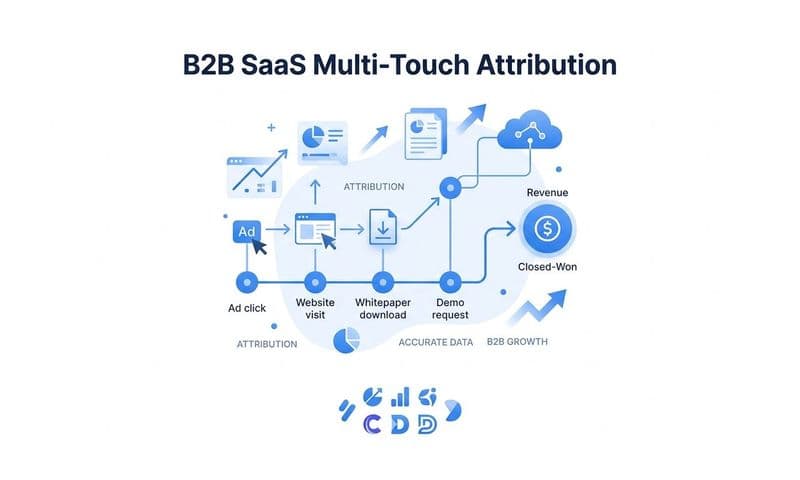
B2B SaaS doesn't work that way. Your buyer might see a LinkedIn ad, read a blog post, attend a webinar, start a free trial, go dormant for three weeks, get a follow-up email from sales, and then sign a contract after a demo. That journey spans weeks or months, involves multiple channels, and includes conversion events that happen both on your website and inside your CRM.
This complexity makes accurate tracking harder and more important at the same time.
Browser pixels can capture what happens on your website, but they can't see what happens after a lead enters your CRM. They can't record when a prospect becomes an MQL, when an opportunity is created, or when a deal closes. These downstream events are often the most valuable signals for ad platform optimization because they represent actual revenue, not just top-of-funnel activity.
Server-side tracking bridges this gap. By connecting your CRM to your attribution infrastructure, you can send downstream events back to Meta and Google as conversion signals. When your ad platform knows that a specific campaign is generating closed-won revenue, not just demo requests, it can optimize its targeting and bidding toward the users most likely to become paying customers.
First-party data enrichment plays a central role here. SaaS companies typically collect meaningful user data at signup: email addresses, company names, job titles, and user IDs. This data can be hashed and included in server-side events, dramatically improving match rates when ad platforms try to connect a conversion event back to a specific user profile. Higher match rates mean more accurate attribution and better algorithm training.
The practical implication is significant. Many SaaS teams discover, once they implement proper server-side tracking, that their attribution models were systematically undervaluing certain channels. A campaign that appeared to generate few conversions based on pixel data may have actually driven a meaningful share of closed revenue, but those downstream events were never being reported back to the ad platform.
Correcting this isn't just about cleaner reporting. It's about ensuring that your ad platform's AI is optimizing toward the right outcomes. When you send pipeline and revenue events as conversion signals, you're effectively telling the algorithm: find more people like the ones who actually became customers, not just the ones who clicked a button on a landing page.
Key Components of a Server-Side Tracking Setup
Understanding the mechanics of server-side tracking is one thing. Building a setup that actually works requires getting three core components right.
The event source: This is where conversion data originates. In a SaaS context, event sources typically include your product (for in-app events like trial starts and subscription activations), your website (for form submissions and demo requests), and your CRM (for downstream events like MQL, opportunity created, and closed-won). Each source needs to be instrumented to capture events and pass them to your processing layer.
The event processing layer: This is the middleware that receives events from your sources, enriches them with first-party identifiers, and routes them to the appropriate ad platform APIs. This layer can be a purpose-built attribution platform, a server-side tag management solution, or custom-built infrastructure. Its job is to normalize event data, apply deduplication logic, and ensure that what gets sent to Meta or Google is clean, complete, and properly formatted.
The destination APIs: These are the ad platform endpoints that receive your server-sent events. Meta's Conversion API and Google's Enhanced Conversions are the most commonly used, but LinkedIn, TikTok, and other platforms have also built server-side event APIs. Each API has its own schema requirements and matching parameters, which the processing layer needs to handle correctly.
One of the most important technical considerations in any server-side setup is event deduplication. Here's the problem it solves: many implementations run both a browser pixel and a server-side event for the same conversion. The browser pixel fires when it can (when the user isn't blocking it), and the server event fires independently. If both events reach the ad platform without deduplication logic, the same conversion gets counted twice, inflating your reported numbers and distorting your attribution.
Ad platforms like Meta address this through event ID matching. When you send a browser pixel event and a server-side event for the same conversion, you assign both the same unique event ID. Meta's system recognizes the duplicate and counts only one conversion. Getting this right requires careful implementation, but it's non-negotiable for any setup that runs both client-side and server-side tracking in parallel.
First-party identifiers are the other critical element. Server-side events are matched to ad platform user profiles using hashed identifiers: email addresses, phone numbers, user IDs, and similar data points. The more identifiers you include with each event, the higher your match rate and the more accurate your attribution. This is where SaaS companies have a real advantage. You typically collect verified email addresses at signup, giving you a reliable first-party identifier to include with every conversion event you send.
How Attribution Platforms Like Cometly Power Server-Side Tracking
Building a server-side tracking setup from scratch is technically possible, but it requires meaningful engineering investment. You need to instrument event sources, build or configure a processing layer, handle API integrations for each ad platform, implement deduplication logic, and maintain the infrastructure over time as APIs evolve and your product changes.
For most SaaS marketing teams, that's not a realistic path. Marketing moves fast, and waiting months for engineering resources to build custom tracking infrastructure means continuing to make budget decisions on incomplete data in the meantime.
This is where purpose-built attribution platforms change the equation. Rather than building the infrastructure yourself, you connect your existing tools, ad platforms, CRM, and website to a platform that handles the complexity for you.
Cometly is built specifically for this problem. It connects your ad platforms, CRM, and website into a unified data layer, capturing every touchpoint from the first ad click through to closed-won revenue. When a user clicks a Meta ad, starts a trial, becomes an MQL in your CRM, and eventually converts to a paying customer, Cometly tracks and connects each of those events into a single, coherent customer journey.
On the server-side tracking side, Cometly handles the Conversion API integration with Meta and Google's Enhanced Conversions, enriches events with first-party data, and manages deduplication so your conversion counts stay accurate. You get the benefits of server-side tracking without having to build or maintain the underlying infrastructure.
The result is something most SaaS marketing teams have never actually had: a single source of truth for marketing performance. Instead of reconciling numbers across your ad platform dashboards, your CRM reports, and your analytics tool, you get one view that shows which ads, channels, and campaigns are driving actual pipeline and revenue.
Cometly's AI layer adds another dimension. By capturing complete, enriched conversion data across every touchpoint, the platform can identify which ads and campaigns are genuinely performing and surface recommendations for where to scale and where to pull back. Those recommendations are grounded in revenue data, not just top-of-funnel click metrics.
There's also a feedback loop benefit that compounds over time. When Cometly sends high-quality, enriched conversion signals back to Meta and Google, it improves the data those platforms use to train their bidding and targeting algorithms. Better signal in means better optimization out. Your Advantage+ campaigns and Smart Bidding strategies start working with a more accurate picture of who your best customers are, which improves targeting and reduces wasted spend.
What Accurate Tracking Unlocks for Growth Teams
Fixing your conversion tracking isn't just a data hygiene exercise. It changes what you're able to do as a growth team.
The most immediate benefit is confidence in your attribution data. When you know your conversion numbers are accurate, you can make budget decisions without second-guessing whether the data reflects reality. Scaling a campaign that's genuinely driving pipeline becomes a straightforward call rather than a leap of faith.
Ad platform performance improves as a direct consequence of better signal. Meta's Advantage+ campaigns and Google's Smart Bidding are both heavily dependent on conversion data to optimize targeting and bids. When those systems receive complete, accurate signals that include downstream revenue events, they can identify and target the users most likely to become paying customers. Many SaaS teams find that campaign performance improves meaningfully once their ad platforms are working with complete data, simply because the algorithms are finally optimizing toward the right outcomes.
AI-driven recommendations become genuinely useful when they're grounded in complete data. Cometly's AI can identify which specific ads and campaigns are driving closed revenue across channels, surfacing insights that would take hours of manual analysis to uncover. Growth teams can act on those insights in real time rather than waiting for monthly reporting cycles.
Perhaps the most significant shift is strategic. Teams that rely on browser pixels and disconnected reporting tools are inherently reactive. They see what happened last month and try to draw conclusions. Teams with accurate, real-time attribution data can move proactively, adjusting spend, pausing underperformers, and scaling winners based on what's actually happening right now.
This shift from reactive to proactive is where server-side conversion tracking delivers its deepest value. It's not just about recovering lost conversions. It's about building the data foundation that lets a SaaS marketing team operate with the speed and precision that modern paid advertising demands.
The Bottom Line
Browser-based tracking alone is no longer a reliable foundation for SaaS companies running multi-channel paid campaigns. The combination of ad blockers, browser privacy restrictions, and third-party cookie deprecation has created a real and growing gap between what actually happens in your funnel and what your ad platforms can see.
Server-side conversion tracking closes that gap. By sending conversion events directly from your server to ad platform APIs, you bypass the browser restrictions that cause data loss, activate your first-party data for better attribution matching, and enable downstream CRM events to flow back into your ad platform as optimization signals.
For B2B SaaS companies with complex, multi-touch sales cycles, this isn't a nice-to-have. It's the difference between ad algorithms that optimize toward actual revenue and algorithms that optimize toward a distorted, incomplete picture of your funnel.
Cometly makes this practical for SaaS marketing teams who need accurate attribution without heavy engineering overhead. It connects your ad platforms, CRM, and website into a single source of truth, handles server-side event delivery to Meta and Google, and surfaces AI-driven insights that help you scale what's working with confidence.
If your team is ready to move from incomplete data to a complete view of what's driving pipeline and revenue, Get your free demo and see how Cometly's attribution platform can transform the way you measure and optimize your paid campaigns.