The tracking landscape has fundamentally changed. For years, third-party cookies were the invisible thread connecting an ad click to a conversion, stitching together user journeys across websites and giving marketing teams a (mostly) unified view of campaign performance. That thread is unraveling, and for B2B SaaS marketing teams, the consequences are real: attribution gaps, unreliable conversion data, and growing uncertainty about where to invest ad budget.
This is not a distant problem. Safari and Firefox have been restricting third-party cookies for years. A significant portion of your audience is already browsing in environments where traditional pixel-based tracking simply does not work the way it used to. The question is not whether your conversion data is affected. It almost certainly is. The question is what you do about it.
The good news is that tracking conversions without third-party cookies is not only possible, it is often more accurate than what you had before. The approaches available today, including server-side tracking, first-party data infrastructure, Conversion API integration, and multi-touch attribution, give you more control, more durability, and better signal quality than cookie-dependent tracking ever provided. This guide walks through each of them in practical terms so you can build a conversion tracking setup that holds up regardless of what any browser vendor decides next.
Why Cookie-Based Tracking Was Already Broken
Before diving into solutions, it is worth understanding why the loss of third-party cookies is less of a catastrophe and more of a reckoning. The truth is that cookie-based conversion tracking had serious limitations long before deprecation became a mainstream conversation.
Third-party cookies work by storing a small identifier in a user's browser when they visit a site or interact with an ad. When that user later visits another site and completes a conversion action, the cookie is read to connect the two events. It sounds clean in theory, but the reality is messier. Browser settings, ad blockers, and privacy extensions have been quietly eroding this system for years.
Apple introduced Intelligent Tracking Prevention in Safari back in 2017, progressively tightening restrictions on how third-party cookies can be used to track users across domains. Mozilla followed with Enhanced Tracking Protection in Firefox, blocking third-party tracking cookies by default. These two browsers together represent a substantial share of web traffic, which means a meaningful portion of your conversions were already being missed before Google announced any Chrome changes.
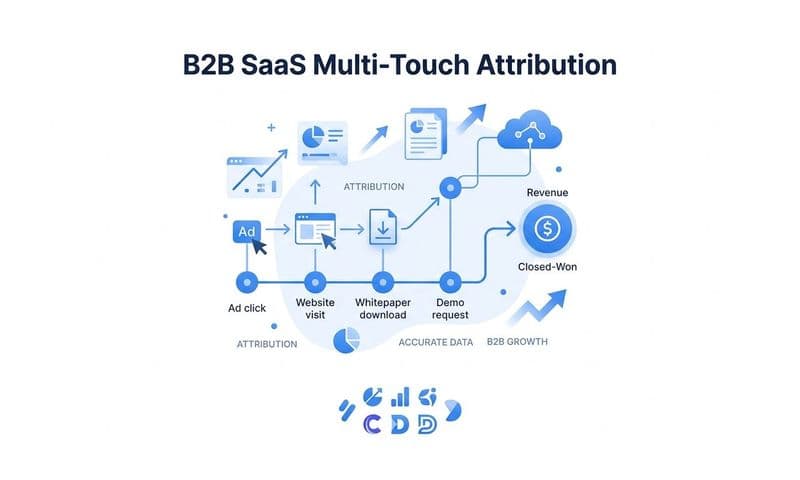
For B2B SaaS specifically, the problem runs deeper. Consider the reality of a typical B2B buying journey: a potential customer clicks a LinkedIn ad on their work laptop, spends a few weeks researching competitors on their home desktop, attends a webinar from their phone, and eventually books a demo through a sales outreach email. That journey spans multiple devices, multiple sessions, and potentially months of time.
Third-party cookies are tied to a single browser on a single device. They expire. They get cleared. They cannot follow a user from Chrome on a MacBook to Safari on an iPhone. For e-commerce, where the gap between ad click and purchase might be hours, this is a manageable limitation. For B2B SaaS, where that gap can stretch to weeks or months, cookie-dependent attribution is structurally unreliable. The discrepancy many marketing teams notice between ad platform reported conversions and actual CRM data is often a direct symptom of this gap. Understanding the full third-party cookie deprecation impact helps reframe how urgently this infrastructure needs to change.
Understanding this context matters because it reframes the goal. You are not trying to replace cookies with something equivalent. You are building something better: a tracking infrastructure grounded in data you actually own.
Server-Side Tracking: The Most Reliable Path Forward
If you want to understand the core technical shift in modern conversion tracking, start here. The distinction between client-side and server-side tracking is fundamental, and once you understand it, the path forward becomes much clearer.
Client-side tracking is what most marketing teams have relied on historically. A pixel or JavaScript tag fires in the user's browser when they complete an action, sending that event data to an ad platform. The problem is that this entire process happens inside the browser, which means it is subject to every privacy setting, ad blocker, and cookie restriction the user or browser vendor has put in place. If the browser blocks the request, the conversion is never recorded. A detailed comparison of server-side tracking vs client-side approaches makes this distinction even clearer.
Server-side tracking works differently. Instead of relying on the browser to fire the event, your own server sends the conversion data directly to the ad platform when a conversion occurs. The browser is not involved in the transmission. Ad blockers cannot intercept it. Browser privacy settings cannot block it. The event travels from your infrastructure to the ad platform's API, bypassing the browser entirely.
In practice, here is how this plays out. A user fills out a demo request form on your website. Your server receives that form submission, processes it, and simultaneously sends a conversion event to Meta's Conversion API, Google's Enhanced Conversions API, or whichever ad platform you are running campaigns on. The ad platform receives a clean, complete event with whatever user data you choose to include, and it can match that event back to an ad interaction.
The accuracy advantage here is significant. Server-side events are not subject to the fragmentation that plagues browser-based tracking. They arrive reliably. They include the data you send, not whatever the browser managed to capture before a privacy setting cut it off. And because ad platform algorithms like those powering Meta and Google Ads rely on conversion signal quality to optimize campaign delivery, better data means better optimization. When your pixel is missing conversions due to browser restrictions, the algorithm is working with an incomplete picture, and campaign performance reflects that. This is precisely why server-side tracking is more accurate than traditional pixel-based methods.
For B2B SaaS teams running paid campaigns across Meta, Google, LinkedIn, and other channels, transitioning to server-side tracking is the single highest-leverage technical change you can make right now. It does not eliminate every tracking challenge, but it removes the browser as a point of failure, which is where most of the data loss was happening in the first place.
First-Party Data Collection: Building Your Own Tracking Infrastructure
Server-side tracking solves the transmission problem. First-party data solves the identity problem. Together, they form the foundation of cookieless conversion tracking that actually works.
First-party data is any data you collect directly from your users through your own properties. This includes form submissions on your website, CRM records created when a lead enters your pipeline, product usage events from within your application, and payment data from your billing system. None of this data relies on third-party cookies. It lives in your systems, under your control, and it is not going anywhere regardless of what browsers do. Understanding what first-party data collection involves is the starting point for building this kind of durable infrastructure.
The key to using first-party data for conversion attribution is first-party identifiers. When a user fills out a form and provides their email address, you have a durable identifier that persists across devices and sessions. That email address can be hashed (converted into an anonymized string using a one-way algorithm) and sent to ad platforms as part of a conversion event. Meta's Conversion API, Google's Enhanced Conversions, and similar tools from other platforms all support this approach. The platform hashes the data on their end as well and attempts to match it against their own user database to connect the conversion back to an ad interaction.
This hashed matching approach is powerful because it works even when no cookie trail exists. If a user clicked a Meta ad six weeks ago, cleared their cookies twice, and is now converting through a different device, a hashed email match can still connect that conversion to the original ad interaction. Cookie-based tracking would have lost the thread entirely.
UTM parameters are another essential component of first-party tracking infrastructure. When you append UTM parameters to your ad URLs, those parameters travel with the user when they click through to your site and can be stored in your own systems, whether in your CRM, your marketing automation platform, or your own database. Because UTMs are stored in your own infrastructure rather than in a third-party cookie, they remain fully functional regardless of browser restrictions.
The practical implication is straightforward: make sure every ad, every email, and every campaign link you control has UTM parameters appended, and make sure your systems are capturing and storing those parameters when users convert. When a lead closes six months later, you still have the original source data sitting in your CRM. That is first-party attribution data that no browser vendor can take away from you.
Attribution Models That Work in a Cookieless World
Solving the technical tracking problem is necessary, but it is not sufficient on its own. You also need an attribution framework that can make sense of the data you are collecting across multiple first-party systems. This is where multi-touch attribution becomes not just useful but essential.
When cookie-based tracking was the dominant approach, many teams defaulted to last-click attribution because it was simple and the cookie chain made it easy to implement. But last-click attribution was always a flawed model, and in a cookieless environment, it becomes even less defensible. If you are only crediting the final touchpoint before conversion, you are making budget decisions based on an incomplete picture of what actually drove the outcome.
Multi-touch attribution distributes credit across all the touchpoints in a customer journey. For B2B SaaS, where a buyer might interact with a LinkedIn ad, a Google search result, a retargeting campaign, and a direct outreach sequence before converting, this matters enormously. The question is not just which touchpoint was last, but which touchpoints were most influential across the journey. Tracking conversions across multiple touchpoints requires connecting data from sources that cookie-based systems were never designed to bridge.
The critical shift in a cookieless world is that you cannot rely on a single browser-based cookie chain to stitch those touchpoints together. Instead, you need to connect data from multiple first-party sources: your ad platforms, your CRM, your website analytics, and your product data. When these systems are integrated into a unified attribution model, you can reconstruct the customer journey using first-party identifiers and UTM data rather than cookie trails.
AI-powered attribution tools add another layer of capability here. When individual touchpoints are missing from a journey because a user switched devices or cleared their browser, data-driven attribution models can analyze patterns across the full dataset to infer likely contribution. Rather than requiring a complete, unbroken cookie trail for every conversion, these models work with the data you have and fill gaps intelligently based on what similar journeys look like. This makes attribution more robust in exactly the conditions where cookie-based tracking breaks down most severely.
Conversion API Integration: Sending the Right Signals to Ad Platforms
Understanding Conversion API integration at a conceptual level is one thing. Knowing what it means for your B2B SaaS campaigns in practice is another, and the practical implications are significant.
A Conversion API, or CAPI, is the mechanism that allows you to send conversion events from your own systems directly to an ad platform's servers. Meta has its Conversions API. Google has Enhanced Conversions and the Google Ads API. LinkedIn, TikTok, and other major platforms have their own equivalents. In each case, the principle is the same: instead of relying on a browser pixel to report conversions, you send the data server-to-server from your infrastructure.
For B2B SaaS, the most powerful application of CAPI integration goes beyond top-of-funnel form fills. Most ad platforms default to optimizing for whatever conversion event you are tracking, and if you are only sending form fill events, the algorithm optimizes for form fills. But form fills are not revenue. They are not even qualified pipeline in many cases. This is a core reason why teams focused on tracking conversions for lead generation need to push downstream events back to ad platforms rather than stopping at the form submission.
With server-side CAPI integration, you can send downstream conversion events back to ad platforms. When a lead becomes a sales-qualified opportunity, you can fire that event. When a deal closes, you can fire that event with the associated revenue value. The ad platform receives richer, more meaningful signals about what your best customers actually look like, and it can optimize campaign delivery accordingly. For B2B SaaS teams trying to improve lead quality rather than just lead volume, this is a fundamental shift in how campaigns can be managed.
Event matching quality is another concept worth understanding here. When you send a conversion event to an ad platform via CAPI, the platform attempts to match that event to a user in its system. The more data you include with the event, the higher the match rate. Hashed email, hashed phone number, user agent, IP address, and other signals all contribute to matching quality. Higher match quality means more conversions are successfully attributed, which means the algorithm has better data to work with. It is a compounding benefit: better data leads to better optimization, which leads to better campaign performance.
Building a Conversion Tracking Stack That Lasts
The individual components of cookieless tracking are valuable on their own, but the real leverage comes from connecting them into a coherent system. Here is what a modern, durable conversion tracking stack looks like in practical terms.
The foundation is server-side event collection. Every significant conversion action in your funnel, from form submissions to demo bookings to CRM stage changes to closed deals, should be firing as a server-side event. This ensures that conversion data is captured reliably regardless of what is happening in the user's browser. Following a structured server-side tracking implementation guide helps ensure no critical events are missed during setup.
On top of that foundation, you need first-party data enrichment. Every event should carry as much first-party context as possible: the user's hashed email if available, the UTM parameters from their original ad click, their user ID if they are a known contact in your CRM. This enriched data is what makes matching and attribution possible across the fragmented, multi-device journeys that characterize B2B buying.
CRM integration is the next critical layer. Your CRM is where first-party data lives at its richest: lead status, opportunity stage, deal value, close date. Connecting your CRM to your tracking infrastructure means that downstream conversion events, the ones that actually matter for revenue attribution, can flow back to ad platforms and attribution tools automatically. You are no longer limited to tracking what happens on your website. You can track what happens in your pipeline. For SaaS businesses specifically, this kind of pipeline-connected tracking is essential for accurate revenue attribution tracking that reflects actual business outcomes.
The final component is a central attribution platform that connects all of these data sources into a single, coherent view. This is where having a single source of truth becomes critical. When tracking is distributed across server-side events, CRM data, UTM parameters, and multiple ad platforms, the risk is that you end up with fragmented data that is hard to act on. A unified attribution platform brings it together so you can see which ads and channels are actually driving pipeline and revenue, not just top-of-funnel activity.
This is precisely the problem Cometly is built to solve. Cometly connects your ad platforms, CRM, and website data to track every touchpoint in real time, from the first ad click to closed-won revenue. It captures enriched conversion events and feeds them back to ad platforms like Meta and Google, improving the signal quality that powers campaign optimization. And it gives marketing teams a clear, unified view of attribution so budget decisions are grounded in actual revenue impact rather than incomplete pixel data.
For B2B SaaS teams managing complex, multi-touch customer journeys across multiple channels, this kind of integrated infrastructure is not a nice-to-have. It is the only way to accurately answer the question that every growth leader is asking: which marketing investments are actually driving revenue?
The Bottom Line on Cookieless Conversion Tracking
The deprecation of third-party cookies is not the end of conversion tracking. It is the end of a tracking approach that was always fragile, always incomplete, and always dependent on infrastructure you did not control. What replaces it is better: more accurate, more durable, and built on data you actually own.
The core approaches covered in this guide work together as a system. Server-side tracking removes the browser as a point of failure. First-party data and hashed matching provide durable identity signals that persist across devices and sessions. UTM parameters preserve source attribution in your own systems. Conversion API integration sends richer, more meaningful signals to ad platforms. And multi-touch attribution, powered by unified first-party data, gives you a complete picture of the customer journey without relying on a cookie chain that was never reliable enough for B2B sales cycles in the first place.
The teams that invest in this infrastructure now will have a meaningful advantage: cleaner data, better-optimized campaigns, and the ability to connect ad spend directly to pipeline and revenue in a way that cookie-based tracking never fully delivered.
Ready to build a conversion tracking setup that works regardless of what browsers do next? Get your free demo and see how Cometly helps B2B SaaS teams track every conversion from first ad click to closed revenue, without relying on third-party cookies.