
Your ad dashboard shows a strong ROAS. Campaigns are hitting their targets. Cost per lead looks reasonable. But when you pull up the CRM, the pipeline is thin, closed-won revenue is not moving, and finance is asking why marketing spend is not translating into growth. Sound familiar?
This disconnect is one of the most expensive and invisible problems in modern B2B SaaS marketing. Inaccurate ad tracking data does not announce itself. It quietly distorts every report you look at, every budget decision you make, and every campaign you scale. By the time you realize something is wrong, you may have spent months optimizing toward the wrong outcomes.
The frustrating part is that the dashboards still look functional. Numbers are populating. Graphs are moving in the right direction. But underneath the surface, the data feeding those reports is incomplete, duplicated, or misattributed in ways that make your best-performing channels look mediocre and your worst-performing channels look like winners.
This article breaks down exactly why inaccurate ad tracking data happens, what it does to your campaigns and your business, and the practical steps you can take to build a tracking foundation you can actually trust. If you have ever stared at a marketing report and felt like it was telling you a different story than your CRM, this is for you.
The Hidden Problem Costing Marketers Their Budget
Let's define the problem clearly before we go further. Inaccurate ad tracking data is what happens when the conversion events, attribution credits, or performance metrics reported by your ad platforms do not match what is actually happening in your CRM or revenue system. The gap between what Meta says happened and what Salesforce recorded is where budget gets wasted.
This problem is especially common in B2B SaaS, and for good reason. B2B buying cycles are long. A single deal might involve a marketing touchpoint in January, a sales demo in March, a procurement review in April, and a contract signature in May. Standard pixel-based tracking is designed for shorter, more linear journeys. It struggles to connect the dots across weeks or months, multiple stakeholders, and conversion events that happen entirely offline.
When a deal closes over a sales call, no pixel fires. When a champion shares a case study with their VP and that VP becomes the economic buyer, no tracking system captures that influence. The result is a persistent gap between what your ad platforms report and what your revenue system records.
What makes this particularly damaging is the compounding effect. Ad platforms like Meta and Google are not just reporting tools. They are optimization engines. They use the conversion signals you send them to train their bidding algorithms, identify high-value audiences, and decide where to show your ads next. When you feed these algorithms bad data, they optimize toward the wrong signals. They learn to find more people who look like your false positives, not your actual customers.
Over time, this creates a feedback loop. Bad data leads to poor algorithm training. Poor algorithm training leads to worse campaign performance. Worse performance leads to more budget being thrown at the problem. And the cycle continues, all while the root cause goes unaddressed. Understanding inaccurate conversion tracking at its source is the only way to break this pattern for good.
The marketers who break this cycle are not necessarily spending more. They are tracking better. Accuracy, in this context, is a genuine competitive advantage.
Root Causes of Inaccurate Ad Tracking Data
Understanding why tracking breaks down is the first step toward fixing it. There are three primary causes, and most B2B SaaS teams are dealing with at least two of them simultaneously.
Browser-side pixel limitations: The traditional approach to conversion tracking relies on a JavaScript pixel that fires in a user's browser when they complete a specific action. This approach has always had limitations, but those limitations have grown significantly over the past few years. Apple's iOS 14+ App Tracking Transparency framework restricted cross-app tracking, and ongoing browser-level restrictions on third-party cookies have made pixel-based tracking increasingly unreliable. Add ad blockers to the mix, and a meaningful portion of real conversions simply never get reported back to your ad platforms. You are making budget decisions based on an incomplete picture, and you may not even know how incomplete it is. Understanding what a tracking pixel is and how it works helps clarify exactly where these gaps emerge.
Duplicate event firing and misconfigured pixels: As marketers have responded to pixel limitations by adding server-side tracking, a new problem has emerged. When both a browser pixel and a server-side event fire for the same conversion without proper deduplication logic in place, the ad platform counts that conversion twice. Meta's own Conversion API documentation explicitly addresses this issue and requires a unique event ID to deduplicate properly. But many implementations skip this step or configure it incorrectly. The result is inflated conversion numbers that make campaigns look far more effective than they actually are. This is one of the most common and most consequential implementation errors in modern ad tracking.
Attribution model mismatches: Even when tracking is technically firing correctly, the attribution models used by different platforms can create a distorted picture of performance. Meta defaults to a seven-day click and one-day view attribution window. Google Ads uses data-driven attribution for eligible accounts but applies its own logic about how to distribute credit. TikTok has its own defaults. Each platform is designed to maximize the credit it claims for conversions, which means when you look at combined reported conversions across channels, the total often exceeds the actual number of deals closed. Every platform is taking credit for the same conversion. Without a unified attribution layer sitting above all of these platforms, you cannot tell which channel actually drove the result.
These three causes often interact with each other, amplifying the inaccuracy. Signal loss from pixels means fewer real conversions are reported. Duplicate firing inflates the conversions that are reported. Attribution model mismatches distort how credit is assigned across channels. The output is a set of reports that feel informative but are fundamentally unreliable.
What Inaccurate Data Actually Does to Your Campaigns
Bad tracking data is not just a reporting inconvenience. It has direct, measurable consequences for how campaigns perform and how the marketing function is perceived inside the business.
Budget misallocation: When a platform reports inflated ROAS for a channel that did not actually close revenue, the natural response is to scale that channel. You put more money behind what appears to be working and pull budget from channels that look less impressive in the dashboard. But if those numbers are wrong, you are doing the opposite of what you should be doing. You are scaling underperforming campaigns and cutting the ones that were genuinely driving pipeline. This is not a hypothetical scenario. It is a predictable outcome of making budget decisions based on platform-reported data without cross-referencing it against CRM and revenue outcomes. Learning how ad tracking tools help you scale with accurate data can prevent this kind of costly misallocation.
Algorithm degradation: This one is harder to see but potentially more damaging over time. Meta, Google, and TikTok use the conversion signals you send them to train their machine learning models. These models decide who to show your ads to, how much to bid, and when to serve impressions. If you are sending noisy or incorrect signals, the algorithm learns the wrong lessons. It starts targeting audiences that look like your false conversions rather than your actual customers. Campaigns that could be efficient become progressively less so, and the degradation happens gradually enough that it is easy to attribute to market conditions or creative fatigue rather than tracking quality.
Loss of stakeholder trust: This is the consequence that marketing leaders often feel most acutely. When your marketing dashboard shows strong performance but the CRM shows weak pipeline and finance shows flat revenue, you end up in uncomfortable conversations with leadership. The numbers do not reconcile. And when marketing cannot explain the gap, the credibility of the entire marketing reporting function comes into question. Budget requests become harder to justify. Campaign results become harder to defend. The team that should be advocating for growth investment finds itself on the defensive instead.
Each of these consequences compounds the others. Misallocated budget reduces the quality of conversion signals. Degraded algorithms produce worse results. Worse results erode stakeholder confidence. And confidence loss leads to reduced budget, which further limits the ability to test and optimize. Breaking this cycle requires addressing the root cause: the accuracy of the data itself.
Server-Side Tracking and First-Party Data: The Modern Fix
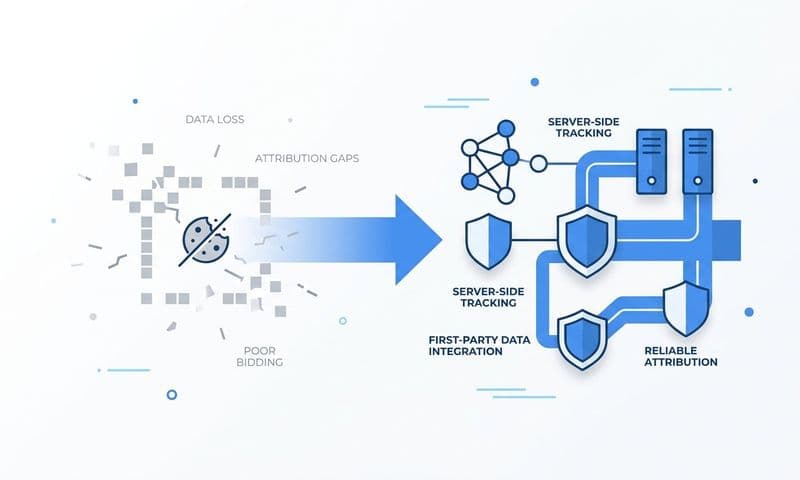
The good news is that the industry has developed a clear answer to the limitations of browser-based pixel tracking. Server-side tracking, combined with first-party data enrichment, is now the standard approach recommended by the ad platforms themselves.
Here is how it works. Instead of relying solely on a JavaScript pixel that fires in a user's browser, server-side tracking sends conversion events directly from your server to the ad platform via an API connection. Meta calls this the Conversions API, or CAPI. Google calls it Enhanced Conversions. The mechanism is the same: the conversion signal travels from your infrastructure to the platform, bypassing the browser entirely. This makes it immune to ad blockers, iOS restrictions, and cookie limitations. The signal gets through reliably, which means your platforms receive a more complete and accurate picture of what is actually happening. The case for why server-side tracking is more accurate than browser-based methods is well established and worth understanding in full.
But server-side tracking alone only solves part of the problem. The real power comes from first-party data enrichment. In a B2B SaaS context, this means passing CRM data back through your server-side events. Instead of just telling Meta that a form was submitted, you can tell it that the lead became a qualified opportunity, that the opportunity moved to a demo stage, or that the deal closed for a specific contract value. You are giving the algorithm a much richer signal to optimize against, one that reflects actual revenue outcomes rather than top-of-funnel activity.
This matters because the quality of the signal determines the quality of the optimization. When you train a Meta campaign on closed-won revenue data rather than form fills, the algorithm learns to find people who look like your actual customers, not just people who click on forms. Over time, this produces meaningfully better targeting and more efficient spend.
Event deduplication is a critical piece of this implementation that cannot be skipped. When both a browser pixel and a server-side event are active, you need to ensure that the same conversion is not counted twice. The way to prevent this is by assigning a unique event ID to every conversion event and passing that ID through both the browser and server-side events. The platform uses this ID to recognize that both events represent the same conversion and counts it only once. Skipping this step is one of the most common causes of inflated conversion numbers in tracking setups that have partially adopted server-side tracking.
Multi-Touch Attribution: Seeing the Full Customer Journey
Even with server-side tracking in place, you still face a fundamental question: when a deal closes, which touchpoints get the credit? This is where attribution modeling becomes critical, and where single-touch models create a significant source of inaccurate ad tracking data in B2B SaaS.
Last-click attribution gives all the credit to the final touchpoint before conversion. First-touch attribution gives all the credit to the first interaction. Both models are simple, but they are also deeply misleading for B2B buyers who interact with multiple channels over weeks or months before making a decision. Think about a typical journey: a prospect sees a LinkedIn ad, later searches for your brand on Google, reads a comparison article, attends a webinar, and then clicks a retargeting ad before requesting a demo. Last-click attribution credits only the retargeting ad. First-click credits only the LinkedIn ad. Neither model captures the reality of how the decision was actually made.
Multi-touch attribution distributes credit across all of the touchpoints in the customer journey, using a defined model to determine how much weight each interaction receives. Linear attribution spreads credit evenly. Time-decay models give more credit to touchpoints closer to the conversion. Position-based models weight the first and last touches more heavily while still acknowledging the middle. Each approach has tradeoffs, but all of them are more representative of complex B2B buying behavior than single-touch models. Exploring multi-touch attribution models for data in depth reveals how each approach handles the complexity of long sales cycles.
The more important shift, though, is extending attribution all the way to closed-won revenue rather than stopping at MQL or demo request. Many B2B SaaS marketing teams measure success at the top of the funnel. A form fill counts as a win. A demo booked counts as a win. But if those leads never close, the marketing spend that generated them did not actually produce business value. When you connect attribution data to pipeline stages and closed-won revenue, you can see which channels and campaigns are generating deals that actually close, not just leads that enter the pipeline.
This distinction changes how you allocate budget. A channel that drives a high volume of MQLs but a low close rate looks very different from a channel that drives fewer leads but closes at a much higher rate. Without revenue-connected attribution, you cannot see this difference. With it, you can make data-driven budget decisions that are grounded in actual business outcomes.
Building a Reliable Ad Tracking Foundation
Fixing inaccurate ad tracking data is not a single action. It is the result of building a tracking stack where every component works together and points to the same source of truth. Here is what that foundation looks like in practice.
Server-side Conversion API integration: This is the technical backbone. Every major ad platform now supports server-side event ingestion. Implementing this correctly, with proper deduplication logic, ensures that your conversion signals are reliable and complete regardless of browser conditions or privacy restrictions.
Consistent UTM naming conventions: Inconsistent or missing UTM parameters are a common, preventable source of attribution errors. When UTMs are missing, traffic gets bucketed as direct, and the channels that actually drove it get no credit. A clear, enforced naming convention across every campaign, ad set, and ad ensures that your analytics tools can accurately attribute sessions and conversions to the right sources. Understanding what UTM tracking is and how it helps marketing is a foundational step toward eliminating this class of attribution error.
CRM integration that maps ad data to pipeline stages: This is the bridge between marketing activity and revenue outcomes. When your ad platform data is connected to your CRM, you can follow a lead from the first ad click through every stage of the sales cycle to closed-won. This gives you the full picture that single-platform reporting cannot provide. Building a proper attribution tracking setup that connects ad data to pipeline stages is what separates teams with reliable reporting from those constantly chasing discrepancies.
Connecting ad spend to revenue data: Integrating your billing system, whether that is Stripe or another platform, with your ad data closes the final loop. Instead of measuring success at the MQL or demo stage, you can see exactly how much revenue was generated from each campaign, channel, or ad. This eliminates the gap between what marketing reports and what finance records.
This is exactly the problem Cometly is built to solve for B2B SaaS teams. Cometly connects your ad platforms, CRM, and website to track the entire customer journey in real time. It captures every touchpoint from first ad click to closed-won revenue, sends enriched conversion signals back to Meta and Google to improve algorithm performance, and provides a single dashboard where marketing, sales, and leadership can look at the same data and reach the same conclusions. When your tracking is this complete, the disconnect between your ad dashboard and your CRM disappears.
Putting It All Together
Inaccurate ad tracking data is not a minor reporting inconvenience. It is a strategic liability that silently drains ad budgets, degrades algorithm performance, and undermines the credibility of every marketing decision you make. The problem is invisible enough to go unaddressed for months, and expensive enough to do serious damage while it does.
The path forward is clear. Understand the root causes: pixel signal loss, duplicate event firing, and attribution model mismatches. Implement server-side tracking with proper deduplication to ensure your conversion signals are reliable and complete. Adopt multi-touch attribution to see how all of your channels contribute to deals, not just the last click. And connect your ad data to real revenue outcomes so that your marketing reports tell the same story as your CRM and your finance team.
Each of these steps builds on the others. Better signals lead to better algorithm training. Better attribution leads to smarter budget allocation. Revenue-connected reporting leads to stronger stakeholder confidence and more defensible budget requests.
If your current tracking setup leaves you questioning whether your data reflects reality, the answer is to build a foundation that you can actually trust. Get your free demo and see how Cometly gives B2B SaaS teams a single source of truth for ad performance, from the first click to closed-won revenue.