
Apple's App Tracking Transparency framework changed the rules for measuring paid ad performance on iOS devices. When users opt out of tracking, the browser-based pixels that marketers have relied on for years stop working reliably, leaving gaps in conversion data and making it harder to know which campaigns are actually driving revenue.
For B2B SaaS marketing teams running paid ads on Meta, Google, or TikTok, this is not a minor inconvenience. It directly affects how you allocate budget, optimize campaigns, and report ROI to leadership. When your ad platform shows one conversion count and your CRM shows another, confidence in your data erodes fast.
The good news is that a reliable iOS attribution workaround is achievable. You do not need to guess or patch together disconnected tools. By combining server-side tracking, first-party data strategies, and smarter attribution models, you can rebuild visibility into your customer journey and feed ad platforms the conversion signals they need to optimize effectively.
This guide walks you through a practical, step-by-step approach to working around iOS tracking limitations. Whether you are running lead generation campaigns for a B2B SaaS product or managing a full-funnel paid media strategy, these steps will help you restore attribution accuracy, improve ad platform performance, and make confident, data-driven decisions again.
Step 1: Audit Your Current Attribution Gaps
Before implementing any workaround, you need to understand exactly where your attribution is breaking down. Jumping straight to technical fixes without this baseline is like patching a roof without knowing where the leaks are.
Start by pulling your conversion data from each ad platform and comparing it side by side with what your CRM or backend analytics is recording. Look for discrepancies in volume, timing, and campaign-level performance. If your CRM shows 40 qualified leads from a given week but Meta Ads Manager reports 18 conversions, that gap is your starting point. Understanding how to fix attribution discrepancies in data is the first skill you need to develop before making any technical changes.
Check device breakdowns first. In Meta Ads Manager, navigate to the breakdown menu and segment your campaign results by device. If a significant portion of your impressions and clicks are coming from iOS devices, that is where your tracking loss is concentrated. Google Ads offers similar device segmentation under the Segment dropdown in your campaigns view.
Review your pixel health. Open Meta's Events Manager and check the event activity for your key conversion events. Look for drops in event volume that coincide with iOS updates or changes in user consent rates. A sudden decline in browser-based pixel events without a corresponding drop in actual leads or signups is a clear signal of iOS-related tracking loss.
Audit your UTM parameter coverage. Pull a sample of recent form submissions or trial signups from your CRM and check how many have complete UTM data attached. Missing UTM parameters on landing pages, broken tracking links, or redirects that strip query parameters are common failure points that compound iOS attribution problems.
Check your attribution windows. B2B SaaS buying cycles are rarely same-day decisions. If your ad platform attribution windows are set to one-day click, you are likely missing conversions from users who clicked an ad, considered their options for several days, and then converted on a return visit. Note which windows are currently configured across each platform.
Document all of this before moving forward. The gap between reported ad platform conversions and actual CRM conversions is your baseline metric. Every technical fix you implement in the following steps should move that number closer together. Without this audit, you have no way to measure whether your iOS attribution workaround is actually working.
Success indicator: You have a clear, documented picture of which channels, campaigns, and conversion events are most affected by iOS tracking loss before making any technical changes.
Step 2: Implement Server-Side Tracking as Your Foundation
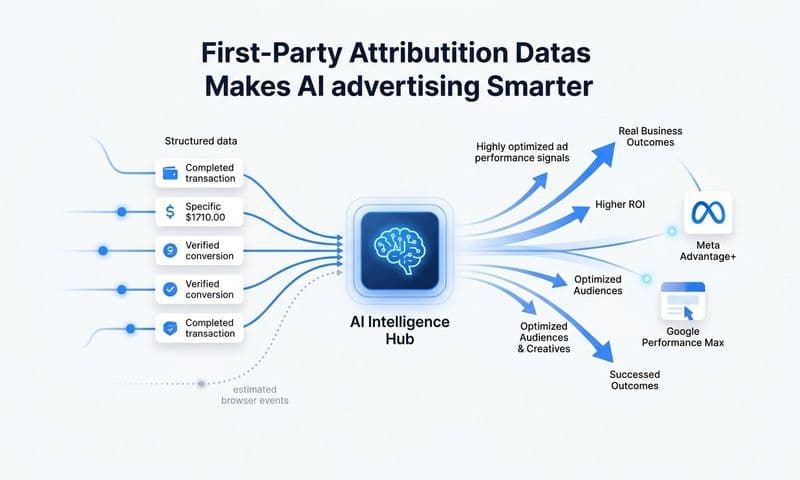
Server-side tracking is the most important technical change you can make to address iOS attribution loss. Here is why it works: standard browser-based pixels rely on JavaScript running in the user's browser to detect and report conversion events. When iOS blocks cross-site tracking or the user opts out via ATT, that JavaScript cannot send data back to Meta or Google. Server-side tracking moves that event firing to your own server, completely bypassing the browser and its restrictions.
Think of it this way: instead of asking the user's device to report the conversion, your server reports it directly to the ad platform. iOS opt-outs become irrelevant because the data never passes through the user's browser at all. Understanding how iOS 14 changed digital advertising forever provides essential context for why this infrastructure shift is necessary.
Set up Meta's Conversion API (CAPI). CAPI allows you to send conversion events directly from your server to Meta, ensuring that iOS opt-outs no longer create blind spots in your Facebook and Instagram campaign data. To implement CAPI, you will need to generate an access token in Meta Business Manager, set up server-side event payloads that include event name, event time, and user data parameters, and send these payloads to Meta's Graph API endpoint whenever a conversion occurs.
Configure Google Enhanced Conversions in parallel. Google Enhanced Conversions work similarly, allowing your server to send first-party conversion data directly to Google Ads rather than relying solely on the Google tag in the browser. This is particularly important for capturing conversions from users browsing in Safari with ITP (Intelligent Tracking Prevention) enabled, which affects both iOS and macOS users.
Prioritize the right conversion events. Not every event on your website needs to be tracked server-side. Focus on the events that matter most for campaign optimization and budget decisions: form submissions, demo requests, free trial signups, and downstream CRM events like qualified leads or opportunities created. These are the signals your ad platforms use to optimize delivery and bidding.
Implement event deduplication carefully. This is a step many teams overlook, and it creates a new problem when missed. Because you are now running both your browser pixel and your server-side tracking simultaneously, both may fire for the same conversion event. Ad platforms will count each event separately unless you implement deduplication. The solution is to assign a unique event ID to each conversion and send that same ID through both the pixel and your server-side event. The ad platform uses this ID to recognize and discard the duplicate, counting the conversion only once.
Test your deduplication setup thoroughly before going live. Check your Events Manager or Conversions dashboard to confirm that event counts match expected volumes and that you are not seeing inflated conversion numbers.
Success indicator: Your ad platform event manager shows server events firing consistently with a high event match quality score, and deduplication is working correctly with no duplicate conversion inflation in your reported data.
Step 3: Enrich Your First-Party Data Before Sending Events
Server-side tracking gets your conversion events to the ad platform reliably. But the quality of those events depends entirely on the data you send with them. An event that arrives at Meta or Google with minimal user information is much harder for the platform to match to the right user and campaign. This is where first-party data enrichment becomes critical.
Ad platforms match server-side events to users using identifiers like email address, phone number, and name. When you send hashed versions of this data alongside your conversion events, the platform can match the event to a known user profile even when device-level identifiers are unavailable due to iOS opt-outs. Meta calls this "event match quality," and a higher score directly correlates with better attribution accuracy and ad optimization performance. Reviewing how Facebook Ads attribution works when platform data fails will help you understand exactly which parameters carry the most matching weight.
Capture hashed customer information at the point of conversion. When a user submits a form, signs up for a trial, or requests a demo, collect their email address, phone number, first name, last name, and location data if available. Hash this data using SHA-256 before sending it with your CAPI or Enhanced Conversions events. This is a privacy-preserving approach that meets ad platform requirements while significantly improving your ability to attribute conversions accurately.
Use UTM parameters consistently across every ad and channel. This sounds basic, but UTM inconsistency is one of the most common attribution failure points in B2B SaaS marketing. Every ad, across every platform, should have properly formatted UTM parameters appended to the destination URL. Use a consistent naming convention so that your analytics and attribution tools can parse and categorize the data correctly.
Store UTM data at the first visit. Here is a detail that makes a significant difference for B2B buying journeys: when a user first lands on your site from a paid ad, capture their UTM parameters and store them in a first-party cookie or your own database immediately. This is important because B2B buyers often click an ad, leave, and return days or weeks later before converting. If they return on an iOS device without tracking consent, the UTM data from that return visit may be missing. But if you stored the original UTM data at the first visit, you can still associate the conversion with the correct source campaign.
Connect your CRM data to your attribution layer. For B2B SaaS companies, many of the most valuable conversions happen offline or downstream from the initial web event. A lead who fills out a demo request form becomes a qualified opportunity in your CRM days later. Passing these downstream CRM events back to your ad platforms as offline conversions gives them a complete picture of which ads drove real revenue, not just initial clicks or form fills.
Success indicator: Your CAPI or Enhanced Conversions setup shows high event match quality scores, and your ad platforms are receiving enriched conversion signals that include customer data parameters alongside each event.
Step 4: Configure Your Attribution Model to Reflect Reality
Technical tracking improvements only tell part of the story. How you assign credit to those tracked touchpoints is equally important, and iOS attribution loss has exposed the weaknesses of models that rely too heavily on the final click before conversion.
Last-click attribution is hit hardest by iOS restrictions because the final touchpoint is often where pixel tracking breaks down. A user might see a LinkedIn ad, click a retargeting ad on Instagram, and then convert by clicking a Google search ad. If iOS tracking blocked the Instagram interaction, last-click attribution gives all the credit to the Google search ad and none to the paid social campaigns that drove awareness and consideration. This is one of the core attribution challenges in marketing analytics that every multi-channel team must address.
Evaluate your attribution windows first. B2B SaaS deals often take days or weeks from first touch to conversion. A seven-day click window in Meta Ads Manager may be cutting off legitimate conversions from users who took longer to decide. Review your actual sales cycle data from your CRM and align your attribution windows to match. For many B2B SaaS companies, a 28-day click window is more representative of how buyers actually behave. Learning more about attribution window performance will help you choose the right settings for your specific sales cycle.
Move toward multi-touch attribution. Multi-touch models distribute credit across multiple touchpoints in the conversion path rather than assigning all credit to one interaction. This approach is more resilient to iOS tracking loss because even if one touchpoint is missing, the model still captures and credits the others. Linear, time-decay, and position-based models all offer more complete pictures of campaign contribution than last-click alone.
Use data-driven attribution in Google Ads where available. Google's data-driven attribution model uses machine learning to distribute conversion credit based on actual conversion path data from your account. Rather than applying arbitrary position rules, it analyzes which touchpoints actually contributed to conversions in your specific account history. This approach tends to be more accurate for accounts with sufficient conversion volume.
Cross-reference ad platform reports against your server-side data. In Meta Ads Manager, configure your attribution settings at the campaign level to match your buying cycle, and then regularly compare the reported conversion numbers against what your server-side tracking and CRM are recording. Understanding the gap between what the platform reports and what your first-party data shows is essential for making informed budget decisions.
Consider a first-party attribution model. For B2B SaaS teams running multi-channel campaigns, a dedicated attribution platform that ingests data from all your sources gives you an unbiased view of performance that no single ad platform can provide. Ad platforms have an inherent incentive to show their own channel in the best light. A neutral, first-party attribution layer removes that bias.
Success indicator: Your attribution model is consistently applied across all channels, your attribution windows match your sales cycle, and you can clearly explain the difference between what each ad platform reports and what your first-party data shows.
Step 5: Use Aggregated Event Measurement and Modeled Data Correctly
Meta introduced Aggregated Event Measurement (AEM) specifically to address the measurement limitations created by iOS 14 and later updates. Understanding how to configure it correctly is essential for any iOS attribution workaround strategy that includes Facebook or Instagram advertising.
AEM allows Meta to report conversion data for iOS users who have opted out of tracking, but it works differently from standard event tracking. Rather than reporting individual user-level conversion data, it aggregates events and uses statistical modeling to fill in the gaps. This means your configuration choices directly affect what gets measured and reported. Staying current with developments like iOS 17 link tracking changes ensures your AEM configuration accounts for the latest privacy restrictions.
Verify your domain in Meta Business Manager first. AEM requires domain verification before you can configure conversion events. If your domain is not verified, you cannot prioritize events and your iOS measurement will remain incomplete. This is a prerequisite, not an optional step.
Prioritize your conversion events in the correct order. Meta allows you to configure up to eight prioritized conversion events per domain within AEM. The critical detail here is that for iOS users who have opted out, Meta can only report one event per user: the highest-priority event that occurred. This means your event priority order must reflect your actual business priorities. Place your highest-value events at the top: demo requests, trial signups, or purchase completions. Lower-value events like page views or content downloads should sit at the bottom of the priority list.
Understand what modeled data means for your decisions. Both Meta and Google use machine learning to model conversions that cannot be directly observed due to iOS opt-outs. This modeled data is directional and useful for understanding trends, but it should not be your sole basis for budget allocation decisions. Cross-reference modeled conversion data against your server-side event data and CRM pipeline data before making significant budget changes.
Audit your AEM configuration regularly. Campaign goals evolve over time, and an AEM configuration that was set up correctly six months ago may no longer reflect your current priorities. If you have added new conversion events, changed your funnel structure, or shifted campaign objectives, revisit your event priority order to ensure your most important conversions are still at the top.
Success indicator: Your AEM is configured with the correct event priority order, your domain is verified, and you understand which portion of your reported Meta conversions are modeled versus directly observed from server-side data.
Step 6: Build a Unified Attribution Dashboard Across All Channels
With server-side tracking, enriched first-party data, and proper attribution models in place, the final step is bringing all of this data together in one view. Without a unified dashboard, you are still making decisions based on fragmented, platform-specific reports that each tell a different version of the same story.
Think about the typical alternative: you check Meta Ads Manager for Facebook performance, then Google Ads for search performance, then your CRM for pipeline data, then your analytics platform for website behavior. Reconciling these manually is time-consuming, error-prone, and almost always incomplete. A unified attribution view eliminates that friction. Exploring the best marketing attribution tools for B2B SaaS companies will help you identify which platforms are built to handle this kind of cross-channel consolidation.
Connect your ad platforms, CRM, and website analytics into one attribution platform. The goal is a single source of truth that shows the full customer journey from first ad click to closed-won revenue. This means your ad spend data, your conversion events, your pipeline stages, and your revenue data all flow into the same place and can be analyzed together.
Track pipeline and revenue attribution alongside ad spend. Surface-level click metrics like CTR and CPC do not tell you whether your campaigns are driving actual business outcomes. When you connect ad spend to pipeline and revenue, you can calculate true CAC and ROAS at the campaign, ad set, and creative level. This is the data that justifies budget decisions and informs strategic allocation across channels.
Set up automated performance monitoring. Real-time alerts that flag significant performance changes mean you catch problems early. If an iOS-impacted campaign starts underperforming or a tracking issue causes a sudden drop in reported conversions, you want to know immediately rather than discovering it during your next weekly review. Speed of response directly affects how much budget is wasted on underperforming campaigns.
Use your unified dashboard to compare attribution models. One of the most valuable uses of a unified attribution view is running model comparisons side by side. Seeing how first-touch, last-touch, and multi-touch models assign credit differently reveals the full contribution of each channel and helps you avoid over-investing in channels that only capture last-click credit while ignoring the channels that generate initial awareness and drive consideration.
This is where platforms like Cometly are built to help. Cometly connects your ad platforms, CRM, and revenue data in one place, captures every touchpoint from ad click to CRM event, and gives your team the clear attribution data needed to make confident budget decisions. Instead of manually reconciling data across multiple tools, you get a single view of what is actually driving revenue.
Success indicator: You have a single source of truth for marketing performance that connects ad spend to pipeline and revenue, and your team can answer attribution questions without manually pulling data from multiple platforms.
Putting It All Together
Recovering from iOS attribution loss is not about finding a single magic fix. It requires layering server-side tracking, first-party data enrichment, proper attribution model configuration, and a unified reporting view into a system that works together. When each piece is in place, you stop relying solely on ad platforms to tell you what happened and start using your own data to drive decisions.
Here is a quick checklist to confirm your iOS attribution workaround is complete:
1. Your current attribution gaps are documented and baselined across all channels and campaigns.
2. Server-side tracking is live for Meta CAPI and Google Enhanced Conversions, with event deduplication configured and verified.
3. Conversion events are enriched with hashed first-party customer data and consistent UTM parameters stored at the first visit.
4. Your attribution model and windows are aligned with your actual sales cycle, and you are using multi-touch attribution where possible.
5. AEM is configured with the correct event priority order and your domain is verified in Meta Business Manager.
6. All channel data flows into a unified attribution dashboard connected to pipeline and revenue data from your CRM.
Cometly is built to help B2B SaaS marketing teams do exactly this. It captures every touchpoint from ad click to CRM event, connects your ad platforms and revenue data in one place, and gives your team the accurate attribution data needed to scale campaigns with confidence. If you are ready to close the gap that iOS created in your marketing data, Get your free demo today and start capturing every touchpoint to maximize your conversions.