Picture this: a potential buyer opens ChatGPT and types "what's the best marketing attribution software for B2B SaaS companies?" They get a confident, synthesized answer with three or four tool recommendations. Your brand is not one of them. No click. No impression. No pipeline. The buyer shortlists your competitors before your website ever had a chance to appear.
This is the new visibility gap, and it is happening right now across thousands of buyer journeys every day. As large language models become a default research tool for software buyers, the question of whether your brand appears in AI-generated responses has shifted from a curiosity to a genuine business problem.
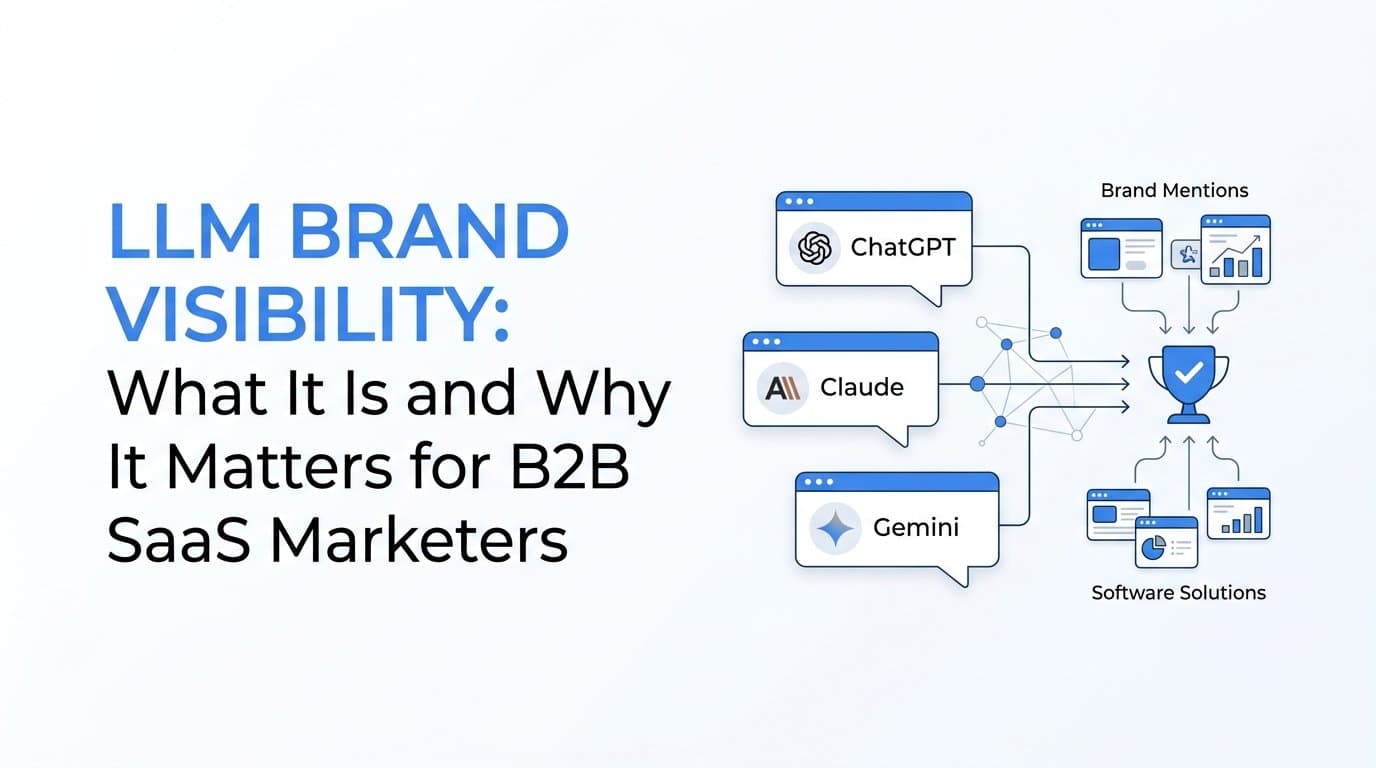
LLM brand visibility refers to how frequently and how favorably your brand appears in responses generated by models like ChatGPT, Claude, Gemini, and Perplexity when users ask questions relevant to your category. It is a new dimension of discoverability that sits above traditional search, and for B2B SaaS marketers, it is quickly becoming as important as organic rankings or paid reach.
By the end of this article, you will understand exactly what LLM brand visibility is, why it creates a direct revenue risk, what signals drive it, how to improve it, and critically, how to measure the actual traffic, leads, and revenue coming from LLM sources using tools like Sight AI and Cometly.
The New Search: How B2B Buyers Are Using AI to Discover Brands
The way B2B buyers research software has changed meaningfully. Where a buyer once typed a query into Google and scanned a list of links, many now open an AI assistant and ask a direct question. The response they receive is not a list of URLs. It is a synthesized answer, often with specific tool recommendations, pros and cons, and context tailored to their stated situation.
Think of it like asking a knowledgeable colleague instead of using a search engine. The colleague does not hand you ten blue links. They say, "For what you're describing, you should probably look at X or Y." That is what LLMs are doing for buyers researching software categories.
This behavioral shift is particularly pronounced during the consideration phase of the B2B buying journey. Buyers ask questions like "how do I track marketing ROI across channels" or "what attribution tools work well for SaaS companies with long sales cycles" and receive direct, confident answers. They may never visit a search results page at all.
LLM brand visibility is the measure of how your brand performs in these moments. Specifically, it captures three things: how often your brand is mentioned when relevant questions are asked, the context in which it appears (recommended, compared, dismissed), and the sentiment attached to those mentions. A brand with strong LLM visibility shows up frequently, in positive contexts, and with accurate descriptions of what it does.
This is fundamentally different from traditional SEO visibility. Search engines return links and let the user decide what to click. LLMs return synthesized answers and do the deciding for the user. If your brand is not in the answer, you do not exist in that moment of discovery. There is no second page to scroll to. There is no "also consider" section unless the model puts it there.
For B2B SaaS marketers who have spent years optimizing for search rankings, this represents a new frontier that requires a different way of thinking about brand presence and content strategy.
Why LLM Invisibility Is a Revenue Problem, Not Just a PR Problem
It is tempting to think of LLM brand visibility as a brand awareness issue, something that matters for perception but sits at arm's length from pipeline. That framing underestimates the risk considerably.
When a buyer asks an AI model for tool recommendations and receives a shortlist that excludes your brand, the downstream consequences are significant. That buyer may shortlist two or three competitors, begin demos, and enter a sales process, all before your brand ever had a chance to appear in a paid ad, an organic result, or a sales outreach sequence. The pipeline loss is not just a missed click. It is a missed opportunity to even compete.
Understanding why LLMs include or exclude brands helps clarify the stakes. These models do not have opinions in the human sense. They draw on patterns in their training data, web-indexed content, third-party review platforms like G2 and Capterra, community discussions on Reddit and LinkedIn, press coverage, analyst mentions, and increasingly, real-time retrieval through tools like Perplexity's live search. Brands with a strong, consistent, and widely-cited content footprint are more likely to appear. Brands with thin coverage, inconsistent positioning, or limited third-party presence are more likely to be overlooked.
This means LLM visibility is not random. It is earned, and it is influenced by the same signals that drive credibility across the web. The difference is that the output is not a ranked list where you can see your position. It is a synthesized narrative where you are either included or you are not.
For B2B SaaS companies specifically, the risk compounds because of how buying decisions actually work. Sales cycles are long. Multiple stakeholders are involved. Buyers do extensive independent research before they ever raise their hand to talk to sales. Early-stage discovery, the moment when a buyer first forms a mental shortlist, is disproportionately influential on the final purchase decision.
If an AI model shapes that shortlist before your brand ever enters the picture, you are playing catch-up for the rest of the cycle. And in competitive categories where several strong alternatives exist, catch-up is difficult.
The compounding effect is worth naming directly: the longer your brand remains invisible in LLM responses, the more buyers form initial shortlists that exclude you, the more your competitors benefit from early-stage credibility, and the harder it becomes to win deals at the bottom of the funnel. LLM invisibility is a slow leak in your pipeline, and it tends to get worse before it gets better if left unaddressed.
What Drives LLM Brand Visibility: The Signals That Matter
If LLM brand visibility is earned rather than purchased, the natural question is: what earns it? The signals that influence how often and how accurately your brand appears in AI-generated responses fall into three main categories.
Content Authority and Coverage: LLMs favor brands that have published clear, consistent, and well-structured content explaining what they do, who they serve, and what problems they solve. This means long-form articles, detailed landing pages, comparison content, and educational resources that collectively paint a complete picture of your brand's positioning. Thin or inconsistent content creates blind spots. If your website says you do "marketing analytics" in five different ways without ever clearly defining your category or use case, an LLM is likely to either omit you or represent you inaccurately.
Third-Party Mentions and Citations: Reviews on platforms like G2, Capterra, and Trustpilot carry weight. So do press mentions, analyst coverage, guest articles on authoritative publications, podcast appearances, and community discussions where your brand is referenced. LLMs aggregate signals from across the web, and a brand that appears in multiple credible, independent contexts is more likely to be represented accurately and favorably. A brand that only exists on its own website is much harder for a model to confidently recommend.
Structured and Semantic Clarity: Brands that clearly define their category, their ideal customer profile, their key use cases, and their differentiators in plain language are easier for LLMs to accurately summarize. If a buyer asks "what attribution tool is best for SaaS companies with long sales cycles," a brand that has explicitly addressed that use case in its content is more likely to appear in the answer than one that uses vague or generic positioning language.
There is an important insight embedded in these three signals: they overlap significantly with strong SEO and content marketing practices. The content that earns backlinks, ranks in search, and generates organic traffic also tends to improve LLM brand visibility. This is good news for marketers who have already invested in content. It means improving LLM visibility is not a separate program requiring a separate budget. It is an extension of the content and brand work you are likely already doing, but with a sharper focus on clarity, third-party presence, and category definition.
The practical implication is that brands with strong content programs have a head start. But having content is not enough. That content needs to be specific, well-structured, and widely referenced to give LLMs the confidence to include your brand in their responses.
How to Optimize Your Brand for LLM Discovery
Knowing what drives LLM brand visibility is useful. Knowing how to act on it is what actually moves the needle. Here are the core strategies that B2B SaaS marketing teams should prioritize.
Publish Category-Defining Content: Create articles, landing pages, and comparison content that clearly articulate your positioning and answer the exact questions buyers are asking AI models. Think about queries like "best attribution software for B2B SaaS," "how to track marketing ROI across channels," or "what is multi-touch attribution and why does it matter." These are not just SEO opportunities. They are the literal questions your buyers are typing into ChatGPT and Perplexity. Content that answers them directly, in plain language, with specific and accurate information, is the content most likely to inform LLM responses.
Build Your Third-Party Presence Systematically: Reviews, mentions, and citations from sources outside your own domain are among the strongest signals you can build. Actively pursue reviews on G2 and Capterra. Pitch guest articles to publications your buyers read. Appear on podcasts in your category. Participate in relevant communities on Reddit and LinkedIn where your brand can be mentioned authentically. Each of these touchpoints adds another data point that LLMs can draw from when forming responses about your category.
Define Your Category with Precision: Avoid generic positioning language. Instead of "marketing analytics platform," be specific: "marketing attribution software for B2B SaaS companies that connects ad spend to closed-won revenue." That level of specificity makes it far easier for an LLM to match your brand to a buyer's specific query. The more precisely you define what you do and who you serve, the more accurately and frequently you will appear when buyers ask relevant questions.
Use Tools Built for LLM Brand Monitoring: One of the most important steps you can take is to actually measure your current LLM brand visibility so you know where you stand and how you are improving. Sight AI is a platform built specifically for this purpose. It tracks how often and in what context your brand appears when users query large language models, giving you actionable data to understand your AI brand presence and identify gaps in your coverage.
With Sight AI, you move from guessing whether your brand is appearing in AI responses to actually knowing. That shift from assumption to data is what allows you to treat LLM visibility as a real marketing channel rather than an abstract concern.
The combination of strong content, active third-party presence, precise positioning, and dedicated monitoring creates a compounding advantage. Each piece reinforces the others, and over time, your brand becomes the kind of well-documented, widely-cited, clearly-positioned brand that LLMs are confident recommending.
Measuring the Real Impact: Tracking LLM Traffic, Leads, and Revenue
Here is where many marketing teams hit a wall. They understand that LLM brand visibility matters. They start investing in content and third-party presence. But then they face a measurement problem that standard analytics tools are not equipped to solve.
Unlike Google, which passes referral data through to your analytics platform, LLMs do not pass standard UTM parameters or consistent referral information. Traffic arriving from ChatGPT or Perplexity often appears as direct traffic in tools like Google Analytics, or it gets lumped into an "other" category that provides no useful signal. This creates a significant blind spot: marketing teams are investing in LLM visibility but have no reliable way to see whether that investment is generating pipeline.
This is where Cometly's LLM attribution capability becomes essential. Cometly is built to help B2B SaaS marketing teams track exactly how much traffic, how many leads, and how much revenue is being driven by LLM sources. Rather than letting AI-driven visits disappear into the "direct" bucket, Cometly identifies and attributes them properly, giving your team a real, data-backed view of whether your LLM brand visibility efforts are translating into actual pipeline.
Think of it this way: if you are publishing content to improve your brand's presence in AI responses, you need to know whether that content is working. Cometly closes the loop by showing you the downstream impact of LLM-driven discovery in terms that matter to your business: sessions, leads, opportunities, and revenue.
Beyond attribution, there is an even more powerful capability available through the integration of Sight AI and Cometly via Cometly's MCP (Model Context Protocol). Marketers can use Sight AI directly within the Cometly environment through this integration. This means you can monitor your LLM brand presence using Sight AI's tracking and then connect those visibility insights directly to the conversion and revenue data that Cometly captures.
The result is a closed-loop view of AI-driven brand performance: from the moment your brand is mentioned in an LLM response, through the traffic it generates, to the leads it produces, and ultimately to the revenue it drives. This is the kind of full-funnel visibility that marketing leaders need to make confident investment decisions about content, brand, and awareness programs.
To be concrete about what this looks like in practice: imagine your team publishes a detailed comparison article targeting a query that buyers frequently ask AI models. Sight AI shows you that your brand's mention rate for that query increases over the following weeks. Cometly then shows you that LLM-sourced traffic to that article is converting into demo requests at a meaningful rate. You now have the data to justify publishing more content of that type and to make the case for budget to support it.
Without this measurement infrastructure, LLM visibility remains a soft metric. With it, it becomes a channel you can optimize, scale, and defend with numbers.
Connecting LLM Visibility to Your Broader Marketing ROI Strategy
The final piece is making sure LLM brand visibility fits into your overall marketing strategy in a way that is sustainable and measurable over time.
The most useful framing is to treat LLM-driven traffic as a top-of-funnel channel in its own right. Just as you track organic search, paid social, and direct traffic as distinct sources with distinct performance characteristics, LLM-driven traffic deserves its own attribution lane. Without that separation, you cannot optimize it. You cannot see which content is driving AI-sourced visits. You cannot compare the conversion rates of LLM-sourced leads against other channels. And you cannot bring concrete numbers to budget conversations about content investment and brand programs.
There is also a strategic efficiency argument for aligning your LLM, SEO, and content strategies rather than treating them separately. The content that ranks well in search and earns authoritative backlinks also tends to improve LLM visibility. The reviews and third-party mentions that build SEO authority also give LLMs more signals to draw from. A unified content strategy that serves all three channels is more efficient than running parallel programs with separate goals and separate budgets.
For marketing leaders, the attribution data that Cometly provides creates a new kind of leverage in budget conversations. When you can show that LLM-sourced traffic is generating a measurable number of leads and a traceable amount of revenue, the case for investing in content quality, review generation, and brand awareness programs becomes concrete rather than theoretical. You are not asking for budget based on intuition. You are presenting data.
This is the maturity level that modern B2B SaaS marketing teams are working toward: a state where every meaningful channel, including AI-driven discovery, has its own measurement framework, its own optimization loop, and its own place in the attribution model. Cometly and Sight AI together make that possible for LLM brand visibility in a way that was not available even a short time ago.
The Bottom Line on LLM Brand Visibility
AI models have become a new layer of brand discovery that sits above traditional search. B2B buyers are using ChatGPT, Claude, Gemini, and Perplexity to form mental shortlists before they ever visit a website, run a search query, or engage with a paid ad. If your brand is not in those AI-generated responses, you are missing a portion of your addressable market at the earliest and most influential stage of the buying journey.
The good news is that LLM brand visibility is not a black box. It is driven by clear, consistent content, strong third-party presence, and precise category positioning, all things that reinforce your existing SEO and content programs. And it is now measurable in ways that connect directly to pipeline and revenue.
The two-part solution is straightforward. Use Sight AI to monitor and improve your brand's presence in LLM responses, so you know where you stand and how you are improving over time. Use Cometly to measure the downstream impact of that visibility in terms of traffic, leads, and revenue, so you can optimize the channel and defend the investment with data. And take advantage of the Sight AI integration available through Cometly's MCP to connect both capabilities in a single, unified workflow.
LLM brand visibility is not a future concern. It is a present reality that is already shaping how buyers discover and shortlist software. The marketing teams that build measurement and optimization capabilities now will have a meaningful advantage as this channel continues to grow.
Ready to start tracking LLM-sourced conversions and see exactly how AI-driven discovery is contributing to your pipeline? Get your free demo today and discover how Cometly's attribution platform, combined with Sight AI through Cometly's MCP, gives you a complete picture of your AI-driven brand performance from first mention to closed-won revenue.