Most B2B SaaS marketing teams are flying partially blind. Leads are coming in, some are converting, and revenue is growing, but the path in between is murky at best. Which ad sparked the first click? Which content piece nudged a prospect toward booking a demo? Which touchpoint finally tipped the deal? Without a clear customer journey map, these questions go unanswered and budget gets misallocated as a result.
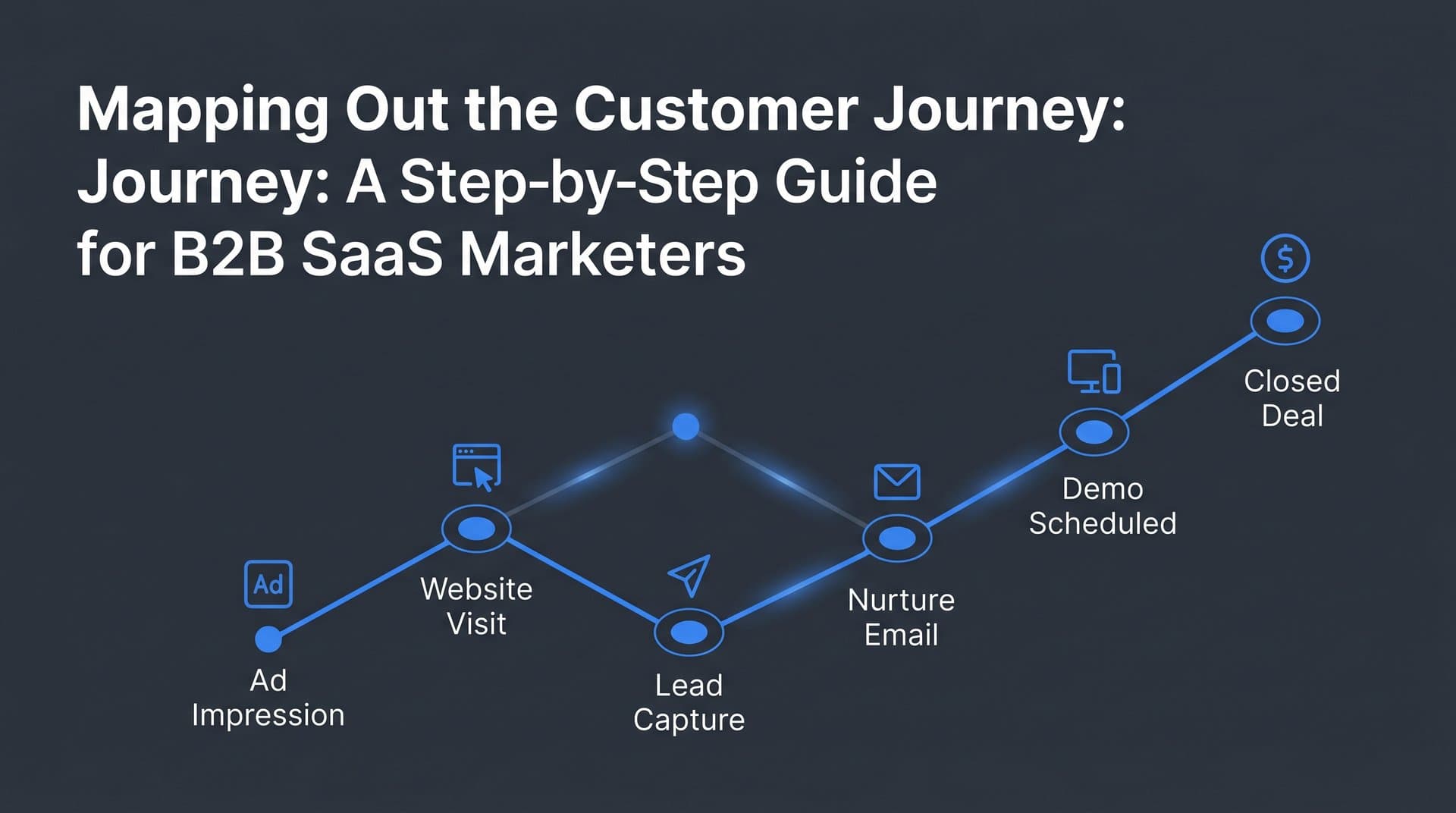
Mapping out the customer journey is the process of documenting every interaction a prospect has with your brand, from the first ad impression to the moment they become a paying customer. It is not just a visual exercise or a workshop deliverable. When done correctly, it becomes the strategic foundation for your attribution model, your content strategy, and your paid media decisions.
This guide is built specifically for B2B SaaS marketing teams, growth leaders, and anyone responsible for connecting ad spend to revenue. You will walk away with a clear, actionable framework for mapping your customer journey in a way that feeds better data into your attribution tools and helps you make smarter decisions about where to invest.
By the end of these seven steps, you will have identified your key buyer personas, documented every touchpoint across the funnel, aligned your data collection to match those touchpoints, and set up the measurement infrastructure to track performance in real time. Whether you are starting from scratch or refining an existing map, this guide will help you build a journey framework that actually reflects how your buyers behave, not how you wish they did.
Step 1: Define Your Ideal Customer Profile and Buyer Personas
Before you map a single touchpoint, you need to know who you are mapping for. A journey map built on vague personas produces vague insights. The sharper your understanding of your buyer, the more useful every subsequent step becomes.
For B2B SaaS specifically, this means thinking beyond a single buyer persona. Most purchases involve a buying committee with at least three distinct roles: the champion who advocates internally for the solution, the economic buyer who controls the budget, and the technical evaluator who assesses integration and security requirements. Each of these stakeholders often engages with different content types, at different stages, through different channels. A journey map that treats them as one homogeneous buyer will miss critical gaps in your funnel coverage.
Start by pulling data from your CRM to identify the firmographic traits of your best customers. Look at company size, industry, team structure, and tech stack. The goal is to find patterns among your closed-won accounts that you can use to define your ideal customer profile with precision. Gut instinct is a starting point, but CRM data is your source of truth.
Next, interview recent closed-won customers directly. Ask them how they first discovered you, what content or interactions moved them forward, what almost made them choose a competitor, and what finally convinced them to sign. These conversations surface insights that no analytics dashboard can provide. You will often discover touchpoints you did not know were influential and gaps in your journey you did not realize existed.
Document the specific pain points and triggering events that push each persona into an active buying cycle. For a VP of Marketing, the trigger might be a board-level pressure to prove marketing ROI. For a marketing ops manager, it might be a broken tracking setup after an iOS update. Understanding what activates the buying process helps you align your top-of-funnel messaging to the moments that actually matter.
Success indicator: You have two to four distinct personas with documented pain points, goals, and decision-making roles, each backed by real CRM and customer interview data.
Step 2: Identify Every Touchpoint Across the Funnel
Most teams dramatically underestimate how many touchpoints exist in their buyer's journey. They think about the obvious ones: the Google ad, the landing page, the demo call. But the real journey is far more complex, and the gaps in your touchpoint inventory are exactly where attribution breaks down.
Start by listing every channel and asset a prospect can interact with across your entire marketing and sales operation. This includes paid ads on Google and LinkedIn, organic search results, blog content, social media posts, email sequences, webinars, product review sites like G2 and Capterra, sales calls, demo follow-ups, proposal reviews, and any self-serve product trials. If a prospect can encounter your brand through it, it belongs on this list.
Group your touchpoints by funnel stage to create a structured view of the journey. Understanding what customer journey touchpoints exist across each stage is the foundation for building a complete inventory that leaves no interaction unaccounted for.
Awareness: Paid ads, organic content, social media, podcast mentions, and PR coverage. These are the channels that introduce your brand to prospects who did not know you existed.
Consideration: Webinars, comparison content, case studies, email nurture sequences, and review site profiles. Prospects at this stage are actively evaluating whether your solution fits their needs.
Evaluation: Product demos, free trials, sales calls, technical documentation, and security reviews. This is where the buying committee gets involved and scrutiny increases.
Decision: Proposal reviews, contract negotiations, champion-to-executive conversations, and final pricing discussions. The deal is close, but it is not done.
Do not rely on memory or internal assumptions to build this list. Pull actual data from your ad platforms, CRM, and analytics tools to see which channels prospects are actively using. You may find that certain channels you have deprioritized are showing up consistently in closed-won journeys.
Account for dark funnel touchpoints as well. Word-of-mouth referrals, Slack community discussions, private peer recommendations, and podcast consumption all influence buying decisions without leaving a traceable digital footprint. You cannot track these directly, but you can acknowledge them in your journey map and account for them when interpreting attribution data.
Flag each touchpoint with a tracking status: currently tracked, partially tracked, or not tracked. This inventory will become essential in Step 4.
Success indicator: A complete list of touchpoints organized by funnel stage, with a tracking status noted for each one.
Step 3: Map the Journey From First Touch to Closed Revenue
Now that you have your personas and your touchpoint inventory, it is time to lay them out in sequence. This is where mapping out the customer journey shifts from a data collection exercise to a strategic visualization of how your buyers actually move through your funnel.
The key word here is "actually." Most teams build journey maps based on how they designed the funnel, not how buyers navigate it in practice. Your CRM and attribution data will tell a very different story if you let it. Use that data to identify the most common paths to conversion, not the ideal path you intended.
Look at your closed-won opportunities and trace the touchpoints backward. What was the first channel that brought each account into your ecosystem? What happened between that first touch and the demo request? How many interactions occurred between the demo and the signed contract? When you aggregate these paths across a meaningful sample of deals, patterns will emerge.
Pay close attention to where prospects drop off most often. A high drop-off rate between awareness and consideration typically signals a content or targeting gap. Prospects are finding you but not finding a reason to engage further. A high drop-off between evaluation and decision often points to a sales process issue or a competitive gap in your positioning.
B2B buyers rarely follow a clean linear path. They revisit earlier stages, conduct independent research on review platforms, compare competitors quietly, and sometimes go dark for weeks before re-engaging. Your journey map should reflect this non-linear reality rather than an idealized funnel diagram. Build in loops and re-entry points that acknowledge this behavior. A deeper look at the B2B customer journey reveals just how many of these detours and re-entry points are common across industries.
Document the average time between key stages: first touch to marketing-qualified lead, MQL to sales-qualified lead, SQL to closed-won. These time benchmarks matter enormously for attribution. If your average sales cycle is 90 days, an attribution model with a 30-day lookback window will systematically misattribute credit.
Differentiate between assisted touchpoints and the final conversion touchpoint. Both matter for understanding your journey, and conflating them leads to poor optimization decisions.
Success indicator: A documented journey map that reflects actual buyer behavior, with drop-off points and average stage durations noted for each transition.
Step 4: Align Your Tracking Infrastructure to the Journey
Your journey map is only as useful as the data behind it. A beautifully documented map means nothing if your tracking setup cannot actually capture the events that matter. This step is about closing the gap between the journey you have mapped and the journey your data stack can see.
The first priority is moving beyond browser-based pixel tracking wherever possible. Client-side pixels have become increasingly unreliable due to ad blockers, browser privacy restrictions, and the ongoing deprecation of third-party cookies. Server-side tracking and Conversion API integrations capture events that browser-based pixels miss, producing a more complete and accurate picture of your journey data. If you are still relying entirely on client-side tracking, you are almost certainly undercounting conversions and misattributing credit.
Set up first-party data collection at every key touchpoint in your journey map. This means tracking form submissions, demo requests, trial signups, CRM stage changes, and any other event that signals meaningful buyer intent. First-party data collected directly from your own properties is the most reliable foundation for attribution as the industry moves away from third-party data sources.
UTM parameter consistency is non-negotiable. If your paid social team uses a different UTM naming convention than your paid search team, your attribution data will be fragmented and incomparable. Establish a single UTM taxonomy and enforce it across every paid channel, every email campaign, and every partner link. This sounds basic, but it is one of the most common sources of attribution data quality problems in practice.
The real power comes when you connect your ad platforms, CRM, and website into a unified data layer. This is where platforms like Cometly provide meaningful value. With 70-plus native integrations, Cometly brings touchpoint data from across your entire marketing and sales stack into a single attribution view, so you can see the full journey without stitching together data manually from five different tools.
Deduplicate your conversion events carefully. When you are tracking via both client-side pixels and server-side APIs, the same conversion can fire twice. Double-counted conversions inflate your reported performance and distort your attribution model. Build deduplication logic into your tracking setup from the start. A structured approach to customer journey tracking ensures your deduplication logic is built into the system from day one rather than patched in after the fact.
Common pitfall: Tracking only the first and last touch while ignoring everything in between. This approach produces attribution data that fundamentally misrepresents what drove the conversion, leading to budget decisions that reward the wrong channels.
Success indicator: Every touchpoint in your journey map has a corresponding tracking event firing correctly and flowing into your attribution platform with clean, consistent data.
Step 5: Choose the Right Attribution Model for Your Journey
Attribution models determine how credit is assigned to the touchpoints along your customer journey. The model you choose shapes every optimization decision you make downstream, so this is not a step to rush through or default to whatever your ad platform suggests.
Here is a clear breakdown of the most common models and when each one makes sense:
First-touch attribution gives all credit to the channel that brought the prospect into your ecosystem. This model is useful for understanding which awareness channels are generating the right type of initial interest, but it tells you nothing about what happened after that first interaction.
Last-touch attribution gives all credit to the final touchpoint before conversion. This model is useful for evaluating bottom-funnel offers and closing content, but it systematically undervalues the awareness and consideration channels that built the relationship over time.
Linear attribution distributes credit equally across all touchpoints in the journey. This model is a significant improvement over single-touch models because it acknowledges that multiple interactions contributed to the conversion. The limitation is that it treats every touchpoint as equally important, which is rarely accurate.
Time-decay attribution gives more credit to touchpoints that occurred closer to the conversion event. This model works reasonably well for shorter sales cycles where recency is a meaningful signal of influence.
Data-driven attribution uses actual conversion patterns from your own data to assign credit based on which touchpoints statistically influenced outcomes. This is the most accurate model for teams with sufficient data volume, because it reflects your specific buyer behavior rather than a predetermined theoretical framework.
For B2B SaaS with long sales cycles and multiple stakeholders, multi-touch attribution models consistently provide a more accurate picture of journey contribution than single-touch models. A prospect who first discovered you through a LinkedIn ad, consumed three blog posts, attended a webinar, and then requested a demo after a sales email did not convert because of one touchpoint. Your attribution model should reflect that reality.
The right model depends on three factors: your average sales cycle length, the typical number of touchpoints in a closed-won journey, and the volume of conversion data you have available. If you are early stage with limited data, start with linear attribution and graduate to data-driven as your data volume grows. Understanding how SaaS revenue attribution works in practice will help you select the model that best fits your current data maturity.
Success indicator: You have selected a primary attribution model that aligns with your sales cycle length and are running it consistently across all campaigns, with a plan to revisit the model selection as your data matures.
Step 6: Analyze Journey Data to Find Revenue-Driving Patterns
With tracking in place and an attribution model selected, you now have the foundation to answer the questions that actually drive smarter marketing decisions. This step is where mapping out the customer journey pays off in concrete, actionable insights.
Start with the most important question: which channels generate the most first touches with prospects who eventually become paying customers, not just leads? Lead volume is a vanity metric if those leads never close. Journey-level analysis connects the top of your funnel to the bottom, showing you which awareness channels are genuinely feeding your pipeline versus which ones are filling your CRM with contacts that go nowhere.
Next, look at which touchpoints appear most frequently in the journeys of your highest-value accounts. High-value accounts often follow different paths than average accounts. If you find that your enterprise closed-won deals consistently include a specific webinar, a particular case study, or a certain email sequence, that is a signal worth acting on. Leveraging customer journey analytics makes it possible to surface these patterns systematically rather than relying on manual deal reviews.
Analyze where prospects from specific channels tend to drop off before converting. A channel that generates a high volume of first touches but consistently loses prospects at the consideration stage is not performing as well as its top-of-funnel numbers suggest. Conversely, a channel with modest reach but high journey completion rates may deserve more budget than it is currently receiving.
Use pipeline attribution to connect ad spend directly to pipeline value and closed revenue, not just lead volume. This is the standard for mature B2B SaaS attribution programs, and it requires integrating your CRM data with your ad platform data. When you can see that a specific campaign contributed to a specific dollar amount of closed revenue, budget decisions become much more defensible.
Segment your journey analysis by persona, company size, or product tier. Patterns that apply to your SMB buyers may not apply to your enterprise buyers, and optimizing for the wrong segment can pull resources away from your highest-value opportunities.
Cometly's AI-driven analysis is built for exactly this type of pattern recognition. It surfaces which ads and campaigns are consistently appearing in high-value customer journeys, helping you identify what is working at scale rather than relying on manual analysis across disconnected data sources.
Common pitfall: Optimizing for touchpoints that appear frequently in all journeys rather than touchpoints that appear frequently in journeys that end in revenue. Frequency alone is not a signal of influence.
Success indicator: You can identify at least three channel or content insights that directly inform your next budget allocation or campaign decision.
Step 7: Activate Your Journey Map to Optimize Campaigns
A journey map that sits in a slide deck produces no ROI. The entire value of this process lives in what you do with the insights. This final step is about turning your journey map from a strategic document into an active optimization tool.
Start with budget reallocation. Use your journey analysis to shift spend toward the channels and touchpoints that appear consistently in high-converting journeys. This does not always mean cutting underperforming channels entirely. Sometimes a channel that looks weak in last-touch attribution is actually generating the majority of your high-value first touches. Your multi-touch journey data will clarify this.
Use your journey data to improve ad targeting by sending enriched conversion events back to Meta, Google, and other ad platforms via Conversion API. When you feed these platforms better quality signals about which actions actually led to revenue, their algorithms can optimize toward prospects who are more likely to follow similar paths. Better event data means better algorithmic targeting, which compounds over time.
Address the content gaps your journey map revealed. If your data shows high drop-off between the consideration and evaluation stages, that is a signal that prospects are not finding what they need to move forward with confidence. Create or update content specifically designed to address the objections and questions that arise at that transition point. Ongoing customer journey optimization ensures these content gaps are identified and closed on a continuous basis rather than treated as a one-time fix.
Build retargeting audiences based on journey stage rather than treating all website visitors as a single audience. A prospect who visited your pricing page three times but did not convert deserves fundamentally different messaging than someone who read a single blog post. Stage-based retargeting is one of the highest-leverage applications of journey map data in paid media.
Set up a recurring reporting process that tracks journey-level metrics on a consistent cadence. Monitor time to conversion, average number of touchpoints per closed deal, and channel contribution by funnel stage. These metrics will shift as your market evolves, your product changes, and your campaigns adapt. Treat your journey map as a living document reviewed at least quarterly, not a one-time workshop output.
Finally, close the feedback loop. When you make a budget, content, or targeting change based on journey insights, set a 30 to 60 day window to measure the impact. This discipline is what separates teams that continuously improve their marketing efficiency from teams that make changes based on instinct and hope.
Success indicator: You have made at least one concrete budget, content, or targeting change based on journey map insights and have a measurement plan in place to evaluate its impact.
Putting It All Together
Mapping out the customer journey is one of the highest-leverage activities a B2B SaaS marketing team can undertake. It replaces guesswork with a documented, data-backed view of how your buyers actually move from first awareness to closed revenue.
Here is a quick checklist to confirm you have completed each step:
ICP and personas defined with CRM-backed data and customer interview insights.
All touchpoints listed and grouped by funnel stage with tracking status noted for each.
Journey flow documented with drop-off points and average stage durations based on real data.
Tracking infrastructure aligned to every touchpoint, with server-side tracking and Conversion API in place.
Attribution model selected and running consistently across all campaigns.
Journey data analyzed for revenue-driving patterns segmented by persona and account value.
At least one campaign or budget decision made based on journey insights, with a measurement plan in place.
The teams that get the most value from journey mapping are the ones who connect it directly to their measurement stack. Platforms like Cometly are built to make this connection seamless, linking every ad click and CRM event into a single, real-time view of which touchpoints are driving pipeline and revenue. With AI-driven recommendations surfacing what is working across every channel, you can scale with confidence rather than assumption.
If your current analytics setup cannot show you the full path from first ad to closed deal, that is the gap your journey map should motivate you to close. Get your free demo today and start capturing every touchpoint to maximize your conversions.