Growth teams face a unique challenge that traditional marketing departments rarely encounter: the pressure to move fast, experiment constantly, and prove ROI on every dollar spent. Yet many growth teams still rely on fragmented dashboards, siloed platform data, and gut instinct when making budget decisions.
Marketing analytics, when deployed strategically, becomes the connective tissue that turns scattered experiments into a repeatable scaling engine. The problem is not a lack of data. Growth teams are often drowning in it. The real challenge is connecting that data in a way that produces clear, confident decisions rather than endless debate about which dashboard to trust.
This guide breaks down seven actionable strategies that growth teams can implement to turn raw data into revenue-driving decisions. Whether you are a lean startup team running campaigns across three platforms or an agency managing dozens of accounts, these approaches will help you build an analytics framework that accelerates growth rather than slowing it down with analysis paralysis.
The strategies build on each other progressively. Start at the beginning if your data is fragmented. Jump to strategies five through seven if your tracking foundation is already solid and you are ready to optimize at scale.
1. Unify Your Data Sources Into a Single Customer View
The Challenge It Solves
Growth teams operating across multiple paid channels, including Meta, Google, LinkedIn, and TikTok, often end up with a different story in every platform dashboard. Facebook says one thing. Google Analytics says another. Your CRM tells a third story entirely. When your data lives in silos, you cannot trust any single report, which means every budget decision carries unnecessary risk.
The Strategy Explained
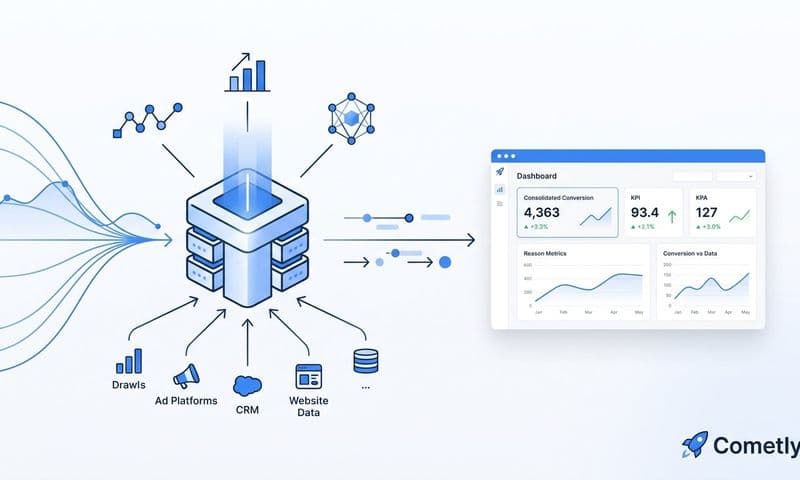
Unifying your data sources means creating a single tracking layer that connects your ad platforms, CRM, and website analytics into one coherent view of the customer journey. Think of it as building a single source of truth that every team member can reference without arguing about which number is correct. Teams looking for the right marketing analytics solution should prioritize platforms that centralize data from all channels automatically.
This unified view lets you trace a customer from their first ad impression through every subsequent touchpoint to the moment they convert and beyond. When your data is connected, patterns that were previously invisible start to emerge. You begin to see which channels initiate journeys, which ones accelerate decisions, and which ones are simply consuming budget without contributing meaningfully to revenue.
Implementation Steps
1. Audit every data source your team currently uses, including ad platforms, your CRM, website analytics, and any offline conversion data you collect.
2. Identify the gaps and conflicts between those sources. Where are the discrepancies? Which platform is over-attributing or under-reporting conversions?
3. Implement a unified tracking solution, such as Cometly's attribution platform, that connects all of these sources into a single dashboard so your team works from one consistent dataset.
4. Define a shared data dictionary so every team member uses the same definitions for key terms like "conversion," "lead," and "qualified opportunity."
Pro Tips
Do not try to solve data unification with spreadsheets or manual exports. The moment your team is copying numbers between tools, you have introduced human error into your most critical decisions. Invest in a platform that automates this connection and updates in real time so your data is always current when you need it most.
2. Adopt Multi-Touch Attribution to See the Full Picture
The Challenge It Solves
Last-click attribution is the default setting for most ad platforms, and it is quietly distorting your view of what is actually working. When every conversion credit goes to the final touchpoint before purchase, you systematically undervalue the channels that introduce customers to your brand and nurture them toward a decision. Over time, this leads to budget cuts in exactly the channels that are doing the heaviest lifting. Understanding these attribution challenges in marketing analytics is the first step toward solving them.
The Strategy Explained
Multi-touch attribution distributes conversion credit across every meaningful touchpoint in the buyer journey rather than handing all the credit to the last click. There are several models to choose from, including linear attribution, time-decay attribution, and data-driven attribution, and each tells a slightly different story about how your channels work together.
The goal is not to find one perfect model and stick with it forever. The goal is to use attribution modeling as a lens that reveals the true contribution of each channel. When you compare a first-touch model against a last-touch model for the same campaign, the differences are often striking and immediately actionable.
Industry best practices suggest that growth teams running campaigns across multiple channels benefit significantly from moving to a data-driven or algorithmic attribution model once they have enough conversion volume to make the model statistically meaningful.
Implementation Steps
1. Start by running your current data through multiple attribution models simultaneously using a tool like Cometly's multi-touch attribution to see how credit shifts across your channels.
2. Identify the channels that appear undervalued in your current last-click model. These are often top-of-funnel channels like display, social awareness campaigns, or content-driven traffic.
3. Present the comparison to your leadership team so budget decisions are made with a fuller picture of channel contribution rather than a single distorted view.
4. Revisit your attribution model quarterly as your channel mix and customer journey evolve.
Pro Tips
Many growth teams find that switching attribution models initially feels uncomfortable because it challenges long-held assumptions about which channels "work." Treat this discomfort as a signal that you are seeing something real. The channels that look weaker under a new model may actually deserve more scrutiny, while the ones that look stronger may deserve more investment.
3. Build Real-Time Feedback Loops Between Ads and Revenue
The Challenge It Solves
Most growth teams optimize their ads based on platform-reported metrics like cost per click, cost per lead, or cost per acquisition. The problem is that these metrics measure activity, not outcomes. A campaign can generate hundreds of leads that never become paying customers, and without a real-time connection between your ad data and your revenue data, you will keep scaling the wrong campaigns.
The Strategy Explained
A real-time feedback loop means connecting downstream revenue events, such as closed deals, subscription activations, or repeat purchases, back to the specific ads that initiated those journeys. When that connection exists, you can see not just which ads generate leads but which ads generate revenue. The best marketing analytics platforms offer real-time conversion data that makes this kind of loop possible.
The second layer of this strategy is syncing enriched conversion data back to your ad platforms. When you send high-quality conversion signals back to Meta, Google, or TikTok, their algorithms use that data to find more people who are likely to convert in the same way. This is the mechanism behind Cometly's Conversion Sync feature, which feeds enriched events back to ad platform algorithms to improve targeting and optimization over time.
Implementation Steps
1. Map the full journey from ad click to revenue event. Identify every step between a prospect clicking an ad and your team recording revenue in the CRM.
2. Connect your CRM to your attribution platform so revenue events are automatically linked to the ad touchpoints that preceded them.
3. Set up conversion sync to send enriched, revenue-validated conversion events back to each ad platform you are running on.
4. Create a real-time dashboard view that shows ad spend alongside pipeline and revenue data so your team can spot disconnects immediately.
Pro Tips
The quality of the conversion signal you send back to ad platforms matters as much as the quantity. Sending back enriched events that include customer value data, not just binary conversion signals, gives platform algorithms significantly more to work with when optimizing your campaigns.
4. Implement Server-Side Tracking to Recover Lost Data
The Challenge It Solves
Browser-based tracking has become increasingly unreliable. Ad blockers, browser privacy settings, and the ongoing deprecation of third-party cookies have created significant gaps in the data that client-side tracking can capture. Since Apple's iOS 14.5 update in 2021 and subsequent privacy changes, many growth teams running Meta campaigns have experienced meaningful drops in reported conversion data. The data did not disappear. The tracking just could not see it anymore.
The Strategy Explained
Server-side tracking moves critical conversion tracking from the browser to your server, bypassing the limitations that affect client-side scripts. When a conversion event fires on your server rather than in a user's browser, it is not subject to ad blockers, browser restrictions, or ITP policies. The result is a more complete and accurate picture of your actual conversion activity. Choosing the right performance marketing tracking software is essential for implementing this correctly.
This is not just a technical fix. It is a strategic advantage. Growth teams using server-side tracking often find that their reported conversion volumes are higher and more accurate than what their browser-based tracking was capturing. That means better optimization signals, better attribution data, and better decisions. Cometly's server-side tracking is built specifically to address these gaps without requiring a complete rebuild of your existing tracking setup.
Implementation Steps
1. Audit your current tracking setup to identify which conversion events are currently tracked client-side and therefore vulnerable to browser restrictions.
2. Prioritize your highest-value conversion events, such as purchases, demo requests, and subscription activations, for migration to server-side tracking first.
3. Implement server-side tracking through your attribution platform and validate that the events are firing correctly by comparing server-side data against your existing records.
4. Monitor the difference in reported conversions before and after implementation to quantify the data recovery your team achieved.
Pro Tips
Server-side tracking also improves page performance by reducing the number of scripts firing in a user's browser. This is a secondary benefit, but it is worth noting when making the case internally for the investment. Faster pages and better data are a compelling combination for any growth team.
5. Use AI-Powered Recommendations to Prioritize Experiments
The Challenge It Solves
Growth teams run a lot of experiments. The challenge is not running them. The challenge is knowing which ones to prioritize when you have limited budget, limited bandwidth, and a dozen competing hypotheses. Without a systematic way to surface high-potential opportunities, teams often default to the loudest opinion in the room rather than the strongest signal in the data.
The Strategy Explained
AI-powered analytics tools can analyze your campaign performance across every channel simultaneously and surface patterns that would take a human analyst days to identify. Rather than manually reviewing dozens of ad sets to find the ones worth scaling, AI can flag high-performing campaigns, identify underperforming budget allocations, and recommend where to shift resources for the greatest expected impact. Understanding the power of AI marketing analytics helps growth teams unlock these capabilities faster.
This is where Cometly's AI Ads Manager and AI Chat features add direct value for growth teams. Instead of spending hours pulling reports, your team can ask the AI a direct question about campaign performance and receive an actionable recommendation backed by your actual attribution data. The result is faster decision-making and more disciplined experiment prioritization.
Implementation Steps
1. Consolidate your campaign data into a single platform where AI can analyze performance across all channels simultaneously rather than in isolation.
2. Define the outcome metrics you want the AI to optimize toward. Revenue, qualified pipeline, and customer acquisition cost are typically more useful than surface-level engagement metrics.
3. Use AI recommendations as a starting point for your weekly experiment prioritization meeting, not as a replacement for human judgment. The AI surfaces the signal. Your team decides how to act on it.
4. Track the outcomes of AI-recommended experiments over time to build confidence in the recommendations and refine the inputs you provide.
Pro Tips
Experienced marketers often report that AI recommendations are most valuable not when they confirm what the team already suspected, but when they surface counterintuitive insights. Pay close attention to the recommendations that challenge your assumptions. Those are often where the biggest opportunities hide.
6. Align Analytics KPIs With Revenue, Not Vanity Metrics
The Challenge It Solves
Clicks, impressions, and follower counts are easy to report and easy to optimize for. They are also largely disconnected from revenue. When growth teams build dashboards around vanity metrics, they create a reporting environment where it is possible to celebrate strong numbers while the business is actually struggling. This misalignment is particularly costly during budget reviews, when leadership needs to understand the true return on marketing investment.
The Strategy Explained
Restructuring your analytics framework around revenue-centric KPIs means replacing or supplementing vanity metrics with measures that directly reflect business outcomes. True ROAS, customer acquisition cost by channel, customer lifetime value by acquisition source, and pipeline contribution by campaign are examples of metrics that connect marketing activity to revenue reality. Learning how to properly evaluate marketing performance metrics is critical for making this transition successfully.
This shift also changes how growth teams communicate with leadership. When your dashboard shows revenue contribution rather than click volume, conversations about budget allocation become much more straightforward. You are no longer defending spend based on activity. You are presenting evidence of return. Many growth teams find that this shift also improves cross-functional alignment because sales, finance, and product teams can all understand and engage with revenue-based metrics in ways they simply cannot with marketing-specific vanity numbers.
Implementation Steps
1. Audit your current dashboards and identify every metric that measures activity rather than outcome. Flag these as candidates for replacement or demotion.
2. Define the three to five revenue-centric KPIs that matter most to your business and ensure your attribution platform can calculate and display them accurately.
3. Rebuild your primary reporting dashboard around these KPIs using a tool like Cometly's analytics dashboard, which connects ad spend directly to revenue outcomes across all channels.
4. Share the new dashboard with leadership and key stakeholders so everyone is working from the same revenue-aligned view of marketing performance.
Pro Tips
Do not eliminate vanity metrics entirely. They still have diagnostic value for understanding campaign mechanics. Instead, relegate them to secondary views that your team uses for troubleshooting rather than featuring them in executive-level reporting where they can distort strategic decisions.
7. Create a Cross-Channel Budget Optimization Cadence
The Challenge It Solves
Even teams with excellent attribution data often fail to act on it consistently. Budget decisions get made at the start of a quarter and then left in place long after the data has signaled that a reallocation would drive better results. Without a structured cadence for reviewing and adjusting budget allocation, your analytics investment produces insights that never translate into action.
The Strategy Explained
A cross-channel budget optimization cadence is a recurring, structured process for reviewing attribution data and making deliberate decisions about where to shift budget based on what the data shows. This is not about reacting to every daily fluctuation. It is about creating a rhythm, typically weekly or biweekly, where your team reviews cross-channel performance, compares it against your revenue-aligned KPIs, and makes intentional adjustments. SaaS companies in particular benefit from understanding how growth teams attribute revenue to marketing efforts when building this cadence.
The cadence should be anchored to your attribution data, not to individual platform dashboards. When you review performance through a cross-channel lens, you can see trade-offs that are invisible when you look at each platform in isolation. A channel that looks expensive on its own may look essential when you account for its role in initiating high-value customer journeys that close through other channels.
Industry best practices suggest that growth teams who establish this kind of disciplined review process tend to make more consistent progress toward their revenue targets because they are continuously realigning resources with what the data shows is working.
Implementation Steps
1. Schedule a recurring cross-channel performance review on your team calendar. Weekly is ideal for fast-moving growth teams. Biweekly works for teams managing more stable campaigns.
2. Define a standard agenda for each review: channel-level ROAS comparison, top and bottom performing campaigns, budget utilization versus plan, and recommended adjustments for the next period.
3. Use your attribution platform to pull a cross-channel performance summary before each review so the meeting starts with data, not opinions.
4. Document every budget decision and the rationale behind it. This creates an institutional memory that helps your team learn from past allocations and improves future decision-making over time.
Pro Tips
The most effective budget optimization cadences include a brief retrospective at the end of each session. Spend five minutes reviewing the decisions you made in the previous period and whether the data validated them. This feedback loop within the cadence itself is what separates teams that continuously improve from those that simply repeat the same review process without learning from it.
Bringing It All Together: Your Growth Analytics Playbook
These seven strategies are not independent tactics. They form a progressive framework that builds on itself as your team's analytics maturity grows.
Start with the foundation. Strategies one and four, unifying your data sources and implementing server-side tracking, are the infrastructure layer. Without them, every other strategy is built on incomplete information. If your data is fragmented or your tracking has gaps, begin here before anything else.
Layer on clarity. Once your data is unified and accurate, strategies two and six, multi-touch attribution and revenue-aligned KPIs, give you the interpretive framework to understand what the data is actually telling you. This is where your reporting transforms from a collection of numbers into a coherent story about what is driving growth.
Accelerate with intelligence. Strategies three and five, real-time feedback loops and AI-powered recommendations, are where your analytics framework starts working for you rather than requiring constant manual effort. These strategies compound over time as your data gets richer and your AI models get smarter.
Maintain momentum with discipline. Strategy seven, the cross-channel budget optimization cadence, is the operational habit that ensures all of this analytical capability translates into consistent action. Data without decisions is just noise.
If you are just starting out, focus on strategies one and four this quarter. If your tracking is already solid, jump directly to strategies five through seven and start putting your data to work at a higher level.
The growth teams that scale most effectively are not the ones with the most data. They are the ones with the clearest, most connected view of how their marketing activity translates into revenue. Building that view is exactly what this framework is designed to help you do.
Ready to elevate your marketing game with precision and confidence? Discover how Cometly's AI-driven recommendations can transform your ad strategy. Get your free demo today and start capturing every touchpoint to maximize your conversions.