Every marketing team faces the same frustrating question: where is our budget actually going, and what is it actually doing? Marketing spend analytics is the practice of tracking, measuring, and optimizing how every dollar flows through your campaigns, channels, and touchpoints. Without a disciplined approach, teams end up pouring money into underperforming channels while starving the ones that quietly drive the most revenue.
The challenge has only grown more complex as marketers manage campaigns across Meta, Google, TikTok, LinkedIn, and more, each with its own reporting dashboard and its own version of the truth. Platform-native reports tend to over-claim credit, attribution models vary wildly, and privacy changes have quietly eroded the accuracy of the data most teams rely on.
The strategies below are designed to help you move beyond surface-level metrics and build a marketing spend analytics practice that connects real revenue back to every dollar invested. Whether you are managing a six-figure ad budget or scaling into seven figures, these approaches will help you allocate with confidence, cut waste, and prove the value of your marketing investment.
1. Unify Cross-Platform Data Into a Single Source of Truth
The Challenge It Solves
When your Meta data lives in Ads Manager, your Google data lives in Google Ads, and your CRM data lives somewhere else entirely, you are not doing analytics. You are doing archaeology. Siloed reporting forces marketers to manually reconcile numbers that were never designed to talk to each other, and the result is always the same: conflicting reports, wasted time, and budget decisions made on incomplete information.
The Strategy Explained
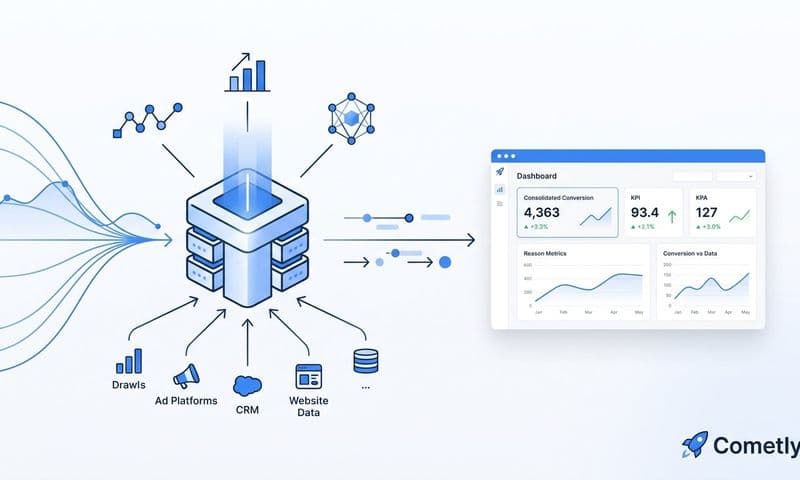
Centralizing your data means pulling every ad platform, your CRM, and your website analytics into a single dashboard where every channel can be compared on equal footing. This is not just about convenience. It is about accuracy. When you can see Meta spend alongside Google spend alongside LinkedIn spend in the same view, patterns emerge that would be invisible when looking at each platform in isolation.
A unified data layer also eliminates the problem of each platform claiming full credit for the same conversion. Side-by-side channel comparison forces honest performance evaluation because the numbers are held to a consistent standard. A strong marketing analytics solution makes this kind of unified view possible without manual reconciliation.
Implementation Steps
1. Audit every data source your team currently uses, including ad platforms, your CRM, website analytics, and any offline conversion data you track.
2. Connect all sources to a centralized analytics platform that normalizes data across channels and presents it in a consistent format.
3. Define a standard set of KPIs that apply across every channel, such as cost per acquisition, return on ad spend, and revenue attributed, so comparisons are always apples-to-apples.
4. Set up automated data refreshes so your dashboard reflects current performance without requiring manual exports or updates.
Pro Tips
Resist the temptation to build this in a spreadsheet. Manual consolidation creates lag and human error. Platforms like Cometly are purpose-built to connect your ad platforms, CRM, and website into a single real-time view, giving your team a reliable foundation for every spend decision that follows.
2. Adopt Multi-Touch Attribution to See the Full Spend Picture
The Challenge It Solves
Last-click attribution is simple, but it is also deeply misleading. It hands all the credit for a conversion to the final touchpoint a customer interacted with before converting, completely ignoring every ad, email, and piece of content that built awareness and consideration along the way. For teams running multi-channel campaigns, last-click attribution systematically undervalues upper-funnel spend and leads to cuts in channels that are actually doing critical work.
The Strategy Explained
Multi-touch attribution distributes conversion credit across every touchpoint in the customer journey. Depending on the model you choose, credit might be weighted equally across all touches, heavily toward the first and last, or dynamically based on which touches statistically correlate most with conversion. The goal is the same in every case: a more accurate picture of how your budget is actually performing across the full funnel.
This matters especially for channels like organic social, display, or branded search that often appear late in a journey but rarely initiate it. Multi-touch attribution reveals their true contribution and gives you the confidence to invest in the full funnel rather than just the bottom of it. Understanding the attribution challenges in marketing analytics is essential before selecting your model.
Implementation Steps
1. Move away from relying solely on platform-native attribution, which is inherently biased toward each platform's own channels.
2. Choose an attribution model that fits your sales cycle. Shorter cycles often work well with linear or time-decay models. Longer, complex journeys may benefit from data-driven attribution.
3. Map your typical customer journey from first touch to close so you understand which touchpoints exist and how they sequence.
4. Use a third-party attribution platform that can track across channels without the conflict of interest that comes with platform-native reporting.
Pro Tips
Do not treat attribution as a one-time setup. Revisit your model quarterly as your channel mix evolves. Cometly's multi-touch attribution capabilities let you compare models side by side, so you can see how credit shifts depending on the lens you apply and make decisions with full context.
3. Track Revenue, Not Just Conversions
The Challenge It Solves
Conversion volume is a useful signal, but it can be deeply misleading as a primary success metric. A campaign that generates many low-value leads can look like a winner in a conversions report while quietly destroying your cost per acquisition when measured against actual revenue. Without connecting marketing data to real sales outcomes, you are optimizing for activity rather than business impact.
The Strategy Explained
Revenue-based measurement means integrating your CRM and sales pipeline data with your marketing analytics so every touchpoint can be evaluated based on the revenue it influenced, not just the form fills or clicks it generated. This is especially important for B2B teams and high-consideration purchases where the gap between a conversion event and a closed deal can span weeks or months.
When revenue data flows back into your marketing analytics, spend decisions become grounded in business outcomes. You can identify which channels bring in customers with the highest lifetime value, which campaigns generate the most qualified pipeline, and where your budget is producing real returns versus inflated conversion counts. Teams looking to boost sales with marketing analytics find that revenue tracking is the single most impactful shift they can make.
Implementation Steps
1. Connect your CRM to your marketing analytics platform so that deal stages, close rates, and revenue values are visible alongside campaign data.
2. Define revenue events at each stage of your funnel, from marketing qualified lead to closed won, and track them as distinct conversion milestones.
3. Build reports that show cost per pipeline dollar and cost per revenue dollar, not just cost per lead or cost per click.
4. Use this data to recalibrate your channel budgets based on which sources consistently produce the highest-value customers.
Pro Tips
This approach requires close alignment between marketing and sales teams. Make sure your CRM fields are consistently filled in and that your attribution platform can ingest deal-level data. Cometly connects your ad platforms and CRM to give you a complete view of the customer journey from first ad click to closed revenue, so every budget conversation is anchored in real outcomes.
4. Use Server-Side Tracking to Plug Data Gaps
The Challenge It Solves
Since Apple introduced its App Tracking Transparency framework with iOS 14.5, pixel-based tracking has become significantly less reliable for many advertisers. Add browser-level ad blockers, cookie restrictions, and the ongoing deprecation of third-party cookies, and many teams are making budget decisions based on data that is meaningfully incomplete. When conversion data disappears, optimization suffers and ad platform algorithms lose the signal they need to perform.
The Strategy Explained
Server-side tracking moves the data collection process from the user's browser to your own server. Instead of relying on a JavaScript pixel that can be blocked or restricted by privacy tools, conversion events are captured and sent directly from your server to ad platforms and analytics tools. The result is a more complete and accurate dataset that is far less vulnerable to browser-level interference.
A growing number of marketing teams have adopted server-side tracking as a core part of their measurement infrastructure precisely because it restores visibility that pixel-based tracking can no longer reliably provide. Mastering data analytics in digital marketing now requires this kind of server-level data foundation. It is not a workaround. It is the new standard for accurate data collection.
Implementation Steps
1. Audit your current tracking setup to identify where conversion data is being lost, particularly on mobile and in browsers with aggressive privacy settings.
2. Implement a server-side event tracking solution that captures conversion events at the server level before sending them to your ad platforms and analytics tools.
3. Cross-reference server-side data against your existing pixel data to quantify the gap and understand how much conversion volume you were previously missing.
4. Use the recovered data to recalibrate your attribution and spend allocation decisions.
Pro Tips
Server-side tracking also improves data quality, not just volume. Because events are validated before being sent, you reduce duplicate conversions and noisy data that can skew your reporting. Cometly's server-side tracking is built to address exactly these gaps, giving your analytics layer a foundation of clean, complete conversion data regardless of what is happening at the browser level.
5. Feed Enriched Conversion Data Back to Ad Platforms
The Challenge It Solves
Ad platform algorithms are only as good as the data you feed them. When conversion signals are sparse, delayed, or low-quality due to tracking gaps, platforms like Meta and Google struggle to identify your best-fit audiences, optimize bidding effectively, or deliver ads to the people most likely to convert. The result is wasted spend and underperforming campaigns that could be doing significantly more with better signal.
The Strategy Explained
Conversion sync means taking your validated, enriched conversion events, including revenue values, lead quality scores, and CRM-confirmed outcomes, and sending them back to your ad platforms through their respective conversion APIs. This gives platform algorithms the high-quality signal they need to optimize targeting and bidding based on what actually matters to your business, not just surface-level click and view data.
This approach is sometimes called closing the loop on your ad data. Instead of letting platforms guess at what a good conversion looks like, you are explicitly telling them based on real outcomes. Many marketers who implement this see their marketing campaign analytics improve over time as the algorithm learns from richer, more accurate conversion data.
Implementation Steps
1. Identify the conversion events that carry the most business value, such as qualified leads, demo requests, or closed deals, and make sure they are tracked with revenue or quality values attached.
2. Set up server-to-server connections to Meta's Conversions API, Google's Enhanced Conversions, and any other platform APIs relevant to your channel mix.
3. Include enrichment data such as customer lifetime value estimates or lead scores so platforms can optimize toward your highest-value customers, not just any converters.
4. Monitor your campaign performance over the weeks following implementation to measure how improved signal quality affects cost per acquisition and return on ad spend.
Pro Tips
The quality of the data you send matters as much as the volume. Sending low-quality or inaccurate conversion events can actually confuse platform algorithms. Cometly's Conversion Sync is designed to send clean, validated, revenue-level events back to Meta, Google, and other platforms, ensuring that the signal you provide actively improves campaign performance rather than introducing noise.
6. Build a Recurring Budget Reallocation Cadence
The Challenge It Solves
Many marketing teams set their budgets at the start of a quarter and then leave them largely unchanged until the next planning cycle. This is a costly habit. Channel performance shifts constantly in response to seasonality, competition, audience saturation, and creative fatigue. A budget that was optimally allocated in January may be significantly misallocated by March, with no mechanism in place to catch the drift.
The Strategy Explained
A recurring budget reallocation cadence means establishing a regular review schedule, weekly for high-spend accounts, bi-weekly or monthly for others, where you systematically evaluate channel performance against defined thresholds and shift budget accordingly. This transforms budget management from a static planning exercise into a dynamic, ongoing discipline.
The key is having both the data and the decision framework in place before the review happens. You need to know in advance what metrics you are evaluating, what performance thresholds trigger a reallocation, and how much flexibility you have to move budget between channels. Tracking the right marketing analytics metrics is what separates productive reviews from subjective conversations.
Implementation Steps
1. Define the core metrics that govern budget allocation decisions for your business, such as return on ad spend, cost per qualified lead, or revenue per channel.
2. Set performance thresholds for each channel: a floor below which budget gets reduced and a ceiling above which you consider increasing investment.
3. Schedule recurring review meetings with a standing agenda that walks through each channel's performance against those thresholds.
4. Document every reallocation decision and the rationale behind it so you can learn from patterns over time and improve your decision-making framework.
Pro Tips
Automate as much of the data preparation as possible so your review meetings focus on decisions rather than data gathering. When your analytics platform surfaces performance trends in real time, you can spot channels that are drifting below threshold before they drain significant budget. Cometly's analytics dashboard is designed to give you that real-time visibility so your reallocation cadence is grounded in current, accurate data at every review.
7. Leverage AI-Driven Insights for Predictive Spend Optimization
The Challenge It Solves
Even with unified data, accurate attribution, and a regular review cadence, there is a limit to how much signal a human analyst can process across dozens of campaigns, hundreds of ad sets, and thousands of daily data points. The volume of marketing data most teams are working with has grown well beyond what manual analysis can reliably surface. Patterns that could unlock significant efficiency gains go undetected simply because there is too much to look at.
The Strategy Explained
AI-powered analytics moves your marketing spend practice from reactive reporting to proactive optimization. Instead of reviewing what happened and adjusting after the fact, AI can identify patterns across your campaign data, flag anomalies before they become expensive problems, and surface specific recommendations for where to shift budget, which creatives to scale, and which campaigns are showing early signs of fatigue.
The adoption of machine learning in marketing analytics has accelerated significantly as the complexity of multi-platform campaign management has grown. Teams that integrate AI-driven insights into their workflow are better positioned to act on opportunities faster and with more confidence than those relying on manual analysis alone.
Implementation Steps
1. Ensure your data foundation is solid before layering in AI. AI recommendations are only as reliable as the data they are trained on, so unified, accurate, server-side-tracked data is a prerequisite.
2. Identify the specific decisions you want AI to support, such as budget reallocation suggestions, creative performance scoring, or audience overlap detection.
3. Use AI recommendations as inputs to your decision-making process rather than as automatic actions. Review the reasoning behind each recommendation before acting on it.
4. Track the outcomes of decisions made with AI guidance versus those made without it to build confidence in the system and refine how you use its outputs over time.
Pro Tips
The best AI-driven tools do not just surface data. They tell you what to do with it. Exploring the broader landscape of predictive analytics in marketing can help you understand the full range of capabilities available. Cometly's AI Ads Manager and AI Chat capabilities are built to analyze your campaign performance across every channel and deliver specific, actionable recommendations so your team spends less time in the data and more time acting on it with confidence.
Putting It All Together
Mastering marketing spend analytics is not about adding more dashboards or drowning in more data. It is about building a system where every dollar can be traced to its impact, every channel is measured on equal footing, and every budget decision is backed by real revenue data.
Start by unifying your data and adopting multi-touch attribution as your foundation. These two steps alone will give you a clearer picture of your marketing performance than most teams ever achieve. Then layer in server-side tracking and conversion sync to ensure the data you are working with is accurate and complete, not just a fraction of what is actually happening.
From there, build a recurring review cadence that keeps your budget aligned with current performance rather than last quarter's assumptions. And bring in AI-driven insights to move from reactive reporting to proactive optimization at a scale that manual analysis simply cannot match.
The teams that treat marketing spend analytics as an ongoing discipline, not a one-time setup, are the ones that consistently find ways to do more with less and scale with confidence. Every strategy on this list compounds on the others. The more of them you implement, the more accurate your data becomes, the better your decisions get, and the more efficiently your budget performs.
If you are ready to see exactly how your marketing dollars translate into revenue, explore how Cometly can give you the clarity and accuracy you need to optimize every campaign. Get your free demo today and start capturing every touchpoint to maximize your conversions.