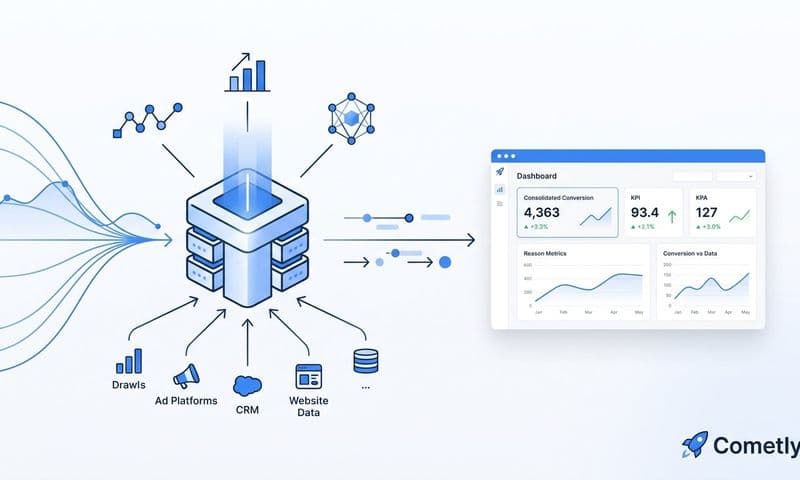
Choosing marketing analytics software is one of the most impactful decisions a marketing team can make, but the pricing landscape is notoriously confusing. Between usage-based tiers, per-seat fees, hidden overage charges, and feature gating, it can feel like you need a spreadsheet just to compare two vendors.
The result? Many teams either overpay for features they never use or underspend on a tool that leaves critical gaps in their data. Both outcomes hurt your bottom line, just in different ways.
This guide walks you through a structured, repeatable process for evaluating marketing analytics software pricing so you can match the right solution to your actual needs and budget. By the end, you will know exactly how to define your requirements, decode common pricing models, calculate the true cost of ownership, and negotiate with confidence.
Whether you are a solo marketer evaluating your first attribution platform or a marketing ops leader comparing enterprise solutions, these steps will help you cut through the noise and make a decision grounded in data, not sales pressure.
Step 1: Define Your Analytics Requirements Before You Look at a Single Price Tag
This step sounds obvious, but most teams skip it. They jump straight to vendor websites, get dazzled by feature lists, and end up anchoring their evaluation around whatever the first vendor showed them. That is a recipe for overpaying or buying the wrong tool entirely.
Start with an honest audit of your current marketing stack. What data are you already collecting, and where are the gaps? Map out every ad platform you run (Meta, Google, TikTok, LinkedIn, and any others), your CRM, your website event tracking, and any offline conversion data. The goal is to see clearly what you have versus what you wish you had.
Next, build your must-have capabilities list. For most modern marketing teams, this includes:
Multi-touch attribution: Understanding which touchpoints across the customer journey actually influence conversions, not just the last click. Investing in a dedicated multi-touch marketing attribution software solution is often a core requirement for teams serious about accurate data.
Server-side tracking: Critical as browser-based tracking continues to face limitations from iOS privacy changes and cookie deprecation. Server-side tracking ensures you capture conversions that client-side scripts miss.
Cross-platform reporting: A unified view of performance across all your ad channels in one place, so you are not manually pulling reports from five different dashboards.
Conversion syncing: The ability to send enriched conversion data back to ad platforms like Meta and Google so their algorithms can optimize toward your actual buyers, not just clicks.
AI-powered recommendations: Automated insights that surface which campaigns, audiences, and creatives are driving real revenue, so you can act faster without digging through raw data.
Now determine your scale factors. How many ad platforms do you run? What is your monthly tracked event volume? How many team members need access to the platform? Which integrations are non-negotiable? These numbers will directly determine which pricing tiers are relevant and which are not.
Finally, separate your needs from your nice-to-haves. It is easy to get excited about a feature you have never had before and treat it as essential. Be honest. If a capability would be useful but would not change how you allocate budget or make decisions, it belongs in the nice-to-have column. You should not pay a premium tier price for features that will sit unused.
How to verify success: Before moving to Step 2, you should have a prioritized requirements document. Needs at the top, nice-to-haves below, and your scale factors clearly documented. This becomes your evaluation filter for everything that follows.
Step 2: Decode the Most Common Pricing Models in Marketing Analytics
Marketing analytics vendors use several distinct pricing structures, and understanding how each one works is essential before you can compare them fairly. Headline prices rarely tell the whole story.
Here are the four dominant models you will encounter:
Per-seat pricing: You pay a fixed fee for each user who needs access to the platform. This model is predictable at small team sizes but can balloon quickly as your organization grows. If you have a marketing team of ten people today and expect to double in size over the next year, per-seat pricing deserves careful scrutiny. Make sure you understand exactly what counts as a "seat" and whether view-only users are charged the same as power users.
Usage or event-based pricing: Your cost scales with the volume of tracked events, sessions, or data points processed each month. This model can work well for smaller businesses with lower traffic, but it penalizes growth. As your ad spend increases and you drive more traffic, your analytics bill climbs in parallel. Watch out for steep overage charges when you exceed your plan's event limit, since these can make your monthly cost unpredictable.
Tiered feature plans: This is the most common model, where vendors offer multiple tiers (often labeled Starter, Professional, and Enterprise) with progressively more features unlocked at higher price points. The critical issue here is feature gating. Many vendors lock capabilities like multi-touch attribution, API access, server-side tracking, or advanced reporting behind their premium tiers. If those features are on your must-have list, the entry-level price is irrelevant to your actual buying decision. For a deeper look at how to evaluate platforms, see our guide on choosing a marketing analytics platform.
Flat-rate pricing: A single monthly or annual fee that includes all features and accommodates a defined usage level. This model offers the most predictability and is often the most transparent. You know exactly what you are paying and what you are getting.
One of the most important distinctions in the market is between vendors with transparent, self-serve pricing and those that require you to contact sales for a quote. Quote-based enterprise pricing is not inherently bad, but it does make apples-to-apples comparisons harder. When a vendor will not publish their prices, it often signals that pricing is highly negotiable, which can work in your favor, but it also means you need to invest more time in the evaluation process.
The most common pitfall at this stage is comparing headline prices without understanding what is actually included at each tier. A tool priced at a lower monthly rate might require a paid add-on for the attribution model you need, a separate fee for API access, and premium support charges on top. Always price the full configuration you need, not the entry-level plan.
Step 3: Calculate the True Total Cost of Ownership
The subscription fee is just the beginning. To make a genuinely informed buying decision, you need to calculate the total cost of ownership (TCO) across the full lifecycle of using the tool.
Start by mapping out the costs beyond the monthly bill:
Implementation and onboarding: How long will it take to get the platform fully set up and integrated with your stack? Does the vendor charge for onboarding, or is it included? Even if onboarding is "free," your team's time has a cost. A complex implementation that takes three weeks of engineering and marketing ops time is not free.
Integration development: If you need custom integrations with your CRM, data warehouse, or internal tools, factor in the development hours required. Some platforms offer native integrations that take minutes to connect; others require custom API work that takes weeks.
Training hours: How intuitive is the platform? A tool with a steep learning curve costs more in productivity loss during ramp-up. Ask vendors how long it typically takes a new user to become proficient.
Hidden fees and overages: Ask vendors directly what happens when you exceed your plan's event or data limits. Some charge a flat overage rate; others automatically upgrade you to the next tier. Either way, you need to know before you sign.
Premium support charges: Many vendors include only community support or email ticketing at lower tiers. Dedicated support, SLA guarantees, and access to a customer success manager often cost extra. If fast support matters to your team, price it in.
There is also a less obvious cost that many buyers overlook: the cost of inaccurate data. If a cheaper tool misattributes conversions, you will make budget allocation decisions based on bad information. You might scale a campaign that looks like it is driving revenue when it is actually not, or cut a channel that is genuinely contributing to pipeline. Understanding the broader impact of marketing and analytics on business success helps frame why data accuracy is worth paying for.
Build a simple TCO spreadsheet comparing three to five vendors. Columns should include: monthly subscription cost, annualized subscription, estimated implementation cost, ongoing maintenance hours per month, support tier cost, and estimated opportunity cost from data gaps or inaccuracies. This gives you a true comparison rather than a surface-level price comparison.
Tip: Ask each vendor directly about their overage policy and what happens when you hit plan limits. How they answer this question tells you a lot about how they handle the customer relationship.
Step 4: Map Pricing Tiers to Your Growth Trajectory
The right tool for your business today might be the wrong tool at two times your current scale. This step is about making sure the platform you choose can grow with you without punishing your success.
Project your needs twelve to twenty-four months out. Ask yourself: Will you add new ad platforms? Are you planning to significantly increase your ad spend? Will your team grow, adding more users who need platform access? Will you expand into new markets that require additional tracking configurations?
With those projections in hand, revisit each vendor's pricing model and calculate what you would pay at your projected scale. Some event-based pricing models, for example, can increase costs dramatically as traffic grows. A platform that costs a reasonable amount at your current volume might become prohibitively expensive once you scale your campaigns.
Look specifically for platforms that grow with you without creating pricing cliffs. Pricing cliffs are points where adding one more user, one more event, or one more data source jumps you into a dramatically higher tier. Platforms that include unlimited users, flexible event thresholds, or graduated pricing tend to be more growth-friendly. Enterprise teams should explore enterprise marketing data analytics software options that are designed for scale from the start.
Contract flexibility also matters here. Monthly commitments give you more flexibility to switch if your needs change, but annual contracts typically offer meaningful discounts. Evaluate the trade-off honestly. If you are confident in the platform after your trial (more on that in Step 6), an annual commitment is usually worth the savings. But if you are still uncertain, month-to-month is worth the premium.
Also review upgrade and downgrade policies. Can you move between tiers easily? Is there a penalty for downgrading? Understanding these terms before you sign protects you if your needs change unexpectedly. Reviewing a curated list of alternatives to marketing analytics software can also help you benchmark pricing flexibility across the market.
How to verify success: You should have a projected cost comparison at your current scale and at two times your current scale for each vendor under consideration. This gives you a forward-looking view of the investment, not just a snapshot.
Step 5: Run a Feature-to-Price Value Analysis
Now it is time to bring your requirements document and your pricing research together into a structured value analysis. This is where you move beyond gut feel and make a defensible, data-driven recommendation.
Create a weighted scoring matrix. Take each requirement from your Step 1 document and assign it an importance score, for example on a scale of one to five, where five means the feature is mission-critical and one means it would be nice but is not essential. Then rate how well each vendor delivers on that requirement, again on a one-to-five scale.
Multiply the importance score by the delivery score for each requirement and sum the results. This gives you a total weighted score for each vendor. Then calculate a value ratio by dividing the total weighted score by the monthly or annual cost. The vendor with the highest value ratio is delivering the most capability per dollar spent.
This framework keeps you honest. It prevents you from being swayed by a slick demo of a feature you rated as a one, while overlooking the fact that the same vendor scored poorly on your five-rated attribution accuracy requirement. For a broader perspective on how to approach this strategically, our guide on marketing analytics strategy provides a useful framework.
Pay particular attention to how vendors score on features that directly impact ad ROI. Strong attribution accuracy, AI-powered optimization recommendations, and conversion syncing are not just nice features. They are capabilities that directly affect how well your ad platforms can optimize your campaigns. A platform that feeds enriched, accurate conversion data back to Meta and Google improves the quality of those platforms' targeting algorithms, which translates into better campaign performance over time.
Think about it this way: a platform with AI marketing analytics and conversion syncing might carry a higher monthly price than a basic analytics tool. But if it helps you identify and cut wasted ad spend on underperforming campaigns, or helps Meta's algorithm find more of your best customers, the return on that investment can be significant. The cheaper tool might actually cost you more in misallocated budget than the premium tool costs in subscription fees.
Common pitfall: Choosing the cheapest option without considering the revenue impact of better data quality. The goal is not to minimize your analytics spend. The goal is to maximize the return on your total marketing investment, and better data is a lever that affects every dollar you spend on ads.
Step 6: Test Before You Commit with Trials and Proof-of-Concept Runs
No amount of research replaces hands-on experience with the platform. Before you sign an annual contract, always request a free trial or pilot period. Most reputable vendors offer this, and if a vendor is reluctant to let you test their product, that hesitation itself is useful information.
Before you start your trial, define your success criteria in writing. This prevents you from drifting through the trial without a clear verdict at the end. Your success criteria should answer questions like: Can you connect all your ad platforms within the first day or two? Does the conversion data match what you see in your CRM? How long does onboarding actually take compared to what the vendor promised? Does the attribution data tell a story that makes sense given what you know about your campaigns?
Focus your trial time on testing the specific features that justified the price point, not just the dashboard's visual appeal. If you are paying for multi-touch attribution, spend real time validating that the attribution model reflects your customer journey accurately. Understanding how to use data analytics in marketing will help you evaluate whether the platform genuinely improves your decision-making during the trial.
Evaluate support quality during the trial period. How quickly does the team respond when you have a question? Are the answers helpful, or do they just point you to documentation? Support quality during a trial often reflects what you will experience as a paying customer. Responsive, knowledgeable support reduces long-term costs by shortening the time you spend stuck on technical issues.
Tip: If possible, run your trial alongside your current analytics tool for a period of time. Comparing the data side by side is one of the most revealing tests you can run. If the new platform surfaces attribution insights that your current tool misses, that difference has real dollar value. If the data looks identical, that is worth knowing too.
Making Your Final Decision with Confidence
You have done the work. Now it is time to bring it all together into a final decision.
Build a summary scorecard that combines your TCO analysis, value ratio scores, growth trajectory projections, and trial results into a single view. This is the document you present to stakeholders when you make your recommendation. It shows that your decision is grounded in a structured process, not a preference or a relationship with a sales rep.
Before you finalize, run through this quick checklist:
Requirements defined: You have a prioritized list of must-haves and nice-to-haves with scale factors documented.
Pricing models understood: You know how each vendor charges and what is actually included at the tier you need.
TCO calculated: You have gone beyond the subscription fee to include implementation, integration, support, and the cost of data inaccuracy.
Growth trajectory mapped: You know what each vendor costs at your current scale and at two times your current scale.
Value scored: You have a weighted feature-to-price analysis that reflects your actual priorities.
Trial completed: You have tested the platform against real success criteria, not just explored the interface.
Choose based on data quality and revenue impact, not sticker price. The right marketing analytics platform pays for itself by helping you make better decisions about where to put your ad budget.
If you are looking for a platform that checks these boxes, Cometly is built for exactly this type of buyer. It offers transparent pricing, AI-powered attribution that connects every touchpoint to real revenue, server-side tracking for accurate data in a privacy-first world, and conversion syncing that feeds enriched data back to Meta, Google, and other ad platforms so their algorithms work harder for you.
Ready to see it in action? Get your free demo today and start capturing every touchpoint to maximize your conversions.