Marketing data is everywhere, and that is exactly the problem. Your ad performance lives in Google Ads, Meta, and TikTok. Your leads are in your CRM. Your web behavior is in your analytics platform. And somewhere in the middle of all that fragmentation, the insights you actually need to make better decisions get lost.
The right marketing data analysis tool changes that. It brings your data together, surfaces what is actually driving revenue, and helps your team move faster with more confidence. We evaluated tools based on data integration depth, analytics capabilities, ease of use, AI features, and overall value for marketing teams.
This list covers a broad range of tools, from attribution-focused platforms to full-stack analytics suites and reporting tools, so whether you are a solo marketer, an agency, or a growth team at a scaling company, there is something here for you. Here are the top marketing data analysis tools worth your attention in 2026.
1. Cometly
Best for: Paid media teams who need accurate attribution from ad click to CRM revenue.
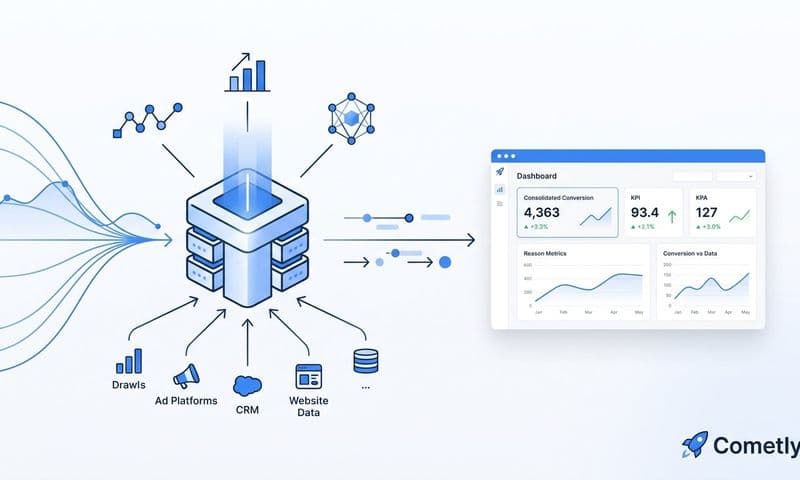
Cometly is an AI-powered marketing attribution platform that connects every ad touchpoint to actual revenue events in your CRM, giving you a clear picture of what is working and what is wasting budget.
 9 Best Marketing Attribution Platforms to Compare in 2026
Where This Tool Shines
Most analytics tools can tell you how many clicks or sessions a campaign generated. Cometly goes further by connecting those clicks to leads, pipeline, and closed revenue. That distinction matters enormously when you are trying to justify ad spend or decide where to scale.
What sets Cometly apart is its combination of server-side tracking and AI-powered recommendations. Server-side tracking addresses one of the most persistent challenges in modern digital marketing: the data loss caused by iOS privacy changes and browser-based tracking limitations. By capturing events server-side, Cometly maintains attribution accuracy even when client-side signals are blocked or degraded.
Key Features
Multi-Touch Attribution: Tracks the full customer journey across all paid channels in real time, so you can see every touchpoint that contributed to a conversion.
AI-Powered Recommendations: Identifies your highest-performing ads and campaigns across every channel, giving you actionable guidance on where to scale and where to cut.
Server-Side Tracking: Captures conversion data at the server level, overcoming the tracking gaps created by iOS updates and browser privacy restrictions.
Conversion Sync: Feeds enriched, conversion-ready event data back to Meta, Google, TikTok, and other ad platforms, improving their algorithmic targeting and optimization.
AI Chat: Lets you ask natural-language questions about your marketing data and get instant answers without needing to build a report or write a query.
Best For
Cometly is built for performance marketers, paid media teams, and agencies who need to understand which ads and channels are actually generating revenue, not just clicks. It is especially valuable for teams running multi-channel campaigns where attribution accuracy directly impacts budget allocation decisions.
Pricing
Custom pricing based on ad spend volume. A demo is available on request at cometly.com.
2. Google Analytics 4
Best for: Foundational web and app analytics for teams of any size.
Google Analytics 4 is Google's event-based analytics platform that tracks user behavior across websites and mobile apps, with built-in predictive capabilities and deep integration with the Google ecosystem.
 11 Best Marketing Analytics Tools to Track and Optimize Campaign Performance in 2026
Where This Tool Shines
GA4's event-based data model is a significant upgrade from its predecessor. Instead of rigid session-based tracking, GA4 lets you define and track virtually any user interaction as an event, giving you more flexibility to measure what actually matters to your business.
The free BigQuery export is a standout feature for data-savvy teams. It lets you push raw GA4 data into a data warehouse for custom analysis, SQL querying, and integration with other data sources, capabilities you would typically pay for in other platforms.
Key Features
Event-Based Tracking: Flexible data model that captures any user interaction across web and app properties without rigid session constraints.
Predictive Metrics: Machine learning models that surface purchase probability, churn probability, and predicted revenue for audience segmentation.
BigQuery Export: Free raw data export to Google BigQuery for advanced custom analysis and data warehousing.
Cross-Platform Tracking: Unified measurement across web and mobile app touchpoints in a single property.
Google Ads Integration: Native connection to Google Ads for campaign reporting and audience sharing.
Best For
Any marketing team that needs a solid foundation for web analytics. GA4 is particularly valuable for teams already invested in the Google ecosystem, running Google Ads, or looking for a free platform with enterprise-grade export capabilities.
Pricing
Free for standard use. GA4 360, the enterprise tier, starts at approximately $50,000 per year.
3. Tableau
Best for: Advanced data visualization and interactive marketing dashboards.
Tableau is an industry-leading business intelligence and data visualization platform that enables marketing teams to build sophisticated, interactive dashboards from virtually any data source.
 10 Best Marketing Data Analysis Tools to Sharpen Your Strategy in 2026
Where This Tool Shines
Tableau's strength is its ability to handle complex, multi-source data and turn it into visuals that are both analytically rigorous and easy to interpret. Marketing teams dealing with large datasets across many channels often find that Tableau gives them analytical depth that simpler dashboarding tools cannot match.
The drag-and-drop interface makes it accessible to marketers without a data science background, while the underlying calculation engine and statistical features satisfy more technical analysts. It is one of the few tools that genuinely works for both audiences.
Key Features
Visual Analytics Builder: Drag-and-drop interface for building complex marketing dashboards without writing code.
Broad Data Connectivity: Connects to hundreds of data sources including databases, cloud platforms, spreadsheets, and marketing tools.
Explain Data: AI-powered feature that automatically surfaces statistical explanations for data anomalies and outliers.
Collaboration and Sharing: Publish and share dashboards through Tableau Server or Tableau Cloud with role-based access control.
Advanced Analytics: Built-in support for calculations, trend forecasting, and statistical analysis within dashboards.
Best For
Marketing teams and analysts who need serious visualization power and are working with complex, multi-source datasets. Tableau is a strong fit for enterprise marketing teams, data-forward agencies, and organizations that have already invested in a data warehouse.
Pricing
Tableau Creator starts at $75 per user per month. Viewer licenses are available at $15 per user per month.
4. Looker Studio
Best for: Budget-friendly reporting and dashboards for Google-centric marketing teams.
Looker Studio is Google's free dashboarding and reporting tool that lets marketing teams build interactive, shareable reports from Google products and a wide range of third-party data connectors.
 9 Best Client Reporting Dashboard Software Tools in 2026
Where This Tool Shines
The price point is the obvious starting point: Looker Studio is completely free with no limits on users, reports, or data sources. For teams that primarily work within the Google ecosystem, it delivers a surprisingly capable reporting experience without any cost.
Real-time collaboration is another genuine strength. Multiple team members can work on the same report simultaneously, similar to Google Docs, which makes it practical for agencies and teams that build reports together or iterate frequently based on client feedback.
Key Features
Native Google Connectors: Direct connections to Google Ads, GA4, Search Console, YouTube, and Google Sheets out of the box.
600+ Partner Connectors: Third-party connectors for platforms like Meta Ads, LinkedIn, HubSpot, and many others (some connectors require paid third-party subscriptions).
Real-Time Collaboration: Multiple users can edit and comment on reports simultaneously with no version conflicts.
Customizable Templates: Pre-built report templates for common marketing use cases that speed up initial setup.
Unlimited Reports and Users: No paywalls on report creation, sharing, or viewer access.
Best For
Small to mid-size marketing teams, freelancers, and agencies looking for a free, flexible reporting tool. Especially well-suited for teams whose primary data sources are Google products.
Pricing
Completely free. Some third-party data connectors may require separate paid subscriptions from connector providers.
5. HubSpot Marketing Analytics
Best for: Inbound marketing teams that need CRM-connected campaign reporting.
HubSpot Marketing Analytics is the built-in analytics suite within HubSpot's marketing platform, connecting campaign performance directly to CRM contacts, deals, and closed revenue.
 10 Best Marketing Analytics Software Packages in 2026
Where This Tool Shines
HubSpot's analytics advantage is its native CRM integration. Unlike standalone analytics tools that stop at the session or lead level, HubSpot can trace a contact's journey from first marketing touch all the way through to a closed deal, giving you true revenue attribution for inbound marketing activities.
For teams already running their marketing and sales in HubSpot, the analytics layer requires no additional setup or data piping. Everything is connected by default, which significantly reduces the operational overhead of building meaningful reports.
Key Features
Revenue Attribution Reporting: Connects marketing touchpoints across email, ads, social, and content to closed deals in the CRM.
Custom Report Builder: Drag-and-drop interface for building reports across any combination of marketing, sales, and CRM data.
Campaign Analytics: Unified performance view across email campaigns, paid ads, social media, and website content.
Contact Journey Analytics: Individual contact-level timelines showing every marketing interaction tied to CRM records.
Dashboard Sharing and Scheduling: Built-in dashboards with automated email delivery on custom schedules.
Best For
Marketing teams already using HubSpot as their CRM and marketing platform. Particularly valuable for B2B teams running inbound programs where connecting marketing activities to pipeline and revenue is a priority.
Pricing
Included with HubSpot Marketing Hub. Professional tier starts at $800 per month, which includes the full analytics suite.
6. Mixpanel
Best for: Product and behavioral analytics focused on user actions, funnels, and retention.
Mixpanel is a behavioral analytics platform that helps teams understand how users engage with their product or website, with deep funnel analysis, cohort tracking, and retention measurement.
 9 Best Cross Device Tracking Solutions for Marketers in 2026
Where This Tool Shines
Mixpanel excels at answering the questions that session-based analytics tools struggle with: not just how many users visited, but what they did, where they dropped off, and whether they came back. That behavioral depth makes it particularly valuable for product-led growth teams and marketers who want to understand post-acquisition engagement.
The segmentation and cohort analysis capabilities are genuinely powerful. You can slice your user base by any combination of properties and behaviors, then track how different cohorts perform over time, without needing a data analyst or SQL skills to do it.
Key Features
Event-Based Segmentation: Deep segmentation and cohort analysis based on any user action or property combination.
Funnel Analysis: Visualize conversion flows and identify exactly where users drop off in any multi-step process.
Retention Reports: Measure how effectively campaigns and product changes drive repeat engagement over time.
Interactive Exploration: Ad-hoc data exploration with no SQL required for most analysis tasks.
Ad Platform Integrations: Connects with major ad platforms and customer data platforms for marketing use cases.
Best For
Product teams, growth marketers, and SaaS companies that need to understand user behavior beyond the acquisition event. Also useful for e-commerce teams analyzing purchase funnel performance and repeat purchase rates.
Pricing
Free plan available for up to 20 million events per month. Growth plan starts at $28 per month, scaling with event volume.
7. Supermetrics
Best for: Marketing teams that need automated data pipelines into spreadsheets or data warehouses.
Supermetrics is a marketing data pipeline tool that automatically pulls data from 100+ ad and marketing platforms into the reporting and analysis environment of your choice.
 10 Best Ad Performance Analytics Software for Smarter Campaigns in 2026
Where This Tool Shines
Supermetrics solves a specific but very common problem: getting your marketing data out of siloed platforms and into a place where you can actually analyze it. If your team lives in Google Sheets or Excel, or if you are building a data warehouse in BigQuery or Snowflake, Supermetrics handles the extraction and delivery automatically.
The breadth of connectors is a real strength. Virtually every major ad platform, social network, SEO tool, and analytics platform is supported, which means you can consolidate data from your entire marketing stack without building custom integrations.
Key Features
100+ Data Source Connectors: Covers all major ad platforms, social channels, SEO tools, and analytics platforms.
Flexible Destinations: Sends data to Google Sheets, Excel, BigQuery, Snowflake, Looker Studio, and more.
Automated Data Refresh: Schedules automatic data pulls so your reports are always current without manual exports.
Data Blending: Combines metrics from multiple sources in a single query for cross-channel reporting.
Pre-Built Query Templates: Ready-made templates for common marketing reporting needs to speed up setup.
Best For
Marketing analysts, agencies, and operations teams who need reliable, automated data pipelines but do not want to build and maintain custom API integrations. Works best as part of a larger reporting stack rather than as a standalone analysis tool.
Pricing
Starts at approximately $39 per month per destination. Pricing scales with the number of connectors and data volume.
8. Funnel.io
Best for: Mid-market and enterprise teams building a centralized marketing data hub.
Funnel.io is a marketing data hub that automatically collects, maps, and transforms data from all your marketing platforms into a unified, analysis-ready format for BI tools and data warehouses.
Where This Tool Shines
Where Supermetrics focuses on extraction, Funnel.io adds a meaningful data transformation layer. It normalizes metrics across platforms, handles schema changes automatically, and standardizes things like currency and cost data so that your cross-channel comparisons are actually apples-to-apples.
That transformation layer is what justifies the higher price point for teams dealing with serious data complexity. If you are managing dozens of ad accounts across multiple currencies and platforms, the time saved on data cleaning and normalization adds up quickly.
Key Features
500+ Data Source Connectors: One of the broadest connector libraries available, with automatic schema handling for platform changes.
Data Mapping and Transformation: Normalizes metrics and naming conventions across platforms so your data is consistent and comparable.
Cost Data Standardization: Automated currency conversion and cost normalization across all connected ad platforms.
Flexible Export Options: Sends clean data to BI tools, data warehouses, or Funnel's own dashboard environment.
No-Code Setup: Designed for marketers rather than engineers, with a visual interface for configuring data flows.
Best For
Mid-market and enterprise marketing teams, as well as larger agencies, that need a robust data foundation for cross-channel analysis. Best suited for organizations with complex multi-platform, multi-currency advertising operations.
Pricing
Custom pricing. Typically starts around $1,000 per month for mid-market teams, scaling with data volume and sources.
9. Klipfolio
Best for: Real-time KPI monitoring and live campaign dashboards.
Klipfolio is a cloud-based dashboarding platform designed for real-time KPI monitoring, with pre-built marketing metrics and fast setup for teams that need immediate visibility into campaign performance.
Where This Tool Shines
Klipfolio's focus on real-time data refresh makes it particularly useful for teams that need to monitor live campaigns rather than review historical reports. When you are running a time-sensitive promotion or managing a high-spend campaign, seeing metrics update in real time rather than waiting for daily refreshes can meaningfully change how quickly you respond.
The PowerMetrics feature is worth highlighting for teams that struggle with metric consistency. It provides a centralized place to define and govern your key metrics so that everyone on the team is working from the same definitions, which eliminates the "which number is right" conversations that slow teams down.
Key Features
Pre-Built Marketing KPIs: Ready-made metric templates and dashboard designs for common marketing use cases.
100+ Data Integrations: Connects to ad platforms, analytics tools, and CRMs for consolidated monitoring.
PowerMetrics: Centralized metric definitions and governance to ensure consistency across your team's reporting.
Real-Time Data Refresh: Live data updates for monitoring active campaigns as they run.
TV Dashboard Mode: Display mode optimized for office screens and marketing operations centers.
Best For
Marketing operations teams, performance marketers running active campaigns, and agencies that want always-on visibility into key metrics. Also useful for teams that need to display live dashboards in a shared office environment.
Pricing
Free plan available. Paid plans for teams start at $125 per month, scaling with users and data connections.
10. Whatagraph
Best for: Agencies building polished, client-ready cross-channel marketing reports.
Whatagraph is a cross-channel marketing reporting platform that combines data aggregation with visually polished, client-ready report templates, built specifically for agencies managing multiple clients and campaigns.
Where This Tool Shines
Whatagraph understands that agency reporting has two audiences: your internal team and your clients. The platform is designed with that dual audience in mind, offering data depth for analysis alongside presentation quality that makes client reports look professional without hours of manual formatting.
The automated delivery feature is a practical time-saver for agencies handling regular client reporting cycles. Once a report is built and scheduled, it goes out automatically, freeing up account managers to focus on strategy rather than report assembly.
Key Features
45+ Native Integrations: Covers all major ad platforms, social channels, and analytics tools with direct connections.
Client-Ready Templates: Visually polished report designs built for client presentations, not just internal analysis.
Cross-Channel Data Blending: Combines data from multiple platforms within a single report view.
Automated Report Delivery: Schedules and sends reports to clients automatically on custom cadences.
White-Label Options: Agency branding capabilities for a fully branded client experience.
Best For
Digital marketing agencies managing multiple client accounts who need to produce regular, polished cross-channel reports efficiently. Also useful for in-house teams that report marketing performance to non-technical stakeholders on a regular schedule.
Pricing
Starts at approximately $249 per month. Pricing scales with the number of data sources and users.
Which Tool Is Right for Your Team?
The right marketing data analysis tool depends entirely on what your primary challenge is. Each of these platforms solves a different piece of the puzzle, and the best choice for your team comes down to where your biggest data gap actually lives.
If your core challenge is attribution accuracy, specifically understanding which ads and channels are generating real revenue rather than just clicks, Cometly is the clear choice. Its combination of multi-touch attribution, server-side tracking, and AI-powered recommendations addresses the exact problem that keeps performance marketers up at night.
For foundational web analytics, Google Analytics 4 remains the essential starting point for virtually every marketing team. If you need advanced visualization and are working with complex, multi-source data, Tableau offers depth that few tools can match. Looker Studio covers most reporting needs for free, making it ideal for budget-conscious teams in the Google ecosystem.
HubSpot Marketing Analytics is the natural fit for inbound teams already on HubSpot who want CRM-connected reporting. Mixpanel serves product and growth teams focused on behavioral analysis and retention. For data pipeline needs, both Supermetrics and Funnel.io solve the extraction and normalization problem, with Funnel.io offering more transformation depth at a higher price point.
Klipfolio is the right pick for teams that need real-time campaign monitoring, while Whatagraph stands out for agencies that prioritize client-ready reporting presentation alongside data accuracy.
Start by identifying your primary data challenge: attribution accuracy, data centralization, visualization, or reporting. That answer will point you toward the right tool faster than any feature comparison.
If your team is focused on understanding which ads and channels actually drive revenue, Get your free demo of Cometly today and see how AI-powered attribution can sharpen your paid media strategy from the ground up.