
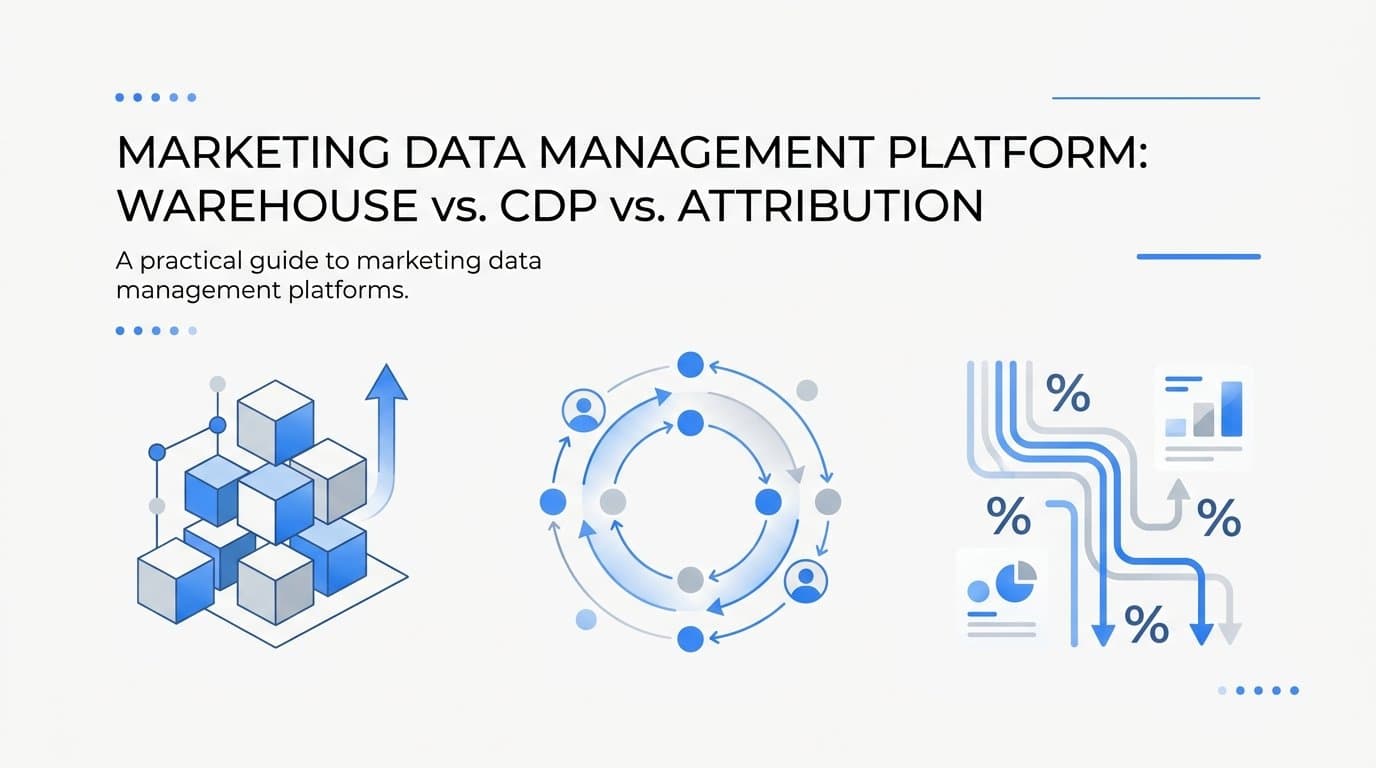
A marketing data warehouse, a customer data platform (CDP), and an attribution platform are not rivals for the same job, and treating them as one is how teams end up with three dashboards and three answers. The attribution platform should own touchpoint and lead source truth, the warehouse should own cross-functional analysis, and the CDP is an optional activation layer. Together they form a marketing data management platform stack, even though no single product sells itself under that name.
This article explains what each tool does well, where each breaks down for a B2B SaaS team, and how they layer so RevOps and growth leaders can trust the numbers they present.
Four Jobs Every Marketing Data Management Platform Must Cover
No single product category owns the term. A marketing data management platform is the combination of collecting, unifying, storing, and activating marketing data. You can buy it as one suite, assemble it from parts, or end up with it by accident. What matters is whether all four functions are covered and who is responsible for each.
Test any tool against these four jobs:
- Capture touchpoints: record ad clicks, visits, form fills, and CRM events as they happen, using first-party methods that survive browser restrictions.
- Resolve identity: connect anonymous visits to known leads, and leads to the accounts they belong to.
- Tie to pipeline and revenue: link those touchpoints to opportunities, closed-won deals, and billed revenue.
- Make data usable: deliver it to analysts, BI tools, ad platforms, and increasingly AI assistants.
Most tools do one or two of these well. Very few do all four.
Why B2B SaaS makes this harder
Ecommerce can often close the loop inside a single session and a single checkout. B2B SaaS cannot. Sales cycles run for months, several contacts from one company engage at different times, important stages happen offline in the CRM, and revenue ultimately lands in a billing system such as Stripe. A tool that sees only the click, or only the invoice, misses most of the story.
What "source of truth" really means
A common misconception is that a source of truth is one tool that does everything. In practice it means one agreed definition of each metric: what counts as a lead, which field holds lead source, how an opportunity is credited. Different systems can hold the data as long as everyone reads the same definitions from the same place.
The Marketing Data Warehouse: Flexible Storage That Needs Good Inputs
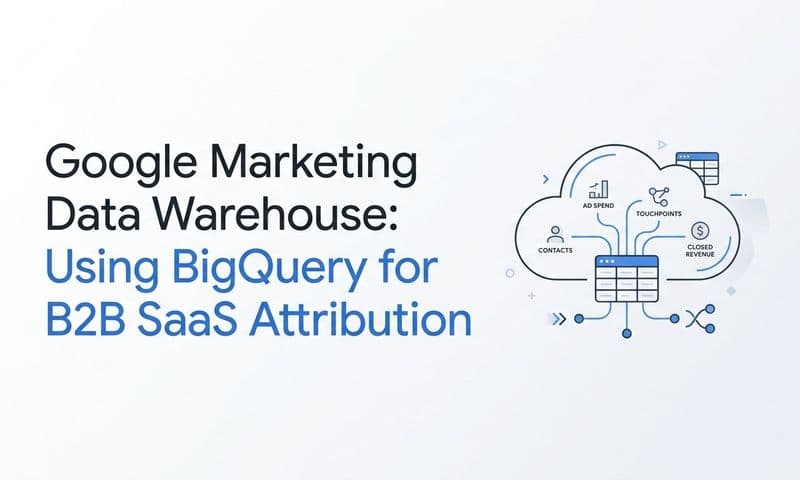
A cloud data warehouse such as Snowflake or BigQuery is a central store where you load data from many systems and query it with SQL. Lakes built on object storage and read by engines like Databricks serve a similar purpose. This differs from a marketing database that lives inside a single tool, such as the contact table in your automation platform. That database is shaped by one vendor's schema and sees only what that vendor sees. The warehouse is shaped by you.
Where it excels
The warehouse is the only place where ad spend, CRM records, product usage, and billing data can sit side by side under your own governance. Finance can reconcile revenue, RevOps can model pipeline velocity, and analysts can build reports that no single vendor interface supports. If you ever ask a question like "do accounts that activate a feature in week one expand faster, by acquisition channel," the warehouse is where it gets answered.
Where it breaks down
A warehouse stores whatever it receives and nothing more. It does not capture clicks, stitch an anonymous visit to a later form fill, or decide how credit should be split across touches. Those jobs happen upstream, and if they were never done, the warehouse cannot recover the information.
The typical failure looks like this. Ad platform exports and CRM tables both land in the warehouse on schedule, but neither carries a shared touchpoint or lead source key. Spend is known by campaign, opportunities are known by contact, and nothing reliably connects the two. Cost per opportunity becomes a guess assembled from UTM fields that sales reps overwrite and forms that drop parameters.
The cost of ownership
Warehouses also require people. Someone has to model the data, maintain pipelines, fix breakages when an API changes, and document definitions. Teams with a data engineer or strong analytics engineer get great leverage. Teams without one often end up with an expensive store that few people query. This is the core of the data warehouse vs marketing database decision: the warehouse offers freedom, but the freedom has a labor bill attached.
The CDP: Built for Activation, Not Marketing Measurement
A customer data platform collects events from your site, app, and other sources, builds unified customer profiles, and syncs audiences to downstream tools. Its natural home is activation: suppress existing customers from an acquisition campaign, trigger an email when a user hits a milestone, or send a high-intent segment to an ad platform.
Strengths
The best CDPs maintain real-time profiles and move audiences to email, ads, and sales tools quickly. If your priority is personalization and consistent messaging across channels, that is a real advantage, and a warehouse alone is slow to match it.
The measurement gap
A profile tells you who did what. It does not, in most cases, apply multi-touch credit to ad spend or reconcile ad platform costs with closed-won revenue. Knowing that a contact viewed pricing twice and clicked a retargeting ad is useful. Knowing which campaigns deserve more budget requires cost data, a credit model, and revenue outcomes joined together. CDP capabilities vary by vendor and change over time, so as of 2026 verify any measurement claims against the vendor's own documentation rather than assuming a profile equals attribution.
The B2B nuance
Many CDPs were designed around individual consumers. B2B buying happens at the account level, with a champion, a finance approver, and a technical evaluator all touching different content. When evaluating a CDP, check how it models contacts and companies, whether it can roll activity up to an account, and how it handles the CRM as a source of stage changes.
Marketing automation tools versus a data warehouse
The same caution applies to marketing automation. These platforms hold engagement history and lead records, and they are excellent at sending and scoring. They are poor systems of record for cross-channel spend and attribution, because they typically see email and form activity but not the full paid media picture or billed revenue. The comparison of marketing automation tools versus a data warehouse is really a comparison of a workflow engine and a analytical store: use the first to act, the second to analyze.
The Attribution Platform: The Layer That Connects Spend to Revenue
An attribution platform captures the touchpoints that lead to a conversion, assigns lead source, and credits channels and campaigns according to a chosen model. Its core jobs are first-party touchpoint capture, server-side conversion tracking, lead source assignment, and attribution modeling, including first touch, last click, linear, data-driven, and multi-touch approaches.
What it answers
Its strength is tracing the path from first ad click to closed-won revenue. Connect the ad platforms, the CRM stages, and Stripe revenue, and the question "which ads and channels actually produce pipeline and revenue" gets a direct answer instead of a platform-reported one. Comparing models side by side also shows how much a channel's apparent value depends on the credit rules.
It also works in the other direction. Through Conversion API and server events, an attribution platform can send enriched, conversion-ready events back to ad platforms such as Meta and Google, with deduplication against browser pixel events so conversions are not counted twice. Ad algorithms then optimize toward qualified pipeline rather than raw form fills.
Where it stops
An attribution platform is not a general-purpose store for product usage, finance, or support data. It should not try to replace the warehouse, and it does not need to. Its job is to produce clean, trustworthy marketing influence data and hand it on.
A question only this layer answers cleanly
Consider: which campaign sourced the contacts behind this quarter's closed-won deals, and which touches came before them? Answering requires captured touchpoints, identity resolution from anonymous visit to contact to company, CRM stage data, and credit logic. A warehouse can run the query, but only if the touchpoint records exist. A CDP can show the profile, but not the cost-to-revenue math. The attribution platform is built around exactly this chain.
Side-by-Side: Which One Should Be the Source of Truth?
Because each tool is strongest at a different job, the comparison is easier to read as a set of roles than a ranking. Capabilities below are general patterns as of 2026, and individual products vary.
- Primary job: warehouse, store and analyze; CDP, unify profiles and activate; attribution platform, capture touchpoints and credit revenue.
- Touchpoint and identity capture: warehouse, none on its own; CDP, event collection and profile stitching; attribution platform, first-party touchpoint capture tied to lead source.
- Attribution modeling: warehouse, only what you build; CDP, limited in most cases; attribution platform, core function.
- SQL flexibility: warehouse, full; CDP, varies; attribution platform, strongest when its raw data is exported to the warehouse.
- Activation: warehouse, via additional tooling; CDP, core function; attribution platform, sends conversion events to ad platforms.
- Effort to maintain: warehouse, highest; CDP, moderate to high; attribution platform, lowest for marketing-specific questions.
The decision rule
Make the attribution platform the source of truth for marketing influence and lead source. Make the warehouse the source of truth for cross-functional reporting, where marketing data meets product, finance, and support. Treat the CDP as optional, justified only when real-time audience activation is a priority.
Three common situations
- Small team, no data engineer: start with the attribution platform. It gives usable answers without modeling work, and a warehouse can come later.
- Mid-stage team with a warehouse and BI: add the attribution layer and export its raw data into the warehouse, so dashboards use captured touchpoints rather than reconstructed ones.
- Enterprise with a CDP in place: keep it for activation, and use attribution to supply the measurement the CDP lacks.
The mistake to avoid
The costliest error is building attribution logic from scratch in SQL when touchpoint data was never captured. No query can credit a click that was never recorded. Capture comes first, and modeling follows.
How Cometly Feeds the Warehouse and AI Agents
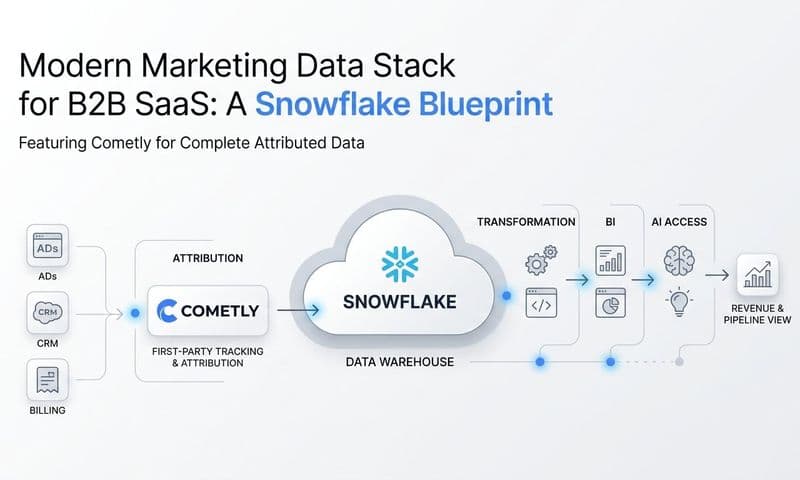
Cometly acts as the attribution layer in this stack. It captures first-party touchpoints and lead source data, and connects ad platforms, your CRM, and your website through 70+ native integrations. From there, the data goes to two destinations: your warehouse and your AI tools.
Data Warehouse Exports
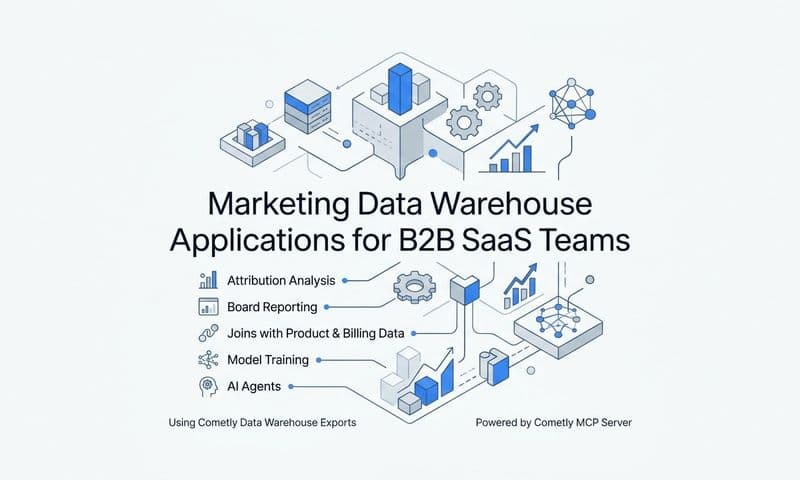
Cometly Data Warehouse Exports deliver raw marketing data as Parquet files with Hive-style partitioning. You can send them to Amazon S3 or Google Cloud Storage buckets that you own, or load them directly into Snowflake and BigQuery. The files also work with Databricks, Athena, and DuckDB.
The available datasets are:
- Ad analytics: a separate dataset for each ad channel, with one row per ad-hierarchy entity per day, using the channel's local date.
- Contacts and companies.
- Raw touchpoints.
- Attributed conversions.
Each export holds a single dataset and has its own cadence and data window, so you can refresh ad analytics on a different schedule than contacts. Because touchpoints, contacts, and attributed conversions arrive together, the shared key problem described earlier is handled before the data reaches your SQL.
The Cometly MCP server
Model Context Protocol (MCP) is a standard that lets AI clients connect to external data sources. The Cometly MCP server lets Claude Desktop, Claude Code, Cursor, and ChatGPT Desktop query Cometly data in natural language, authenticated through OAuth. It offers about 50 read-only tools across ad analytics, events, contacts, companies, reports, segments, integrations, and diagnostics. It cannot create, modify, or delete records, so an assistant can read your data but not change it. You need a Cometly Space with the Use Public API permission, and the endpoint takes the form https://app.cometly.com/mcp/{space_id}/public-api.
Setup details for exports, the MCP endpoint, and the REST Public API are in the Cometly documentation.
One Stack, Three Owners: Putting Each Layer in Charge of Its Own Truth
The strongest stack lets the attribution layer own touchpoint and lead source truth, the warehouse own cross-functional analysis, and AI agents read from both. The CDP joins when activation demands it. Settle the metric definitions first, then assign each to the system best able to produce it.
A practical first step is to set up one export, such as attributed conversions, or connect one AI client through the MCP server, using the setup guides at docs.cometly.com.
Ready to elevate your marketing game with precision and confidence? Discover how Cometly's AI-driven recommendations can transform your ad strategy. Get your free demo today and start capturing every touchpoint to maximize your conversions.