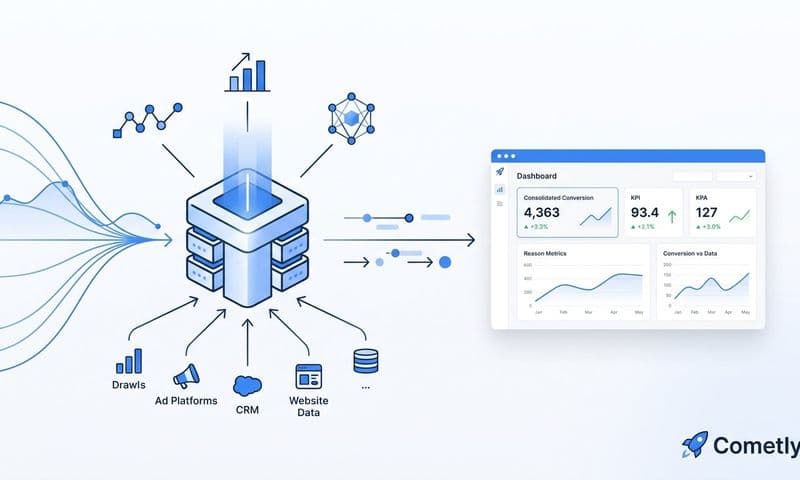

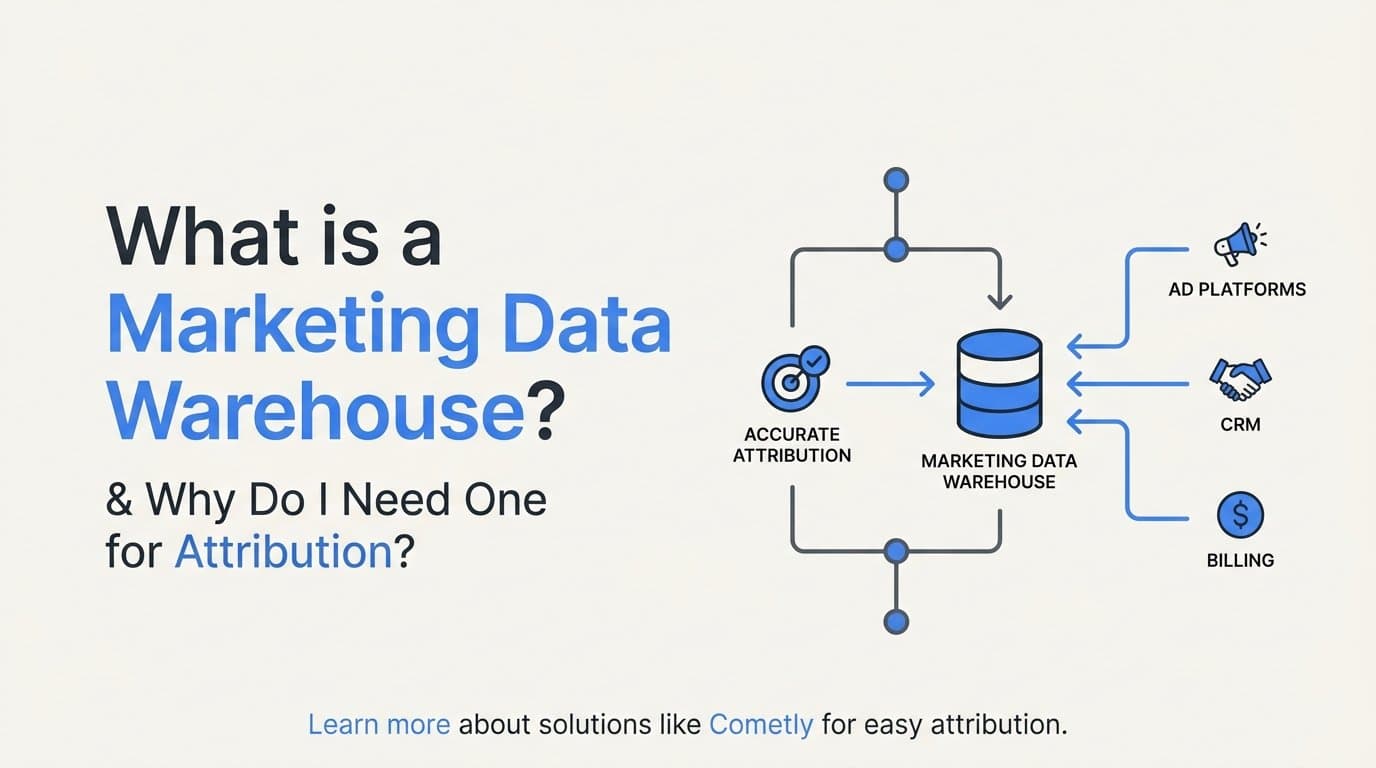
A marketing data warehouse is a centralized repository that consolidates raw event-level data from your ad platforms, CRM, website, and billing tools into one queryable system. You need one for attribution because accurate attribution requires complete, unified data that no single ad platform or analytics tool holds on its own.
If you are a B2B SaaS team that wants attribution-ready data consolidation without building warehouse infrastructure from scratch, Cometly is purpose-built for exactly that. With 70+ native integrations and real-time pipeline-to-revenue tracking, it functions as a managed alternative to a self-built warehouse stack, giving you multi-touch attribution without writing a line of SQL.
The underlying pain point is straightforward: your marketing data is fragmented. Meta reports conversions one way, Google reports them another, your CRM holds deal data in a separate silo, and Stripe sits in yet another system. When your data lives in disconnected tools, every attribution model you run is working with an incomplete picture. The result is misattributed spend, poor budget decisions, and a persistent inability to answer the question every growth leader needs answered: which marketing activities are actually driving revenue?
This article answers five specific questions that marketers and growth teams ask when they start thinking seriously about their data foundation. How does a marketing data warehouse actually work? Why does fragmented data break attribution models? What does your data layer need to support different attribution models? Should you build a warehouse or use a managed attribution platform? And how does a marketing data warehouse differ from other tools like CDPs or Google Analytics?
How a Marketing Data Warehouse Actually Works
Think of a marketing data warehouse as having three distinct layers, each doing a specific job. Understanding these layers is what separates a warehouse from the dashboards and spreadsheets most marketing teams rely on today.
The ingestion layer is responsible for pulling raw event data from every source: ad platforms like Meta, Google, and LinkedIn; your CRM; your website; and your billing system. This happens continuously, capturing events as they occur rather than waiting for a nightly export or a manual download.
The storage layer is where the data lives in a structured schema that preserves event history and timestamps. This is critical. Unlike a dashboard that shows you aggregated totals (clicks: 4,200, conversions: 87), the storage layer keeps every individual event with its full context. A click event carries UTM parameters, device type, session ID, and a precise timestamp. A CRM event carries lead ID, deal stage, and close date. Attribution requires joining these two event streams on a shared identifier, and that join is only possible when both streams are stored at the raw event level.
The query layer is where attribution models actually run. When you want to know which touchpoints contributed to a closed deal, you are running a query across the unified event history, joining ad click events to CRM stage transitions to revenue records. This is not a dashboard calculation. It is a structured query against complete, chronological data.
This architecture is fundamentally different from a spreadsheet or a BI dashboard. Spreadsheets work with aggregated exports; they cannot join raw events across systems. Dashboards visualize data that has already been summarized by the tools feeding them. Neither can perform the event-level joins that attribution modeling requires.
It is also worth distinguishing a data warehouse from a data lake. A data lake stores raw, unstructured data in its original format, which offers flexibility but requires significant transformation work before the data is queryable. A warehouse enforces a schema upfront, which means the data is already structured for analytical queries. For marketing attribution specifically, that structure matters: you need to reliably join ad click events to CRM deal stages and Stripe revenue records, and that requires consistent field names, data types, and identifiers across every source.
Common warehouse technologies include Google BigQuery, Snowflake, Amazon Redshift, and Databricks. These are general-purpose tools that give engineering teams maximum flexibility. Purpose-built attribution platforms like Cometly handle the ingestion, schema management, and query logic on your behalf, so marketing teams get the output of a warehouse without managing the infrastructure.
Why Fragmented Data Breaks Attribution Models
Here is the core problem with relying on ad platform reporting for attribution: every platform counts conversions using its own attribution window and its own counting method. Meta might claim a conversion if someone saw your ad within seven days of converting. Google might claim the same conversion because the user clicked a search ad two days later. LinkedIn might claim it because the user engaged with a sponsored post three weeks earlier.
Sum those reported conversions across platforms and you will almost always overstate performance. The same conversion gets counted multiple times, once by each platform that touched the customer within its attribution window. This double-counting problem is well-documented and it makes cross-channel budget decisions unreliable. A data warehouse solves this by storing raw, deduplicated click and conversion events that you control. You define the attribution logic, not each platform independently.
The CRM gap compounds the problem significantly. Most attribution tools operate at the lead or session level. They can tell you which ad drove a form submission, but they cannot tell you whether that lead became a paying customer six weeks later. That information lives in your CRM, in a completely separate system. Without a unified data layer that connects ad-level touchpoints to CRM deal stages and closed-won revenue, pipeline attribution and revenue attribution are simply not possible. You are left optimizing for leads rather than revenue, which often means optimizing for the wrong thing.
Identity resolution adds another layer of complexity. A single buyer at a target account might encounter your brand through a LinkedIn sponsored post on a work laptop during the morning, run a branded Google search on a personal phone during lunch, and then visit your site directly from a desktop later that week. From the perspective of any individual platform, these look like three different users. From the perspective of your attribution model, they are one buyer on one journey.
A warehouse that stores first-party identifiers, specifically hashed email addresses, user IDs assigned at form submission or sign-up, and persistent session IDs, is the only place where these fragmented signals can be stitched into a single, coherent customer journey. Third-party cookies, which once served as a rough identity layer across the web, are no longer a reliable mechanism due to browser privacy restrictions and their ongoing deprecation. First-party data stored in a warehouse is the durable alternative.
When you look at these three problems together, platform-level double-counting, the CRM disconnect, and cross-device identity fragmentation, it becomes clear why attribution breaks down for most B2B SaaS teams. Each problem is a data gap, and data gaps are a warehouse problem before they are an attribution problem.
What Attribution Models Require From Your Data Layer
Different attribution models have different data requirements, and understanding those requirements helps clarify exactly what your data layer needs to support.
First-touch attribution needs the earliest UTM-tagged session associated with each lead or user ID. If that first session is missing because a browser ad blocker fired before your pixel loaded, the model assigns credit to the wrong touchpoint or defaults to direct traffic.
Last-click attribution needs the session immediately preceding the conversion event. This is the simplest model to run but still requires that the conversion event and the preceding session share a common identifier so they can be joined.
Linear and time-decay attribution need every touchpoint in chronological order with accurate timestamps. A missing touchpoint does not just create a gap; it distorts the weighting across all remaining touchpoints. If three of seven touchpoints are missing, the model distributes credit incorrectly across the four it can see.
Data-driven attribution is the most demanding. It requires a statistically significant volume of complete, multi-touchpoint journeys stored at the event level. The algorithm learns which touchpoint sequences correlate with conversion by analyzing patterns across thousands of journeys. If your data is incomplete, the model learns from a biased sample and produces biased recommendations.
Multi-touch attribution in particular is a query, not a dashboard calculation. You must store every touchpoint event, join them to a conversion event on a shared identifier, sort them chronologically, and then run a weighting algorithm across the full sequence. No dashboard tool does this natively. It requires a data layer that preserves event history at the granular level.
This is where server-side tracking becomes directly relevant to data completeness. Browser-side pixels, the traditional mechanism for capturing ad clicks and page events, are increasingly unreliable. Ad blockers prevent pixels from firing. Safari's Intelligent Tracking Prevention limits cookie lifespans. Firefox blocks third-party tracking by default. The result is that a meaningful portion of real touchpoints never make it into your data layer when you rely exclusively on client-side tracking.
Server-side tracking via Conversion API, specifically Meta's Conversion API and Google's Enhanced Conversions, sends first-party event data directly from your server rather than from the user's browser. These events are not subject to ad blockers or cookie restrictions, so they reach your data layer intact. Cometly's server-side Conversion API integration is designed specifically to close this gap, feeding enriched, complete conversion events into both the attribution data layer and back to the ad platforms to improve their own optimization algorithms.
Do You Need to Build a Warehouse or Use an Attribution Platform?
This is the most practical question most marketing and growth teams face once they understand the data requirements. The honest answer depends on your engineering capacity and how quickly you need results.
A self-managed warehouse built on Snowflake, BigQuery, or Redshift gives you maximum flexibility. You control the schema, the transformation logic, and the attribution SQL. A common modern stack pairs one of these warehouses with a transformation tool like dbt and a data pipeline tool like Fivetran or Airbyte to handle ingestion from ad platforms and CRMs. This path is viable and powerful, but it carries real costs. Building and maintaining ETL pipelines requires data engineering time. Ad platforms change their APIs regularly, and every API change can break an ingestion pipeline. Writing attribution SQL that correctly handles identity resolution, deduplication, and multi-touch weighting is a specialized skill. Schema updates ripple through downstream models. For teams with two or more dedicated data engineers and existing warehouse infrastructure, this is a reasonable investment.
For teams without that engineering depth, a purpose-built attribution platform is the more practical path. Cometly is built specifically for B2B SaaS teams that need revenue attribution without building and maintaining warehouse infrastructure. It provides pre-built connectors to 70+ ad platforms and CRMs, a managed data layer that handles ingestion and identity resolution, and attribution models that run automatically. The Stripe integration is particularly relevant for B2B SaaS: it connects billing revenue directly to ad spend, so you can see cost-per-closed-deal and revenue-per-campaign without writing a single query.
Other managed attribution platforms worth knowing include Rockerbox, which serves both B2B and ecommerce teams, and Northbeam and Triple Whale, which are primarily ecommerce-focused. For B2B SaaS specifically, the CRM-to-revenue join is the critical differentiator. Most ecommerce-focused tools are not built around the longer sales cycles and multi-stakeholder journeys that characterize B2B SaaS buying.
The decision framework is straightforward. If you have fewer than two data engineers and need attribution insights within days rather than months, a managed platform like Cometly is the faster, lower-risk path. If you have existing warehouse infrastructure, dedicated engineering resources, and complex custom data models that a managed platform cannot accommodate, building on your own stack may be the right long-term investment. Many teams start with a managed platform and layer in warehouse connectivity as their data maturity grows.
Related Questions Marketers Ask About Marketing Data Warehouses
What is the difference between a marketing data warehouse and a CDP?
A CDP (Customer Data Platform) is designed to build unified customer profiles for real-time activation: personalization, audience segmentation, and campaign targeting. A data warehouse is designed for analytical queries and attribution modeling. They serve different purposes. A CDP like Segment or Twilio focuses on making profile data available to downstream tools in real time. A warehouse focuses on storing complete event histories that can be queried for attribution analysis. Many teams use both: a CDP for activation and a warehouse for analysis. Some modern CDPs offer warehouse-native modes that blur this line, but the core use cases remain distinct.
Can I use Google Analytics as my marketing data warehouse?
No. Google Analytics stores aggregated, and in some configurations sampled, data with limited raw event export capabilities and retention periods. It does not support the session-to-revenue joins required for multi-touch attribution. Google Analytics 4 improved raw event access through its BigQuery export, which is a step toward warehouse-native analysis, but the platform itself is a reporting layer, not a data warehouse. Using the GA4 BigQuery export as part of a broader warehouse setup is reasonable; treating GA4 alone as your attribution data foundation is not.
How long does it take to set up a marketing data warehouse for attribution?
A self-managed warehouse setup typically takes weeks to months, depending on the number of data sources, the complexity of identity resolution logic, and available engineering capacity. Building reliable ETL pipelines, writing attribution models in SQL, and validating data quality across sources is a substantial project. A managed attribution platform like Cometly can be connected and tracking within days using its native integrations, with attribution models running automatically once data sources are linked.
What data sources should feed a marketing data warehouse for attribution?
At minimum, you need ad platform click and impression data from Meta, Google, and LinkedIn; CRM deal and stage data showing the full pipeline from lead to closed-won; website session and form submission events with UTM parameters and session IDs; and billing or revenue data from Stripe or Chargebee. Each additional source adds a layer of attribution accuracy. For B2B SaaS teams with longer sales cycles, CRM stage data is particularly important because it allows you to attribute revenue to specific campaigns rather than stopping at lead or trial conversion.
Putting It All Together: Building an Attribution-Ready Data Foundation
Start by auditing what you are currently losing. Check your ad blocker rate using a server-side tracking comparison. Look at how many leads in your CRM have no associated ad touchpoint. Identify whether your attribution tool can see closed-won revenue or only top-of-funnel conversions. These gaps tell you how broken your current attribution data foundation actually is.
Then decide whether a managed platform or a self-managed warehouse fits your team. If you have engineering resources and complex data requirements, a Snowflake or BigQuery stack with custom attribution SQL gives you full control. If you need attribution insights quickly and do not have dedicated data engineers, a managed platform removes the infrastructure burden and gets you to accurate data faster.
For B2B SaaS teams specifically, Cometly is built around the problems that matter most in that context. It captures every touchpoint from first ad click to closed-won revenue, handles identity resolution across devices and sessions, and feeds enriched conversion events back to Meta and Google via Conversion API to improve ad platform targeting algorithms. The AI-driven recommendations surface which campaigns and channels are driving actual revenue, not just clicks or leads, so you can scale spend with confidence rather than guesswork. No SQL required, no ETL pipelines to maintain, and no schema updates to manage when an ad platform changes its API.
Attribution accuracy is ultimately a data problem before it is a modeling problem. Get the data foundation right and every attribution model you run becomes more reliable. Get your free demo and see how quickly you can get attribution-ready data without building warehouse infrastructure from scratch.