Managing analytics across a dozen client accounts, five ad platforms, and a dozen reporting deadlines is enough to make any agency team's head spin. The data exists, but turning it into clear, actionable insights that actually prove ROI to each client? That's where most agencies struggle.
The right marketing analytics tool changes everything. It transforms scattered platform data into a coherent story your clients can understand and your team can act on. Whether you need deep attribution accuracy, automated client reporting, or a unified data pipeline, there's a tool built for exactly that problem.
To narrow down this list, we focused on tools that deliver on multi-client management, cross-platform tracking, attribution capabilities, reporting flexibility, and the ability to scale as your agency grows. Here are the top marketing analytics tools agencies are relying on in 2026.
1. Cometly
Best for: Agencies needing accurate cross-platform attribution and AI-powered campaign optimization
Cometly is an AI-powered marketing attribution platform that tracks the full customer journey from ad click to revenue, with server-side tracking and conversion sync built in.
 9 Best Marketing Attribution Platforms to Compare in 2026
Where This Tool Shines
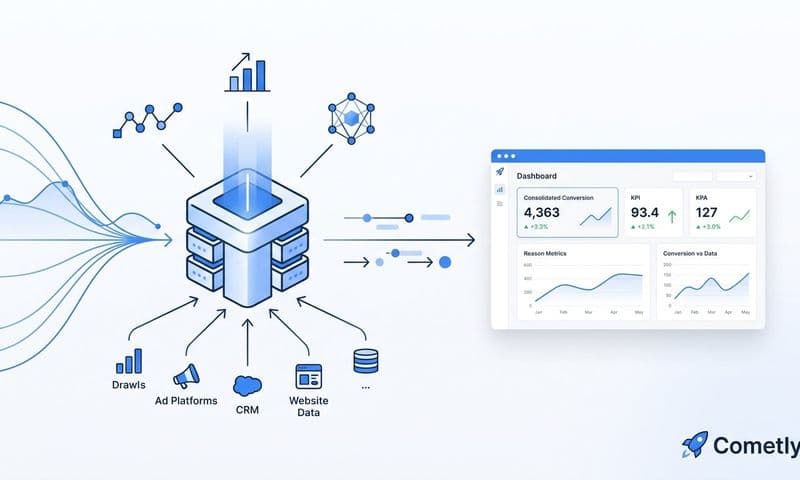
Cometly solves one of the most persistent agency headaches: figuring out which ads are actually driving revenue when every platform tells a different story. By connecting ad platforms, your CRM, and your website into a single attribution view, it gives you a ground-truth picture of campaign performance that no individual platform can provide on its own.
The server-side tracking capability is particularly valuable right now. As browser-based tracking continues to degrade, Cometly's first-party data approach keeps measurement accurate in a cookieless landscape. Add in the AI Chat feature that lets you query your data in plain language, and you have a tool that makes sophisticated analysis accessible to your entire team, not just your data specialists.
Key Features
Multi-Touch Attribution: Tracks every touchpoint across all ad platforms to show which channels and campaigns are genuinely driving conversions and revenue.
Server-Side Tracking: Captures conversion data accurately even when browser-based tracking fails, ensuring your reporting stays reliable regardless of privacy changes.
Conversion Sync: Feeds enriched, first-party conversion data back to Meta, Google, TikTok, and other platforms to improve their algorithmic targeting and ad optimization.
AI-Powered Recommendations: Surfaces budget allocation and campaign scaling suggestions based on actual performance data, so your team spends less time analyzing and more time acting.
AI Chat for Data Analysis: Lets anyone on your team ask natural-language questions about campaign data and get instant, accurate answers without writing a single query.
Best For
Agencies running paid campaigns across multiple platforms for clients who want clear, revenue-tied attribution. Especially strong for teams managing Meta, Google, and TikTok simultaneously where cross-platform data discrepancies are a constant challenge.
Pricing
Custom pricing based on ad spend volume. A demo is available on request, making it easy to evaluate fit before committing.
2. Google Analytics 4
Best for: Agencies needing a free, foundational web analytics layer with deep Google ecosystem integration
Google Analytics 4 is Google's event-based web analytics platform offering cross-device tracking, predictive metrics, and native integration with Google Ads and Search Console.
 11 Best Marketing Analytics Tools to Track and Optimize Campaign Performance in 2026
Where This Tool Shines
GA4 is the baseline for virtually every agency's analytics stack, and for good reason. Its event-based data model is far more flexible than the old session-based approach, letting you track exactly the user interactions that matter for each client without being constrained by predefined hit types.
The free BigQuery export is a standout feature that many agencies underutilize. It opens the door to custom SQL analysis, data blending with other sources, and long-term data retention that goes well beyond GA4's standard limits. For agencies managing clients with significant traffic volumes, this alone justifies the setup effort.
Key Features
Event-Based Data Model: Tracks any user interaction as a custom event, giving agencies the flexibility to measure what matters most for each client's goals.
Free BigQuery Export: Sends raw event data to BigQuery for advanced analysis, custom modeling, and integration with other data sources.
Predictive Audiences: Uses machine learning to identify users likely to convert or churn, enabling smarter remarketing strategies within Google Ads.
Cross-Device Tracking: Follows users across web and app touchpoints using Google signals and user IDs for a more complete journey view.
Native Google Ads Integration: Syncs goals and audiences directly with Google Ads campaigns for seamless optimization and reporting.
Best For
Every agency should have GA4 as a foundational layer. It's particularly essential for clients running Google Ads or SEO campaigns where native integration provides a significant advantage in audience building and conversion tracking.
Pricing
Free for standard use. GA4 360 offers enterprise-grade features and higher data limits at custom pricing for high-volume clients.
3. HubSpot Marketing Analytics
Best for: Agencies managing inbound marketing and lead generation with CRM-tied revenue attribution
HubSpot Marketing Analytics is a CRM-connected analytics suite that ties campaign performance directly to contacts, deals, and closed revenue within HubSpot's ecosystem.
 10 Best Marketing Analytics Software Packages in 2026
Where This Tool Shines
HubSpot's biggest differentiator is the direct connection between marketing activity and CRM data. Instead of stopping at lead generation, you can trace which campaigns influenced which deals and how much revenue they contributed. For agencies working with B2B clients, that closed-loop reporting is often exactly what stakeholders want to see.
The built-in multi-touch attribution models mean you don't need a separate tool to answer questions about first touch versus last touch versus linear credit distribution. Everything lives inside the same platform where the contact and deal data already sits, which dramatically reduces the complexity of building meaningful attribution reports.
Key Features
Revenue Attribution Reporting: Connects marketing touchpoints directly to CRM deals, showing which campaigns influenced pipeline and closed revenue.
Multi-Touch Attribution Models: Offers multiple built-in attribution models so agencies can show clients different perspectives on campaign credit.
Campaign Performance Dashboards: Provides drill-down visibility into campaign results with customizable views for different stakeholders.
Customer Journey Analytics: Maps the full path from first marketing touch through to closed deal for each contact.
Custom Report Builder: A drag-and-drop interface for building reports that combine CRM and marketing data without technical expertise.
Best For
Agencies running inbound marketing, content, or email campaigns for B2B clients already using HubSpot as their CRM. The value diminishes significantly if clients aren't on HubSpot's CRM.
Pricing
Marketing Hub Professional starts at $800/month; Enterprise starts at $3,600/month. Pricing scales with contact list size.
4. Databox
Best for: Agencies that need a single dashboard pulling data from many tools into one clean client view
Databox is a dashboard and reporting platform that aggregates data from 100+ marketing tools into a unified view, with dedicated features for managing multiple client accounts.
 9 Best Ad Platform Reporting Tools to Sharpen Your Campaign Insights in 2026
Where This Tool Shines
Databox excels at the one thing agencies need most: consolidating data from a dozen different tools into a single dashboard that clients can actually understand. Rather than logging into each platform separately, your team gets a live view of all key metrics in one place, and clients can access their own branded dashboards without needing platform credentials.
The benchmark groups feature is a genuinely useful differentiator. It lets agencies compare a client's performance against anonymized data from similar businesses, which adds real context to reporting conversations. Instead of just showing numbers, you can show how a client stacks up against peers in their industry.
Key Features
100+ Native Integrations: Connects directly to Google Analytics, Facebook Ads, HubSpot, Shopify, and dozens of other platforms without requiring a separate data pipeline tool.
Drag-and-Drop Dashboard Builder: Lets agencies build custom dashboards quickly, with a mobile app for on-the-go access.
Automated Goal Tracking: Sets performance targets and sends alerts when metrics are trending off course before they become a client problem.
Agency Partner Program: Provides multi-client management features, white-label options, and agency-specific billing structures.
Benchmark Groups: Compares client performance against anonymized industry peers to add competitive context to reporting.
Best For
Agencies that manage many clients across diverse tool stacks and need a flexible, visual reporting layer that works without heavy technical setup. Particularly strong for agencies that prioritize client-facing dashboards.
Pricing
Free plan available; paid plans start at $59/month. Agency plans with multi-client management are available at custom pricing.
5. Supermetrics
Best for: Agencies that want to pipe marketing data into spreadsheets, BI tools, or data warehouses for custom analysis
Supermetrics is a data pipeline tool that moves marketing data from 150+ sources into the destinations where your team already works, from Google Sheets to BigQuery.
 9 Best Marketing Analytics Tools for Agencies in 2026
Where This Tool Shines
Supermetrics is not a reporting tool in the traditional sense. It's the plumbing that gets your data where it needs to go. If your agency has analysts who live in spreadsheets or a data team building dashboards in Looker Studio or Tableau, Supermetrics removes the manual export-and-paste workflow that wastes hours every week.
The breadth of connectors is its strongest asset. With 150+ source integrations spanning ad platforms, SEO tools, social media, and CRMs, it's rare to encounter a data source Supermetrics can't handle. Automated refresh schedules mean your reports are always pulling fresh data without anyone having to trigger a manual update.
Key Features
150+ Data Connectors: Covers virtually every major ad platform, SEO tool, CRM, and social media channel agencies work with.
Flexible Destinations: Sends data to Google Sheets, Looker Studio, BigQuery, Snowflake, Excel, and more, fitting into your existing workflow.
Automated Data Refresh: Schedules regular data pulls so reports always reflect current performance without manual intervention.
Data Blending: Combines data from multiple sources in a single query, enabling cross-channel analysis in your preferred destination.
Agency Account Management: Supports team access controls and multi-account structures suited to agency workflows.
Best For
Agencies with analysts or data teams who want to build custom reports in spreadsheets or BI tools rather than use a pre-built dashboard platform. Less suited to agencies without technical capacity to build their own reporting layer.
Pricing
Starts at around $39/month per connector. Agency bundles are available for teams managing multiple data sources across many clients.
6. Triple Whale
Best for: Agencies managing e-commerce and Shopify brands that need pixel-based attribution and creative analytics
Triple Whale is an e-commerce analytics and attribution platform built primarily for Shopify brands, combining first-party pixel tracking with creative performance analysis and profitability dashboards.
 9 Best Marketing Analytics Tools for Agencies in 2026
Where This Tool Shines
Triple Whale was built for a very specific use case: direct-to-consumer e-commerce brands running paid ads on Meta, Google, and TikTok while using Shopify as their store. If your agency serves clients in that space, it's one of the most purpose-built tools available. The real-time profit and loss dashboard is especially useful for clients who want to see true profitability after ad spend, not just ROAS.
The creative analytics functionality helps agencies answer a question that's often harder than it looks: which specific ad creatives are actually driving purchases? By connecting creative performance to actual revenue outcomes rather than just clicks or impressions, it gives creative teams clear data to guide their next production cycle.
Key Features
First-Party Pixel: Captures conversion data directly from Shopify stores, reducing reliance on browser-based tracking that's increasingly unreliable.
Creative Performance Analytics: Breaks down ad performance by creative asset to identify which visuals and copy are generating the best results.
Real-Time P&L Dashboard: Shows true profitability after factoring in ad spend, cost of goods, and other expenses in real time.
Multiple Attribution Models: Offers total impact, linear, and other attribution models so agencies can show clients different views of channel credit.
Affluencer Hub: Tracks influencer and affiliate performance alongside paid ad results for a complete acquisition picture.
Best For
Agencies focused exclusively or primarily on Shopify e-commerce brands. The tool is less relevant for B2B, lead generation, or non-Shopify e-commerce clients.
Pricing
Plans start around $100/month and scale with store revenue. Pricing is structured to grow alongside the client's business.
7. Whatagraph
Best for: Agencies that prioritize visually polished, automated client reports with white-label branding
Whatagraph is a cross-channel marketing reporting platform designed specifically for agencies, with automated report delivery, white-label customization, and visual data storytelling built in.
Where This Tool Shines
Whatagraph's entire design philosophy is built around making agency reporting faster and more professional. The pre-built report templates cover most common client reporting scenarios out of the box, and the visual presentation is polished enough that reports look like they were custom-designed rather than auto-generated. For agencies that spend significant time on monthly reporting, the time savings add up quickly.
White-labeling is thorough: custom logos, brand colors, custom domains for report delivery, and branded client portals. Clients receive reports that look like they came directly from your agency, reinforcing your brand rather than advertising the tool you're using.
Key Features
50+ Native Integrations: Connects to major ad platforms, social media channels, SEO tools, and email marketing platforms agencies commonly manage.
White-Label Reports: Fully branded reports with your agency's logo, colors, and domain, keeping your brand front and center with clients.
Automated Report Scheduling: Delivers reports to clients on a set schedule via email, eliminating manual distribution every month.
Cross-Channel Data Blending: Combines data from multiple sources into a single report so clients see their full marketing picture in one place.
Agency Report Templates: Pre-built templates for common reporting scenarios that agencies can deploy immediately and customize as needed.
Best For
Agencies that send regular performance reports to many clients and want to automate that process without sacrificing visual quality or brand consistency.
Pricing
Starts at around $249/month. Agency plans with multi-client pricing are available for larger teams managing many accounts.
8. Mixpanel
Best for: Agencies working with SaaS or app clients who need deep user behavior and funnel analysis
Mixpanel is a product analytics platform focused on user behavior tracking, funnel analysis, and cohort segmentation for web and mobile applications.
Where This Tool Shines
Mixpanel occupies a different space from most tools on this list. Rather than focusing on marketing channel attribution, it focuses on what users do after they arrive. For agencies working with SaaS clients or app developers, understanding where users drop off in a signup funnel or which features drive long-term retention is often just as important as knowing which ad drove the initial click.
The retroactive property analysis is a feature that saves significant time in practice. You can define new user properties or event properties after the fact and apply them to historical data, meaning you don't need to predict every analysis question before you start tracking. That flexibility is genuinely valuable when client reporting needs evolve over time.
Key Features
Event-Based Tracking with Retroactive Analysis: Captures user interactions as events and allows new properties to be applied to historical data after the fact.
Funnel Analysis: Shows conversion rates at each step of any user flow, making it easy to identify where drop-off is happening and why.
Cohort Retention Analysis: Groups users by behavior or acquisition date to track how well different segments retain over time.
A/B Test Analysis: Measures the impact of product experiments on conversion and retention metrics within the same platform.
Interactive Real-Time Dashboards: Provides live views of key product metrics that update as user activity happens.
Best For
Agencies serving SaaS companies, mobile apps, or any digital product where user behavior inside the product is as important as the marketing that drives acquisition.
Pricing
Free plan supports up to 20 million events per month. The Growth plan starts at $28/month and scales with event volume.
9. AgencyAnalytics
Best for: Full-service agencies that want an all-in-one platform combining SEO, PPC, and social reporting with white-label client portals
AgencyAnalytics is an all-in-one reporting and analytics platform built specifically for marketing agencies, combining SEO monitoring, PPC tracking, and social media analytics with white-label client dashboards.
Where This Tool Shines
AgencyAnalytics earns its place on this list by being genuinely purpose-built for agencies rather than adapted from a tool designed for individual brands. The platform handles the full spectrum of services a typical full-service agency delivers: organic search, paid advertising, social media, and email, all in one place. Having built-in SEO tools like rank tracking and site audits means agencies don't need to pay for a separate SEO platform for basic monitoring needs.
The client permission management system is thoughtful. You can give each client access to their own branded dashboard showing only their data, while your team manages everything from a central agency view. Clients feel informed and engaged without getting access to account-level settings or other clients' data.
Key Features
80+ Integrations: Spans SEO, PPC, social media, email marketing, and review platforms so agencies can report on all services from one place.
White-Label Dashboards: Fully branded client portals with custom logos, colors, and domain for a professional client experience.
Built-In SEO Tools: Includes rank tracking, site audit, and backlink monitoring without needing a separate SEO platform subscription.
Automated Report Scheduling: Sends branded reports to clients automatically on weekly or monthly schedules.
Staff and Client Permission Management: Controls exactly what each team member and client can see and access within the platform.
Best For
Full-service digital agencies offering SEO, PPC, and social media services who want a single platform for client reporting, monitoring, and communication without stitching together multiple tools.
Pricing
Starts at $79/month for 5 client campaigns, with pricing scaling per additional campaign. Straightforward per-campaign pricing makes it easy to forecast costs as your client roster grows.
Choosing the Right Analytics Stack for Your Agency
No single tool wins across every category, and the best agencies typically build a complementary stack rather than relying on one platform to do everything. The key is matching tools to the specific problems you're solving.
If attribution accuracy across paid channels is your primary challenge, Cometly belongs at the center of your stack. Its server-side tracking, multi-touch attribution, and conversion sync solve the cross-platform data discrepancy problem that plagues agencies running campaigns on Meta, Google, and TikTok simultaneously. The AI-powered recommendations and AI Chat feature also make it easier for your entire team to act on data, not just analyze it.
For client-facing reporting and dashboard automation, AgencyAnalytics and Whatagraph are strong choices depending on whether you need built-in SEO tools or prioritize visual report design. Databox fits well when your clients use a wide variety of tools and you need a flexible aggregation layer.
If your agency works heavily with e-commerce brands on Shopify, Triple Whale's first-party pixel and creative analytics fill a gap that general attribution tools don't address as precisely. For SaaS or app clients, Mixpanel adds a product analytics layer that complements your marketing attribution data.
Supermetrics and GA4 are foundational for almost every agency: GA4 as a free baseline for web analytics, and Supermetrics as a data pipeline for teams that want to build custom analysis in spreadsheets or BI tools.
The agencies that get the most value from their analytics stack are the ones that start with a clear attribution foundation and build outward from there. Accurate data at the campaign level makes every other reporting and analysis tool more valuable.
Ready to give your agency a clearer picture of what's actually driving client revenue? Get your free demo of Cometly and see how AI-powered attribution can transform the way you analyze and optimize campaigns across every channel.