

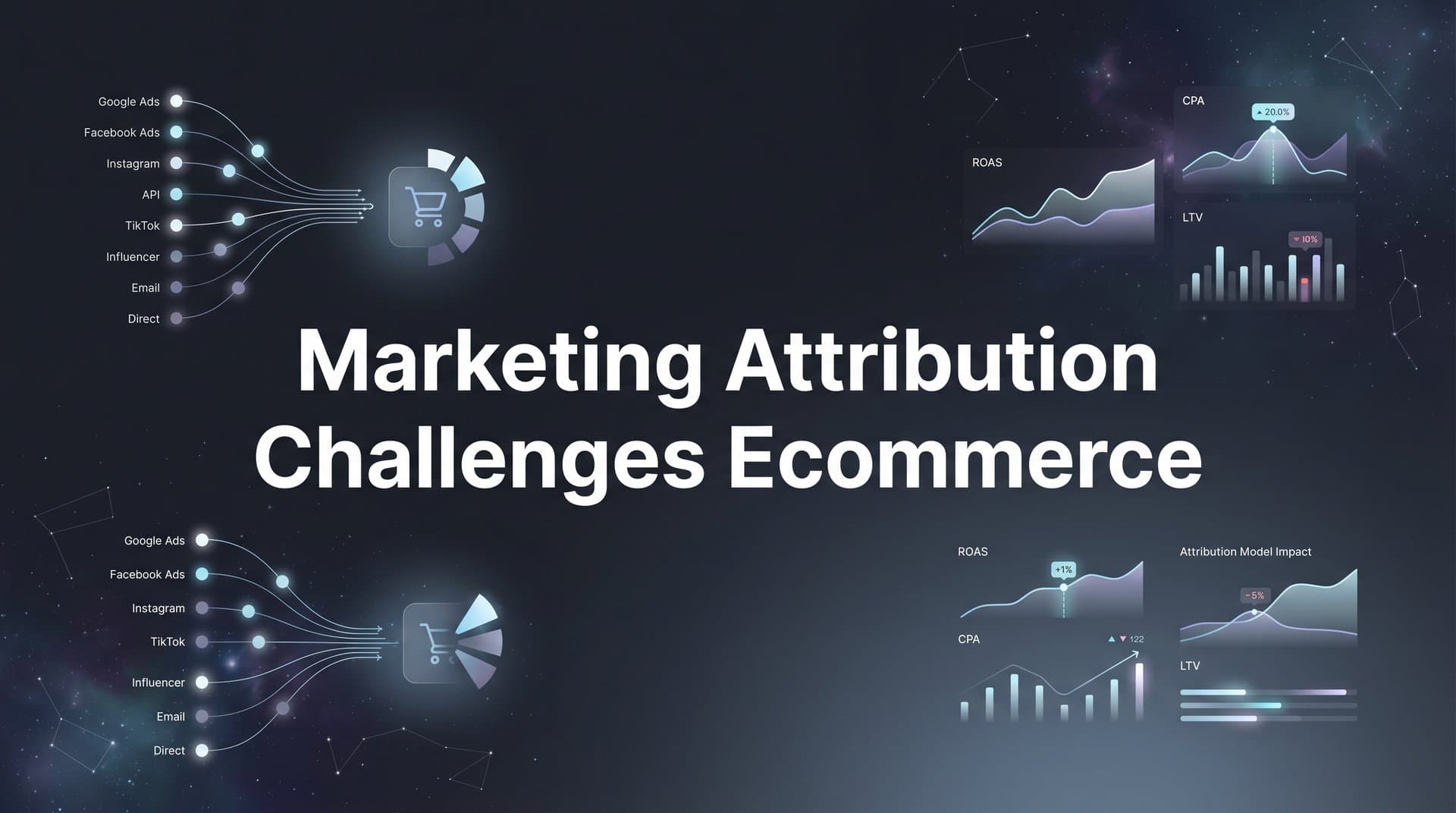
You're staring at three different dashboards, and they're all telling you a different story about the same sale.
Google Analytics says it came from organic search. Meta Ads Manager insists it was their retargeting campaign. Shopify's reports show the customer clicked a Google Shopping ad. Each platform is absolutely certain they deserve the credit, and the numbers don't even come close to adding up.
This isn't a glitch in your reporting. This is the new reality of ecommerce attribution, and it's costing you thousands of dollars in misallocated ad spend every month. The tracking systems that worked perfectly well a few years ago are now giving you fragmented, conflicting data that makes it nearly impossible to know which marketing efforts actually drive revenue.
The truth is, your attribution data is probably lying to you. Not because the platforms are intentionally deceptive, but because the entire infrastructure of digital tracking has fundamentally changed. Privacy updates, multi-device shopping behaviors, and platform limitations have created a perfect storm of attribution chaos that affects every ecommerce brand.
But here's the good news: these challenges are solvable. You just need to understand what's actually broken and how to fix it with modern attribution approaches that work in today's privacy-first landscape.
The Perfect Storm: Why Ecommerce Attribution Broke
The attribution crisis didn't happen overnight. It was the result of several major shifts that converged to break the tracking systems ecommerce brands had relied on for years.
When Apple released iOS 14.5 in 2021, they fundamentally changed the game by requiring apps to ask users for permission to track their activity. The result? Most users opted out. Suddenly, the pixel-based tracking that platforms like Meta had built their entire attribution model around stopped working for the majority of mobile users.
This created an immediate ripple effect across the entire digital advertising ecosystem. Ad platforms could no longer see the complete customer journey, which meant they started making educated guesses about conversions instead of tracking them directly. When platforms cannot confirm whether someone converted or not, they tend to over-report, claiming credit for sales they influenced but cannot verify.
Meanwhile, analytics tools like Google Analytics began under-reporting because they lost visibility into significant portions of the customer journey. The gap between what your ad platforms report and what your analytics show has never been wider, creating common attribution challenges in digital marketing that affect brands of all sizes.
But privacy changes are just one piece of the puzzle. Ecommerce customer journeys have become dramatically more complex. Today's shoppers don't follow a simple path from ad to purchase. They discover products on Instagram, research them on Google, read reviews on their phone during lunch, abandon their cart on desktop at work, receive a retargeting ad on their tablet at home, and finally purchase three days later on their laptop.
That's not an extreme example. That's increasingly typical behavior. Ecommerce customer journeys now span an average of four to six touchpoints across multiple devices before purchase. Each device switch creates a potential tracking gap where the connection between touchpoints gets lost.
The third factor making attribution so challenging is that ad platforms are fundamentally siloed. Meta only sees what happens on Meta. Google only sees what happens on Google. TikTok only sees what happens on TikTok. None of them can see the full picture of how their ads work together with other channels to drive conversions.
This means each platform self-reports inflated numbers because they're only seeing their own slice of the journey. They're not lying, exactly. They're just reporting from an incomplete perspective, and that incomplete data is what you're using to make budget allocation decisions.
The combination of privacy restrictions, complex multi-device journeys, and platform data silos has created an attribution environment where getting accurate data requires a completely different approach than what worked in the past. The old methods are not just less effective. They're actively misleading.
The Five Attribution Roadblocks Every Ecommerce Brand Faces
Understanding what broke is one thing. Recognizing how these issues manifest in your day-to-day marketing is another. Here are the five specific attribution roadblocks that are probably affecting your ecommerce business right now.
Cross-Device Tracking Gaps: Your customer discovers your product in an Instagram ad on their phone during their morning commute. They visit your site, browse a few products, but don't buy because they're on mobile and prefer to complete purchases on desktop. Three days later, they remember your brand, search for it on Google from their laptop at home, and make a purchase.
What does your attribution show? Google Analytics gives all the credit to the Google search because that was the last touchpoint before purchase. Meta sees the initial click but no conversion, so their algorithm thinks that user was not a good prospect. The connection between the Instagram ad that created awareness and the eventual purchase is completely lost.
This happens constantly in ecommerce. Customers research on mobile and buy on desktop. They browse on tablets and purchase on phones. Every device switch creates a potential break in the attribution chain, and those breaks add up to massive blind spots in your data. Understanding attribution for ecommerce stores requires addressing these cross-device challenges head-on.
Last-Click Attribution Bias: Google Analytics defaults to last-click attribution, which means the final touchpoint before purchase gets 100% of the credit. This systematically undervalues everything that happened earlier in the customer journey.
Think about what this means for your marketing strategy. Your awareness campaigns on Meta or TikTok might be doing an incredible job of introducing new customers to your brand. But if those customers don't convert immediately and instead come back later through a Google search or direct visit, last-click attribution gives zero credit to the ads that actually created the opportunity.
You end up making decisions based on data that fundamentally misrepresents how your marketing actually works. You might cut budgets on high-performing awareness campaigns because they're not getting credit for the conversions they're driving.
Platform Data Silos: Your ad platforms, website analytics, and CRM all collect data, but they don't talk to each other. Meta knows about ad clicks. Google Analytics knows about website sessions. Your CRM knows about customer lifetime value and repeat purchases. But none of these systems can connect their data to create a complete view of the customer journey.
This fragmentation means you're constantly trying to piece together insights from multiple incomplete sources. You might see that a customer made a purchase, but you cannot easily connect that purchase back to every marketing touchpoint they encountered along the way. The data exists in different places, but it's not unified in a way that lets you understand cause and effect.
Post-Purchase Attribution Blindness: Most attribution systems stop tracking once the first purchase happens. But in ecommerce, customer lifetime value matters more than first-purchase revenue. A customer who makes one small purchase and never returns is far less valuable than someone who becomes a loyal repeat buyer.
Without post-purchase attribution, you cannot see which acquisition channels bring in customers who actually stick around. You might be spending heavily on channels that drive cheap first purchases but terrible long-term value, while underinvesting in channels that acquire genuinely valuable customers.
Cookie Deprecation and Tracking Prevention: Browsers are increasingly blocking third-party cookies and implementing tracking prevention features. Safari and Firefox already block most tracking by default. Chrome has announced plans to phase out third-party cookies. This means traditional pixel-based tracking is becoming less and less reliable.
When your tracking pixels get blocked, conversions happen but don't get recorded. Your ad platforms think their campaigns are underperforming because they're not seeing all the conversions they're actually driving. This incomplete data feeds into their optimization algorithms, degrading targeting over time.
How Broken Attribution Bleeds Your Ad Budget
Attribution problems are not just annoying reporting issues. They directly cost you money by causing you to make poor budget allocation decisions based on incomplete data.
The most common mistake is over-investing in bottom-funnel channels that get last-click credit while starving the awareness campaigns that actually create demand. When Google Shopping or branded search gets credit for every conversion, it looks like your best-performing channel. So you increase budget there and cut spending on Meta or TikTok campaigns that are not showing direct conversions.
But here's what's actually happening: those awareness campaigns on Meta and TikTok are introducing new customers to your brand. Those customers then search for you on Google and convert. Google gets the credit, Meta gets blamed for poor performance, and you reallocate budget away from the channel that's actually creating new demand.
The result? Your overall conversion volume drops because you're investing less in customer acquisition and more in capturing demand that already exists. You're essentially eating your own seed corn by cutting the marketing that creates future customers. This is one of the most damaging marketing funnel attribution challenges brands face today.
Another way broken attribution bleeds budget is by causing you to kill high-performing campaigns based on incomplete data. A campaign might be driving significant awareness and consideration, contributing to conversions that happen days or weeks later. But if your attribution system only sees immediate conversions, that campaign looks like a failure.
You pause it, thinking you're cutting waste. In reality, you just eliminated a campaign that was working, and you will not see the impact until weeks later when your overall conversion volume mysteriously drops. By then, it's hard to connect the dots back to the campaign you killed.
Perhaps the most insidious way broken attribution costs you money is by feeding bad conversion data to ad platform algorithms. Meta, Google, and TikTok all use machine learning to optimize ad delivery. These algorithms need accurate conversion data to learn which types of users are most likely to purchase.
When your tracking is incomplete and the platforms only see a fraction of actual conversions, their algorithms make poor decisions about who to show ads to. They think certain user segments are not converting when they actually are, so they stop targeting those users. Meanwhile, they over-invest in showing ads to segments where conversions happen to be tracked more reliably, even if those segments are not actually your best customers.
This degradation in targeting efficiency compounds over time. The longer your ad platforms operate with incomplete conversion data, the worse their targeting becomes, and the more you have to spend to achieve the same results. It's a vicious cycle that many ecommerce brands are trapped in without realizing the root cause is their attribution setup.
Multi-Touch Attribution Models: Choosing the Right Lens
Understanding that last-click attribution is flawed is just the beginning. The question becomes: what attribution model should you use instead? The answer is more nuanced than picking a single model and calling it a day.
Different attribution models serve different purposes, and the most sophisticated approach is to compare multiple models side-by-side to get a complete picture of how your marketing works. Selecting the right attribution model for ecommerce marketing depends on your specific business goals and customer journey complexity.
First-Touch Attribution: This model gives all credit to the very first touchpoint that introduced a customer to your brand. It's useful for understanding which channels are best at creating awareness and bringing new potential customers into your ecosystem. If you're focused on growth and customer acquisition, first-touch attribution helps you identify which campaigns are doing the heavy lifting of discovery.
Last-Touch Attribution: Despite its limitations, last-touch attribution is not useless. It shows you which channels are most effective at closing sales and converting ready-to-buy customers. This is valuable information for optimizing your bottom-funnel strategy and understanding what convinces people to actually complete a purchase.
Linear Attribution: This model distributes credit equally across all touchpoints in the customer journey. If someone interacted with five different marketing touchpoints before purchasing, each one gets 20% of the credit. Linear attribution is useful for understanding the full scope of your marketing ecosystem and ensuring that every contributing channel gets some recognition.
Time-Decay Attribution: This approach gives more credit to touchpoints that happened closer to the conversion. The logic is that recent interactions are more influential in the final purchase decision than things that happened weeks ago. Time-decay models work well for ecommerce brands with longer consideration cycles where multiple touchpoints build momentum toward a sale.
Data-Driven Attribution: This is the most sophisticated approach, using machine learning to analyze actual conversion patterns and assign credit based on statistical contribution. Instead of following a predetermined formula, data-driven attribution looks at your specific customer journeys and determines which touchpoints actually increase the likelihood of conversion.
The catch with data-driven attribution is that it requires clean, connected data across your entire funnel to work properly. If your tracking is fragmented and you have gaps in your customer journey data, data-driven models will produce unreliable results. You need a solid foundation of unified tracking before advanced attribution models become useful.
The most valuable approach is not picking one model and ignoring the others. It's comparing multiple attribution models side-by-side to see how credit distribution changes. When you look at first-touch and last-touch attribution together, you can see which channels are great at awareness but weak at conversion, and which channels are great at closing but do not bring in new customers.
This comparative view reveals opportunities for optimization. Maybe you need to improve your retargeting to convert more of the awareness traffic you're generating. Or maybe you need to invest more in top-funnel campaigns because your bottom-funnel channels are saturated and you need more new prospects entering the funnel.
Server-Side Tracking: The Foundation of Accurate Attribution
All the attribution models in the world cannot help you if the underlying tracking data is incomplete and unreliable. This is where server-side tracking becomes essential for modern ecommerce attribution.
Traditional browser-based tracking relies on cookies and pixels that load in the customer's browser. When someone visits your site, tracking scripts fire, cookies get set, and data gets sent to your analytics platforms. This approach worked well for years, but it has become increasingly unreliable as browsers implement tracking prevention and users install ad blockers.
Server-side tracking takes a fundamentally different approach. Instead of relying on browser-based tracking that can be blocked, server-side tracking captures conversion data directly from your server and sends it to ad platforms and analytics tools. This bypasses browser limitations entirely, ensuring that conversions get tracked even when cookies are blocked or pixels fail to load.
The practical impact is significant. Browser-based tracking might only capture 60-70% of actual conversions due to ad blockers, cookie restrictions, and tracking prevention features. Server-side tracking captures conversions directly, giving you a much more complete and accurate picture of campaign performance. Implementing proper ecommerce attribution tracking setup is crucial for capturing this data reliably.
But server-side tracking is not just about capturing more conversions. It's about connecting your entire marketing ecosystem to create a unified view of every customer journey. When you implement server-side tracking properly, you're connecting your ad platforms, website, and CRM into a single system that can see every touchpoint from initial ad click to final purchase and beyond.
This unified tracking is what makes multi-touch attribution actually possible. Without it, you're trying to piece together customer journeys from fragmented data sources that don't communicate with each other. With it, you have a complete record of every interaction that led to every conversion.
There's another crucial benefit to server-side tracking: enriched conversion data. When you send conversion events back to ad platforms through server-side tracking, you can include additional information that browser-based pixels cannot access. Things like customer lifetime value, order details, subscription status, and other CRM data can be passed back to Meta, Google, and other platforms.
This enriched data feeds into ad platform algorithms and dramatically improves their ability to optimize targeting. Instead of just knowing that someone converted, the algorithm knows they converted with a high-value order, became a repeat customer, or fit a specific customer profile. This helps the AI find more customers who match your best buyer patterns.
The feedback loop created by server-side tracking is powerful. Better conversion data leads to better targeting, which leads to more conversions from higher-quality customers, which provides even better data to optimize against. It's a virtuous cycle that compounds over time.
Building an Attribution System That Actually Works
Understanding the problems and solutions is valuable, but the real question is: how do you actually implement an attribution system that solves these challenges? Here's the practical roadmap.
Start with unified tracking that connects all touchpoints from ad click to CRM event in one platform. This means implementing server-side tracking that captures data from your website, ad platforms, and customer database in a centralized system. The goal is to create a single source of truth where every customer interaction is recorded and connected, regardless of device or platform. The right ecommerce attribution tracking solutions can make this process significantly easier.
This foundation is non-negotiable. Every other attribution improvement depends on having clean, connected data across your entire marketing funnel. Without it, you're still trying to solve the puzzle with missing pieces.
Once you have unified tracking in place, use AI-powered analysis to identify which ads and channels genuinely drive revenue, not just clicks or last-touch conversions. Modern attribution platforms use machine learning to analyze conversion patterns and determine statistical contribution across your entire marketing mix.
This goes beyond simple attribution models to provide actionable insights about what's actually working. You might discover that certain ad creatives drive significantly more downstream revenue than others, even if they don't show the best immediate conversion rates. Or you might find that specific audience segments have much higher lifetime value, making them worth paying more to acquire.
The key is moving from descriptive attribution to predictive insights. Instead of just reporting what happened, AI-powered attribution helps you understand what's likely to happen if you make specific changes to your marketing strategy. Leveraging data science for marketing attribution enables this level of sophisticated analysis.
Create feedback loops that continuously improve ad platform performance with accurate conversion data. This means using server-side tracking to send enriched conversion events back to Meta, Google, and other platforms. The more complete and accurate the conversion data you provide, the better their algorithms can optimize targeting and delivery.
This is not a one-time setup. It's an ongoing process of ensuring that your ad platforms receive accurate, timely conversion data that helps their AI make better decisions. As your tracking improves and you capture more complete customer journey data, the quality of your ad platform optimization improves in parallel.
Finally, build a testing framework that lets you validate attribution insights with real-world experiments. Attribution models provide hypotheses about what's driving results, but you should test those hypotheses with structured experiments. Run incrementality tests to measure the true impact of specific channels. Use geo-holdout tests to validate that your attribution model is accurately representing cause and effect.
The combination of unified tracking, AI-powered analysis, enriched conversion data, and systematic testing creates an attribution system that actually works in today's complex ecommerce environment. It's not about finding one perfect attribution model. It's about building a comprehensive system that gives you confidence in your marketing decisions.
Moving Forward with Confidence
Attribution challenges in ecommerce are real, but they're solvable with the right approach and technology. The tracking systems that worked in the past are not coming back. Privacy restrictions will continue to tighten, customer journeys will keep getting more complex, and platform data silos are not going away.
But that does not mean you're stuck making marketing decisions based on incomplete, misleading data. Modern attribution approaches built on server-side tracking, unified data, and AI-powered analysis can give you accurate visibility into what's actually driving revenue.
The brands that solve attribution first gain a massive competitive advantage. While competitors waste budget on misattributed channels and make decisions based on fragmented data, you can confidently scale campaigns that genuinely drive results. You can feed your ad platform algorithms the enriched conversion data they need to find your best customers. You can optimize across the entire customer journey instead of just the last click.
Accurate attribution is not just about better reporting. It's about making confident scaling decisions and maximizing every ad dollar. When you know what's really working, you can invest aggressively in the channels and campaigns that drive profitable growth instead of second-guessing every budget allocation.
The technology to solve ecommerce attribution challenges exists today. Unified attribution platforms can connect your ad platforms, website, and CRM to track every touchpoint in the customer journey. AI-powered analysis can identify what's genuinely driving revenue across your entire marketing mix. Server-side tracking can capture conversions reliably and feed enriched data back to ad platforms to improve their targeting.
Ready to elevate your marketing game with precision and confidence? Discover how Cometly's AI-driven recommendations can transform your ad strategy. Get your free demo today and start capturing every touchpoint to maximize your conversions.


