
Your Google Ads dashboard says you had 47 conversions last month. Your Meta Ads Manager claims 61. LinkedIn is reporting 23. But when your sales team pulls up the CRM, only 38 deals actually closed. So which number do you trust? More importantly, which number do you build your budget around?
This is the reality for most marketing leaders in 2026. You have more dashboards, more data, and more reporting tools than ever before, yet the confidence you feel in your decisions has not kept pace. You find yourself in meetings where different team members cite different numbers for the same campaign, and somehow everyone is technically correct based on the platform they pulled from.
This is marketing data fragmentation, and it is one of the most consequential problems in modern B2B marketing. It is not a reporting inconvenience. It is a structural issue that silently corrupts budget decisions, distorts performance analysis, and makes it nearly impossible to know what is actually driving revenue.
The good news is that it is solvable. This article breaks down exactly what causes fragmentation, how to recognize it in your own stack, and what it takes to build a data foundation that gives you a single, trustworthy view of marketing performance from first ad click to closed deal.
The Fragmentation Problem Nobody Talks About Openly
Marketing data fragmentation happens when your performance data lives in disconnected silos across platforms, tools, and teams, making it impossible to construct a unified, accurate picture of what is working. It is not a new problem, but it has grown dramatically as the number of channels a typical marketing team operates across has expanded.
Think about the average B2B SaaS marketing stack today. You are running paid search on Google, paid social on Meta and LinkedIn, maybe TikTok or YouTube. You have email marketing in HubSpot or Marketo, organic traffic flowing through your website, and sales activity tracked in your CRM. Each of these systems generates data. The problem is that none of them were designed to talk to each other in a coherent, deduplicated way.
Each ad platform has its own native reporting logic. Meta counts conversions based on its own attribution windows. Google uses different windows. LinkedIn has its own methodology entirely. When a buyer clicks a Google ad, sees a retargeting ad on Meta three days later, opens a sales email, and then books a demo, every platform in that chain will claim credit for the conversion. There is no automatic reconciliation between them.
This is the compounding effect that makes fragmentation so damaging. Your total reported conversions across platforms will almost always exceed your actual conversions, often by a significant margin. That means your blended ROAS figures are inflated, your cost-per-acquisition numbers are artificially low, and the performance picture you are optimizing against does not reflect reality.
The root cause is structural. Each platform is incentivized to show its own value, so they are built to capture credit within their own ecosystem. They are not built to give you an honest, cross-platform view of contribution. That job falls to you, and without the right infrastructure, most teams are left manually reconciling spreadsheets and making educated guesses.
For B2B SaaS companies specifically, this problem is more acute than in most industries. Sales cycles are long. They span weeks or months, involve multiple decision-makers, and touch many different channels before a deal closes. A lead that entered through a LinkedIn ad might not convert to revenue for 60 to 90 days. Without coherent cross-channel tracking across that entire journey, you are optimizing based on fragments of a story you cannot fully read.
How Fragmented Data Corrupts Your Marketing Decisions
The attribution overlap problem is where fragmentation does its most direct damage. When Meta, Google, and LinkedIn each independently claim credit for the same closed deal, you cannot trust any single platform's reported ROI. And when you cannot trust the ROI figures, every scaling decision becomes a gamble dressed up as strategy.
Here is a concrete illustration of how this plays out. A prospect sees a Google Search ad and clicks through to your site. They do not convert immediately. A week later, they see a retargeted Meta ad and click again. Two days after that, a sales rep follows up via email and they book a demo. The deal closes three weeks later.
In this scenario, Google will likely count the conversion because the click happened within its attribution window. Meta will also count it because the retargeting click occurred within its window. If LinkedIn ran any impressions during that period, it may count a view-through conversion as well. Your CRM records one closed deal. Your ad platforms collectively report three or four. That gap is not a technical glitch. It is the structural consequence of operating without a unified attribution layer.
The customer journey blind spot compounds this problem. Fragmented data gives you channel-level snapshots rather than a view of the actual path a buyer traveled. You can see that Google drove clicks and that Meta drove clicks, but you cannot see how those touchpoints interacted, which ones were genuinely influential, and which ones were simply present. When you optimize based on channel-level snapshots, you are making decisions based on an incomplete map.
This directly connects to budget waste. Without a unified view, teams routinely over-invest in channels that appear to perform well in isolation but contribute little to actual pipeline. A campaign might show a strong click-through rate and a low cost-per-click in its native dashboard, but if those clicks rarely progress through the funnel to revenue, that spend is not efficient. You would only know that if you could connect the ad data to CRM outcomes, and most teams cannot do that reliably.
The downstream effect on growth conversations is significant. When marketing leaders cannot present a consistent, credible performance narrative, it erodes trust with leadership and finance teams. Budget requests become harder to justify. The argument for scaling a channel that "looks good in the dashboard" carries less weight when the CFO knows the numbers come from a platform with an obvious incentive to report favorably. Understanding the core attribution challenges in marketing analytics is the first step toward fixing this dynamic.
The Technical Reasons Fragmentation Gets Worse Over Time
If fragmentation already felt like a manageable problem a few years ago, the technical landscape has shifted in ways that make it structurally worse. The most significant driver is the degradation of browser-based tracking.
Apple's App Tracking Transparency framework fundamentally changed how iOS devices handle user tracking. When users are prompted to opt out of tracking across apps and websites, the data that flows back to ad platforms through pixels becomes incomplete. Meta's pixel, for example, loses visibility into a meaningful portion of iOS conversions when users decline tracking. The platform still runs the ads. It just cannot see all the results.
The broader deprecation of third-party cookies in browsers has a similar effect. Pixel-based tracking relies on cookies to connect an ad click to a downstream conversion. As browsers restrict or eliminate third-party cookies, those connections break. The result is that platform-reported conversion data increasingly understates actual conversions in some cases, while still over-counting through attribution overlap in others. You get a data environment that is simultaneously inflated and incomplete, which is the worst possible combination for decision-making.
Attribution window conflicts add another layer of distortion. Meta's default attribution setting uses a 7-day click and 1-day view window. Google's default is a 30-day click window. If a conversion happens 10 days after a Google ad click and 2 days after a Meta ad interaction, both platforms count it within their respective windows. Neither platform is lying. They are each reporting accurately within their own defined logic. But without a neutral layer that deduplicates across platforms using your own data, you have no way to reconcile those reports into a single truth.
The first-party data gap is the deepest structural vulnerability. Companies that rely entirely on ad platform pixels and native analytics to measure performance have essentially outsourced their measurement to the platforms they are paying. When those platforms' tracking capabilities degrade due to privacy changes, the measurement degrades with them. Companies that own their first-party event data, collected directly from their own servers and properties, are far more insulated from these shifts.
This is why server-side tracking and Conversion API integrations have become increasingly important. They represent a shift from relying on the browser as the intermediary to sending conversion data directly from your server to ad platforms. That shift bypasses many of the browser-level restrictions that have made pixel tracking less reliable, and it gives you a more durable, privacy-resilient foundation for measurement.
Signs Your Team Is Already Operating With Fragmented Data
Fragmentation is often invisible until you know what to look for. Here are the diagnostic signals that indicate your team is already operating with a fragmented data problem.
Platform conversions consistently exceed CRM deals: If the sum of reported conversions across your ad platforms is significantly higher than the number of deals or qualified leads in your CRM for the same period, you have an attribution overlap problem. This is the clearest and most common symptom of fragmentation.
Different team members cite different numbers for the same campaign: When the paid social manager pulls Meta data, the demand gen lead pulls HubSpot data, and the VP of Marketing pulls a Looker dashboard, and all three numbers are different, that is fragmentation showing up in your team dynamics. It creates confusion, slows decisions, and undermines confidence in the data.
Budget decisions are made based on whichever dashboard looks best: This is a subtle but telling sign. When teams default to the platform that tells the most favorable story rather than a neutral, unified source, it means no neutral source exists. Decisions made this way tend to reinforce existing spend patterns rather than surface what is actually working. Adopting best practices for using data in marketing decisions can break this cycle.
Significant time spent on manual data reconciliation: If your team regularly exports data from multiple platforms, pastes it into spreadsheets, and manually attempts to reconcile the numbers, that process is a direct symptom of fragmentation. It is also an enormous time sink that adds no analytical value and still produces an imperfect result.
The downstream effect on growth decisions is real and measurable. Fragmented data leads to inconsistent messaging to leadership, difficulty proving marketing ROI in terms that connect to revenue, and an inability to confidently scale channels that are genuinely working. When you cannot point to a single, trusted number, every conversation about marketing performance becomes a negotiation rather than a data-driven discussion.
Building a Unified Data Foundation to Eliminate Fragmentation
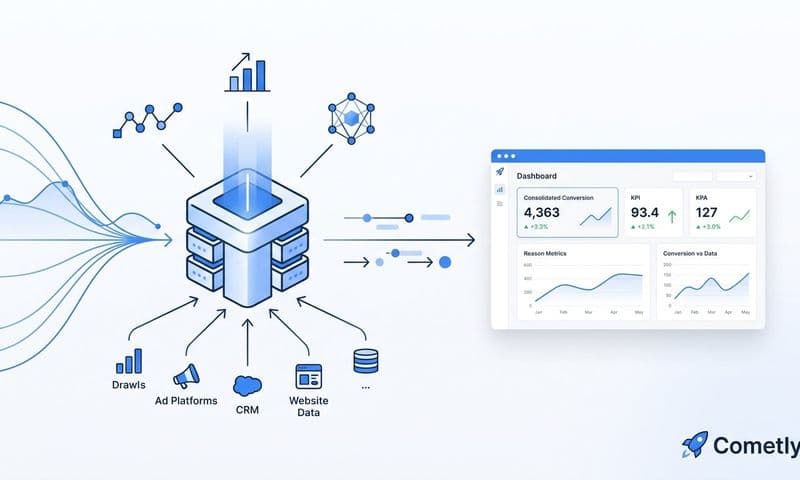
The instinct when confronted with a data problem is often to add more tools. Another analytics platform, another dashboard, another integration. But that approach typically adds complexity without solving the underlying structural issue. The solution to marketing data fragmentation is not more data sources. It is a centralized attribution layer that connects your ad platforms, CRM data, and website events into one consistent, deduplicated view.
This is the single source of truth principle. Rather than asking each platform to report its own performance and then trying to reconcile those reports manually, you build a system where all conversion events flow through a central layer that applies consistent attribution logic and deduplicates across channels. Every team member, every report, and every budget conversation draws from the same underlying data.
The technical foundation for this is server-side tracking combined with Conversion API integration. Here is what that means in plain language. Traditional pixel-based tracking works by placing a small piece of code in the user's browser that fires when a conversion happens and sends that data to the ad platform. The problem is that this process is increasingly disrupted by browser privacy settings, ad blockers, and iOS restrictions.
Server-side tracking moves that data collection off the browser and onto your own server. When a conversion happens, your server sends the event data directly to the ad platform's API rather than relying on the browser to do it. This approach is far more reliable, far less susceptible to browser-level blocking, and gives you direct control over the data that flows to each platform. Conversion API integrations with Meta, Google, and other platforms are built specifically to receive this server-side data.
The analytical framework that sits on top of this technical foundation is multi-touch attribution. Rather than accepting each platform's self-reported, last-click or view-through attribution, a multi-touch model distributes credit across all touchpoints in the actual customer journey based on their real contribution. You can see that the LinkedIn ad introduced the prospect, the Google retargeting ad brought them back, and the email sequence pushed them to book a demo. Each touchpoint gets appropriate credit, and no single platform inflates its own importance. Exploring digital marketing attribution software purpose-built for this model is a practical next step.
For B2B SaaS companies with long sales cycles, this matters enormously. A deal that closes 90 days after the first touchpoint involves many interactions across many channels. Multi-touch attribution makes that entire journey visible and attributable, so you can understand not just which channels drive clicks but which channels drive revenue.
The integration between your ad data and your CRM is the final piece. When your attribution layer connects ad spend to pipeline stages and closed-won revenue, you can finally answer the question that matters most: which marketing investments are actually generating revenue, not just leads? A well-structured marketing attribution data lake makes this connection scalable and reliable.
Turning Unified Data Into Confident Marketing Decisions
Once you have a unified attribution foundation in place, the way you make marketing decisions changes fundamentally. The budget allocation conversation shifts from "this channel looks good in its own dashboard" to "this channel contributes X to pipeline and Y to closed revenue across our entire customer journey." That is a qualitatively different conversation, and it leads to qualitatively better decisions.
When you can see which channels and campaigns actually contribute to pipeline and closed revenue, scaling decisions become evidence-based. You are not scaling based on a platform's self-reported ROAS. You are scaling based on a neutral view of which investments generate real business outcomes. That distinction matters enormously when you are deciding where to put the next dollar of budget. Teams that adopt a rigorous data-driven marketing strategy consistently make faster, more confident scaling decisions.
There is also a compounding benefit for ad platform performance. When you feed enriched, deduplicated conversion events back to Meta and Google through their Conversion APIs, their machine learning algorithms receive better training data. Instead of optimizing toward users who triggered a pixel event in a browser, they optimize toward users who actually converted to customers according to your own first-party data. Over time, this improves targeting quality, reduces wasted spend, and raises the overall efficiency of your paid campaigns.
This is one of the less obvious but highly valuable benefits of solving the fragmentation problem. Clean data does not just improve your reporting. It improves the performance of the ad platforms themselves by giving their AI systems a more accurate signal to optimize against.
The competitive dimension is worth naming directly. Teams that eliminate fragmentation and operate from a single source of truth can iterate faster. They can identify what is working within days rather than waiting weeks to reconcile spreadsheets. They can justify spend increases with confidence because the data is credible. They can have productive conversations with leadership about marketing ROI because the numbers are consistent and connected to revenue outcomes.
Teams that are still operating with fragmented data are spending meaningful time and energy managing the fragmentation rather than acting on insights. They are slower to scale winning campaigns, slower to cut underperforming ones, and less able to make the case for marketing investment when it matters most. Leveraging actionable marketing data rather than siloed platform reports is what separates high-velocity teams from those stuck in reporting cycles.
The gap between these two operating modes compounds over time. Every month you operate with clean, unified data, you make better decisions. Every month you operate with fragmented data, you make decisions based on a distorted picture. That difference accumulates into a meaningful strategic advantage or disadvantage depending on which side of the line you are on.
The Bottom Line on Data Fragmentation
The data chaos that feels familiar to most marketing leaders is not an inevitable consequence of operating across multiple channels. It is a solvable infrastructure problem. Marketing data fragmentation is not just a reporting annoyance. It is a strategic risk that affects every budget decision, every growth conversation, and every campaign optimization you make.
The path forward is clear: build a centralized attribution layer that connects your ad platforms, CRM, and website events into one unified view. Invest in server-side tracking and Conversion API integration to ensure your data collection is durable and privacy-resilient. Apply multi-touch attribution to understand the actual contribution of every touchpoint in the customer journey. And connect your marketing data directly to revenue outcomes so that every spend decision is grounded in business results, not platform-reported metrics.
Cometly is built specifically to solve this problem for B2B SaaS teams. It connects your ad platforms, CRM, and website events into a single source of truth, tracks the entire customer journey from first ad click to closed-won revenue, and feeds enriched conversion data back to Meta and Google to improve ad platform performance over time. If your team is still reconciling spreadsheets or trusting platform dashboards that tell conflicting stories, it is time to fix the foundation.
Get your free demo and see how Cometly gives you a clear, accurate view of which ads and channels are actually driving your pipeline and revenue.