You're running paid campaigns on Google and Meta, publishing content, nurturing leads through email, and still your revenue team can't tell you which channel is actually closing deals. Sound familiar? This is the defining frustration of SaaS marketing, and it's not a creative problem. It's a measurement problem.
Marketing for SaaS operates under a completely different set of rules than e-commerce or traditional B2B product sales. When someone buys a pair of shoes online, the transaction closes in minutes. When a SaaS buyer evaluates your product, they might spend weeks reading comparison articles, attending a webinar, clicking a retargeting ad, joining a free trial, and talking to three different stakeholders before a deal ever lands in your CRM. Attributing that revenue to a single campaign is not just inaccurate, it's actively misleading.
The SaaS teams that scale predictably are not necessarily the ones with the biggest budgets or the most creative ads. They are the ones who have built measurement systems that connect every dollar of spend to pipeline and revenue. This article breaks down the frameworks, channels, funnel architecture, attribution models, and measurement infrastructure that make that possible.
Why SaaS Marketing Plays by Different Rules
The subscription model fundamentally changes what marketing success looks like. In a transactional business, your job is done when someone buys. In SaaS, the sale is just the beginning. A customer who churns after two months may have cost you more to acquire than they ever returned in revenue. That reality forces a different north star metric: the ratio of customer lifetime value to customer acquisition cost, commonly referred to as LTV:CAC.
A healthy LTV:CAC ratio is widely cited as a benchmark for SaaS business health. The implication for marketing is significant: optimizing purely for volume of leads or lowest cost per click can actively destroy value if those leads churn quickly or never convert to paid customers at all. Marketing must be accountable not just for generating interest, but for generating the right kind of interest from buyers who are genuinely fit for the product.
The buying journey compounds this challenge. B2B SaaS decisions rarely happen in a single session. Multiple stakeholders are involved, evaluation periods stretch across weeks or months, and buyers interact with your brand across a wide range of touchpoints before they ever speak to sales. A single ad click does not close a SaaS deal. The customer journey is a sequence of interactions, and understanding which of those interactions matter most is the core attribution challenge.
Then there is churn. Churn is the silent tax on SaaS growth, and marketing has more influence over it than most teams realize. When marketing attracts buyers who are a poor fit for the product, those customers churn faster, drag down net revenue retention, and increase the cost of growth. Aligning marketing messaging with what the product actually delivers, and targeting audiences who match your best customers' profile, is not just a brand exercise. It is a retention strategy.
This is why marketing for SaaS cannot operate in isolation. It needs to be connected to product data, CRM data, and revenue outcomes. The teams that treat marketing as a top-of-funnel activity disconnected from what happens downstream are the ones who find themselves optimizing toward metrics that have no relationship to revenue.
The Core SaaS Marketing Channels and When to Use Each
Not every channel works the same way, and in SaaS, the distinction between demand capture and demand generation is one of the most important strategic concepts you can internalize.
Paid Search (Google Ads): Google Ads excels at demand capture, reaching buyers who are already actively searching for a solution like yours. These are high-intent queries: comparisons, reviews, specific use case searches. The conversion path is shorter here because the buyer has already identified a need. However, demand capture only reaches buyers who are already in-market, which means it scales with existing demand rather than creating new demand.
Paid Social (Meta Ads, LinkedIn Ads): Meta and LinkedIn operate in demand generation territory. You are reaching buyers before they are actively searching, which means the path to conversion is longer and the attribution is more complex. These channels are systematically undervalued by last-click attribution models because the final conversion often appears to come from a branded search or direct visit, not the social ad that originally created awareness and intent. If you are making budget decisions based purely on last-click data, you are almost certainly underspending on demand generation channels.
Content Marketing and SEO: Content builds compounding organic traffic over time, which is one of the few marketing investments in SaaS that genuinely reduces CAC as it matures. Bottom-of-funnel content targeting high-intent queries, such as comparison pages, use case guides, and solution-specific how-tos, tends to convert at meaningfully higher rates than broad awareness content. The trade-off is time: SEO takes months to produce results, which makes it a complement to paid channels rather than a replacement.
Product-Led Growth (PLG): Free trials and freemium tiers blur the boundary between marketing and product. When your product itself is the primary acquisition and activation mechanism, the conversion path includes in-product events that most ad platforms never see. Tracking a user from an ad click through trial signup, through activation milestones, through upgrade, requires measurement infrastructure that goes well beyond a standard pixel. PLG creates real growth leverage, but only if you can actually measure what is driving activation and expansion.
The channel mix that works for your SaaS business depends on your price point, sales motion, and stage of growth. What does not change is the requirement to measure each channel's contribution to pipeline and revenue, not just to clicks and leads.
Building a SaaS Funnel That Connects Ads to Revenue
Most SaaS marketing funnels have a measurement gap. Data flows freely at the top, where ad platforms report impressions, clicks, and form fills with precision. But somewhere between lead and closed-won deal, the thread breaks. Marketing sees cost per lead. Sales sees pipeline. Finance sees revenue. Nobody sees the full picture.
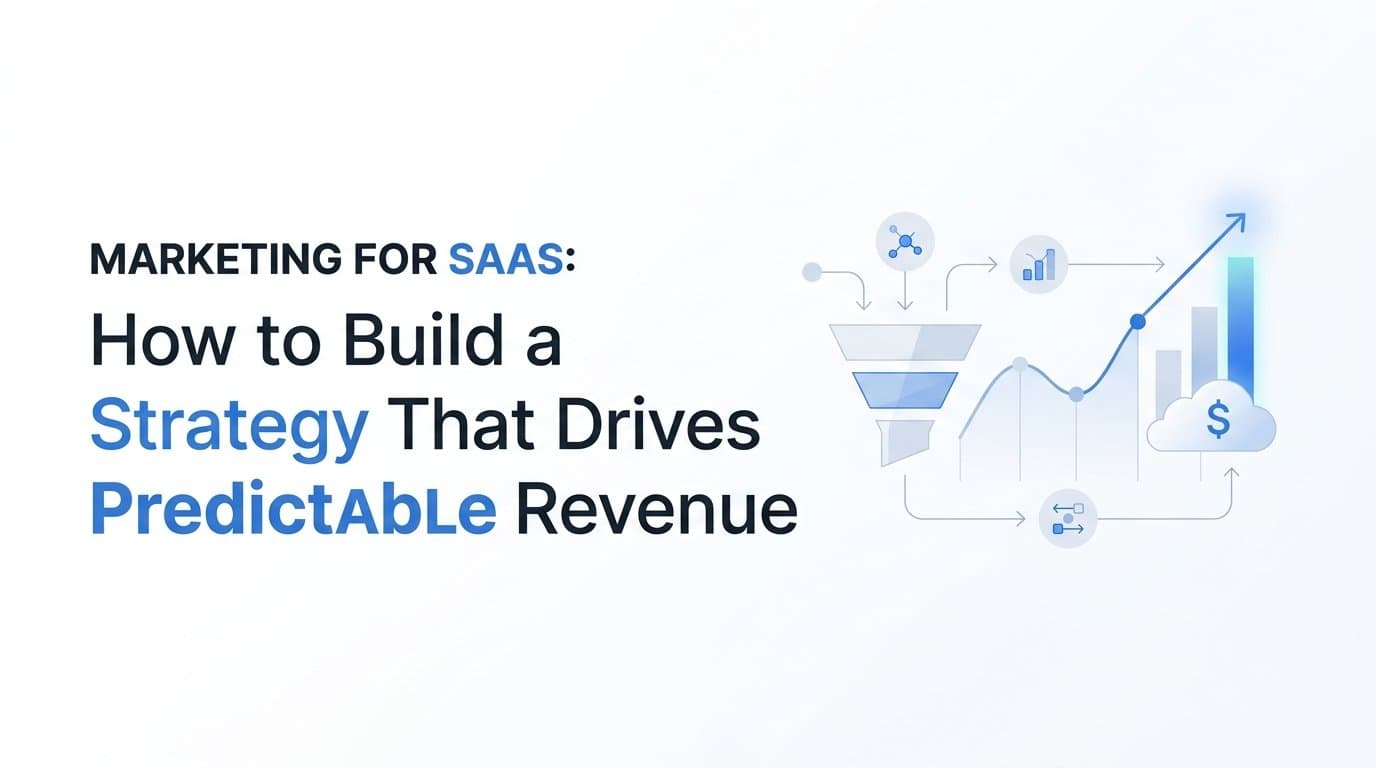
Closing that gap starts with mapping the full funnel as a sequence of defined conversion events. Think of it this way: first ad impression, first click, landing page visit, trial signup or lead form submission, sales qualified lead, opportunity created, and closed-won deal. Each of these stages is a conversion event, and each one should feed data back into your attribution system. If you are only tracking the middle of that sequence, you are making budget decisions with incomplete information.
The most common mistake SaaS marketing teams make is optimizing ad campaigns toward cost per lead rather than cost per closed deal. These are not the same metric, and in many cases they point in opposite directions. A campaign that generates a high volume of cheap leads from an audience that rarely converts to paying customers will look great in your ad platform and terrible in your CRM. Optimizing for it will consistently produce the wrong outcome.
Pipeline attribution solves this by connecting your CRM data with your ad platform data. When a deal closes in Salesforce or HubSpot, that event should be traceable back to the original ad campaign, ad set, and creative that started the customer journey. With that connection in place, you can calculate true cost per acquisition, cost per opportunity, and cost per closed deal, segmented by channel, campaign, and audience.
This kind of funnel architecture requires a few things to work properly. You need consistent UTM tracking across all paid channels. You need a CRM that captures lead source data and preserves it through the pipeline stages. And you need an attribution system that can join ad platform data with CRM data at the individual lead or contact level. When those pieces are in place, the funnel stops being a black box and becomes a decision-making tool.
Attribution Models That Actually Make Sense for SaaS
Attribution models are the rules your measurement system uses to assign credit for a conversion across the touchpoints that preceded it. For SaaS, where the customer journey spans weeks and dozens of interactions, choosing the right model is not a minor technical detail. It shapes every budget decision you make.
First-touch attribution gives all credit to the channel or campaign that generated the very first interaction. This is useful for understanding what is driving awareness and filling the top of the funnel. If you want to know which channels are introducing new buyers to your brand, first-touch data tells that story. The limitation is that it ignores everything that happened after that initial touchpoint, which in a long SaaS sales cycle is most of the journey.
Last-click attribution does the opposite: it credits the final touchpoint before a conversion. In SaaS, that final touchpoint is frequently a branded search or a direct visit, because buyers who are ready to convert often return to your site by searching your brand name or typing your URL directly. Last-click attribution therefore tends to over-credit branded search and direct traffic while systematically undercrediting the demand generation campaigns that created awareness and intent in the first place. If your paid social spend looks inefficient on a last-click basis, this is often why.
Multi-touch attribution distributes credit across the full sequence of touchpoints, giving SaaS marketing teams a more accurate picture of how channels work together across the buying journey. Linear models distribute credit equally. Time-decay models weight later touchpoints more heavily. Position-based models give extra credit to the first and last touchpoints. Data-driven models use machine learning to assign credit based on observed conversion patterns, which is the most accurate approach when you have sufficient conversion volume to support it.
For most SaaS marketing teams, multi-touch attribution is the right direction. It acknowledges the reality of how SaaS buyers actually behave, and it prevents the systematic misallocation of budget that comes from relying on first-touch or last-click models alone.
The Measurement Stack Every SaaS Marketing Team Needs
Getting attribution right in SaaS is not just about choosing the right model. It requires the right measurement infrastructure underneath it. And for most teams, that infrastructure has at least one critical gap: unreliable conversion tracking at the browser level.
Browser-based pixel tracking has become significantly less reliable over the past few years. Ad blockers, iOS privacy changes, and increasing cookie restrictions mean that a meaningful portion of conversions that happen on your site are never reported back to your ad platforms. The result is under-reported conversion data, which distorts your optimization signals and causes your ad platform's algorithms to make worse decisions about who to target and how to bid.
Server-side conversion tracking and Conversion API (CAPI) integrations address this directly. Instead of relying on a browser pixel to fire when a user converts, server-side tracking sends the conversion event directly from your server to the ad platform. This approach is far less susceptible to blocking and signal loss, and it gives Meta and Google a more accurate and complete picture of which ad interactions are producing results. For SaaS companies running significant paid budgets, implementing CAPI is not optional. It is foundational.
First-party data enrichment is the next layer. When a user fills out a form or signs up for a trial, that event should be enriched with the original ad click data, the UTM parameters, the campaign and ad set identifiers, and then connected to whatever happens downstream in your CRM. This creates a continuous thread from the first ad interaction to the eventual revenue outcome, and it gives your ad platforms the signal quality needed for accurate audience targeting and algorithmic optimization.
The third component is a centralized attribution platform that pulls data from your ad channels, your CRM, and your website into a single view. Without this, you are left reconciling discrepancies between what Google Ads reports, what Meta Ads reports, and what your CRM shows. Those discrepancies are not just inconvenient. They lead to conflicting interpretations of performance and budget decisions made on incomplete data. A single source of truth eliminates that problem and gives your entire team a shared, accurate understanding of what is driving revenue.
Scaling SaaS Marketing with Confidence
Scaling ad spend is straightforward when you know what is working. It becomes a high-risk exercise when you do not. Increasing budget on a campaign that looks strong in your ad platform but generates poor-quality pipeline is not growth. It is an expensive way to generate churn.
The prerequisite for confident scaling is accurate attribution down to the pipeline and revenue level. Before you increase spend on any campaign, you should be able to answer: what is the cost per opportunity this campaign generates, and what is the cost per closed deal? If you can answer those questions with confidence, scaling becomes a straightforward ROI calculation. If you cannot, you are essentially guessing.
AI-driven insights add another dimension to this. Modern attribution platforms can surface which ads, audiences, and channels are generating the highest-quality leads, not just the highest volume. That distinction matters enormously in SaaS, where lead quality varies significantly by source and audience segment. Rather than relying on gut instinct or platform-reported ROAS, you can make reallocation decisions based on which campaigns are actually contributing to pipeline and revenue.
There is also a compounding advantage to clean data that builds over time. As your attribution system collects more first-party signals and feeds them back to ad platforms via CAPI and enhanced conversions, the targeting algorithms improve. Better signals mean better audience matching, which means higher conversion rates and lower CAC over time. The teams that invest in measurement infrastructure early do not just get better reporting. They get better-performing campaigns, because the data quality feeding their ad platforms is higher than their competitors'.
This compounding effect is one of the strongest arguments for treating measurement as a core competency rather than an afterthought. Every enriched conversion event you send back to Meta or Google is an investment in future campaign performance.
Putting It All Together
Marketing for SaaS is as much a measurement discipline as it is a creative or channel discipline. The teams that win are not always the ones with the most sophisticated campaigns. They are the ones who can connect every dollar of spend to pipeline and revenue, then use that clarity to make faster, smarter decisions about where to invest next.
That requires the right funnel architecture, the right attribution model, and the right measurement infrastructure working together. It requires server-side tracking to capture the conversions your pixels are missing. It requires CRM integration to connect leads to closed deals. And it requires a platform that brings all of that data into a single, coherent view.
This is exactly the problem Cometly is built to solve. Cometly is a marketing attribution and analytics platform designed specifically for B2B SaaS companies, connecting your ad platforms, CRM, and Stripe revenue data to track the entire customer journey from first ad click to closed-won deal. With multi-touch attribution, server-side conversion tracking, Conversion API integration, and AI-driven recommendations, Cometly gives your team a single source of truth for marketing performance and the insight needed to scale with confidence.
If you are ready to stop making budget decisions based on cost per lead and start making them based on cost per closed deal, Get your free demo and see how Cometly connects your ad spend directly to revenue.