

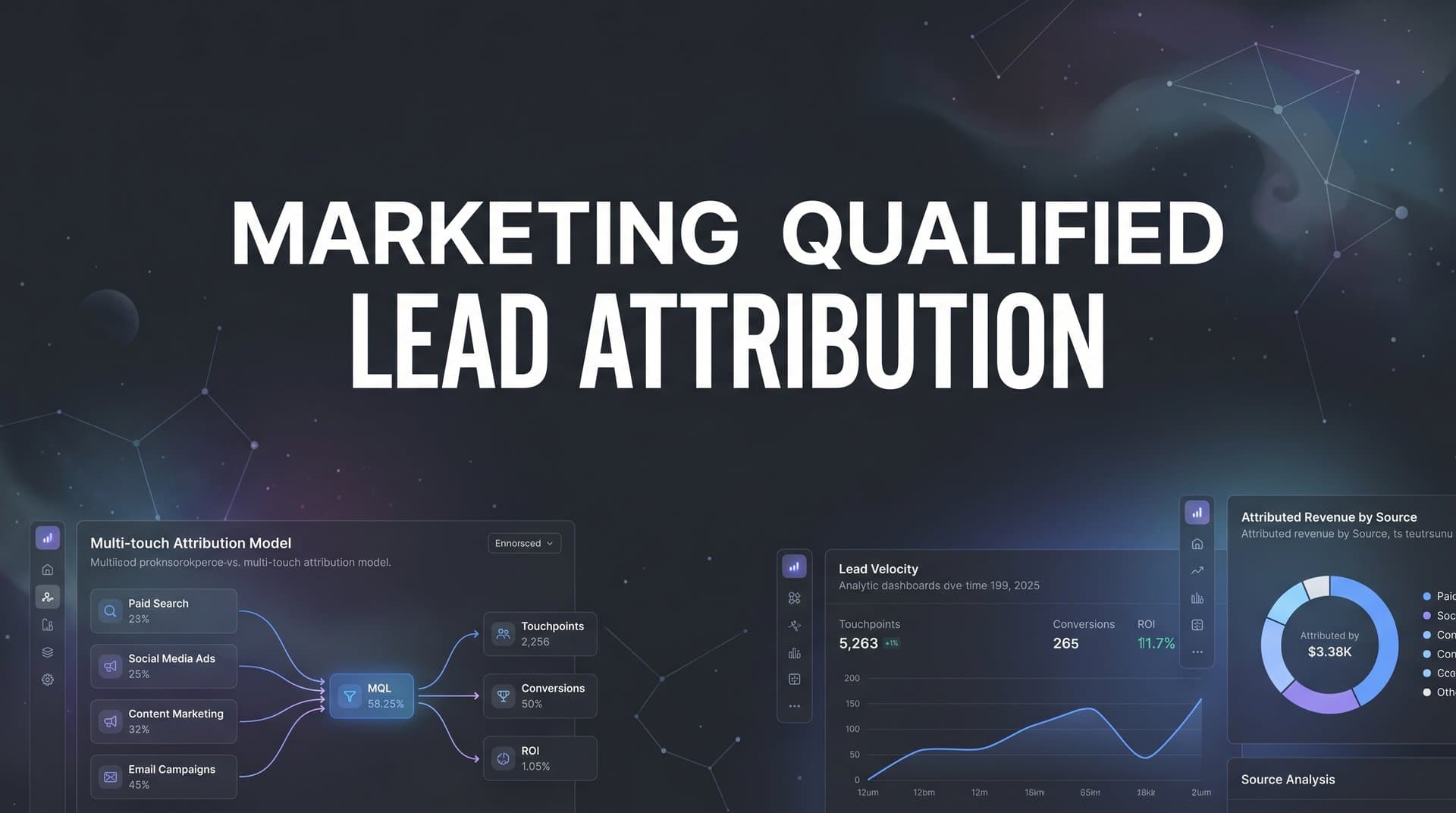
You've spent thousands on ads this month. Leads are flowing into your CRM. Your sales team is working them. But here's the question that keeps you up at night: which campaigns actually generated the leads your sales team wants to talk to?
Most marketing teams operate in a frustrating fog. They can see which ads got clicked. They can see form submissions. They can even see which leads got marked as Marketing Qualified Leads in the CRM. But connecting those three dots? That's where the visibility breaks down.
The result is predictable and expensive. You scale campaigns based on surface-level metrics like clicks and raw lead volume, only to discover later that those leads never converted to opportunities. Meanwhile, the campaigns quietly generating your best MQLs get overlooked because they don't look impressive in your ad platform dashboard.
Marketing qualified lead attribution solves this visibility gap. It connects your ad spend directly to the leads that sales actually qualifies and works. Instead of guessing which campaigns deserve more budget, you know exactly which sources generate MQLs that turn into pipeline. This article breaks down how MQL attribution works, why it matters more than vanity metrics, and how to implement it across your marketing stack so you can stop guessing and start scaling what actually converts.
The MQL Visibility Problem Most Marketing Teams Face
Here's what typically happens in most marketing operations. Someone clicks your Facebook ad, visits your website, and fills out a demo request form. Your ad platform records a conversion. Your analytics tool captures a form submission. Everything looks great in your dashboard.
Then the lead hits your CRM. Your sales development team reviews it. Maybe they do some qualification calls. A week later, the lead gets marked as an MQL because they meet your criteria: right company size, actual budget, genuine interest. That's when the value becomes real.
But here's the problem: your ad platform has no idea that MQL qualification happened. It thinks all leads are created equal. The person who downloaded a random ebook and never responded to outreach looks exactly the same as the qualified prospect who's ready for a sales conversation. Your optimization algorithms can't tell the difference.
Standard analytics tools make this worse. Most tracking stops at the form submission. Google Analytics shows you the source of the form fill, but it doesn't follow that lead through your sales process. When your rep marks someone as an MQL three days later, that qualification event lives in your CRM, completely disconnected from the marketing data that brought them in. Understanding marketing attribution vs Google Analytics helps clarify why native tools fall short.
The disconnect between ad platforms and CRM qualification creates a massive blind spot. You're optimizing campaigns based on incomplete data. Your Meta ads might be generating tons of form fills, but if none of them qualify as MQLs, you're burning budget on the wrong audience. Meanwhile, your LinkedIn campaign might generate fewer leads overall, but if most of them become MQLs, that's where your budget should go.
This visibility gap leads directly to misallocated budgets. Teams scale campaigns that generate high lead volume without asking whether those leads actually qualify. They cut campaigns that look expensive per lead without realizing those leads convert to MQLs at twice the rate. The result is predictable: wasted spend on low-quality sources and missed opportunities to scale what's actually working.
How Marketing Qualified Lead Attribution Actually Works
Marketing qualified lead attribution tracks the complete journey from the moment someone clicks your ad to the moment they get marked as an MQL in your CRM. It maintains the connection between marketing touchpoints and sales qualification events, even when those events happen days or weeks apart.
The foundation is identity resolution. When someone clicks your ad, proper attribution tracking captures their unique identifier along with the campaign details. As they move through your website, that identifier stays with them. When they fill out a form, you connect that identifier to their contact record in your CRM. Later, when your sales team qualifies them as an MQL, the system already knows which campaigns influenced that person's journey.
Server-side tracking plays a crucial role here. Browser-based tracking faces limitations from cookie restrictions, ad blockers, and iOS privacy features. These barriers mean you lose tracking data for a significant portion of your visitors. Server-side tracking bypasses these limitations by sending conversion data directly from your server to your analytics platform, maintaining accuracy even when browser tracking fails.
The technical flow looks like this: Someone clicks your Google ad with UTM parameters. Your tracking system captures those parameters and assigns a unique identifier. They browse your site, and server-side tracking maintains that identifier across pages. They submit a demo request, and the form submission sends data to both your CRM and your attribution platform. Your attribution system connects the CRM contact ID to the original ad click data. Days later, when your SDR marks them as an MQL in the CRM, that qualification event flows back to your attribution platform, completing the connection. The right lead attribution software for marketing automates this entire process.
Connecting ad platform IDs to CRM records is where the real power emerges. Modern attribution platforms can match the Facebook Click ID or Google Click ID from the original ad interaction to the contact record in your CRM. This direct connection means you can see exactly which ad creative, which audience, and which campaign generated each qualified lead.
The data enrichment happens in both directions. Your attribution platform receives MQL qualification events from your CRM and connects them back to the original marketing touchpoints. At the same time, it can send enriched conversion data back to your ad platforms, teaching their algorithms which types of users actually become qualified leads. This feedback loop improves campaign optimization over time.
What makes this different from basic lead tracking is the persistence across time and systems. Basic tracking tells you someone filled out a form. MQL attribution tells you that person became a qualified lead, which campaigns they interacted with along the way, and how much you spent to generate that qualification. That's the difference between surface metrics and actual business value.
Single-Touch vs Multi-Touch Models for MQL Attribution
Choosing the right attribution model determines how you distribute credit across the campaigns that influenced each MQL. The model you select shapes how you interpret performance data and where you allocate budget.
First-touch attribution assigns all credit to the initial campaign that brought someone into your funnel. If a prospect first discovered you through a LinkedIn ad, that campaign gets 100% credit for the eventual MQL, regardless of what happened afterward. This model makes sense when you're focused on demand generation and want to understand which campaigns are best at creating awareness with your target audience.
First-touch works well for teams with shorter sales cycles or when you're primarily concerned with top-of-funnel efficiency. If most people who become MQLs do so quickly after their first interaction, giving full credit to that initial touchpoint reflects reality. It's also simpler to explain to stakeholders and easier to act on since you're optimizing for one clear metric: which campaigns bring in new prospects who eventually qualify. For a deeper dive into model selection, explore what is a marketing attribution model.
Multi-touch attribution distributes credit across all the campaigns someone interacted with before becoming an MQL. If a prospect clicked a Facebook ad, later engaged with a retargeting campaign, and then converted through a Google search ad, all three campaigns receive partial credit. The exact distribution depends on which multi-touch model you choose: linear gives equal credit to all touchpoints, time-decay gives more credit to recent interactions, and position-based emphasizes the first and last touchpoints.
Multi-touch models reveal the full campaign mix that nurtures leads to qualification. They're particularly valuable for longer sales cycles where prospects typically interact with multiple campaigns before they're ready to talk to sales. If your average prospect takes weeks or months to move from awareness to MQL status, multi-touch marketing attribution platforms show you which combination of campaigns works together to move people through that journey.
The right model depends on your specific situation. Consider your sales cycle length first. If most MQLs qualify within days of their first interaction, first-touch attribution probably reflects your reality. If qualification typically takes weeks and involves multiple touchpoints, multi-touch models provide more actionable insights.
Your marketing mix matters too. If you run a simple funnel with mostly top-of-funnel campaigns and minimal retargeting, first-touch makes sense. If you run sophisticated nurture sequences with multiple campaign types working together, multi-touch attribution helps you understand how those campaigns complement each other.
Many teams start with first-touch attribution for its simplicity, then graduate to multi-touch models as their marketing becomes more sophisticated. The key is choosing a model you'll actually use to make decisions, not the most complex option that sounds impressive but creates analysis paralysis.
Setting Up MQL Attribution Across Your Marketing Stack
Implementing marketing qualified lead attribution requires connecting three core systems: your ad platforms, your website tracking, and your CRM. Each integration serves a specific purpose in maintaining the connection between ad spend and qualified leads.
Start with your ad platform integrations. Connect Facebook Ads, Google Ads, LinkedIn Ads, and any other paid channels you use. These integrations capture campaign data, ad creative details, and unique click identifiers. The click IDs are particularly important since they allow you to match ad clicks to specific conversions later, even when cookie tracking fails.
Your website tracking infrastructure comes next. Implement both client-side and server-side tracking to maximize data accuracy. Client-side tracking captures user behavior in the browser, while server-side tracking ensures conversion data reaches your analytics platform even when browser limitations interfere. Server-side tracking has become essential as browser privacy features and ad blockers increasingly block traditional tracking methods. Comprehensive attribution marketing tracking requires both approaches working together.
CRM integration completes the loop. Your attribution platform needs to receive lead data from your CRM, including when leads get marked as MQLs. This typically works through webhooks or API connections that push qualification events in real time. When your sales team changes a lead status to MQL in Salesforce or HubSpot, that event should flow immediately to your attribution platform so it can connect the qualification back to the original marketing touchpoints.
Defining MQL criteria consistently is critical for meaningful attribution data. If different team members use different standards for what qualifies as an MQL, your attribution data becomes unreliable. Document your MQL criteria clearly: company size requirements, budget indicators, timeline expectations, and decision-maker involvement. Make sure your sales development team applies these criteria consistently when qualifying leads in your CRM.
UTM parameter hygiene matters more than most teams realize. Establish naming conventions for your campaign parameters and enforce them across your team. If one person uses "facebook" and another uses "fb" in their UTM source tags, you'll fragment your attribution data. Create templates for common campaign types and make them easy for your team to use correctly.
Conversion sync feeds your MQL data back to ad platforms, teaching their optimization algorithms which users actually become qualified leads. When you send MQL conversion events back to Facebook or Google, their systems learn to find more people who match the characteristics of your qualified leads. This creates a virtuous cycle: better attribution data leads to better ad targeting, which generates higher-quality leads, which provides even better data for optimization.
The technical setup typically involves creating custom conversion events in your ad platforms, then configuring your attribution system to send MQL qualification events to those platforms using their conversion APIs. This requires some technical implementation, but the performance improvement makes it worthwhile. Ad platforms optimize much more effectively when they know which conversions actually matter to your business.
Using MQL Attribution Data to Optimize Campaign Performance
Once you're tracking MQL attribution, the real value comes from using that data to make smarter budget decisions. The insights you gain should directly inform which campaigns you scale, which you pause, and where you test new approaches.
Start by identifying which campaigns generate MQLs that actually convert to opportunities. Your attribution dashboard should show you not just MQL volume by source, but MQL-to-opportunity conversion rates. A campaign might generate lots of MQLs, but if those MQLs rarely advance to opportunities, the quality isn't there. Conversely, a campaign with lower MQL volume but higher opportunity conversion rates deserves more investment. Understanding channel attribution in digital marketing revenue tracking helps you connect these dots.
Calculate true MQL cost for each campaign and channel. This goes beyond cost per lead to show you what you're actually paying for qualified prospects. If your Facebook campaign generates leads at fifty dollars each but only 20% become MQLs, your real cost per MQL is two hundred fifty dollars. If your LinkedIn campaign costs one hundred dollars per lead but 60% become MQLs, your actual MQL cost is only one hundred sixty-seven dollars. The LinkedIn campaign is more efficient despite appearing more expensive at the surface level.
Reallocate budget based on these MQL economics rather than vanity metrics. Many teams optimize for cost per lead or cost per click without considering lead quality. MQL attribution lets you optimize for what actually matters: the cost of generating leads that sales wants to work. Shift budget away from high-volume, low-quality sources toward campaigns that generate fewer but better-qualified prospects.
Build lookalike audiences from your highest-quality MQL sources. Export lists of contacts who became MQLs from your best-performing campaigns, then upload those lists to your ad platforms to create lookalike audiences. These audiences are based on people who actually qualified, not just anyone who filled out a form. The targeting precision improves dramatically when you're modeling from real qualified leads rather than raw conversion data.
Use attribution data to inform creative testing. If certain ad creatives consistently generate MQLs with higher opportunity conversion rates, analyze what makes them different. Maybe they set clearer expectations about your product, attracting more qualified prospects from the start. Use those insights to guide your next round of creative development.
Review your attribution data weekly to catch trends before they become expensive problems. If a campaign's MQL quality starts declining, you want to know immediately, not after you've spent another ten thousand dollars. Set up alerts for significant changes in MQL conversion rates or MQL cost so you can investigate and adjust quickly.
Putting MQL Attribution Into Practice
Implementation success starts with clear MQL definitions and consistent CRM tagging. Document exactly what qualifies someone as an MQL in your organization. Make sure everyone on your sales development team understands and applies these criteria uniformly. Inconsistent qualification creates noisy data that undermines your attribution insights.
Review your attribution data weekly, not monthly. Marketing performance shifts quickly, and monthly reviews mean you're working with stale information. Set up a recurring meeting to examine MQL attribution by source, identify trends, and make budget adjustments. This regular cadence keeps your spending aligned with what's actually working. The right marketing attribution analytics platform makes these reviews efficient and actionable.
Connect attribution insights to revenue outcomes for full-funnel visibility. MQL attribution is powerful, but linking those MQLs to closed revenue makes the business case undeniable. Track which campaigns generate MQLs that become customers, and calculate customer acquisition cost by original marketing source. This complete view shows you not just which campaigns generate qualified leads, but which campaigns generate profitable customers.
Start small if you're new to attribution. You don't need to implement every feature and integration on day one. Begin with your highest-spend channels, get MQL tracking working correctly, and prove the value with improved budget decisions. Then expand to additional channels and more sophisticated attribution models as your team builds confidence with the data. For B2B organizations, attribution for B2B marketing campaigns requires particular attention to longer sales cycles.
Share attribution insights across your revenue team. Marketing shouldn't be the only team looking at this data. Sales leadership benefits from understanding which sources generate their best opportunities. Customer success can see which acquisition channels correlate with higher retention. When everyone works from the same attribution data, your entire revenue operation becomes more aligned and efficient.
Transform Guesswork Into Data-Driven Growth
Marketing qualified lead attribution eliminates the visibility gap that costs most teams thousands in wasted ad spend every month. When you can connect your campaigns directly to the leads that sales actually wants to work, budget decisions become obvious. You stop scaling campaigns based on vanity metrics and start investing in the sources that generate real pipeline.
The technical infrastructure exists today to track the complete journey from ad click to qualified lead. Server-side tracking overcomes browser limitations. CRM integrations maintain the connection between marketing touchpoints and qualification events. Conversion sync feeds better data back to ad platforms, improving their optimization over time.
What separates high-performing marketing teams from everyone else isn't creativity or budget size. It's data clarity. When you know exactly which campaigns generate qualified leads that convert to opportunities, you can scale with confidence instead of hope. That clarity is now achievable with the right attribution infrastructure.
Ready to elevate your marketing game with precision and confidence? Discover how Cometly's AI-driven recommendations can transform your ad strategy. Get your free demo today and start capturing every touchpoint to maximize your conversions.


