

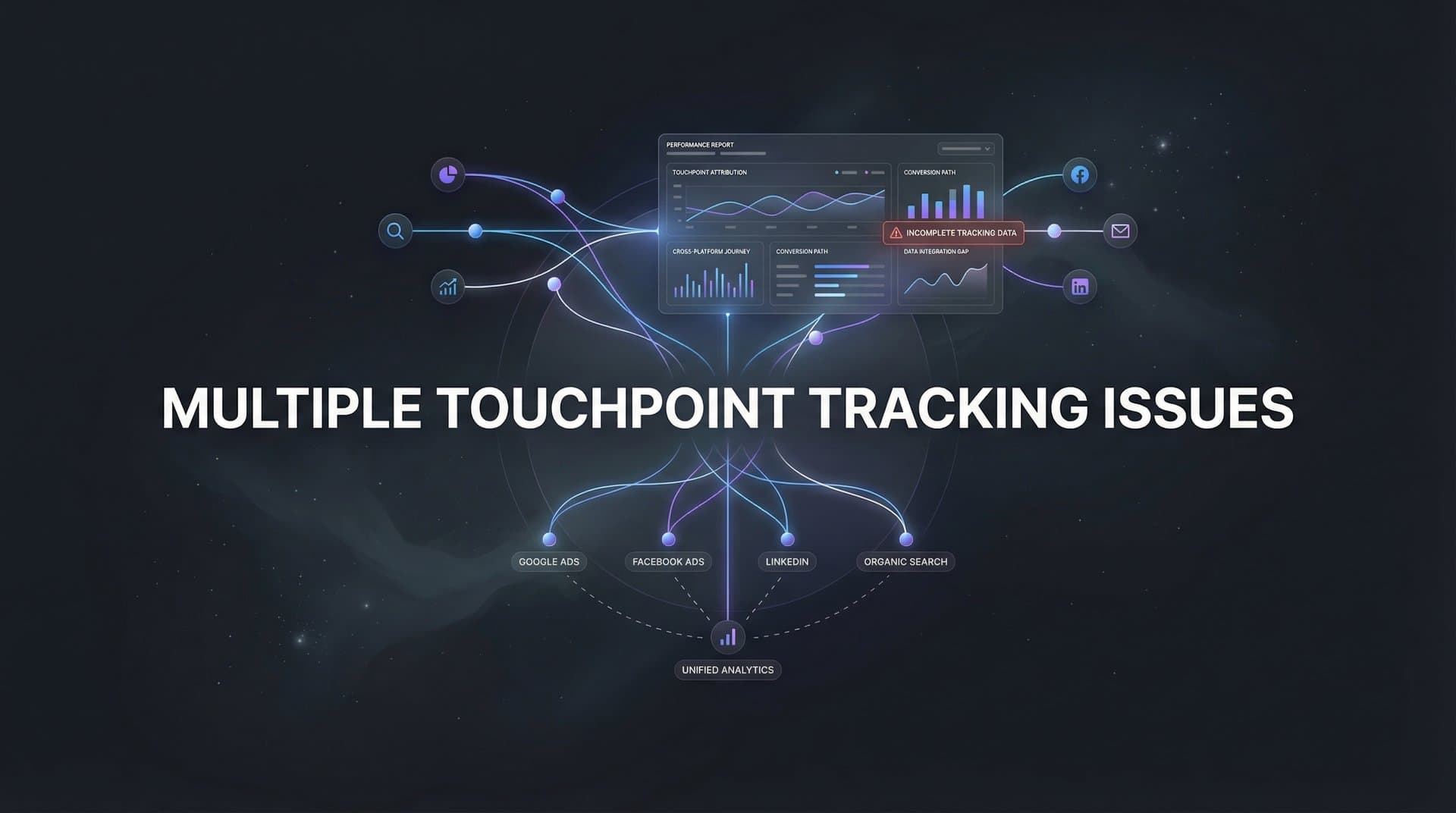
You open your analytics dashboard on Monday morning, coffee in hand, ready to review last week's performance. Google Ads shows a $5,000 sale attributed to a search campaign. Meta Ads Manager claims credit for the same purchase through a retargeting ad. Your CRM tells yet another story, crediting an email campaign that went out three days before the conversion. Three platforms, one sale, three completely different narratives.
This isn't a technical glitch. It's the reality of multiple touchpoint tracking issues that every modern marketer faces.
Today's customers don't see an ad and immediately buy. They research on mobile during their commute, compare options on desktop at work, click a retargeting ad on their tablet at home, and finally convert after receiving an email reminder. Each interaction leaves a digital footprint, but those footprints are scattered across platforms that don't communicate with each other. The result? Your attribution data doesn't just have gaps. It has contradictions, overlaps, and blind spots that make confident decision-making nearly impossible.
This article breaks down exactly why multiple touchpoint tracking falls apart, what it costs you in real terms, and how to build a tracking infrastructure that actually reflects reality. Because understanding where your customers come from isn't just about better reporting. It's about knowing which marketing investments actually drive revenue.
The Anatomy of a Broken Customer Journey
The average customer now interacts with a brand across six to eight touchpoints before making a purchase decision. That's not marketing theory. That's the messy reality of how people actually buy in 2026.
Picture a potential customer's actual journey: They see your Facebook ad while scrolling during lunch. Later that evening, they Google your product category and click your search ad. The next day, they visit your website directly by typing your URL. A week later, they click through from an email campaign. Finally, they see a retargeting ad on Instagram and complete the purchase.
Five touchpoints. One conversion. But here's where everything breaks down.
Facebook's tracking pixel fires when they click the initial ad, dropping a cookie to claim credit. Google's tracking code fires when they click the search ad, creating its own attribution claim. Your email platform records the click-through and marks it as a conversion driver. Instagram's pixel fires on the final click before purchase. Each platform operates in isolation, tracking what it can see while remaining blind to everything else.
The fundamental problem is that modern marketing attribution was built on a foundation that no longer exists. Traditional tracking assumes continuous cookie-based monitoring across a linear journey. It assumes browsers allow unrestricted third-party tracking. It assumes customers use one device throughout their decision process.
None of those assumptions hold true anymore.
What you see in your dashboards isn't a complete picture of the customer journey. It's a collection of fragmented snapshots, each captured by a different camera with a different lens, at different moments in time. When you try to piece these snapshots together, the gaps become obvious. The customer who clicked your Facebook ad on mobile doesn't carry that attribution signal when they later convert on desktop. The interaction that happened in Safari, where Intelligent Tracking Prevention limits cookie duration to seven days, disappears from your tracking after a week even if the customer is still in their decision process.
The gap between what actually happened and what your data shows isn't just inconvenient. It fundamentally undermines your ability to understand which marketing activities create value. You're making budget decisions based on incomplete information, scaling channels that might not deserve more investment while underfunding the touchpoints that actually move customers toward purchase.
This fragmentation compounds as your marketing becomes more sophisticated. Add TikTok to your channel mix? That's another walled garden with its own tracking methodology. Launch a podcast sponsorship? Good luck connecting those listeners to eventual conversions. Run offline events or direct mail campaigns? The attribution chain breaks completely. Understanding multiple touchpoints before conversion becomes essential for any serious marketer.
The complexity isn't going away. Customer journeys are becoming more intricate, not simpler. The number of potential touchpoints continues to multiply. And every new channel you add creates another potential point of failure in your tracking infrastructure.
Five Root Causes Behind Tracking Failures
Understanding why touchpoint tracking breaks down requires looking beyond surface-level symptoms to the structural issues that create these problems in the first place.
Privacy Updates That Rewrote the Rules: Apple's App Tracking Transparency framework, introduced with iOS 14.5, fundamentally changed mobile attribution. Users now explicitly opt in or out of tracking, and the majority choose to opt out. When someone sees your ad in a mobile app but doesn't grant tracking permission, that entire interaction becomes invisible to your attribution system. The ad impression happened. The click might have happened. But your tracking infrastructure has no record of it. Browser manufacturers followed suit with increasingly aggressive privacy protections. Safari's Intelligent Tracking Prevention limits client-side cookie duration, Firefox blocks third-party cookies by default, and Chrome continues moving toward Privacy Sandbox alternatives that restrict traditional tracking methods. Learning how to fix iOS tracking issues has become a critical skill for marketers.
Cross-Device Journey Fragmentation: Cookies don't travel between devices. When a customer clicks your ad on their iPhone during their morning commute, that interaction is tracked via a mobile cookie. When they later research your product on their work laptop, that's a completely different cookie environment. If they ultimately convert on their home desktop three days later, that's yet another disconnected tracking context. Without a unified identity layer that recognizes the same person across devices, these three interactions appear as three separate, unrelated users in your analytics. The attribution chain breaks at every device switch, creating phantom users and orphaned touchpoints that never connect to actual conversions. These cross device tracking issues plague even the most sophisticated marketing teams.
Data Silos That Never Communicate: Your Meta Ads Manager knows about ad clicks and conversions tracked by the Meta pixel. Google Ads knows about search clicks and conversions tracked by Google's conversion tag. Your CRM knows about form submissions, sales calls, and closed deals. Your email platform tracks opens, clicks, and email-attributed conversions. But these systems don't talk to each other. They each maintain their own version of reality, creating overlapping and contradictory attribution claims. The sale that actually resulted from a customer journey spanning paid social, organic search, email nurture, and a sales call gets claimed in full by each platform, resulting in attribution totals that exceed your actual revenue.
Attribution Window Mismatches: Meta uses a default attribution window of seven days for clicks and one day for views. Google Ads defaults to 30 days for clicks. Your CRM might track the entire sales cycle, which could span months. These different lookback periods mean platforms are literally measuring different things. A customer who clicked your Meta ad 10 days ago and then converted via Google search gets attributed entirely to Google in Meta's reporting because the click fell outside Meta's seven-day window. But in Google's 30-day window, it appears as a Google-driven conversion. Neither platform sees the full story, and neither attribution claim is technically wrong within its own framework. They're just measuring different slices of the same journey.
Server-Side and Client-Side Tracking Gaps: Traditional client-side tracking relies on JavaScript code running in the user's browser to fire tracking pixels and send conversion data. This approach fails when browsers block scripts, users have ad blockers installed, or JavaScript errors prevent code execution. Server-side tracking captures events directly from your server, bypassing browser-based restrictions. But many businesses still rely entirely on client-side tracking, creating gaps where conversions happen but never get recorded. The customer who completes a purchase while using an aggressive ad blocker shows up as revenue in your order system but remains invisible in your ad platform reporting. You spent money to acquire that customer, but your attribution system has no record of the conversion, making that entire channel appear less effective than it actually is.
These five root causes don't operate in isolation. They compound each other. A customer journey that spans multiple devices, encounters privacy restrictions, crosses attribution window boundaries, and includes touchpoints across siloed platforms creates a perfect storm of tracking failure. The more complex your marketing becomes, the more opportunities exist for these issues to fragment your data.
The Real Cost of Inaccurate Touchpoint Data
Tracking problems aren't just frustrating. They're expensive. The decisions you make based on incomplete attribution data have real financial consequences that compound over time.
Budget Misallocation at Scale: When your attribution data tells you that Channel A drives a 3x return while Channel B barely breaks even, you naturally shift budget toward Channel A. But what if Channel A's performance is inflated by last-click attribution bias, while Channel B's contribution is invisible because it primarily drives awareness and consideration touchpoints early in the journey? You scale the wrong channel, underfund the channel that actually creates demand, and watch overall performance decline even as you invest more. This isn't a hypothetical risk. It's the daily reality for marketers making decisions based on platform-reported attribution that doesn't reflect true incremental impact.
Think about the compounding effect over time. If you misallocate 20% of your budget based on faulty attribution data, and your monthly ad spend is $50,000, that's $10,000 per month flowing to the wrong channels. Over a year, that's $120,000 in misallocated spend. The lost ad revenue from tracking issues extends beyond the wasted investment. You're also not investing that budget in the channels that would have generated actual returns.
Broken Ad Platform Optimization: Modern ad platforms rely on conversion data to optimize delivery. Meta's algorithm learns which audiences are most likely to convert based on the conversion signals you send back. Google's Smart Bidding adjusts bids in real-time based on conversion probability. When your tracking infrastructure misses conversions or attributes them incorrectly, you're feeding incomplete or false data to these algorithms.
The algorithm thinks certain audiences don't convert when they actually do, because the conversion signal never made it back to the platform. It continues showing ads to audiences that appear to perform well in your tracking but don't actually drive valuable outcomes. The optimization loop breaks down. Instead of getting smarter over time, the algorithm optimizes toward a flawed understanding of what success looks like.
This creates a vicious cycle. Poor tracking leads to poor optimization. Poor optimization leads to worse performance. Worse performance leads to reduced confidence in the channel. You pull back investment, missing out on genuine opportunities, all because your tracking infrastructure couldn't accurately capture what was actually working.
Strategic Blind Spots That Limit Growth: Beyond immediate budget allocation and algorithm optimization, inaccurate touchpoint tracking creates strategic blind spots that prevent you from understanding your business at a fundamental level. You can't identify which content types drive the most engaged users. You don't know which channels work synergistically versus which operate independently. You miss the pattern where customers who engage with both your content marketing and paid social convert at three times the rate of single-touchpoint users.
These blind spots limit your ability to develop effective strategies. You can't build on what works if you don't know what actually works. You can't test hypotheses about customer behavior if your data doesn't reflect actual behavior. You can't confidently expand into new channels or markets because you lack reliable data about what drives success in your current environment.
The businesses that solve attribution challenges gain a massive competitive advantage. They know which investments create value. They feed better data to ad platform algorithms, improving efficiency. They identify opportunities that competitors miss because competitors are working with fragmented, contradictory data. The cost of inaccurate tracking isn't just the immediate waste. It's the compounding disadvantage of making decisions in the dark while competitors operate with clarity.
Building a Unified Tracking Foundation
Fixing multiple touchpoint tracking issues requires moving beyond platform-specific pixels toward a unified infrastructure that captures the complete customer journey. This isn't about adding more tracking tools. It's about creating a single source of truth that connects all your data.
Implementing Server-Side Tracking: Server-side tracking represents a fundamental shift in how conversion data is captured. Instead of relying on browser-based pixels that can be blocked, server-side tracking captures events directly from your server and sends them to ad platforms via API. When a customer completes a purchase, your server records the conversion and sends that data to Meta, Google, and other platforms through their respective conversion APIs.
This approach bypasses browser restrictions, ad blockers, and cookie limitations. The conversion happened on your server. You have a direct record of it. You can reliably send that data to platforms regardless of what's happening in the customer's browser environment. Server-side tracking doesn't completely replace client-side tracking, but it fills critical gaps where browser-based methods fail.
Implementation requires technical setup, but the benefits extend beyond just capturing more conversions. Server-side tracking lets you send enriched data that client-side pixels can't access. You can include customer lifetime value, product categories, subscription tier, or any other server-side data point that helps platforms optimize delivery. The ad algorithm receives richer signals, leading to better targeting and improved performance.
Creating a Single Source of Truth: A unified tracking foundation connects data from all sources into one system that maintains a complete view of each customer journey. This means integrating your ad platforms, website analytics, CRM, email marketing, and any other customer touchpoint into a centralized attribution system. Effective tracking conversions across multiple channels requires this integrated approach.
When a customer clicks a Facebook ad, that interaction is recorded. When they later visit your website via organic search, that touchpoint is captured and connected to the same customer profile. When they submit a form, receive email follow-ups, and eventually convert, all those interactions link together in a single customer journey view.
This unified approach solves the data silo problem. Instead of each platform claiming full credit for the conversion, you see the actual sequence of touchpoints that led to the purchase. You understand which channels work together, which touchpoints are most influential at different stages, and where customers typically enter and exit your funnel.
Building this infrastructure requires choosing attribution software that can ingest data from multiple sources, match interactions to individual customer profiles, and maintain accurate journey tracking across devices and platforms. The technical complexity is real, but the alternative is continuing to make decisions based on fragmented, contradictory data.
Leveraging First-Party Data Strategies: In a privacy-first world, first-party data has become your most valuable asset for maintaining tracking accuracy. First-party data is information you collect directly from customers with their consent: email addresses, account information, purchase history, and authenticated website interactions. Implementing first-party data tracking for ads is now essential for accurate attribution.
When a customer logs into your website or provides their email address, you can track their behavior using first-party identifiers that aren't subject to the same restrictions as third-party cookies. This creates a persistent identity that follows the customer across sessions and devices as long as they remain logged in or identified.
First-party data strategies also enable better data enrichment. You can connect ad clicks to known customer profiles, understanding not just that someone converted, but who they are, what they've purchased before, and their lifetime value. This enriched data flows back to ad platforms, improving targeting and optimization.
The shift toward first-party data requires rethinking how you collect and manage customer information. It means building systems that encourage customers to identify themselves, whether through account creation, email capture, or loyalty programs. It means implementing customer data platforms that unify first-party data from all sources. And it means using that data responsibly, respecting privacy while leveraging it to create better customer experiences and more effective marketing.
Choosing the Right Attribution Model for Complex Journeys
Once you have unified tracking infrastructure in place, the next challenge is deciding how to assign credit across multiple touchpoints. The attribution model you choose fundamentally shapes how you understand channel performance and allocate budget.
Why Last-Click Attribution Fails: Last-click attribution gives 100% credit to the final touchpoint before conversion. It's simple, easy to understand, and completely inadequate for multi-touchpoint customer journeys. Last-click attribution systematically undervalues awareness and consideration channels while overvaluing bottom-funnel touchpoints.
Consider a customer who discovers your brand through a Facebook ad, researches via organic search, receives nurture emails, and finally clicks a retargeting ad before purchasing. Last-click attribution gives all credit to that retargeting ad. But the retargeting ad only worked because the earlier touchpoints built awareness and consideration. Scaling retargeting based on last-click attribution eventually hits a wall because you're not investing in the top-funnel activities that feed qualified users into your retargeting audiences.
Last-click attribution creates perverse incentives. It encourages focusing on channels that capture existing demand rather than channels that create new demand. It makes brand-building activities appear ineffective because they rarely drive immediate conversions. For any business with a customer journey spanning multiple touchpoints, last-click attribution provides a fundamentally misleading view of what drives performance.
Comparing Multi-Touch Attribution Models: Multi-touch attribution models distribute credit across multiple touchpoints based on different assumptions about how influence works throughout the customer journey. Understanding touchpoint attribution tracking helps you select the right model for your business.
Linear attribution gives equal credit to every touchpoint. If a customer had five interactions before converting, each touchpoint receives 20% credit. This approach acknowledges that multiple touchpoints contribute to conversion, but it assumes all touchpoints are equally important, which rarely reflects reality.
Time-decay attribution gives more credit to touchpoints closer to conversion, based on the assumption that recent interactions have more influence. The first touchpoint might receive 10% credit, the second 15%, the third 25%, and the final touchpoint 50%. This model works well for businesses where consideration happens quickly and recent touchpoints are genuinely more influential.
Position-based attribution, sometimes called U-shaped attribution, gives more credit to the first and last touchpoints while distributing remaining credit across middle interactions. A common split is 40% to first touch, 40% to last touch, and 20% distributed among middle touchpoints. This model reflects the reality that both awareness and conversion touchpoints play critical roles.
Data-driven attribution uses machine learning to analyze actual conversion patterns and assign credit based on statistical influence. Instead of using predetermined rules, data-driven models look at customers who converted versus those who didn't, identifying which touchpoint combinations are most predictive of conversion. This approach requires significant data volume but provides the most accurate understanding of true touchpoint influence.
Testing and Validating Your Model: No attribution model is perfect, and the right choice depends on your specific business, customer journey, and channel mix. The key is testing your attribution model against actual business outcomes to ensure it guides you toward decisions that improve performance.
Compare attributed revenue across different models to understand how your perspective shifts. If last-click shows Channel A driving 60% of revenue while linear attribution shows it driving 35%, that gap reveals how much credit Channel A receives purely from being the final touchpoint. Use this analysis to identify channels that are systematically undervalued or overvalued by your current model.
Validate attribution models against incrementality tests. Run holdout experiments where you stop spending on a channel and measure the actual impact on conversions. If your attribution model says a channel drives 30% of revenue, but pausing it only reduces conversions by 10%, your model is overstating that channel's incremental impact. Use these tests to calibrate your understanding and adjust your model accordingly.
The goal isn't finding a perfect attribution model. It's finding a model that's directionally accurate enough to guide better decisions than you'd make with last-click attribution or platform-reported numbers alone.
Feeding Better Data Back to Ad Platforms
Solving attribution isn't just about better reporting. It's about creating a feedback loop where accurate tracking improves ad platform optimization, which improves performance, which generates more accurate data.
Why Data Quality Matters for Algorithms: Modern ad platforms operate as black boxes powered by machine learning. You set objectives, define target audiences, and provide creative assets. The algorithm handles the rest, deciding who sees your ads, when, and at what bid price. But these algorithms are only as good as the data they receive.
When you send conversion data back to Meta or Google, you're training the algorithm to recognize patterns associated with valuable outcomes. The algorithm learns that users who engage with certain content types, visit specific pages, or match particular demographic profiles are more likely to convert. It uses this learning to optimize future ad delivery.
Incomplete or inaccurate conversion data trains the algorithm on false patterns. If your tracking misses 30% of conversions, the algorithm thinks certain audiences don't convert when they actually do. It optimizes toward the wrong signals, showing ads to users who appear to convert based on your incomplete data while missing genuinely valuable audiences. Addressing conversion tracking accuracy issues directly impacts your campaign performance.
Enriched conversion data amplifies optimization effectiveness. Instead of just telling Meta that a conversion happened, you can send conversion value, customer lifetime value predictions, product categories, or subscription tiers. The algorithm uses this enriched data to optimize toward high-value conversions, not just conversion volume.
Creating a Conversion Sync Feedback Loop: Conversion sync refers to the process of sending accurate, enriched conversion data from your unified tracking system back to ad platforms. This creates a virtuous cycle where better tracking leads to better optimization.
When your server-side tracking captures a conversion that client-side pixels missed, you can send that conversion back to the ad platform via API. The platform's algorithm receives the signal, learns from it, and improves future optimization. As optimization improves, performance increases. As performance increases, you generate more conversion data. As you generate more data, your attribution becomes more accurate and your optimization becomes more effective. Understanding how ad tracking tools can help you scale ads using accurate data is crucial for maximizing this feedback loop.
This feedback loop compounds over time. Small improvements in tracking accuracy lead to modest optimization gains. Those gains generate more conversions, providing more data to improve tracking further. The algorithm gets smarter, performance improves, and the gap between your results and competitors who operate with poor tracking widens.
The businesses that master this feedback loop gain sustainable competitive advantages. They're not just tracking better. They're using better tracking to drive better performance, which generates better data, which drives even better performance. It's a flywheel that accelerates over time, creating compounding returns from the same ad spend that competitors waste on poorly optimized campaigns.
Moving Forward with Confidence
Multiple touchpoint tracking issues are solvable, but solving them requires a fundamental shift in how you think about attribution. The platform-centric approach where you rely on Meta's numbers, Google's numbers, and your CRM's numbers doesn't work when customer journeys span all three. You need customer-journey-centric infrastructure that tracks the complete path from first interaction to conversion and beyond.
This shift isn't just technical. It's strategic. It means investing in unified attribution systems that connect all your data sources. It means implementing server-side tracking to capture conversions that browser-based methods miss. It means choosing attribution models that reflect the reality of multi-touchpoint journeys rather than oversimplifying to last-click convenience.
The marketers who solve attribution challenges gain clarity that transforms decision-making. They know which channels create demand versus which capture existing demand. They understand which touchpoint combinations drive the highest-value customers. They feed enriched data back to ad platforms, improving optimization and reducing wasted spend. They scale with confidence because their data reflects reality.
The alternative is continuing to make decisions based on fragmented, contradictory data. It's watching different platforms claim credit for the same conversions while you struggle to understand what actually drives performance. It's allocating budget based on incomplete information and hoping you're making the right choices.
Start by auditing your current tracking infrastructure. Identify where gaps exist. Understand which conversions you're missing and why. Map out your customer journey to see where tracking breaks down across devices, platforms, and attribution windows. Then build a plan to implement unified tracking that captures the complete picture.
The businesses that win in modern marketing aren't necessarily the ones with the biggest budgets. They're the ones with the clearest data. They're the ones who understand what actually drives results and can confidently invest in channels that create value. They're the ones who've solved multiple touchpoint tracking issues and turned that solution into a sustainable competitive advantage.
Ready to elevate your marketing game with precision and confidence? Discover how Cometly's AI-driven recommendations can transform your ad strategy. Get your free demo today and start capturing every touchpoint to maximize your conversions.



