B2B SaaS marketing teams are sitting on more data than ever before. Ad platform dashboards, CRM pipelines, website analytics, email engagement reports: the data keeps piling up. Yet despite all of it, one question remains stubbornly difficult to answer: where should we invest next?
The problem isn't a lack of data. It's that most of the tools marketers rely on are built to explain the past, not inform the future. You can see which campaigns generated leads last quarter, but you can't easily predict which ones will generate pipeline next quarter. That gap between what happened and what will happen is exactly where predictive marketing analytics steps in.
Predictive marketing analytics represents a fundamental shift in how growth teams operate. Instead of waiting for results to roll in and then adjusting, you're working from forecasts and probability models that point you toward better decisions before you commit budget. For B2B SaaS companies managing long sales cycles, complex buyer journeys, and recurring revenue targets, that shift isn't just useful. It's a competitive necessity.
This article breaks down what a predictive marketing analytics tool actually does, how it differs from traditional analytics, why data quality is the foundation everything else rests on, and what to look for when evaluating one for your team.
From Hindsight to Foresight: The Core Idea Behind Predictive Analytics
To understand where predictive analytics fits, it helps to see the full picture of analytics maturity. Data science practitioners commonly describe a four-stage model that moves from basic reporting to intelligent action.
The first stage is descriptive analytics: what happened? This is your standard dashboard showing impressions, clicks, conversions, and revenue last month. The second stage is diagnostic analytics: why did it happen? This involves digging into the data to understand which variables drove a spike or a drop. Most marketing teams operate primarily in these first two stages.
Predictive analytics is the third stage: what will happen? It uses historical data patterns, statistical modeling, and machine learning to forecast future outcomes. Think lead conversion likelihood, expected channel performance, or projected pipeline contribution from a specific campaign. The fourth stage, prescriptive analytics, takes it one step further by recommending specific actions based on those predictions. Modern predictive tools are increasingly blending stages three and four together.
For B2B SaaS companies specifically, this forward-looking capability addresses some real structural challenges. Sales cycles in B2B SaaS often stretch across weeks or months, involving multiple stakeholders and several touchpoints before a deal closes. That means the feedback loop between marketing spend and revenue outcome is long. If you're waiting for closed-won data to tell you whether a campaign worked, you're already several months behind.
Recurring revenue models add another layer of complexity. A conversion that looks good on the surface might represent a customer who churns in 60 days. A lead that took longer to close might represent a customer who expands their contract three times over. Predictive analytics helps surface those distinctions earlier, so marketers can optimize for long-term value rather than short-term conversion volume.
The bottom line is that B2B SaaS growth teams operate in an environment where the cost of misallocated spend compounds over time. Predictive analytics gives you a way to reduce that cost by acting on probability rather than waiting for certainty.
Core Capabilities: What These Tools Are Actually Built to Do
A predictive marketing analytics tool isn't a single feature. It's a set of interconnected capabilities, each designed to forecast a different aspect of your marketing performance. Understanding what these capabilities are makes it easier to evaluate whether a tool will actually move the needle for your team.
Predictive Lead Scoring: This is one of the most widely used applications. The tool analyzes historical conversion data to identify patterns among leads that eventually became customers, then scores incoming leads based on how closely they match those patterns. For B2B SaaS teams, this means sales can prioritize outreach toward leads most likely to convert, rather than working a flat list.
Churn Prediction: Predictive models can analyze behavioral signals across your customer base to flag accounts showing early signs of disengagement. While this is often associated with customer success, it connects directly to marketing because understanding churn patterns helps you refine which customer profiles to target in acquisition campaigns.
Budget Forecasting: Rather than allocating budget based on last quarter's performance and intuition, predictive tools can model expected returns by channel based on historical ROAS patterns, seasonality, and conversion rate trends. This shifts budget decisions from reactive to proactive.
Campaign Performance Prediction: Before a campaign has run long enough to generate statistically significant results, predictive models can estimate likely outcomes based on early signals and comparable historical campaigns. This reduces the time and money spent on underperforming campaigns.
Audience Segmentation: Predictive tools can identify which audience segments are most likely to convert at different stages of the funnel, enabling more precise targeting and personalization across channels.
What makes all of these capabilities work is the data pipeline underneath them. These tools ingest data from ad platforms, CRMs, website behavior tracking, and other sources to build and continuously update their models. The quality and completeness of that pipeline directly determines how accurate the predictions are.
This is why the distinction between a standalone predictive tool and an integrated attribution platform with predictive capabilities matters so much. A standalone tool that pulls fragmented data from disconnected sources will produce less reliable predictions than a platform that maintains a unified, continuously updated data layer across your entire marketing stack. Integration isn't just a convenience. It's a prerequisite for accuracy.
The Data Foundation: Why Attribution Quality Drives Prediction Quality
There's a foundational principle in machine learning that applies directly here: garbage in, garbage out. A predictive model is only as reliable as the data it's trained on. And for B2B SaaS marketing teams, the single biggest threat to data quality is incomplete or inaccurate attribution.
Think about what happens when attribution is broken. A lead converts after engaging with a LinkedIn ad, a retargeting campaign, a blog post, and a sales email. If your attribution model only captures the last click, you're crediting the sales email and leaving the other three touchpoints invisible. Your predictive model then learns from that incomplete picture and builds forecasts on a distorted version of reality.
Over time, those distortions compound. Channels that actually contribute to pipeline get starved of budget because they're not getting credit. Channels that happen to be last-touch get over-invested. Your predictions get further from reality because the training data keeps reflecting the same blind spots.
Multi-touch attribution solves this by capturing the full customer journey. Whether you're using a linear model that distributes credit evenly across touchpoints, a time-decay model that weights recent interactions more heavily, or a data-driven model that assigns credit based on statistical contribution, the goal is the same: give your predictive models a complete signal, not a partial one.
Server-side tracking and first-party data enrichment have become equally critical inputs. Browser-based tracking has grown increasingly unreliable due to cookie deprecation, iOS privacy changes, and the widespread use of ad blockers. When tracking pixels fail to fire or cookies get blocked, touchpoints disappear from your data. Those gaps corrupt the completeness of your attribution data and, by extension, the accuracy of any predictions built on top of it.
Server-side tracking routes data collection through your own server rather than the browser, making it far more resilient to these restrictions. Conversion APIs like Meta CAPI and Google Enhanced Conversions send conversion events directly from your server to the ad platform, capturing events that client-side tracking would have missed entirely.
For B2B SaaS teams evaluating a predictive marketing analytics tool, this means the conversation has to start with attribution infrastructure. A sophisticated predictive model sitting on top of weak attribution data will produce confident-sounding predictions that are fundamentally unreliable. Getting the data foundation right isn't a preliminary step. It's the whole game.
Key Metrics Predictive Tools Help You Forecast and Optimize
Once you have a solid attribution foundation, predictive tools can start generating forecasts that directly inform strategic decisions. Here are the metrics where predictive analytics creates the most meaningful impact for B2B SaaS growth teams.
Pipeline Velocity by Campaign Source: Pipeline velocity measures how quickly deals move through your sales funnel from first touch to closed-won. Predictive tools can forecast velocity based on where a lead came from and how they engaged along the way. This is powerful because not all conversions are created equal. A lead from a high-intent search campaign might close in three weeks. A lead from a broad awareness campaign might take three months. Knowing this in advance lets you set realistic expectations and allocate resources accordingly.
Customer Lifetime Value Prediction by Channel: This is where predictive analytics moves beyond conversion metrics and into revenue quality. By analyzing historical data on which acquisition channels tend to produce high-LTV customers versus those that generate quick churn, predictive tools surface which campaigns deserve more investment based on long-term business value rather than short-term conversion volume. For SaaS companies where expansion revenue is a key growth lever, this distinction is critical.
Budget Allocation Forecasting: Rather than waiting to see which campaigns underperform and then shifting budget, predictive tools allow you to model expected ROAS and conversion rates by channel before you commit spend. This proactive reallocation capability means you're not just optimizing based on what worked last month. You're anticipating what's likely to work next month based on trend patterns, seasonality, and channel-specific signals.
Lead-to-Pipeline Conversion Rate Forecasting: For teams that need to hit pipeline targets, predictive tools can model expected conversion rates at each stage of the funnel based on current lead volume and quality scores. This gives revenue operations and marketing leadership a forward-looking view of whether current campaigns are on track to hit quarterly goals, well before the quarter ends. Understanding your SaaS marketing analytics in full context is what makes these forecasts actionable rather than theoretical.
The common thread across all of these metrics is that they shift your team from a reactive posture to a proactive one. Instead of reading last month's results and wondering what to change, you're reading next month's forecasts and deciding how to act.
How AI Recommendations Turn Predictions Into Decisions
Predictions are only valuable if they drive action. One of the most important developments in modern predictive marketing analytics tools is the move from passive dashboards to active AI-driven recommendations. The difference matters more than it might seem.
A dashboard shows you data. An AI recommendations engine interprets that data and tells you what to do about it. That might look like flagging a campaign whose early performance signals suggest it's trending toward underperformance, before it's wasted a significant portion of its budget. It might look like identifying a high-performing ad set that has room to scale and surfacing that opportunity before you would have spotted it manually.
For growth teams managing multiple campaigns across several channels simultaneously, this kind of proactive intelligence is genuinely transformative. The cognitive load of monitoring everything at once is reduced, and the risk of missing a critical signal in a noisy dashboard is significantly lower. The power of AI marketing analytics lies precisely in this ability to surface what matters before it becomes obvious.
There's also a compounding feedback loop worth understanding. When you send enriched conversion data back to ad platforms through tools like Meta CAPI or Google Enhanced Conversions, you're not just improving your own attribution. You're improving the ad platform's own machine learning algorithms. Those algorithms use your conversion data to refine targeting, optimize delivery, and identify higher-quality audiences. Better targeting generates better leads. Better leads produce richer conversion data. That data feeds back into both the ad platform and your own predictive models, improving accuracy over time.
This feedback loop is one of the most underappreciated dynamics in modern performance marketing. Teams that invest in clean, enriched first-party data aren't just helping their own analytics. They're compounding their advantage in ad platform optimization over time.
The practical outcome for B2B SaaS growth teams is faster, more confident decision-making. Less time debating whether a channel is working. Less reliance on gut instinct when allocating budget. A clearer path to scaling the campaigns that are genuinely driving pipeline and revenue, based on evidence rather than assumption.
Evaluating a Predictive Marketing Analytics Tool for B2B SaaS
Not all predictive marketing analytics tools are built with B2B SaaS in mind. Evaluating them through the lens of your specific business model, sales cycle, and data environment will save you from investing in a tool that looks impressive in a demo but doesn't fit your actual workflow.
Native CRM and Ad Platform Integrations: Your predictive models need to pull data from where your business actually lives. That means tight integrations with your CRM for pipeline and revenue data, and native connections to the ad platforms where you're spending. Shallow integrations that require manual data exports or introduce sync delays will degrade model accuracy and slow down your team.
Attribution Model Flexibility: B2B SaaS buyer journeys are complex. You need the ability to compare attribution models, whether first-touch, last-touch, linear, time-decay, or data-driven, and understand how different models change your view of channel performance. A tool that locks you into a single attribution methodology limits your ability to understand the full picture. Reviewing the best marketing attribution tools for B2B SaaS can help you benchmark what flexible attribution should actually look like.
Server-Side Tracking Support: As discussed earlier, browser-based tracking is increasingly unreliable. Any serious predictive analytics platform needs to support server-side tracking and Conversion API integrations to ensure the underlying data is as complete and accurate as possible.
Real-Time Data Refresh: Predictive models built on stale data produce stale predictions. Look for platforms that update data in real time or near real time, so your forecasts reflect current campaign performance rather than yesterday's snapshot. Marketing analytics platforms with real-time conversion data give your models the freshest possible signal to work from.
Connection from Ad Spend to Closed-Won Revenue: This is the single most important criterion for B2B SaaS teams. A predictive tool that can only see top-of-funnel metrics will produce predictions that optimize for leads rather than revenue. You need a platform that connects ad spend data all the way through to pipeline and closed-won deals, so predictions are grounded in actual business outcomes.
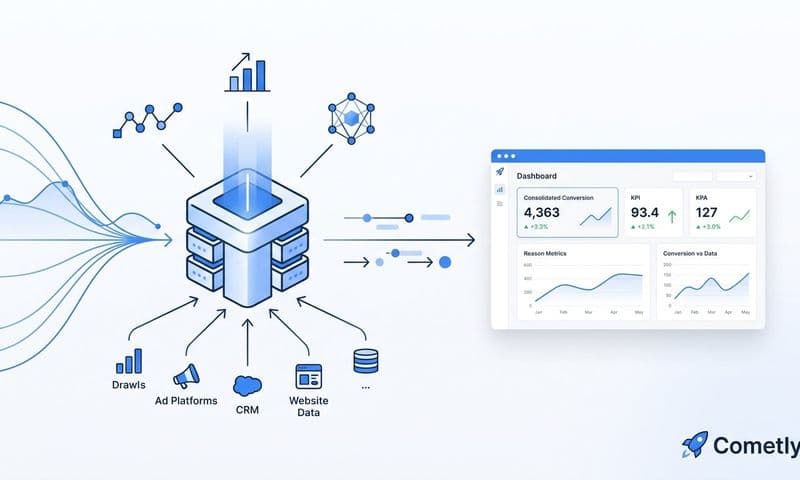
Cometly is built specifically to address these needs for B2B SaaS companies. It connects your ad platforms, CRM, and website into a single attribution layer, tracks the full customer journey from first ad click to closed-won revenue, and surfaces AI-powered insights that help teams identify what's working and scale it with confidence. With support for server-side tracking, multi-touch attribution, Stripe revenue integration, and more than 70 native integrations, Cometly provides the data foundation that makes predictive analytics actually reliable rather than just theoretically appealing.
Putting It All Together: Your Path to Predictive Marketing
The shift from reactive reporting to predictive marketing isn't just a technology upgrade. It's a change in how your team thinks about decisions. Instead of asking "what happened last quarter," you start asking "what's most likely to happen next quarter, and what should we do about it now."
But that shift only works if the foundation is solid. Predictive models are powerful, but they're entirely dependent on the quality of the data feeding them. Incomplete attribution, missing touchpoints, and browser-based tracking gaps don't just create reporting inaccuracies. They corrupt the inputs that your predictive models learn from, and they degrade every forecast that comes out the other side.
Before adopting any predictive marketing analytics tool, audit your current attribution infrastructure. Ask whether you're capturing the full customer journey or just the last click. Ask whether your tracking survives ad blockers and privacy restrictions. Ask whether your ad spend data connects all the way to closed-won revenue or stops at the lead stage.
If the answer to any of those questions reveals gaps, closing them isn't a prerequisite to getting started. It's the most important investment you can make in your predictive analytics capability.
The teams that will win in B2B SaaS marketing over the next few years won't just be the ones with the biggest budgets. They'll be the ones with the clearest data, the most accurate predictions, and the discipline to act on both. That combination is what turns marketing from a cost center into a genuine growth engine.
Ready to build the attribution foundation that makes predictive marketing possible? Get your free demo and see how Cometly connects every touchpoint to revenue so your team can forecast, optimize, and scale with real confidence.