Most marketing teams are flying blind. Not because they lack data, but because the data they have is already old by the time it reaches them. A campaign runs for a week, the weekly report gets pulled, someone notices the cost per lead is trending in the wrong direction, and by the time a decision gets made, another week of budget has already been spent on something that was not working.
This is the reality for many B2B SaaS marketing teams today, and it is an expensive problem. In markets where every dollar of pipeline matters and ad costs continue to climb, waiting days or weeks for performance data is not a reporting inconvenience. It is a strategic disadvantage.
Real time marketing performance tracking closes this gap. Instead of relying on scheduled reports that reflect decisions already made, real time tracking gives marketing teams continuous visibility into what is happening right now: which campaigns are generating qualified leads, which channels are driving pipeline, and where budget is being wasted. This article breaks down exactly how real time tracking works, what it requires technically, which metrics actually matter, and how to act on live data without overreacting to every fluctuation.
Why Delayed Data Is Costing Your Marketing Team
The traditional marketing reporting cycle has a fundamental design flaw. It is built around human schedules, not business speed. Weekly reports, monthly dashboards, and quarterly reviews are useful for strategic planning, but they are completely inadequate for managing active paid media campaigns in a competitive environment.
Think about what happens during a typical reporting lag. A campaign targeting a specific audience segment starts underperforming. Cost per click rises, conversion rates drop, and the signal is there in the raw data. But because that data is not surfaced until the next reporting cycle, budget continues to flow into the campaign for days. By the time a marketer sees the problem, the damage is already done.
This compounding cost is especially acute in paid media. Ad platforms will spend whatever budget you give them, and they will do it whether or not the results are there. Without real time visibility, the feedback loop between spend and outcome is broken. You are essentially making decisions in the dark, then waiting for the lights to come on to see where you ended up.
The problem goes beyond wasted spend. In B2B SaaS, where sales cycles are long and pipeline creation is the primary goal of marketing, delayed data means delayed course correction. If a campaign is generating high volumes of low-quality leads, that signal may not reach the marketing team until those leads have already entered the CRM and started consuming sales team time. The downstream cost of bad marketing analytics data is not just a budget line item. It is pipeline contamination.
Contrast this with what becomes possible when performance data is available as events happen. Marketing teams can identify underperforming campaigns within hours rather than days. Budget can be reallocated toward what is working before the week is out. Audience segments showing signs of fatigue can be refreshed before performance tanks. And the alignment between marketing activity and revenue outcomes becomes tighter because the feedback loop is continuous rather than periodic.
Real time tracking does not just speed up reporting. It fundamentally changes how marketing decisions get made, shifting teams from reactive to proactive in a way that compounds over time.
Defining Real Time Tracking: More Than a Live Dashboard
The phrase "real time" gets used loosely in marketing technology, so it is worth being precise about what it actually means in the context of performance tracking.
Real time marketing performance tracking refers to the continuous collection, processing, and surfacing of marketing data as events occur, rather than in batches or scheduled pulls. When a user clicks an ad, submits a form, or triggers a CRM event, that data flows into your tracking system immediately and becomes available for analysis within seconds or minutes, not hours or days.
This requires a specific technical architecture. Data must be captured at the source, transmitted without delay, processed and attributed correctly, and surfaced in a way that marketers can actually act on. Each step in that chain matters. A real time analytics platform that pulls from a data warehouse updated once a day is not real time tracking. It is a faster version of the same delayed reporting problem.
The data sources that feed a real time tracking system span the entire customer journey. Ad platform events, including impressions, clicks, and video views, represent the top of the funnel. Website behavior, form submissions, and demo requests represent mid-funnel engagement. CRM events, including lead creation, MQL status changes, opportunity creation, and deal closures, represent the bottom of the funnel where marketing activity connects to revenue.
Pulling all of these sources into a unified real time view is what separates meaningful performance tracking from simple ad platform reporting. Most ad platforms show you what happened on their platform. Real time marketing performance tracking shows you what happened across the entire journey, from first touch to closed-won deal.
One important distinction worth making is the difference between activity metrics and outcome metrics. Many tools offer real time visibility into clicks, impressions, and reach. These are useful signals, but they are not the metrics that drive business decisions. The metrics that actually matter in real time are the ones connected to revenue: pipeline created by channel, cost per qualified lead by campaign, MQL-to-SQL conversion rate by source, and attributed revenue by ad set.
Real time tracking only creates strategic value when it is surfacing these outcome-level metrics, not just activity at the top of the funnel.
The Technical Foundation: What Makes Real Time Tracking Reliable
Understanding why real time tracking works requires understanding the technical components that make it possible, and why some approaches are more reliable than others in today's privacy-first environment.
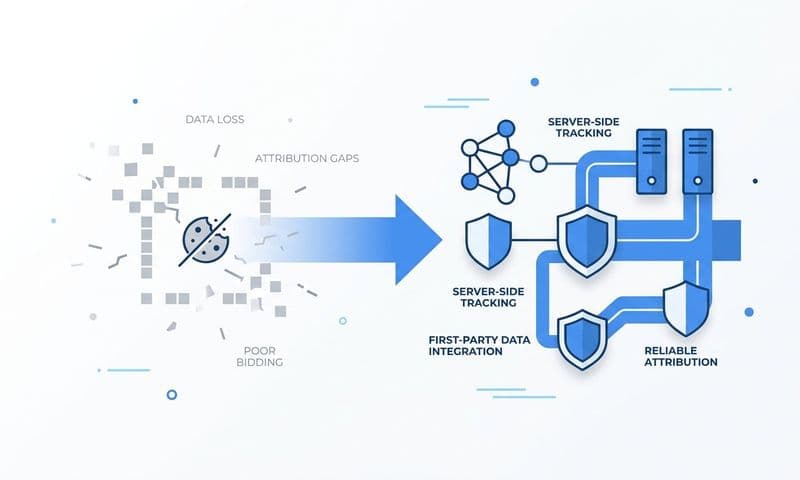
Server-Side Tracking and Conversion APIs: Browser-based pixel tracking, which has been the dominant method for capturing marketing events for years, is increasingly unreliable. iOS privacy changes, browser-level ad blocking, and the deprecation of third-party cookies have created significant gaps in what pixels can capture. When a user has an ad blocker installed or is browsing in a restricted environment, pixel-based events simply do not fire. This means a meaningful portion of conversions go untracked, attribution becomes inaccurate, and the data fed back to ad platforms for optimization is incomplete.
Server-side tracking solves this by capturing events on the server before they ever reach the browser. Instead of relying on a JavaScript tag firing in the user's browser, server-side events are sent directly from your server to the ad platform via Conversion APIs, such as Meta's Conversions API or Google's Enhanced Conversions. These events are not subject to browser restrictions, which means they capture conversions that ad tracking tools relying on pixels would miss entirely.
For real time tracking, server-side events are essential. They provide a more complete and accurate signal, which means the real time data you are acting on actually reflects what is happening rather than a degraded subset of it.
Multi-Touch Attribution as the Analytical Layer: Real time data is only as valuable as the attribution model applied to it. In B2B SaaS, where buyers interact with multiple touchpoints across weeks or months before converting, attributing a conversion to a single channel misrepresents how pipeline is actually created.
Multi-touch attribution maps each touchpoint across the customer journey and distributes credit in a way that reflects the full path to conversion. When this model is applied to real time data, it means that as events occur, they are immediately attributed across the channels and campaigns that contributed to them. This gives marketing teams an accurate, up-to-the-minute view of which channels are actually driving outcomes, not just which channel happened to be the last touch. Understanding attribution challenges in marketing analytics is essential before implementing any multi-touch model.
First-Party Data Enrichment: Raw event data tells you that something happened. Enriched data tells you who it happened to and why it matters. By connecting CRM data to real time tracking events, marketing teams can segment performance by company size, industry, deal stage, and lead source. A form submission from a target account at an enterprise company is a very different signal than a form submission from a small business that is outside your ideal customer profile. First-party enrichment makes that distinction visible in real time.
Key Metrics to Monitor in Real Time for B2B SaaS
Not all metrics benefit equally from real time visibility. The goal is to focus on the signals that are both actionable and meaningful, which means filtering out vanity metrics and concentrating on the data points that connect marketing activity to business outcomes.
Early Ad Performance Signals: Click-through rate trends by campaign and audience segment are useful leading indicators of creative fatigue or audience misalignment. When CTR drops sharply, it often signals that the audience has seen the creative too many times or that the message is not resonating with the segment being targeted. Frequency metrics are closely related: rising frequency without a corresponding rise in conversions is a reliable early signal of audience exhaustion. Catching these signals in real time allows creative refreshes or audience adjustments before performance deteriorates significantly.
Pipeline and Revenue Signals: For B2B SaaS, the metrics that matter most are the ones connected to pipeline creation. Real time visibility into leads entering the funnel by source, MQL-to-SQL conversion rates by channel, and opportunity creation rates by campaign allows marketing teams to see not just that leads are coming in, but whether those leads are actually advancing through the funnel. Knowing how to evaluate marketing performance metrics correctly is what separates teams that act on insight from those that react to noise.
Pipeline velocity is a particularly valuable metric in this context. It measures how quickly deals move through the pipeline from initial contact to close. When tracked in real time and segmented by marketing source, it reveals which channels are generating leads that convert quickly and which are producing leads that stall. This information directly informs budget allocation decisions.
Channel-Level Attribution Metrics: Which channels and campaigns are generating attributed revenue right now? This is the question that real time attribution tracking answers directly. By connecting ad spend data to CRM events and revenue outcomes in real time, marketing teams can see the cost per pipeline dollar generated by channel and make immediate budget reallocation decisions based on current performance rather than last month's results. The complete guide to performance marketing attribution covers how to structure this analysis across complex multi-channel environments.
The combination of these three metric categories, early performance signals, pipeline indicators, and channel attribution, gives marketing teams a complete picture of what is working and what needs to change, updated continuously rather than in periodic batches.
Acting on Real Time Data Without Overreacting
Real time access to performance data creates a new challenge: the temptation to react to every fluctuation. A campaign that looks like it is underperforming on a Tuesday morning may simply be experiencing normal day-of-week variation. Acting on every signal without context leads to constant campaign disruption, which actually degrades performance over time, especially in ad platforms that rely on algorithmic learning periods.
The solution is to establish clear decision thresholds before you have real time data in front of you. A decision threshold defines the specific conditions under which a particular action should be taken. For example, if cost per acquisition exceeds a defined benchmark by a certain percentage over a defined time window, that triggers a review and potential campaign pause. If a campaign hits a target return on ad spend with sufficient volume, that triggers a budget increase.
Building this kind of response framework removes the guesswork from real time decision-making. Instead of asking "should we do something about this?" every time a metric moves, the framework answers that question in advance. Teams act on trends and thresholds, not on moment-to-moment noise.
It is also important to align real time insights with longer-term attribution analysis. Real time data excels at surfacing immediate performance signals, but it does not always capture the full picture of how today's activity connects to future revenue. A top-of-funnel campaign running now may not generate pipeline for another 30 to 60 days, depending on the length of your sales cycle. Real time tracking of early funnel engagement, such as content downloads and demo requests, serves as a leading indicator of future pipeline, but it needs to be interpreted in the context of historical attribution data that shows how those early signals have converted over time.
The most effective approach combines real time visibility with multi-touch attribution modeling. Real time data tells you what is happening now. Attribution modeling tells you what it means for revenue. Together, they give marketing teams both the speed to act and the context to act wisely.
Practically, this means building a tiered response system. Some signals, like a campaign suddenly spending at ten times its normal rate due to a targeting error, warrant immediate action. Others, like a slight dip in CTR over two days, warrant monitoring rather than intervention. Defining these tiers in advance is what separates disciplined real time decision-making from reactive campaign management.
Choosing the Right Platform for Real Time Performance Tracking
The components described throughout this article, server-side tracking, multi-touch attribution, first-party data enrichment, and real time dashboards, only deliver value when they work together in a single integrated system. Piecing them together from separate tools creates data gaps, attribution inconsistencies, and reporting delays that undermine the real time advantage you are trying to create.
When evaluating a real time marketing performance tracking platform, the key capabilities to look for include native integrations with the ad platforms and CRMs your team already uses, server-side tracking and Conversion API support, flexible attribution modeling that goes beyond last-touch, and AI-driven recommendations that help marketers interpret data at scale without manually analyzing every metric. Reviewing the best performance marketing tracking software options available can help narrow down which platforms meet these requirements.
Cometly is built specifically to bring these components together for B2B SaaS marketing teams. It connects ad platform data, CRM events, and website behavior into a single real time view that shows exactly which ads and channels are generating pipeline and revenue. Rather than toggling between your ad platform dashboards, your CRM, and a separate analytics tool, Cometly surfaces the complete customer journey in one place, from the first ad click to the closed-won deal.
The platform's server-side tracking and Conversion API integrations ensure that conversion events are captured accurately even in environments where pixel tracking falls short. Multi-touch attribution modeling maps each touchpoint across the customer journey, so the real time data you see reflects actual contribution to revenue rather than a single-touch approximation. And first-party data enrichment from CRM context means the signals you are acting on are segmented by the dimensions that matter most in B2B: company size, deal stage, and lead quality.
One of the compounding benefits of this approach is what happens when enriched, real time conversion data is fed back to ad platforms. When Meta and Google receive accurate, complete conversion signals through their respective APIs, their algorithms can optimize targeting and bidding more effectively. Over time, this creates a flywheel: better data fed to ad platforms produces better algorithmic performance, which generates better leads, which produces better data. Real time tracking is not just about seeing what is happening. It is about continuously improving the system that drives results.
The Bottom Line on Real Time Marketing Performance Tracking
Real time marketing performance tracking is not a feature reserved for enterprise marketing teams with large budgets and dedicated analytics staff. It is a foundational capability for any B2B SaaS company that wants to grow efficiently and make marketing decisions based on what is actually happening rather than what happened last week.
The shift from reactive to proactive marketing is the core value of real time tracking. Instead of diagnosing problems after the budget has already been spent, marketing teams can identify what is working and what is not as it unfolds. Budget allocation decisions become data-driven in a meaningful sense, not just in the sense that they reference data from a previous period.
The technical requirements are real but manageable: server-side tracking for reliable event capture, multi-touch attribution for meaningful analysis, first-party data enrichment for actionable segmentation, and a platform that brings it all together in a unified view. The strategic requirements are equally important: clear decision thresholds, a response framework that distinguishes signal from noise, and the discipline to combine real time visibility with longer-term attribution context.
If your team is still making budget decisions based on weekly reports and last-touch attribution, the gap between your current approach and what is possible with real time tracking represents a significant competitive opportunity. The teams that close that gap first will allocate budget more efficiently, generate better-quality pipeline, and compound their advantage over time.
Ready to see exactly which ads and channels are driving your pipeline and revenue right now? Get your free demo and discover how Cometly connects every touchpoint to real revenue so your marketing team can make smarter decisions, faster.