
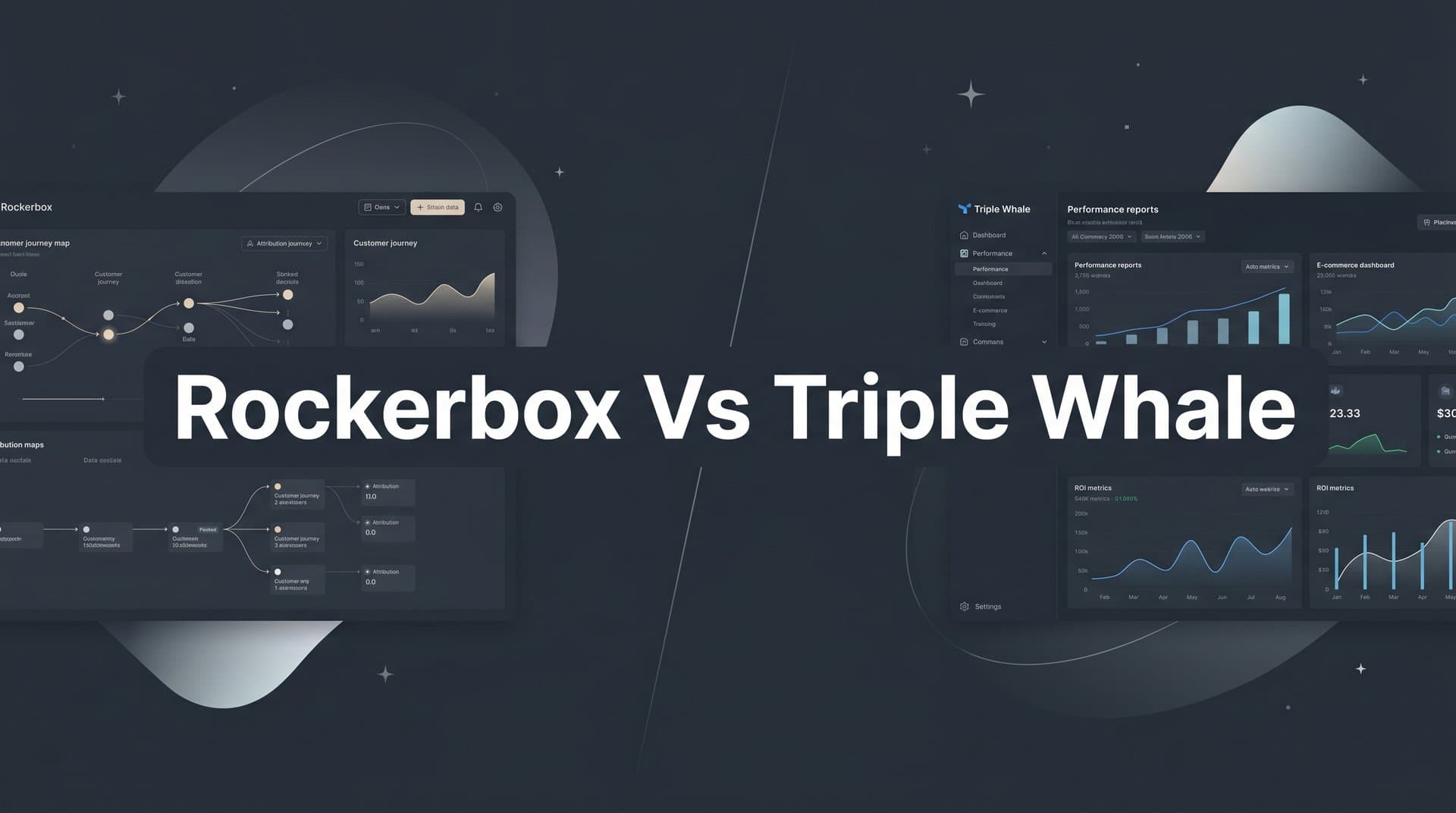
When you are evaluating Rockerbox vs Triple Whale, you are not just comparing two tools. You are deciding how your team will measure marketing performance, allocate budget, and justify spend to leadership.
Both platforms have built strong reputations in the attribution space, but they were designed with different business models and use cases in mind. Rockerbox has traditionally served direct-to-consumer and e-commerce brands that need cross-channel measurement and media mix modeling. Triple Whale built its name in the Shopify ecosystem, offering blended ROAS reporting and creative analytics for DTC brands.
If you are a B2B SaaS company or a growth team managing complex sales cycles, pipeline attribution, and multi-touch customer journeys, you may find that neither platform fully addresses your needs out of the box. The features that make these tools compelling for e-commerce operators often do not translate cleanly into the metrics that matter most for B2B growth teams: pipeline stages, deal velocity, and closed-won revenue.
This guide walks through seven practical strategies for evaluating attribution platforms so you can make a confident, data-backed decision. Whether you land on Rockerbox, Triple Whale, or discover that a purpose-built B2B attribution platform like Cometly is a better fit, these strategies will help you assess what actually matters for your business.
1. Map Your Attribution Needs to Your Business Model First
The Challenge It Solves
The most common mistake teams make when evaluating attribution platforms is starting with features instead of fit. DTC-focused tools like Rockerbox and Triple Whale were built around e-commerce purchase events, where the customer journey is relatively short and the conversion is a transaction. B2B SaaS teams operate in a fundamentally different environment, where a single closed deal can involve multiple stakeholders, dozens of touchpoints, and a sales cycle that spans weeks or months.
The Strategy Explained
Before you open a single demo or read a comparison chart, audit your own business model. Write down what your attribution platform actually needs to measure. Is it purchase events and blended ROAS? Or is it MQL-to-SQL conversion rates, pipeline velocity, and revenue tied to specific campaigns?
Platforms built for DTC brands default to metrics like return on ad spend, cost per purchase, and creative performance at the SKU level. Those metrics are largely irrelevant if you are running demand generation for a SaaS product with a 60-day average sales cycle. Starting with this clarity prevents you from being swayed by polished demos that showcase capabilities you will never actually use.
Implementation Steps
1. List the five most important metrics your marketing team reports to leadership each month and confirm whether your current or prospective tool can surface them natively.
2. Map your customer journey from first touch to closed deal and identify every stage where you need attribution data, including lead source, pipeline stage, and revenue outcome.
3. Use this documented list as your evaluation scorecard when speaking with vendors, so every conversation is grounded in your actual requirements rather than their feature highlights.
Pro Tips
Involve your sales and revenue operations teams in this audit. They often have the clearest picture of where attribution data breaks down and what information would actually help them prioritize pipeline. The best attribution platform is the one that aligns with how your entire revenue team thinks about growth, not just how your marketing team reports on campaigns.
2. Evaluate Attribution Models Each Platform Supports
The Challenge It Solves
Not all attribution platforms offer the same model flexibility, and the default model a tool uses can significantly distort your budget decisions. Many DTC-oriented tools lean heavily on last-click or blended ROAS, which simplifies reporting but obscures the full contribution of upper-funnel channels. For B2B teams running awareness campaigns alongside retargeting and outbound sequences, this kind of flattened reporting can lead to systematic underinvestment in channels that actually start the buying journey.
The Strategy Explained
Evaluate whether each platform lets you compare multiple attribution models side by side. First-touch attribution tells you which channels are best at generating awareness. Last-click shows you what closes deals. Linear and time-decay models distribute credit across the journey in different ways. Data-driven attribution uses machine learning to assign credit based on actual conversion patterns in your data.
The ability to toggle between these models without rebuilding your reports is a meaningful differentiator. Growth leaders often report that the real insight comes not from any single model, but from understanding how credit shifts when you change the model, because that gap reveals which channels are doing work that last-click reporting ignores entirely.
Implementation Steps
1. Ask each vendor to demonstrate how their platform handles multi-touch attribution across a customer journey that includes paid search, paid social, organic, and direct traffic.
2. Request a side-by-side model comparison view and verify that you can switch between first-touch, linear, time-decay, and data-driven models within the same dashboard.
3. Test the platform against a real campaign dataset if possible, and check whether the model outputs change your interpretation of which channels are performing.
Pro Tips
Be cautious of platforms that offer only one or two attribution models and frame this as simplicity. For B2B teams with complex journeys, model flexibility is not a nice-to-have feature. It is the mechanism by which you build a defensible case for budget allocation. A platform that locks you into a single model is making attribution decisions for you.
3. Assess Cross-Channel Tracking Depth and Data Coverage
The Challenge It Solves
A platform is only as accurate as the data it captures. Many attribution tools handle paid social and paid search well but provide shallow or inconsistent coverage for organic search, email, direct traffic, and offline touchpoints. When your reporting has gaps, you end up with attribution models that look complete but are actually missing entire segments of the customer journey. This leads to budget decisions based on incomplete information.
The Strategy Explained
Evaluate whether each platform tracks paid ads, organic, email, and direct traffic with equal depth and consistency. Pay particular attention to how each tool handles server-side tracking and Conversion API integrations. As browser-based tracking becomes less reliable due to cookie deprecation and privacy changes, platforms that rely exclusively on pixel-based or client-side tracking will increasingly undercount conversions and misattribute revenue.
Server-side tracking and integrations like Meta's Conversion API and Google Enhanced Conversions capture events that browser-based pixels miss entirely, giving you a more complete and accurate picture of what is actually driving results. This is especially important for B2B teams where a single missed touchpoint can distort the attribution of a high-value deal.
Implementation Steps
1. Ask each vendor to walk you through their tracking architecture and confirm whether they support server-side event tracking in addition to client-side pixels.
2. Verify native support for Meta Conversion API and Google Enhanced Conversions, and ask how the platform handles event deduplication when both browser and server events fire for the same conversion.
3. Test tracking coverage across your key channels by running a controlled evaluation period and comparing reported conversions against your CRM data to identify gaps.
Pro Tips
Platforms like Cometly are built with server-side tracking as a core capability rather than an add-on, which matters significantly as privacy changes continue to erode the reliability of pixel-based attribution. When evaluating any platform, ask specifically how it handles iOS privacy restrictions and browser cookie limitations, because those gaps compound over time and quietly degrade the accuracy of your reporting.
4. Test How Each Platform Handles the Full Revenue Journey
The Challenge It Solves
Many attribution tools stop at the lead or click level. They can tell you which ad drove a form fill, but they cannot tell you whether that lead converted into a paying customer three months later. For B2B SaaS teams, this gap is critical. Marketing investments need to be evaluated against pipeline and revenue outcomes, not just top-of-funnel conversion events. Without this connection, you are optimizing for activity rather than results.
The Strategy Explained
Test whether each platform integrates with your CRM and revenue data sources to close the loop from ad spend to actual closed-won revenue. This means the platform needs to ingest deal stage data from your CRM, match those deals back to their originating marketing touchpoints, and surface that connection in a way your team can act on.
For SaaS companies with subscription revenue, integration with payment platforms like Stripe adds another layer of accuracy. When your attribution platform can see both the marketing touchpoints and the actual revenue generated, you can make budget decisions based on true return on investment rather than proxy metrics like cost per lead.
Implementation Steps
1. Map the specific CRM and revenue data sources your team uses and confirm that each platform has a native, maintained integration with those systems rather than a generic webhook or manual import process.
2. During your evaluation, test the end-to-end data flow by tracing a known deal from your CRM back to its attributed marketing touchpoints within the platform and verify the connection is accurate.
3. Ask vendors how they handle multi-stakeholder attribution for accounts where multiple contacts engaged with marketing before a deal closed, since this is a common scenario for B2B teams.
Pro Tips
Cometly was built specifically to connect ad spend to pipeline and closed-won revenue, with native integrations for CRM data and Stripe. If your team currently reports on pipeline attribution manually or relies on disconnected spreadsheets to bridge the gap between marketing data and revenue outcomes, a platform with this capability built in will save significant time and improve the accuracy of every budget conversation you have.
5. Compare Reporting Flexibility and Dashboard Usability
The Challenge It Solves
A powerful attribution engine is only useful if your team can actually interpret and act on the reports it generates. Many platforms offer impressive underlying data but present it through dashboards designed for a different type of operator. Creative analytics dashboards built for DTC teams look very different from pipeline-level attribution reports built for B2B growth teams, and using the wrong interface slows down decision-making and increases the risk of misreading your data.
The Strategy Explained
Evaluate whether each platform's default reporting views match how your team actually makes decisions. A B2B growth team needs to see metrics like cost per pipeline opportunity, revenue attributed by channel, and campaign performance broken down by deal stage. If a platform's primary dashboard surfaces creative fatigue scores and blended ROAS by product category, you will spend more time customizing reports than acting on insights.
Reporting flexibility matters too. The ability to filter by date range, channel, campaign, and funnel stage without building custom reports from scratch is the difference between a tool your team uses daily and one that collects dust after the first month.
Implementation Steps
1. During your trial or demo, navigate to the default dashboard without guidance and assess whether the primary metrics displayed are relevant to your team's goals without customization.
2. Test the filtering and segmentation capabilities by attempting to answer three specific questions your team asks regularly, such as which paid channel drove the most pipeline last quarter.
3. Ask whether reports can be exported, scheduled, or shared with stakeholders who do not have platform access, since attribution data often needs to flow into leadership reviews and board-level reporting.
Pro Tips
Pay attention to how quickly you can answer a specific business question from a cold start in the platform. If it takes more than a few clicks to surface the insight you need, that friction will compound across your team over time. The best attribution platforms surface the right answer before you finish forming the question.
6. Pressure-Test Integration Ecosystems and Data Syncing
The Challenge It Solves
Your attribution platform does not operate in isolation. It needs to connect cleanly with your ad platforms, CRM, analytics tools, and data warehouse to provide accurate, up-to-date reporting. Many teams discover integration gaps only after they have committed to a platform, when they realize that data is syncing inconsistently, events are being duplicated, or key tools are missing from the native integration library entirely.
The Strategy Explained
Audit the native integration ecosystem of each platform against your existing tech stack before you make a decision. A long list of integrations on a vendor's website does not tell you how well those integrations actually work. You need to ask specific questions about data syncing frequency, event deduplication logic, and how the platform handles discrepancies between ad platform reported conversions and what the attribution tool records.
Server-to-server tracking integrations deserve particular scrutiny. These are the connections that make your attribution data more accurate as browser-based tracking degrades, and they require careful configuration to avoid double-counting events or missing conversions entirely.
Implementation Steps
1. Build a list of every tool in your current stack that needs to exchange data with your attribution platform and confirm native integration support for each one before shortlisting vendors.
2. Ask vendors specifically how their platform handles event deduplication when both a browser pixel and a server-side event fire for the same conversion, and request documentation on their deduplication logic.
3. Test data syncing latency by checking how quickly events recorded in your CRM or ad platform appear in the attribution dashboard, since delayed data can affect campaign optimization decisions.
Pro Tips
Cometly offers more than 70 native integrations, including ad platforms, CRM tools, and analytics systems, with server-side tracking built into the core architecture. When evaluating any platform, ask the vendor to walk you through a live integration with your specific CRM and ad platforms rather than relying on documentation alone. A live walkthrough surfaces gaps that a feature checklist will not.
7. Factor in AI-Driven Insights and Scalability for Growth Teams
The Challenge It Solves
As your ad spend scales, manual analysis becomes a bottleneck. Growth teams that spend hours each week pulling reports, cross-referencing channel data, and building spreadsheet models to identify which campaigns are working are not operating efficiently. The volume of data generated by a mature multi-channel program exceeds what any team can process manually, and the lag between data collection and insight generation slows down optimization cycles.
The Strategy Explained
Evaluate whether each platform uses AI to surface actionable insights automatically, rather than requiring your team to discover them through manual exploration. Specifically, look for platforms that can identify high-performing campaigns and channels across your entire ad mix, flag underperforming spend before it becomes a budget problem, and send enriched conversion data back to ad platforms like Meta and Google to improve algorithmic targeting over time.
This last capability, often called a conversion feedback loop, is increasingly valuable as ad platform algorithms rely on conversion signals to optimize delivery. When your attribution platform sends accurate, enriched conversion data back to Meta CAPI or Google Enhanced Conversions, you improve the quality of the signal those algorithms use, which compounds into better targeting and lower cost per acquisition over time.
Implementation Steps
1. Ask each vendor to demonstrate their AI-driven insight capabilities specifically, including how the platform surfaces recommendations and how frequently those recommendations update as new data comes in.
2. Evaluate whether the platform supports sending enriched conversion events back to your ad platforms and confirm that this process is automated rather than requiring manual data exports.
3. Assess scalability by asking how the platform performs as event volume increases and whether pricing scales in a way that remains sustainable as your campaigns and data volume grow.
Pro Tips
Cometly's AI-driven recommendations are designed specifically for growth teams that need to move quickly across multiple channels. The platform identifies which ads and campaigns are actually driving pipeline, not just generating clicks, and feeds that enriched data back to ad platform algorithms to improve targeting quality over time. For teams scaling from a few campaigns to a full multi-channel program, this kind of automated insight layer becomes the difference between reactive and proactive budget management.
Putting It All Together
Choosing between Rockerbox and Triple Whale comes down to one core question: does this platform reflect how your business actually generates revenue? Both tools offer meaningful capabilities, but they were built primarily for e-commerce and DTC brands. Their default metrics, dashboards, and integration priorities reflect that origin, which is a genuine limitation for B2B SaaS teams with longer sales cycles, multi-stakeholder journeys, and pipeline-level reporting needs.
The seven strategies in this guide give you a structured way to cut through the noise. Start by documenting what your attribution platform actually needs to measure. Evaluate model flexibility, tracking depth, and CRM integration before you get distracted by surface-level features. Test dashboards against your real workflows, not just polished demo scenarios. And factor in AI-driven insights and scalability, because the platform you choose today needs to serve your team as your program grows.
If your evaluation reveals that neither Rockerbox nor Triple Whale fully addresses your needs, that is a signal worth taking seriously. A purpose-built platform like Cometly connects every touchpoint from the first ad click to closed-won revenue, integrates with your CRM and Stripe, and uses AI to surface which campaigns are actually driving pipeline. It was designed for exactly the kind of complex, multi-touch attribution that B2B SaaS growth teams need.
The right attribution platform is the one that tells you the truth about your marketing, not just the one with the best brand recognition. Run your evaluation against your actual criteria, and the right choice will become clear.
Ready to see how purpose-built B2B attribution works in practice? Get your free demo today and start capturing every touchpoint to maximize your conversions.