

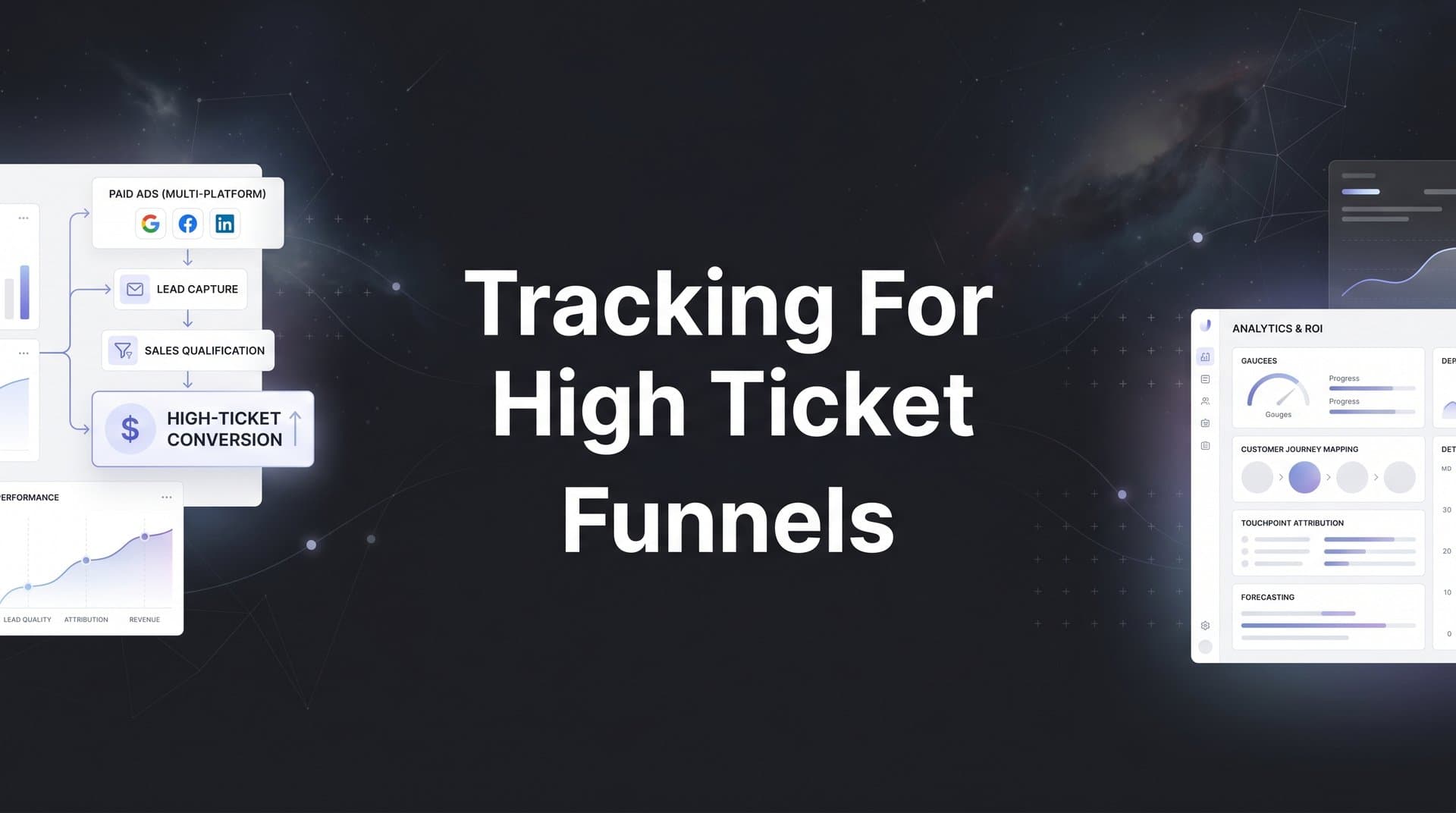
High ticket sales funnels break traditional analytics. When someone clicks your ad in January but doesn't purchase your $10,000 coaching program until March, standard tracking tools lose the thread. They credit the wrong campaign, misattribute the revenue, or worse—show zero connection between your ad spend and that closed deal.
This disconnect isn't just frustrating. It's expensive.
Without proper tracking, you can't identify which campaigns actually generate buyers versus tire-kickers. You waste budget on channels that look good on paper but never close. You kill winning campaigns because surface metrics don't show their true value. And you make scaling decisions based on incomplete data.
High ticket sales cycles demand a different approach. Your buyers interact with 10-15 touchpoints over weeks or months. They consume content, book calls, submit applications, and ghost you for two weeks before suddenly buying. Browser cookies expire. Ad blockers interfere. Mobile tracking restrictions scramble the data. By the time someone wires you $15,000, traditional analytics has forgotten how they found you.
This guide shows you exactly how to build tracking infrastructure that works for high ticket funnels. You'll connect every stage from initial ad click through closed deal, capture offline conversions from your CRM, implement multi-touch attribution that credits the full buyer journey, and create dashboards that tie marketing spend directly to revenue.
The result? Complete visibility into what's actually driving your high ticket sales, which campaigns deserve more budget, and where your funnel leaks opportunities. Whether you sell consulting packages, enterprise software, coaching programs, or premium services, these six steps transform how you measure and optimize funnel performance.
Step 1: Map Your High Ticket Funnel Stages and Conversion Events
Before installing any tracking code, you need a clear map of your buyer journey. High ticket funnels typically include multiple stages between first contact and closed deal, and each stage generates data you need to capture.
Start by documenting every stage your prospects move through. A typical high ticket funnel might include: ad impression, landing page visit, lead magnet download, application submission, call booking, sales call completion, proposal sent, follow-up touchpoints, and finally the closed deal. Your specific funnel might add or remove stages depending on your sales process.
Next, identify which events qualify as micro-conversions versus macro-conversions. Micro-conversions indicate interest and engagement but don't directly generate revenue. These might include video views, content downloads, webinar registrations, or initial form submissions. Macro-conversions represent meaningful business outcomes: qualified applications, booked sales calls, proposals accepted, and closed deals with actual revenue attached.
Document the typical timeline for your sales cycle. Do most buyers close within 30 days of first contact? Or does your average sale take 90-120 days? Understanding your timeline determines how you'll configure attribution windows later. If 80% of your deals close within 60 days, you need tracking that maintains visitor identity for at least that long.
Create a tracking plan spreadsheet with these columns: Stage Name, Event Name, Event Trigger, Data Source, and Revenue Value. For example, "Application Submitted" might trigger when someone completes your application form, the data lives in your CRM, and it has no direct revenue value. "Deal Closed" triggers when your CRM marks an opportunity as closed-won, data lives in your CRM, and it includes the actual purchase amount.
This mapping exercise reveals gaps in your current tracking. You might discover you're capturing lead form submissions but not tracking which leads actually book calls. Or you're monitoring call bookings but losing visibility into which calls convert to proposals. Identifying these gaps now prevents tracking blind spots later.
Pay special attention to touchpoint sequences. High ticket buyers rarely follow a linear path. They might download a lead magnet, disappear for three weeks, watch a webinar, submit an application, book a call, cancel it, rebook two weeks later, have the call, then close a month after that. Your tracking needs to capture this messy reality, not just the simplified funnel you drew in your marketing deck.
The output of this step is a complete tracking plan document that lists every conversion tracking for high ticket sales event you need to measure, where that data currently lives, and how it connects to revenue. This becomes your blueprint for the technical implementation in the following steps.
Step 2: Install Server-Side Tracking Across Your Funnel Pages
Browser-based tracking fails spectacularly for high ticket sales funnels. Traditional pixel tracking relies on cookies that expire within 7-30 days, but your sales cycle runs 60-180 days. iOS privacy restrictions block mobile tracking for users who opt out. Ad blockers strip tracking parameters. By the time your prospect converts, browser-based systems have lost their identity.
Server-side tracking solves this by collecting data directly from your server rather than relying on browser cookies. When someone visits your landing page, the server captures their information and sends it to your tracking platform immediately. This creates a persistent visitor identity that survives cookie deletion, browser changes, and device switching.
Start by implementing server-side tracking on your primary funnel entry points. These include landing pages where paid traffic arrives, organic content pages that generate leads, and any page where prospects take their first conversion action. The tracking code should fire when the page loads and capture the visitor's click ID (gclid for Google, fbclid for Meta), UTM parameters, IP address, and any other identifying information available.
Configure tracking on your conversion pages next. This means application forms, call booking pages, lead magnet download confirmations, and any thank you page that follows a meaningful action. Each of these pages should trigger a conversion event that gets logged with the visitor's original traffic source data attached.
Server-side tracking requires technical implementation, but modern attribution platforms handle most of the complexity. You'll typically install a tracking snippet in your website's header, configure event triggers for specific pages or actions, and verify the data flows correctly into your tracking dashboard.
Test your implementation thoroughly before relying on it for real decisions. Submit test applications from different traffic sources. Book test calls using various UTM parameters. Verify that each test conversion appears in your tracking platform with the correct source attribution. Check that revenue values pass correctly when you mark test deals as closed.
Pay special attention to first-party data tracking for ads. This means capturing information directly from your prospects through forms, rather than relying solely on third-party cookies. When someone submits an application, you collect their email address, which becomes a persistent identifier even if they switch devices or clear cookies. This email-based identity matching dramatically improves attribution accuracy for long sales cycles.
Server-side tracking also enables you to enrich visitor data over time. When an anonymous visitor becomes a known lead, you can append their email and CRM contact ID to their historical browsing data. This connects their entire journey from first ad click through closed deal, even when that journey spans multiple devices and months of time.
The key success indicator for this step is simple: you should be able to track a visitor from initial ad click through every funnel stage, maintaining their identity and source attribution throughout, regardless of how long the journey takes or how many times they return to your site.
Step 3: Connect Your CRM to Capture Offline Conversions
Most high ticket sales happen offline. Someone might click your ad, submit an application online, but the actual purchase occurs during a Zoom call three weeks later. If your tracking system doesn't connect to your CRM, you'll never know which marketing campaign generated that $25,000 deal.
CRM integration closes this gap by syncing offline conversion data back to your tracking platform. When a sales rep marks an opportunity as closed-won in your CRM, that event should automatically appear in your marketing analytics with full source attribution and revenue value attached.
Start by connecting your CRM to your tracking platform. Most modern attribution tools integrate directly with HubSpot, Salesforce, Close, Pipedrive, and other popular CRMs. The integration typically requires API access and takes 15-30 minutes to configure. You'll authorize the connection, map fields between systems, and define which CRM events should sync to your tracking platform.
Map your CRM pipeline stages to tracking events. A typical mapping might look like this: "Lead Created" in CRM triggers a "New Lead" event in tracking, "Opportunity Created" triggers "Qualified Lead," "Proposal Sent" triggers "Proposal Stage," and "Closed Won" triggers "Purchase" with the deal value attached. This creates a complete funnel view that shows how leads progress from first contact through closed revenue.
Configure revenue value passing so your tracking platform knows exactly how much each closed deal is worth. This is critical for calculating accurate return on ad spend. When your CRM marks a deal as closed-won with a value of $15,000, that exact amount should flow into your tracking system and get attributed to the marketing touchpoints that influenced the sale. Platforms with revenue tracking capabilities make this process seamless.
Enable bi-directional sync if your tracking platform supports it. This means data flows both ways: marketing events from your tracking platform update contact records in your CRM, and sales events from your CRM update attribution data in your tracking platform. Bi-directional sync ensures your sales team sees which campaigns generated each lead, while your marketing team sees which leads actually closed.
Set up lead scoring or qualification rules based on tracking data. When your tracking platform identifies that a lead came from a high-performing campaign, engaged with multiple touchpoints, and matches your ideal customer profile, it can automatically flag that contact as high-priority in your CRM. Your sales team focuses on the leads most likely to close, improving conversion rates across the funnel.
Test the integration with a closed-loop example. Create a test contact in your CRM, move it through your pipeline stages, and mark it as closed-won with a test revenue amount. Verify that each stage transition appears correctly in your tracking platform and that the final revenue gets attributed to the correct marketing source. If the test works, your real deals will flow through the same way.
The CRM integration transforms your tracking from "we got 50 leads this month" to "we closed $180,000 in revenue, and here's exactly which campaigns generated those deals." That's the difference between guessing and knowing what works.
Step 4: Link Ad Platforms for Cross-Channel Attribution
Your high ticket prospects don't live on a single ad platform. They see your LinkedIn ad at work, your Meta ad while scrolling at night, and your Google ad when searching for solutions. Without cross-platform attribution tracking, you can't see how these touchpoints work together to drive conversions.
Connect all your active ad platforms to your tracking system. This typically includes Meta Ads, Google Ads, LinkedIn Ads, TikTok Ads, and any other channels where you run paid campaigns. Most attribution platforms offer native integrations that pull cost and performance data automatically once you authorize the connection.
Configure UTM parameters consistently across every campaign. UTM parameters are the tags you add to your URLs that identify the traffic source, medium, campaign name, and other details. A consistent UTM structure might look like: utm_source=facebook, utm_medium=cpc, utm_campaign=high-ticket-webinar-q1. Every ad on every platform should include these parameters, using the same naming conventions so your data aggregates cleanly.
Set up conversion sync to feed accurate conversion data back to your ad platforms. When someone clicks your Meta ad, submits an application, books a call, and closes a $20,000 deal six weeks later, Meta's algorithm should know about that conversion. Conversion sync sends this data back to Meta, Google, and other platforms so their algorithms can optimize for actual buyers, not just cheap clicks.
Verify that click ID capture works correctly for each platform. Google uses gclid, Meta uses fbclid, LinkedIn uses li_fat_id, and so on. Your tracking system should capture these click IDs when someone arrives from an ad, then use them to match conversions back to specific campaigns, ad sets, and even individual ads. This granular attribution shows exactly which creative, headline, or targeting approach drives results.
Enable automatic cost data imports so your tracking platform knows how much you're spending on each channel. When your dashboard shows that LinkedIn generated three closed deals worth $60,000 and you spent $8,000 on LinkedIn ads that month, you can calculate a precise 7.5x return on ad spend. Without cost data, you're just guessing at profitability.
Configure platform-specific tracking requirements. Meta requires a pixel on your website plus Conversions API for server-side events. Google needs both the Google tag and enhanced conversions configured. LinkedIn wants the Insight Tag installed. Each platform has its own technical requirements, and you need all of them working correctly for accurate attribution.
Test cross-platform attribution by running small campaigns on multiple channels simultaneously, then tracking how conversions get attributed. You might discover that LinkedIn ads generate awareness, prospects then click a Google retargeting ad, and they finally convert after seeing your Meta testimonial ad. This multi-touch insight is invisible without proper cross-channel tracking.
The goal of this step is complete visibility into how your ad platforms work together throughout the buyer journey, with accurate data flowing both into your tracking system for analysis and back to ad platforms for optimization.
Step 5: Configure Multi-Touch Attribution for Long Sales Cycles
Last-click attribution destroys high ticket marketing budgets. When someone interacts with your brand 12 times over three months before buying, crediting 100% of that sale to the final touchpoint ignores the 11 other interactions that made the conversion possible. Multi-touch attribution solves this by distributing credit across the entire buyer journey.
Choose attribution models that reflect how high ticket sales actually work. Linear attribution gives equal credit to every touchpoint, which works well when you need to understand the full journey. Position-based attribution (also called U-shaped) gives more credit to the first and last touchpoints while still acknowledging middle interactions. Data-driven attribution uses machine learning to assign credit based on which touchpoints statistically correlate with conversions.
Set appropriate attribution windows for your sales cycle length. If your average deal closes within 60 days of first contact, use a 60-day attribution window minimum. Many high ticket businesses use 90-day or even 180-day windows to capture the full journey. The window should be long enough that conversions get attributed to their true source, not just the most recent touchpoint. Understanding attribution for high ticket sales is essential for making accurate budget decisions.
Understand how different models credit touchpoints throughout the journey. Linear attribution might show that your awareness campaigns on LinkedIn deserve credit even though they rarely generate direct conversions. Position-based attribution highlights both the campaigns that introduce prospects to your brand and the retargeting campaigns that close them. Time-decay attribution gives more credit to recent touchpoints, which can be useful if you believe proximity to conversion indicates influence.
Compare model outputs side by side to identify which channels truly influence purchases. Run reports showing the same conversion data through linear, position-based, and last-click models. You'll often discover that awareness channels look much more valuable under multi-touch models, while retargeting channels look less dominant. This insight helps you allocate budget to the full funnel, not just bottom-of-funnel tactics.
Pay attention to touchpoint sequences in your attribution data. You might notice that prospects who engage with a webinar, then download a case study, then book a call have a 60% close rate, while prospects who skip straight from ad click to call booking only close 20% of the time. These sequence insights reveal which content and touchpoints actually prepare buyers for purchase.
Configure view-through attribution if you run display or video campaigns. View-through attribution credits ad impressions that someone saw but didn't click, recognizing that seeing your ad five times builds awareness even if they eventually convert through a different channel. This is particularly important for high ticket sales where brand familiarity influences purchasing decisions.
The success indicator for this step is that you can answer questions like "Which campaigns influenced this $30,000 deal?" and get a complete answer that includes the LinkedIn ad that generated awareness, the blog post they read two weeks later, the webinar that qualified them, and the retargeting ad that brought them back to book a call. That's multi-touch attribution working correctly.
Step 6: Build Dashboards to Monitor Funnel Performance
Data without dashboards is just noise. You need organized views that show exactly how your funnel performs, where money gets wasted, and which campaigns deserve more budget. Build dashboards that answer the questions you ask every week when making marketing decisions.
Create views showing cost per lead, cost per qualified application, and cost per acquisition at the campaign level. A high ticket funnel dashboard might show that LinkedIn campaigns cost $180 per lead but generate applications that close at 40%, while Meta campaigns cost $45 per lead but close at only 8%. The cheaper lead source isn't necessarily the better investment when you factor in close rates and deal values.
Set up campaign-level reporting that ties ad spend directly to closed revenue. Your dashboard should show: Campaign Name, Total Spend, Leads Generated, Applications Submitted, Calls Booked, Deals Closed, Total Revenue, and Return on Ad Spend. This view reveals which campaigns actually generate profit versus which ones just generate activity. A dedicated marketing performance tracking platform simplifies this reporting process.
Monitor time-to-close metrics to understand your typical sales cycle length. Track the average days between first ad click and closed deal, broken down by traffic source. You might discover that LinkedIn leads close in 45 days on average while Google leads take 75 days. This insight helps you set realistic expectations and avoid killing campaigns before they've had time to generate returns.
Identify drop-off points between funnel stages to find optimization opportunities. If 100 people visit your landing page but only 8 submit applications, you have a landing page problem. If 50 people submit applications but only 10 book calls, you have a qualification or follow-up problem. If 30 people complete sales calls but only 3 close, you have a sales process problem. Dashboards that show conversion rates between each stage reveal exactly where to focus improvement efforts.
Build attribution comparison views that show the same data through different attribution models. Create a dashboard with three columns: Last-Click Attribution, Linear Attribution, and Position-Based Attribution. Run your campaign performance through all three models. The differences reveal which campaigns get undervalued by last-click models and deserve more budget under multi-touch approaches.
Set up automated alerts for significant changes in funnel performance. Configure notifications when cost per acquisition increases by more than 30%, when a campaign stops generating conversions, or when a new campaign shows exceptional results. These alerts help you catch problems early and capitalize on wins quickly.
Your dashboards should answer these questions within 30 seconds: What's my current return on ad spend? Which campaigns are profitable? Where is my funnel leaking opportunities? How long does my sales cycle take? Which traffic sources generate the highest-value customers? If you can't answer these questions instantly, your dashboards need refinement.
Putting It All Together
You now have the complete framework for tracking high ticket sales funnels from first ad click through closed revenue. Your system captures every touchpoint, maintains visitor identity across long sales cycles, connects offline conversions from your CRM, and provides multi-touch attribution that shows what actually drives purchases.
Here's your implementation checklist. First, you've mapped your funnel stages and defined conversion events for each stage. Second, you've installed server-side tracking on all funnel pages to maintain visitor identity beyond cookie expiration. Third, you've connected your CRM to capture offline conversions with accurate revenue values. Fourth, you've linked all ad platforms with consistent UTM parameters and conversion sync enabled. Fifth, you've configured multi-touch attribution with appropriate windows for your sales cycle. Sixth, you've built dashboards that tie marketing spend directly to closed revenue.
Let your tracking system accumulate data for at least one complete sales cycle before making major budget decisions. If your average deal closes in 60 days, wait 60 days to see the full picture. Initial data will be incomplete because deals that eventually close are still in progress. After one full cycle, your attribution data becomes reliable enough to guide scaling decisions.
Use your attribution insights to optimize aggressively. Double down on campaigns that show strong multi-touch influence, even if their last-click metrics look mediocre. Cut campaigns that generate cheap leads but never close deals. Reallocate budget from awareness channels that don't contribute to conversions toward channels that appear throughout high-value buyer journeys.
Monitor your dashboards weekly to catch performance shifts early. High ticket funnels can change quickly when a winning ad creative fatigues, a competitor enters your space, or market conditions shift. Weekly dashboard reviews help you spot these changes and adjust before they tank your results.
The difference between guessing and knowing what drives your high ticket sales comes down to tracking infrastructure. With these six steps complete, you know exactly which campaigns generate revenue, which touchpoints influence purchases, and where to invest your next marketing dollar.
Ready to elevate your marketing game with precision and confidence? Discover how Cometly's AI-driven recommendations can transform your ad strategy. Get your free demo today and start capturing every touchpoint to maximize your conversions.


