You're staring at your ad dashboard. 12,000 clicks this month. Your budget is draining steadily. But here's the question that keeps you up at night: how many of those clicks actually turned into customers?
This is where conversion rate becomes your most honest advisor. It's the metric that tells you whether your marketing spend is building a business or just burning cash. While impressions and clicks measure activity, conversion rate measures results.
Understanding conversion rate isn't just about knowing a formula. It's about developing the ability to diagnose campaign health, compare channel performance, and make budget decisions based on actual business outcomes rather than vanity metrics. Whether you're running Meta ads, Google campaigns, or a multi-channel strategy, conversion rate is the common language that translates marketing activity into revenue impact.
The Math Behind Every Marketing Decision
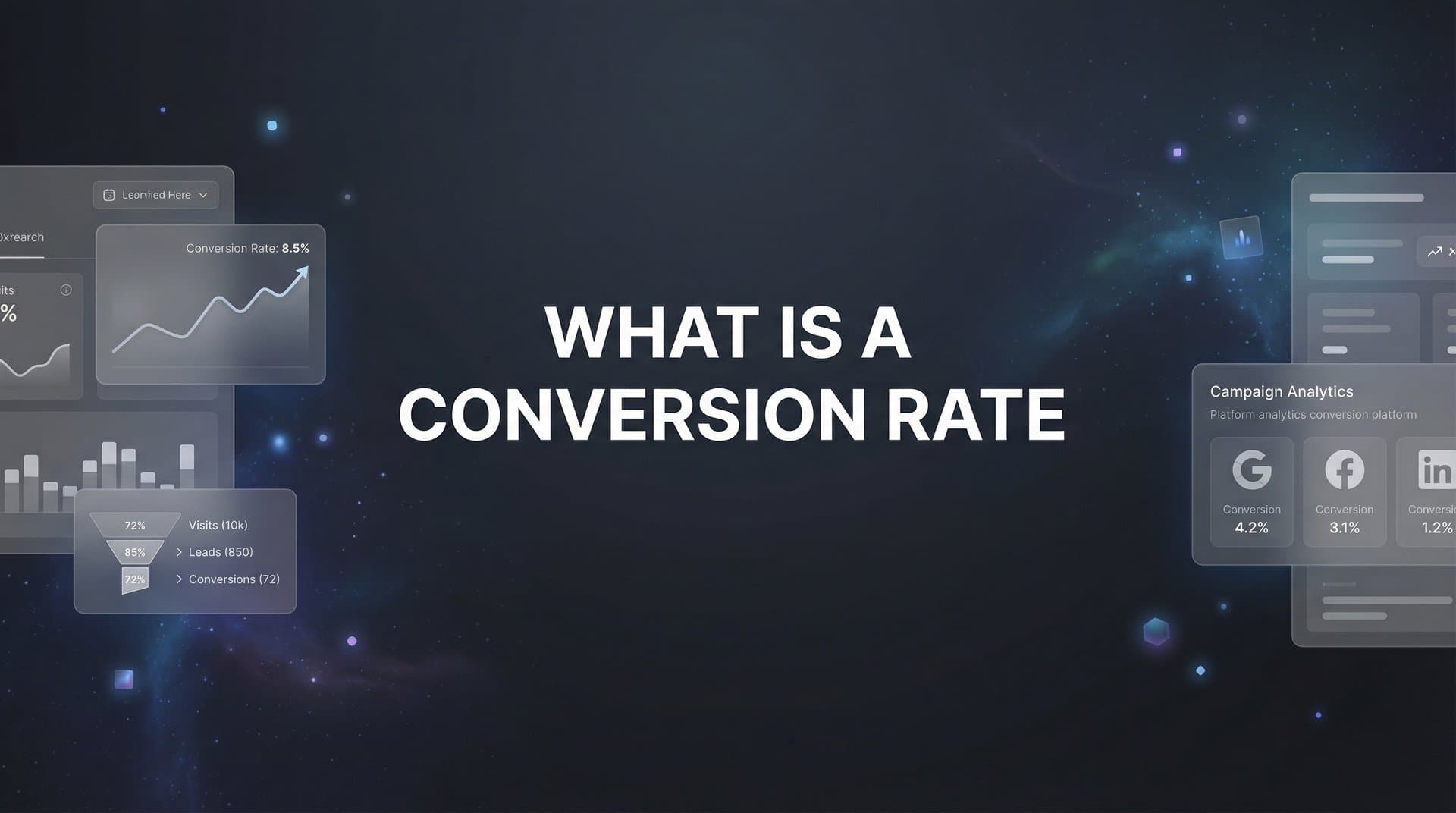
The conversion rate formula is deceptively simple: divide your conversions by your total visitors, then multiply by 100 to get a percentage. If 100 people visit your landing page and 3 make a purchase, you have a 3% conversion rate.
But here's where it gets interesting—what counts as a "conversion" depends entirely on your business goal. For an ecommerce store, it's completed purchases. For a SaaS company, it might be demo bookings or free trial signups. For lead generation businesses, it's often form submissions or phone calls.
Let's say you're running a campaign to promote a new software product. You send 5,000 visitors to your landing page. 150 people book a demo. Your conversion rate is (150 ÷ 5,000) × 100 = 3%. That number tells you that for every 100 people who see your offer, three are interested enough to take the next step.
The critical skill is identifying which conversion actions actually matter for your business model. A SaaS company might track multiple conversion points: free trial signups, paid conversions from trials, and direct purchases. Each has a different conversion rate, and each tells a different story about your funnel performance.
Think of it like this: if you're selling a $10 impulse-buy product, your conversion action is the purchase itself. But if you're selling enterprise software with a six-month sales cycle, tracking "purchase" conversions would leave you blind for half a year. Instead, you'd track earlier conversion points—demo requests, consultation bookings, or proposal downloads—that predict eventual revenue.
This is why marketers running complex funnels often track micro-conversions alongside macro-conversions. A micro-conversion might be someone watching 75% of your product video. A macro-conversion is the actual sale. Both matter, but they tell different stories about where people are in their buying journey.
The math stays the same regardless of what you're measuring. What changes is your definition of success and how you interpret the results. A 1% conversion rate on $50,000 software demos is spectacular. A 1% conversion rate for sales on $5 impulse purchases suggests something is fundamentally broken.
Why This Single Metric Reveals Campaign Health
Conversion rate is your campaign's vital sign. Just like a doctor uses multiple indicators to assess health, marketers use conversion rate to diagnose what's working and what's failing.
High traffic with low conversions tells a specific story: your targeting is bringing people in, but something breaks when they arrive. Maybe your landing page doesn't match your ad promise. Maybe your offer isn't compelling enough. Maybe your checkout process has too much friction. The traffic proves you can attract attention—the low conversion rate proves you're not converting that attention into action.
Low traffic with high conversions tells the opposite story. You've found an audience that genuinely wants what you're offering, but you're not reaching enough of them. This scenario is actually easier to fix—you don't need to rebuild your offer or redesign your landing page. You need to scale your reach to more people like the ones already converting.
Here's where conversion rate directly impacts your customer acquisition cost. Let's say you spend $5,000 on ads that generate 2,000 clicks. At a 2% conversion rate, you get 40 customers. Your cost per customer is $125. Improve your conversion rate to 4%, and suddenly you're getting 80 customers for the same $5,000—your cost per customer drops to $62.50. You didn't spend more. You just converted more of the traffic you already paid for.
This relationship between conversion rate and acquisition cost is why experienced marketers obsess over even small conversion rate improvements. A shift from 2% to 2.5% might sound trivial, but it represents a 25% improvement in how efficiently you're turning ad spend into customers.
Conversion rate also becomes your universal comparison tool. You're running campaigns on Meta, Google, and TikTok simultaneously. Each platform reports different metrics in different formats. But conversion rate gives you an apples-to-apples comparison. If your Meta campaign converts at 5% and your Google campaign converts at 2%, you know where to focus optimization efforts—regardless of differences in click-through rates, impressions, or platform-specific metrics.
The same logic applies when comparing different audiences, ad creatives, or landing page variations. You might have one ad that gets twice as many clicks as another, but if its conversion rate is half as good, it's not actually performing better—it's just more expensive per conversion.
Think of conversion rate as the great equalizer. It cuts through all the noise and answers the only question that actually matters: what percentage of the people you paid to reach actually did what you wanted them to do?
Setting Realistic Benchmarks for Your Industry
You'll find plenty of articles claiming "the average conversion rate is X%." Ignore them. Generic benchmarks are worse than useless—they're misleading.
A company selling $20 subscription boxes and a company selling $50,000 enterprise software both have "conversion rates," but comparing them is meaningless. The buying decision, commitment level, and consideration period are completely different. Expecting similar conversion rates would be like expecting a Formula 1 car and a cargo truck to have the same fuel efficiency.
Context determines whether a conversion rate is good or terrible. Several factors legitimately affect what conversion rate you should expect. Understanding good conversion rate benchmarks requires examining your specific business context rather than relying on generic industry averages.
Price point matters enormously. Lower-priced offers typically convert at higher rates because the decision requires less consideration. A $15 purchase can be impulse-driven. A $15,000 purchase requires approval, budget allocation, and careful evaluation. If your conversion rate is "low" compared to industry averages but you're selling a high-ticket offer, you might actually be performing exceptionally well.
Purchase complexity plays a similar role. Buying a pair of shoes requires one decision. Buying marketing software requires evaluating features, comparing competitors, getting team buy-in, and potentially negotiating contracts. More complex purchases naturally have lower conversion rates—not because your marketing is failing, but because the buying process inherently involves more steps and longer timelines.
Audience temperature dramatically impacts conversion rates. Someone who's been researching solutions for weeks and clicks your retargeting ad converts at a much higher rate than someone who's never heard of you and sees your ad for the first time. This is why bottom-of-funnel campaigns typically have higher conversion rates than top-of-funnel campaigns—you're reaching people further along in their buying journey.
Funnel stage matters too. A landing page asking for an email address in exchange for a free guide will convert at a higher rate than a page asking for a credit card to start a paid subscription. The commitment level is different, so the conversion rate should be different.
So how do you know if your conversion rate is good? Establish your own baseline. Track your conversion rate over time and measure improvement against your own historical performance. If you converted at 2% last quarter and you're converting at 3% this quarter, that's meaningful progress—regardless of what some industry benchmark says.
Your real competition isn't other companies' conversion rates. It's your own past performance. The goal is continuous improvement, not hitting an arbitrary percentage that may or may not be relevant to your specific business model, audience, and offer.
Five Levers That Actually Move Conversion Rates
Improving conversion rates isn't about tricks or hacks. It's about systematically removing obstacles between someone's interest and their action. Here are the levers that consistently move the needle.
Landing Page Alignment: Your ad makes a promise. Your landing page needs to deliver exactly what that promise suggested—immediately and obviously. If your ad says "Get a free marketing audit" and your landing page talks about your company history before eventually mentioning the audit, you've created friction. The visitor has to work to confirm they're in the right place. Every moment of confusion is a conversion killer.
Message match means your headline, imagery, and offer on the landing page should feel like a natural continuation of the ad someone just clicked. If your ad shows a specific product, that product should dominate your landing page. If your ad promises a specific benefit, that benefit should be the hero message on your page. Alignment builds confidence. Misalignment builds doubt.
If you're evaluating vendors, our ecommerce product video generator breakdown can help.
Friction Reduction: Every field in your form, every step in your checkout, every piece of information you request is a potential abandonment point. The question isn't "what information do we want?" It's "what's the absolute minimum information we need to move this person forward?"
Many businesses kill their conversion rates by asking for too much too soon. If you're offering a free guide, you probably don't need someone's phone number, company size, and job title. You need an email address. That's it. You can collect more information later, after you've delivered value and built trust. Monitoring your form completion rate helps identify where prospects abandon your conversion process.
Look at your conversion path and ask: what would happen if we removed this field? What if we eliminated this step? What if we made this optional instead of required? Sometimes the fastest way to improve conversion rates is subtraction, not addition.
Audience Targeting Refinement: You can have a perfect landing page and still struggle with conversion rates if you're showing it to the wrong people. This is where the relationship between click-through rate and conversion rate becomes revealing.
High clicks with low conversions often means your ad is attracting attention from people who aren't actually good fits for your offer. Maybe your targeting is too broad. Maybe your ad creative is misleading about what you're actually offering. Maybe you're reaching people at the wrong stage of their buying journey.
Refining your audience isn't about reaching more people—it's about reaching more of the right people. Sometimes improving conversion rates means accepting fewer clicks from better-qualified prospects. A campaign that generates 1,000 clicks at 1% conversion rate (10 conversions) is worse than a campaign that generates 500 clicks at 3% conversion rate (15 conversions)—even though the second campaign has half the traffic.
Trust Building: People don't convert when they don't trust you. Trust signals include customer testimonials, security badges, clear refund policies, professional design, and transparent pricing. The higher the commitment you're asking for, the more trust signals you need.
If you're asking someone to enter their credit card information, they need to feel confident you're legitimate. If you're asking for a demo booking, they need to believe the demo will actually be valuable. Trust isn't about manipulation—it's about providing the reassurance people naturally need before taking action.
Speed and Technical Performance: A landing page that takes five seconds to load has already lost a significant percentage of potential conversions. People are impatient, especially on mobile devices. Technical issues, slow load times, broken forms, and confusing navigation all directly damage conversion rates.
This is the unsexy side of conversion rate optimization, but it's often the highest-impact. You can have the world's most compelling offer, but if your page doesn't load or your form doesn't submit properly, your conversion rate will suffer regardless of your messaging quality.
Tracking Conversions Accurately Across Platforms
Here's a scenario every multi-channel marketer has experienced: Meta reports 50 conversions. Google reports 45 conversions. Your actual sales data shows 38 purchases. So which number is correct?
The challenge of accurate conversion tracking has become significantly more complex. You're running campaigns across Meta, Google, TikTok, and potentially other platforms simultaneously. Each platform has its own tracking pixel. Each platform uses different attribution windows. Each platform has its own method for claiming credit when a conversion happens.
This creates a fundamental problem: platform-reported conversions often conflict with each other and with your actual business results. Meta might claim credit for a conversion because someone saw your ad on Instagram three days ago. Google might claim credit for the same conversion because the person later clicked a search ad. Your analytics might show the person actually came through organic search.
Everyone's claiming credit, but only one conversion actually happened. This isn't just a reporting annoyance—it directly impacts your ability to calculate accurate conversion rates and make informed budget decisions.
Privacy changes have made this worse. iOS updates limiting tracking capabilities mean platform pixels miss conversions they would have previously captured. Cookie deprecation in browsers creates similar blind spots. The result is that platform-reported conversion rates are increasingly understated—you're converting more people than your dashboards suggest, but you can't see the full picture. Understanding conversion window attribution helps explain why different platforms report conflicting numbers.
This is where server-side conversion tracking provides clearer conversion insights. Instead of relying on browser-based pixels that can be blocked or limited by privacy settings, server-side tracking captures conversion data directly from your server when someone completes an action. This creates a more complete and accurate record of what's actually happening.
Multi-touch attribution takes this further by tracking the entire customer journey across all touchpoints. Instead of giving 100% credit to whichever platform claims the "last click," you can see every interaction that contributed to a conversion—the Facebook ad they saw first, the Google search they did later, the email they clicked before finally purchasing. Understanding multi-touch conversion value reveals how different channels work together to drive results.
This complete view changes how you interpret conversion rates. You might discover that campaigns you thought were underperforming based on platform-reported conversions are actually generating significant value as assisted conversions. Or you might find that channels claiming high conversion rates are mostly taking credit for conversions that other channels initiated.
Accurate tracking isn't just about satisfying your curiosity—it's the foundation for meaningful conversion rate analysis. If your conversion data is incomplete, fragmented across platforms, or missing key touchpoints in the customer journey, every decision you make based on that data will be flawed. You'll cut budgets from campaigns that are actually working and increase spend on campaigns that are getting undeserved credit.
Putting Conversion Rate Data Into Action
Understanding conversion rates is valuable. Acting on conversion rate insights is what actually improves your marketing performance. Here's how to translate numbers into decisions.
Create a regular review cadence. Checking conversion rates daily creates noise—you'll react to normal fluctuations that don't represent real trends. Checking them quarterly means you'll miss opportunities to course-correct. Weekly or bi-weekly reviews hit the sweet spot for most businesses—frequent enough to catch meaningful changes, infrequent enough to see actual patterns.
When you review conversion rates, look for changes and ask why. If your conversion rate dropped from 4% to 3%, what changed? Did you launch new ad creative? Did you adjust your targeting? Did you change something on your landing page? Did a competitor launch a promotion? Conversion rate changes always have causes—your job is detective work to identify them.
Connect conversion rate improvements to revenue impact. A percentage increase sounds abstract. Dollars feel real. If improving your conversion rate from 2% to 3% means you'll generate 50 additional customers per month at $100 average order value, that's $5,000 in monthly revenue—$60,000 annually. Suddenly that percentage point improvement has a clear business value. Understanding lift in conversion rate helps you quantify the impact of your optimization efforts.
This translation from percentage to dollars is crucial for getting buy-in on optimization initiatives. "We should test a new landing page to improve our conversion rate" is a weak pitch. "We should test a new landing page because a 1% conversion rate improvement would generate an additional $60,000 in annual revenue" is a compelling business case.
Use conversion data to inform budget allocation decisions across your marketing mix. If your Meta campaigns consistently convert at 5% and your Google campaigns convert at 2%, that doesn't automatically mean you should cut Google and go all-in on Meta—but it does mean you should investigate why the gap exists and whether you can close it.
Maybe your Google campaigns are targeting colder audiences who need more nurturing. Maybe your Meta campaigns benefit from retargeting warm traffic that Google campaigns initially generated. Maybe your Google landing pages need optimization work. The conversion rate difference is a signal that demands investigation, not an automatic instruction to shift budgets.
The most sophisticated marketers use conversion rate data to build feedback loops. They test changes, measure conversion rate impact, learn what works, and apply those learnings to other campaigns. Over time, this compounds into significant competitive advantages—not because of one brilliant insight, but because of consistent, data-driven improvement.
Turning Data Into Competitive Advantage
Conversion rate is more than a metric to report in your monthly dashboard. It's the foundation for understanding whether your marketing spend is actually driving business results or just generating activity that looks impressive but doesn't translate to revenue.
The marketers who master conversion rate analysis develop an almost intuitive sense for campaign health. They can look at their numbers and immediately know whether they have a traffic problem, a targeting problem, or a conversion problem. They know which changes will move the needle and which are just cosmetic adjustments that won't impact results.
This expertise comes from accurate tracking. You can't optimize what you can't measure properly. If your conversion data is incomplete, fragmented across platforms, or missing key touchpoints in the customer journey, every optimization decision becomes guesswork instead of strategy.
The competitive advantage goes to marketers who can see the complete picture—every touchpoint, every interaction, every conversion—and use that visibility to make smarter budget allocation decisions. While others are flying blind, trusting platform-reported numbers that conflict with reality, you're working from accurate data that shows exactly what's driving results.
This is where the multiplier effect kicks in. Better conversion tracking leads to better conversion rate optimization. Better conversion rates lead to lower customer acquisition costs. Lower acquisition costs lead to the ability to scale campaigns profitably while competitors struggle with unit economics that don't work.
Ready to elevate your marketing game with precision and confidence? Discover how Cometly's AI-driven recommendations can transform your ad strategy—Get your free demo today and start capturing every touchpoint to maximize your conversions.