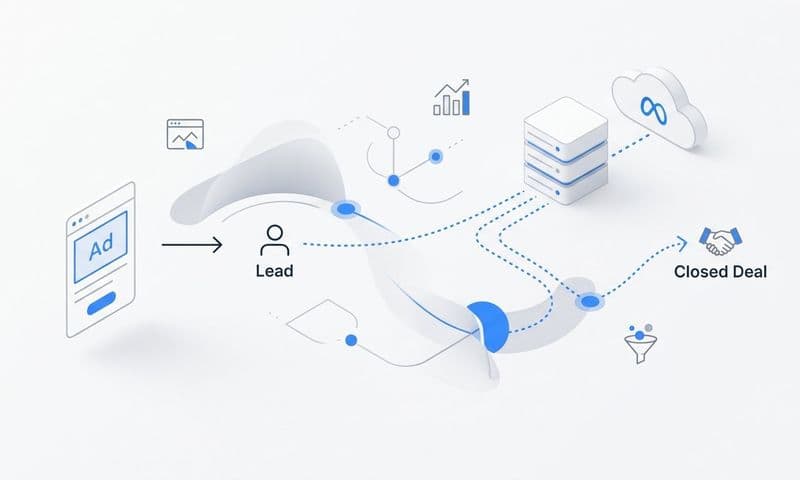
You're running campaigns on Google, Meta, and LinkedIn. Leads are coming in. The pipeline is moving. But when your VP of Revenue asks which channels are actually driving closed-won deals, you find yourself staring at three different dashboards that all tell a different story. Sound familiar?
This is the reality for most B2B SaaS marketing teams operating at any meaningful scale. You're investing real budget across multiple channels, and somewhere between the first ad impression and a signed contract, the signal gets lost. Attribution software exists to solve exactly this problem, but knowing when to implement it is just as important as knowing why.
The good news is that the timing question has a practical answer. There are specific, observable signals that indicate your team is ready to move from gut-feel budget decisions to data-driven attribution. This guide walks you through those signals, explains what changes once you implement, and helps you build the case for moving sooner rather than later.
The Hidden Cost of Flying Blind on Marketing ROI
Here's the compounding problem with multi-channel marketing without attribution: every dollar you spend generates data, but without the right infrastructure, that data never connects into a coherent picture. You end up with platform-reported metrics that each tell their own flattering story, a CRM that credits the last touchpoint before conversion, and a team that makes budget decisions based on whichever dashboard happens to be open at the time.
The most immediate pain point is duplicate lead counting. Meta reports a conversion. Google reports the same conversion. Your CRM attributes it to an organic search visit. Suddenly one closed deal has been counted three times across three platforms, and your reported ROAS looks significantly healthier than your actual return. When you try to explain to leadership why the pipeline numbers don't match the ad platform reports, you're in a difficult position.
The second pain point is the inability to defend budget allocation. When every channel appears to be performing based on its own native reporting, it becomes nearly impossible to make a principled case for increasing spend on one channel versus another. Teams default to spreading budget evenly, following instinct, or simply continuing whatever worked last quarter, none of which is a growth strategy.
The third and perhaps most overlooked pain point is the loss of historical data. Attribution software needs time to build accurate models. Every month you delay implementation is a month of customer journey data that goes uncaptured. When you finally do implement, you start from zero, which means your models are less accurate early on and your team has no historical baseline to compare against.
This is why the framing of attribution as a "future nice-to-have" is strategically costly. The longer you wait, the more you've already spent without visibility, and the longer it takes to build the data foundation that makes attribution genuinely powerful. Early implementation is not just an operational choice; it's a compounding advantage.
Five Clear Signals You Are Ready for Attribution Software
Not every team needs enterprise attribution software on day one. But there are specific inflection points that indicate the cost of not having it now outweighs the cost of implementation. Here are the five clearest signals to watch for.
Signal 1: You are running paid campaigns on two or more channels simultaneously. The moment you are actively spending on Google Ads and Meta, or LinkedIn and paid search at the same time, you have a multi-channel attribution problem. Each platform reports conversions using its own methodology, its own attribution window, and its own definition of what counts as a conversion. Without a unified attribution layer, you cannot confidently compare performance across channels or allocate incremental budget based on revenue impact rather than platform-reported ROAS.
Signal 2: Your sales cycle is longer than two weeks. In B2B SaaS, a prospect rarely sees one ad and immediately books a demo. They might click a LinkedIn ad, read a blog post, attend a webinar, see a retargeting ad on Google, and then finally convert through a branded search. If your last-click attribution in the CRM credits that branded search, you've misattributed the conversion and potentially undervalued every earlier touchpoint that actually drove the decision. The longer your sales cycle, the more misleading last-touch attribution becomes, and the more valuable multi-touch attribution is.
Signal 3: You have a defined, measurable conversion event. If you've identified a specific conversion event, whether that's a demo booked, a trial started, or an MQL threshold reached, and you're investing meaningfully in paid acquisition to drive that event, you need to connect ad spend directly to those outcomes. Without attribution, you're essentially running paid campaigns on faith that they're contributing to your conversion goals. With attribution, you can trace every conversion back to the specific touchpoints that preceded it.
Signal 4: You are preparing for a budget planning conversation. Every quarter or annual planning cycle, marketing leaders face the same challenge: justify current spend and make the case for next period's budget. If you're walking into that conversation with platform-reported metrics instead of revenue-attributed data, you're at a disadvantage. B2B revenue attribution software gives you the language of pipeline and revenue, which is the language that finance and executive leadership speak.
Signal 5: You are scaling a team or agency relationship. As soon as more than one person or team is responsible for different channels, the risk of siloed reporting increases significantly. Attribution creates a shared source of truth that aligns your paid search team, your paid social team, and your content team around the same performance data, reducing internal debates about which channel deserves credit and focusing the conversation on what actually drives growth.
What Actually Changes After Implementation
The shift that happens when you implement attribution software is not just about better reports. It's a fundamental change in how your team understands and acts on marketing data.
The most immediate change is the move from platform-reported metrics to unified, cross-channel visibility. Instead of logging into four separate dashboards and trying to reconcile conflicting numbers, you have a single source of truth that normalizes data across all channels. This eliminates the duplicate conversion counting problem and gives you an accurate picture of what each channel is actually contributing, not what each platform claims it's contributing.
The customer journey becomes visible in a way it simply wasn't before. You can see that a typical prospect interacts with your brand across several touchpoints before booking a demo, that LinkedIn tends to appear early in the journey while branded search tends to appear late, and that certain content types consistently show up in the journeys of prospects who eventually become customers. This kind of journey-level visibility is impossible with last-click attribution or platform-native reporting.
Budget reallocation becomes defensible. This is where attribution software moves from a reporting tool to a growth lever. When you can point to specific data showing that one channel consistently appears in the journeys of your highest-value customers while another channel drives clicks but rarely appears in closed-won deals, you have a principled basis for shifting budget. You're no longer arguing from instinct; you're arguing from evidence.
Teams also find that attribution changes the quality of their internal conversations. Rather than debating which channel "feels" like it's working, teams can align around shared data and focus their energy on optimization. This reduces friction between channel owners and creates a more collaborative environment where everyone is working toward the same revenue outcomes.
Perhaps most importantly, attribution creates a feedback loop. As you make budget decisions based on attribution data and observe the results, your models improve, your team builds intuition grounded in evidence, and your ability to forecast pipeline from specific channel investments becomes more reliable over time.
Choosing the Right Attribution Model for Your Sales Motion
One of the most common points of confusion when implementing attribution software is the question of which attribution model to use. The honest answer is that there is no universally correct model. The right choice depends on your sales cycle, your go-to-market motion, and what specific question you are trying to answer.
Here's a quick orientation across the main model types. First-touch attribution gives all credit to the channel that generated the initial awareness, which is useful if you want to understand what's driving top-of-funnel discovery. Last-touch attribution credits the final interaction before conversion, which is simple but often misleading in longer sales cycles. Linear attribution distributes credit equally across all touchpoints, which acknowledges the full journey but treats every interaction as equally important. Time-decay attribution weights touchpoints more heavily as they get closer to the conversion event, which reflects the logic that later interactions are often more decisive. Data-driven attribution uses machine learning to assign credit based on which touchpoints actually correlate with conversion, which is the most sophisticated approach but requires sufficient data volume to be reliable.
For B2B SaaS teams with longer sales cycles and multiple stakeholders involved in the buying decision, multi-touch attribution models typically surface more accurate insights than single-touch models. When a deal takes several weeks or months to close and involves multiple decision-makers, collapsing the entire journey to a single touchpoint misrepresents how the decision was actually made.
The most valuable capability is not picking one model and committing to it permanently. It's having the flexibility to compare models side by side and understand how each one tells a different story about your pipeline. Seeing the same data through a first-touch lens versus a time-decay lens can reveal which channels are driving awareness versus which are closing deals, and that distinction is often more actionable than any single model view on its own.
Think of attribution models as lenses rather than verdicts. Each one illuminates a different aspect of your customer journey, and the ability to switch between them is what gives you a complete picture.
Why Server-Side Tracking Is Now a Core Requirement
Even if you implement attribution software with the right model configuration, the quality of your data depends entirely on the completeness of your tracking. And browser-based tracking alone is no longer sufficient to capture a complete picture of your customer journey.
Ad blockers, iOS privacy changes, and the gradual deprecation of third-party cookies have created meaningful gaps in browser-side tracking. A significant portion of your website visitors are either blocking tracking scripts entirely or operating in environments where cookies are restricted. When those visitors convert, their journey data is incomplete or missing, which distorts your attribution results and skews your understanding of which channels are performing.
Server-side tracking and Conversion API (CAPI) integrations solve this by sending conversion events directly from your server to ad platforms, bypassing the browser entirely. When a conversion event fires on your server, it doesn't matter whether the user has an ad blocker installed or whether their browser is restricting cookies. The event is captured and transmitted accurately, which means your attribution data reflects what actually happened rather than what your browser-side scripts were able to observe.
There is also a downstream benefit that goes beyond your own reporting accuracy. Ad platforms like Meta, Google, and LinkedIn use the conversion signals you send them to power their bidding and targeting algorithms. Meta Advantage+, Google Smart Bidding, and LinkedIn's campaign optimization tools all depend on conversion data to understand which users are most likely to convert and how to allocate impressions accordingly. When you send richer, more complete conversion data through server-side integrations, you're not just improving your attribution reports; you're improving the quality of the optimization signals that these platforms use to run your campaigns.
In practical terms, this means better targeting, more efficient bidding, and improved campaign performance, all as a direct result of having more complete data flowing through your attribution infrastructure. Server-side tracking is not an advanced optional feature. For any B2B SaaS team running meaningful paid acquisition, it's a foundational requirement for accurate attribution and effective ad platform optimization.
Building the Growth Infrastructure That Scales With You
It helps to think about attribution software not as a reporting layer but as growth infrastructure. Once it's in place, it connects your ad spend to pipeline velocity, your customer acquisition cost by channel, and ultimately your closed-won revenue. These are the metrics that matter to growth leaders, CFOs, and boards, and they are metrics you simply cannot produce reliably without attribution.
AI-driven attribution recommendations accelerate the decision-making process in ways that manual dashboard analysis cannot. Rather than spending hours correlating data across channels, teams receive signals about which campaigns are underperforming relative to their cost, which channels are contributing disproportionately to high-value deals, and where budget reallocation would have the greatest impact. This compresses the feedback loop between data and action, which is one of the most significant operational advantages attribution provides.
The compounding nature of attribution data is worth emphasizing again. A team that implements attribution today and runs it consistently for twelve months will have a significantly more accurate model than a team that implements it twelve months from now. Historical data improves model accuracy, reveals seasonal patterns, and creates the baseline against which future performance can be measured. Every month of delay is a month of learnable signal that cannot be recovered.
Teams that build this infrastructure early also find that it changes how they hire, how they brief agencies, and how they structure campaigns. When you know that attribution data will eventually surface the revenue contribution of every channel, you make better decisions about where to invest time and budget from the start. Attribution doesn't just improve your reporting; it improves your strategy.
This is the compounding advantage of early implementation: better data leads to better decisions, which leads to better performance, which generates better data. The flywheel starts spinning the moment you put the infrastructure in place.
The Bottom Line on Attribution Timing
There is no perfect moment to implement attribution software, but there are clear signals that indicate you are leaving real money and insight on the table without it. If you are running campaigns on multiple channels, operating with a sales cycle longer than two weeks, investing in paid acquisition to drive defined conversion events, preparing for budget planning conversations, or scaling a team across multiple channels, the time to implement is now, not next quarter.
The five signals outlined in this guide are not hypothetical. They reflect the real inflection points where the cost of not having attribution begins to outweigh the cost of implementation. And the longer you wait past those inflection points, the more historical data you lose and the harder it becomes to build accurate models from scratch.
What attribution enables is not just better reporting. It's the ability to connect every ad click to pipeline and revenue, to defend budget decisions with evidence rather than instinct, and to feed better conversion data back to ad platforms so their optimization algorithms work harder for you. It's the difference between managing marketing by feel and managing it with precision.
Cometly is built specifically for B2B SaaS teams who want exactly this kind of end-to-end visibility. From server-side conversion tracking and Conversion API integration to multi-touch attribution models and AI-driven campaign recommendations, it connects your ad platforms, CRM, and website into a single source of truth. If you're ready to stop guessing and start making confident, revenue-backed marketing decisions, Get your free demo today and start capturing every touchpoint that matters.