You log into Facebook Ads Manager on a Tuesday morning and see 50 conversions from last week's campaign. Feeling good, you switch over to Google Analytics and notice the number is 30. Then you open your CRM and find only 22 deals that actually closed. Same campaign, same time period, three completely different stories.
If this scenario sounds familiar, you are not alone. This is one of the most common and frustrating experiences in digital advertising, and it leads many marketers to question their tools, their data, and sometimes their own sanity. The temptation is to assume something is broken, that a pixel misfired, that someone set up tracking incorrectly, or that one of the platforms is simply lying.
Here is the truth: none of these platforms are broken, and none of them are lying. They are each telling you the truth as they see it. The problem is that each platform has a fundamentally different way of seeing the world. Different attribution models, different tracking methods, different data sources, and different business incentives all combine to produce numbers that will almost never perfectly align. Understanding why this happens is the first step toward making smarter decisions with your data instead of reacting to numbers that seem to contradict each other.
This article breaks down the specific reasons why Facebook Ads shows different numbers than your CRM, Google Analytics, and other platforms, and walks you through practical steps to bring more clarity and confidence to your measurement strategy.
Every Platform Keeps Its Own Score: The Attribution Model Gap
Think of attribution like a sports team arguing over who deserves credit for a win. The quarterback says it was his touchdown pass. The receiver says he made the catch. The offensive line says they protected the pocket. Everyone is right from their own perspective, but none of them are giving you the full picture.
Facebook Ads Manager, by default, uses a 7-day click and 1-day view attribution window. This means Facebook will claim credit for a conversion if someone clicked your ad within the past seven days before converting, or if they simply viewed your ad within the past day before converting. That second part is where things get especially interesting.
View-through conversions are one of the biggest contributors to inflated Facebook numbers. If someone scrolls past your ad on Monday without clicking, then searches Google on Wednesday and converts through a paid search ad, Facebook will still count that as a conversion it influenced. Google Analytics, depending on its attribution model, may credit that same conversion entirely to paid search. Your CRM records the deal but has no idea which channel deserves credit. This is a core reason ad platforms show different numbers for the same customer actions.
Google Analytics 4 defaults to a data-driven attribution model, which uses machine learning to distribute credit across multiple touchpoints based on historical conversion patterns. Universal Analytics, which many teams used for years before the GA4 transition, defaulted to last-click attribution, meaning the final channel before conversion got all the credit. These are fundamentally different methodologies, and neither one matches how Facebook attributes conversions.
There is also an important structural reality to acknowledge here. Every ad platform is financially incentivized to show you the best possible version of its own performance. Facebook wants you to believe its ads drove your conversions. Google wants the same. Neither platform is going to voluntarily discount its own contribution to a sale. This is not malicious, it is just how self-reported platform data works. Each platform is an interested party, and that inherent bias means you should never rely on any single platform's numbers as your definitive source of truth. Understanding Facebook Ads attribution in depth is critical to interpreting these numbers correctly.
The only way to cut through the noise is to build a measurement approach that sits outside of any individual ad platform and tracks the full customer journey independently.
How Privacy Changes and Browser Restrictions Broke the Tracking Chain
Even if every platform used the same attribution model, modern privacy changes have introduced a new layer of complexity that makes accurate tracking significantly harder than it was just a few years ago.
Apple's App Tracking Transparency framework, introduced with iOS 14.5 in April 2021, fundamentally changed the relationship between Facebook and its ability to track user behavior across apps and websites on Apple devices. Before ATT, Facebook could track what users did after clicking an ad, including purchases, sign-ups, and other conversion events, across third-party apps and websites. After ATT, users had to explicitly opt in to being tracked. A large portion of iOS users chose not to opt in, which means Facebook lost direct visibility into a significant share of conversions happening on Apple devices. Many advertisers noticed their Facebook ads stopped working after iOS 14 as a direct result of these changes.
To compensate, Meta introduced Aggregated Event Measurement, a framework that limits the number of conversion events advertisers can track per domain and uses statistical modeling to estimate conversions that can no longer be directly observed. In practice, this means some of the conversion numbers you see in Facebook Ads Manager are not actual observed conversions. They are modeled estimates based on patterns from users who did consent to tracking. This modeling can be reasonably accurate in aggregate, but it introduces discrepancies when you compare Facebook's numbers to tools that track actual server-side events or use first-party data.
Browser-level restrictions compound the problem further. Safari's Intelligent Tracking Prevention limits the lifespan of third-party cookies, which the Facebook pixel relies on to connect ad clicks to downstream conversions. Firefox's Enhanced Tracking Protection applies similar restrictions. As users increasingly browse on Safari or privacy-focused browsers, the pixel has less and less ability to close the loop between an ad click and a conversion, especially when that conversion happens days later or on a different device. This is why tracking paid ads after the iOS update requires a fundamentally different approach than before.
The result is a tracking chain with multiple broken links. A user clicks a Facebook ad on their iPhone, browses your website, leaves, returns three days later on their laptop through a direct visit, and converts. The pixel may never connect those two sessions. Facebook may model the conversion or miss it entirely. Google Analytics may credit direct traffic. Your CRM records the lead with no channel data at all.
This is why server-side tracking solutions like the Facebook Conversions API have become essential rather than optional for advertisers who want accurate data. We will cover that in more detail shortly.
Pixel Fires, Deduplication Failures, and Technical Culprits
Beyond attribution models and privacy restrictions, there are several technical issues that contribute to the numbers you see in Facebook Ads Manager being out of sync with your other tools.
One of the most common is pixel double-firing. The Facebook pixel is a JavaScript snippet that fires conversion events based on user actions on your website. In multi-step checkout flows, single-page applications, or pages that users frequently refresh, the pixel can fire the same purchase or lead event more than once for a single conversion. Your CRM records one closed deal. Facebook records two or three purchase events. This is one of the key reasons behind why Facebook overreports conversions compared to your actual sales data.
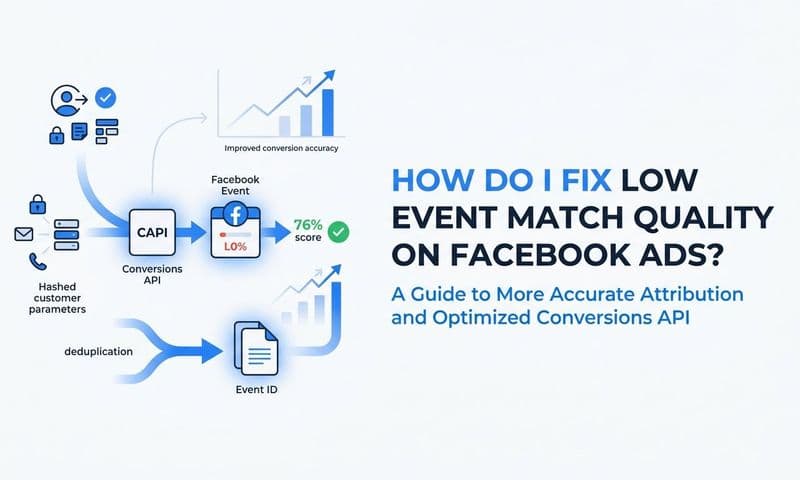
Deduplication is supposed to solve this problem. When you use both the Facebook pixel and the Conversions API together, Meta's system is designed to deduplicate events so that the same conversion is not counted twice. But deduplication requires passing consistent event IDs across both the pixel and the API, and when that setup is not configured correctly, you end up with inflated numbers rather than accurate ones.
Time zone differences are another underappreciated source of confusion. Facebook's reporting uses the time zone set in your ad account. Google Analytics uses a separate time zone configured in its own settings. Your CRM may use yet another. A conversion that happens at 11:30 PM in one time zone might appear on a completely different date in another system. When you pull weekly or daily reports and compare them side by side, these time zone shifts can make it look like conversions are missing or misaligned when they are simply being counted on different days.
Event definition mismatches matter too. Facebook might be tracking an "Add to Cart" event as a meaningful conversion metric in your campaign setup, while your CRM only records completed purchases as conversions. If you are comparing these two numbers without accounting for what each one actually measures, the discrepancy is not a tracking problem. It is a definition problem. Standardizing what counts as a conversion across all your tools is a foundational step that many teams skip, and it directly relates to understanding why conversion tracking numbers are wrong.
Cross-Platform Data Conflicts: One Journey, Three Different Verdicts
Let's walk through a concrete example of how a single customer journey produces conflicting data across platforms. This will make the abstract concepts above much more tangible.
A potential customer sees your Facebook ad on Monday while scrolling through their feed on an iPhone. They do not click. On Wednesday, they remember your brand and search for it on Google, clicking your paid search ad and visiting your website. They browse but do not convert. On Thursday, they return via a direct visit, complete a purchase, and become a customer.
Here is how each platform interprets this journey. Facebook sees the view-through conversion because the user saw the ad within the 1-day view window... actually, the view was on Monday and the conversion was Thursday, so it falls outside the 1-day view window but within the 7-day click window only if they clicked. In this case, since they only viewed and did not click, Facebook may or may not claim credit depending on how the campaign is configured and whether modeling fills in the gap. Google Analytics credits the paid search click from Wednesday, since that was the last paid touchpoint before the direct visit and conversion. Your CRM records the purchase with minimal source data, possibly showing "direct" or leaving the source field blank entirely.
UTM parameters are the standard method for passing campaign data into Google Analytics, but they come with their own complications. If UTMs are not consistently applied to every ad URL, some traffic arrives untagged and gets misattributed. If a redirect strips the UTM parameters before the user lands on your page, the source data is lost. If a user clicks a Facebook ad, then later clicks a Google ad, the UTM from the second click overwrites the first in Google Analytics, erasing Facebook's contribution from the record entirely. Properly tracking for Facebook and Google Ads requires careful coordination across both platforms.
Facebook's own attribution system does not rely on UTM parameters. It uses its own pixel and click identifiers, which is why Facebook's numbers and Google Analytics numbers will almost always differ even when both are configured correctly.
The deeper issue here is the absence of a single source of truth. Without a unified view of the customer journey that sits above all these individual platforms, marketers are forced to make budget decisions based on whichever platform's story they happen to trust most. It often remains unclear which ads drive actual revenue when you rely solely on self-reported platform data. That is a fragile foundation for spending decisions that can run into the thousands or millions of dollars.
Practical Fixes to Align Your Numbers and Find the Truth
Understanding why the numbers differ is important. But what you actually need are practical steps to reduce the discrepancies and build a measurement approach you can trust. Here is where to focus your energy.
Implement server-side tracking alongside your pixel. The Facebook Conversions API sends conversion data directly from your server to Meta, bypassing the browser entirely. This means iOS restrictions, cookie limitations, and ad blockers have far less impact on your data. When used alongside the pixel with proper deduplication, the Conversions API can recover a meaningful portion of the conversion data that browser-based tracking misses. Investing in tracking Facebook ads accurately is not optional anymore for advertisers who care about data accuracy. It is a foundational requirement.
Standardize your event definitions and attribution windows. Before you compare numbers across platforms, make sure you are actually comparing the same thing. Define what counts as a conversion in your business, whether that is a completed purchase, a qualified lead form submission, or a booked call, and make sure every platform is measuring that same action. Align your attribution windows as much as the platforms allow, and document your choices so your entire team is working from the same definitions.
Audit and enforce consistent UTM parameters. Build a UTM naming convention and enforce it across every ad, every channel, and every campaign. Use a UTM builder to eliminate manual errors. Check regularly that UTMs are surviving redirects and landing on your pages intact. This will not close the gap between Facebook's attribution and Google Analytics entirely, but it will reduce the noise caused by untagged or inconsistently tagged traffic.
Align time zones across your platforms. Set the same time zone in Facebook Ads Manager, Google Analytics, and your CRM wherever possible. This one simple step eliminates a category of discrepancy that causes unnecessary confusion in daily and weekly reporting.
Use a dedicated attribution platform to unify your data. This is where the real leverage is. Tools like Cometly connect your ad platforms, your website, and your CRM to track leads to revenue across the complete customer journey using first-party data. Instead of asking each platform to grade its own homework, you get a single, independent view of which ads and channels are actually driving leads and revenue.
Cometly captures every touchpoint from the first ad click to the final closed deal, giving its AI a complete and enriched view of each customer journey. That means you can see which campaigns are genuinely contributing to revenue, not just which ones are claiming credit. Cometly also feeds enriched conversion data back to Meta, Google, and other ad platforms through server-side integrations, which improves the quality of signals those platforms use for targeting and optimization. Better data in means better algorithmic decisions out, which translates directly to improved ad performance over time.
Making Confident Budget Decisions When the Numbers Don't Match
Here is a mindset shift that will save you a lot of frustration: stop trying to get Facebook Ads Manager, Google Analytics, and your CRM to show the same number. They never will, and chasing perfect alignment is a distraction from the actual goal, which is making confident, informed decisions about where to invest your budget.
What you should focus on instead is directional accuracy and relative performance. If Facebook shows that Campaign A drove significantly more conversions than Campaign B, and your attribution platform confirms that Campaign A's audiences are generating more downstream revenue in your CRM, that directional signal is actionable. You do not need the numbers to be identical across platforms to know which campaign deserves more budget. Knowing which ads are actually working requires looking beyond any single platform's self-reported metrics.
This is where AI-powered attribution tools provide real value. Rather than manually reconciling numbers across five different dashboards, an AI-driven platform can analyze cross-channel data holistically and surface which ads and campaigns are actually moving the needle on revenue. It removes the guesswork from optimization and replaces it with data-driven recommendations grounded in the full customer journey, not just the slice of it that any single platform can see.
The marketers who win in this environment are not the ones who find a way to make all their numbers match. They are the ones who build a measurement stack that gives them enough clarity to act with confidence. That means combining server-side tracking, consistent event definitions, and a unified attribution layer that sits above the individual platforms and gives you an independent view of performance.
Relying on any single platform's self-reported data to make budget decisions is like asking a vendor to audit their own invoice. The incentives are misaligned. Build a system that works for you, not for the platforms.
Putting It All Together
Facebook showing different numbers than your CRM or Google Analytics is not a glitch. It is a predictable outcome of how modern ad tracking works across fragmented platforms, competing attribution models, privacy restrictions, and technical limitations that have only grown more complex over the past several years. Every platform you use is telling you its version of the truth, shaped by its own methodology and its own incentives.
The path forward is not to pick one platform to trust and ignore the rest. It is to build a measurement approach that gives you an independent, unified view of the customer journey. That means implementing server-side tracking, standardizing your event definitions and UTM parameters, aligning time zones, and using a dedicated attribution platform to connect the dots across all your channels.
Start by auditing your current tracking setup. Identify where the biggest gaps are, whether that is a missing Conversions API integration, inconsistent UTM tagging, or mismatched event definitions. Then prioritize the fixes that will have the most impact on the quality of your data.
When your measurement stack is built on first-party data and unified attribution, the noise from platform discrepancies becomes much easier to manage. You stop reacting to conflicting numbers and start making decisions based on what is actually driving revenue.
Ready to elevate your marketing game with precision and confidence? Discover how Cometly's AI-driven recommendations can transform your ad strategy. Get your free demo today and start capturing every touchpoint to maximize your conversions.