If your Facebook Ads performance data feels unreliable, you are not alone. Since Apple's App Tracking Transparency framework launched, many marketers have watched their reported conversions shrink, their audiences narrow, and their optimization decisions become increasingly difficult to trust. The numbers inside Meta Ads Manager no longer match what shows up in the CRM. Conversions go underreported. The algorithm receives incomplete signals. And every campaign cycle, the gap between what you're spending and what you can prove widens.
This is not a minor inconvenience. Inaccurate performance data leads to wasted budget, misguided scaling decisions, and a growing distrust of the metrics that are supposed to guide your strategy. Many marketers respond by either over-investing in channels that appear to be working (but may not be) or pulling back on campaigns that are actually driving results but aren't getting proper credit.
The good news is that this is a solvable problem. Not with a single quick fix, but with a layered system that addresses the root causes of data loss and builds a foundation you can actually rely on.
This guide walks you through six concrete steps to improve your Facebook Ads performance data from the ground up. You will learn how to audit your current tracking setup, implement server-side solutions that bypass browser limitations, connect your CRM data to close the attribution loop, feed enriched conversion events back to Meta's algorithm, apply multi-touch attribution to understand the full customer journey, and build dashboards that give you a single source of truth.
Whether you manage campaigns in-house or run an agency handling multiple client accounts, these steps apply regardless of ad spend level. Let's get into it.
Step 1: Audit Your Current Facebook Tracking Setup for Data Gaps
Before you can fix anything, you need to know exactly what is broken. Most marketers are surprised to discover just how many gaps exist in their current setup once they take a systematic look. Start here before touching anything else.
Open Meta Events Manager and run through the diagnostics panel. Look at your pixel health score, check which events are firing, and review whether those events are being received consistently. Pay close attention to the event match quality score for each conversion event. A low score tells you that Meta cannot reliably match the events it receives to real user profiles, which directly limits how well the algorithm can optimize your campaigns.
Next, check your Aggregated Event Measurement configuration. This is the framework Meta uses to handle conversion reporting in a privacy-compliant way for iOS users. If your events are not properly prioritized or configured, you may be losing visibility into a significant portion of your iOS-driven conversions entirely. Many advertisers have struggled with this since the iOS update, and understanding why Facebook Ads stopped working after iOS 14 is essential context for this audit step.
Now comes the most revealing part of the audit: compare your Ads Manager reported conversions against your actual backend data. Pull the same time period from your CRM, your payment processor, or your order management system. How large is the gap? Many marketers discover meaningful discrepancies that cannot be explained by attribution window differences alone.
These gaps are typically caused by a combination of factors. Ad blockers prevent the browser-based pixel from firing. Safari's Intelligent Tracking Prevention limits cookie lifespans. iOS users who opt out of tracking are invisible to pixel-based measurement. And delayed reporting windows mean some conversions show up in Ads Manager days after they actually occurred, making real-time decisions unreliable. If you are seeing significant discrepancies, you may want to explore underreporting conversions in Facebook Ads for a deeper look at the causes.
Common gap types to document: underreported purchase conversions, lead form submissions that appear in your CRM but not in Events Manager, and add-to-cart or initiate-checkout events that fire inconsistently across devices.
The output of this step is a documented list of every discrepancy between what Ads Manager reports and what your backend confirms. This becomes your baseline. Every subsequent step should measurably close these gaps, and you need the baseline to know whether it is working.
Success indicator: You have a clear, written record of your conversion gap by event type, along with notes on which tracking mechanisms are currently in place and where they are failing.
Step 2: Implement Server-Side Tracking to Capture What the Pixel Misses
The browser-based pixel was built for a different era of the internet. It relies on JavaScript running in the user's browser, which means anything that interferes with that browser environment, whether an ad blocker, a privacy setting, or a cookie restriction, creates a gap in your data. Server-side tracking solves this by moving the data collection process off the user's device and onto your server, where those browser-level restrictions no longer apply.
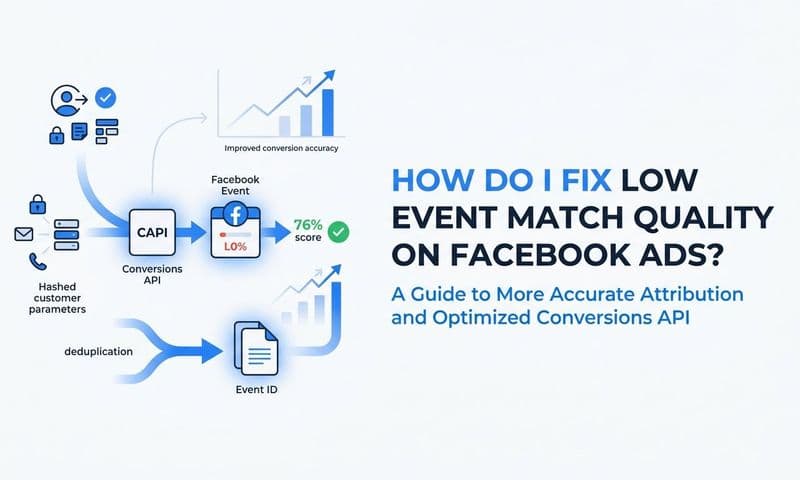
Meta's Conversions API (CAPI) is the primary tool for this. Instead of waiting for a pixel to fire in the browser, CAPI sends conversion events directly from your server to Meta's servers. For a detailed walkthrough, see this Conversion API implementation tutorial that covers the full setup process. The user's browser never has to execute any tracking code for the event to be recorded. This means conversions that would have been invisible to the pixel are now captured.
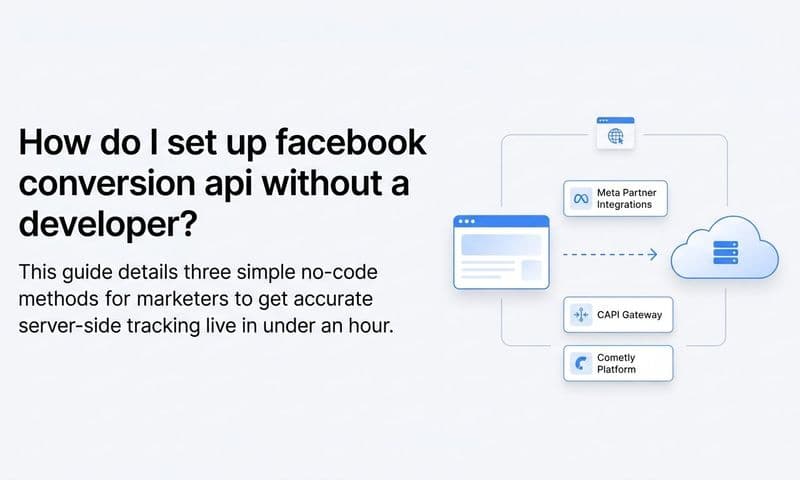
Setting up CAPI can be done through a direct API integration or through a partner integration if you use a platform like Shopify, WooCommerce, or a customer data platform. The partner route is faster and requires less technical overhead. The direct route gives you more control and flexibility, particularly if you have custom events or a complex funnel.
One critical detail that many teams overlook: deduplication. When you run both the browser pixel and CAPI simultaneously (which is the recommended approach, since the pixel still captures useful browser-side signals), you need to make sure the same event is not counted twice. Meta uses an event ID to deduplicate, so every event sent through both channels must carry a matching unique identifier. Skipping this step inflates your conversion counts, confuses the algorithm, and makes your performance data less trustworthy than before you started.
This is where a tool like Cometly adds significant value. Cometly's server-side tracking layer is designed to work alongside CAPI, capturing every touchpoint from the initial ad click through downstream CRM events without relying solely on the browser. It handles deduplication automatically and enriches the events it sends with additional data points that improve match quality. Rather than building and maintaining this infrastructure yourself, you get a purpose-built system that connects your ad platforms, website, and CRM into a single tracking architecture. You can explore the broader landscape of Facebook tracking software to understand how different solutions compare.
Common pitfall: Implementing CAPI without deduplication logic. This is one of the most frequent mistakes teams make, and it creates a new set of data problems while trying to solve the original ones.
Success indicator: Your event match quality score in Events Manager improves after implementation, and the gap between Ads Manager reported conversions and your actual backend conversions begins to narrow. Use the baseline you documented in Step 1 to measure this directly.
Step 3: Connect Your CRM and Revenue Data to Close the Attribution Loop
Even with server-side tracking in place, your Facebook Ads data still only tells part of the story. Meta can tell you that someone clicked your ad and submitted a lead form. What it cannot tell you is whether that lead became a qualified opportunity, closed as a customer, or churned after 30 days. For businesses with a sales cycle longer than a few hours, this is a critical blind spot.
The fix is connecting your CRM to your ad data so that downstream pipeline events flow back to the originating campaign. This means when a lead in HubSpot moves from "Marketing Qualified Lead" to "Closed Won," that outcome is tied back to the Facebook ad, ad set, and campaign that first brought that person into your funnel. Understanding Facebook Ads attribution is key to making this connection work effectively.
Without this connection, you are optimizing your Facebook campaigns toward the wrong goal. You might be generating plenty of leads, but if those leads are low quality and rarely convert to revenue, you are training Meta's algorithm to find more people just like them. The algorithm is only as smart as the data you feed it, and if the best signal you give it is a lead form submission, it will optimize for lead form submissions rather than for customers.
Connecting your CRM typically involves mapping a unique identifier (often the click ID or a UTM-tagged lead ID) from the ad click through to the CRM record. When a deal closes or a revenue event occurs, that identifier allows you to trace the outcome back to its source. The implementation complexity varies depending on your CRM and your funnel architecture, but the principle is consistent across platforms.
Cometly is built specifically to bridge this gap. It links ad platform data, website events, and CRM outcomes into one unified customer journey view. Instead of jumping between Meta Ads Manager, HubSpot, and a spreadsheet to piece together what happened, you get a single connected picture that shows the full path from ad impression to closed revenue.
A practical example: Imagine a prospect who fills out a demo request form after clicking a Facebook ad. They enter your CRM as a new lead. Three weeks later, they sign a contract. With CRM integration in place, that closed deal is attributed back to the original campaign, giving you accurate revenue-per-campaign data rather than just cost-per-lead data.
Success indicator: You can trace a specific closed deal back to the exact Facebook ad, ad set, and campaign that sourced it. Revenue attribution is no longer a manual process requiring cross-referencing multiple tools.
Step 4: Feed Enriched Conversion Data Back to Meta's Algorithm
Here is something many advertisers do not fully appreciate: Meta's algorithm is not just using your conversion data to report results. It is using that data as training signals to decide who to show your ads to next. The quality of the conversion signals you send directly determines the quality of the audiences Meta builds for you.
This is the concept of a conversion feedback loop. When Meta receives a conversion event, it uses that signal to identify patterns among the people who converted and find more people who look like them. If you are only sending basic top-of-funnel events like page views or add-to-carts, the algorithm learns to find people who browse but do not necessarily buy. If you send enriched downstream events that include value, lead quality indicators, and actual revenue outcomes, the algorithm learns to find people who convert at a higher level. This is a core principle behind effective Facebook Ads optimization.
Enriched conversion data goes beyond the standard event parameters. It includes things like conversion value, customer lifetime value signals, lead quality scores from your CRM, and downstream pipeline stages. The more context you give Meta about what a "good" conversion actually looks like for your business, the better it can optimize toward those outcomes.
What enriched events look like in practice:
Basic event: A "Lead" event fires when someone submits a form. Meta knows a form was submitted. That is all.
Enriched event: A "Lead" event fires with a quality score from your CRM, a predicted lifetime value, and a flag indicating whether this lead matches your ideal customer profile. Meta now knows not just that a form was submitted, but that this particular form submission represents a high-value prospect.
Cometly's Conversion Sync feature is designed specifically for this purpose. It sends enriched, conversion-ready events back to Meta and other ad platforms so the algorithm can optimize toward the outcomes that actually matter to your business rather than surface-level engagement metrics. This directly improves the efficiency of your campaigns over time as the algorithm receives better training data with every conversion cycle. Ultimately, this is how you stop wasting money on Facebook Ads by ensuring every dollar is guided by accurate signals.
Common pitfall: Only sending top-of-funnel events to Meta. This trains the algorithm to optimize for low-intent behavior, which gradually increases your cost per acquisition and decreases the quality of leads or customers your campaigns generate.
Success indicator: Over time, you observe a downward trend in cost per acquisition and an improvement in lead or customer quality as Meta's algorithm receives better training signals and refines its targeting accordingly.
Step 5: Apply Multi-Touch Attribution to See the Full Conversion Path
Facebook's default attribution window, typically a 7-day click and 1-day view model, gives you a narrow slice of the customer journey. For businesses with longer sales cycles or multi-channel customer acquisition paths, this window misses a significant portion of the contribution your Facebook campaigns are actually making.
Consider what a typical B2B or considered-purchase customer journey looks like. A prospect might first encounter your brand through a Facebook awareness campaign. They do not convert immediately. A week later, they search for your brand on Google and visit your website again. Two weeks after that, they see a Facebook retargeting ad and finally book a demo. Under last-click attribution, Google Search gets full credit. Under Facebook's default view-through attribution, the retargeting campaign might claim credit. Neither model tells the full story, which is a key reason why attribution data doesn't match across platforms.
Multi-touch attribution models distribute credit across every touchpoint in the customer journey rather than assigning it all to one interaction. The right model depends on your business and sales cycle:
Linear attribution: Distributes credit equally across all touchpoints. Useful when you want to understand the overall contribution of each channel without favoring any particular stage of the funnel.
Time-decay attribution: Gives more credit to touchpoints that occurred closer to the conversion. Useful for shorter sales cycles where recency is a strong signal of intent.
Position-based attribution: Assigns the most credit to the first and last touchpoints, with the remaining credit distributed across the middle. Useful when you want to value both acquisition and closing equally.
The challenge is that no single model is universally correct. The right approach is to compare models side by side so you can understand how your Facebook campaigns contribute at different stages of the funnel, not just at the final touch.
Cometly's multi-touch attribution lets you do exactly this. You can compare attribution models across your campaigns and see how Facebook Ads contribute to conversions at every stage of the customer journey. This changes how you evaluate campaign performance. A top-of-funnel awareness campaign might look weak under last-click attribution but reveal strong assist value under a linear or position-based model.
Success indicator: You can confidently identify which Facebook campaigns are primarily responsible for introducing new prospects to your brand versus which ones are closing conversions. This distinction directly informs how you allocate budget and structure your campaign architecture.
Step 6: Build a Unified Dashboard and Use AI to Optimize in Real Time
At this point, you have fixed the data collection layer, connected your CRM, enriched your conversion signals, and applied multi-touch attribution. The final step is bringing all of this together into a single view that your team can actually use to make decisions quickly and confidently.
The problem with the current state for most marketing teams is fragmentation. Ads Manager lives in one tab. Google Analytics is in another. The CRM is in a third. Each platform uses slightly different attribution logic, different time zones, and different definitions of a "conversion." When you pull numbers from all three and try to reconcile them in a spreadsheet, you spend more time arguing about which number is right than actually optimizing your campaigns. This fragmentation is a core driver of unreliable marketing performance data across organizations.
A unified dashboard solves this by pulling all of your data into one place with consistent definitions, consistent attribution logic, and consistent time windows. When everyone on the team is looking at the same numbers from the same source, decision-making becomes faster and more aligned.
Cometly's analytics dashboard is built for exactly this use case. It combines Facebook Ads data with cross-channel performance and CRM revenue into a single view, so you can see how your campaigns are performing relative to actual business outcomes rather than just platform-level metrics. You do not need to toggle between tools or manually reconcile numbers. For a deeper understanding of how to leverage this kind of data, explore how marketing analytics data connects to real revenue outcomes.
Beyond the dashboard itself, Cometly's AI-powered recommendations layer surfaces insights that would take hours to find manually. It identifies high-performing ads across your campaigns, flags underperformers before they drain your budget, and suggests budget reallocations based on what is actually driving revenue. These are not generic recommendations. They are based on your specific data, your specific attribution setup, and your specific conversion goals.
The AI Chat feature takes this a step further. Instead of manually pulling reports or building custom views, you can ask natural-language questions about your data and get immediate answers. Questions like "Which campaign drove the most revenue last month?" or "What is my cost per acquisition by ad set this week?" become instant queries rather than multi-step reporting tasks.
Success indicator: Your team makes optimization decisions from one dashboard with consistent, trustworthy data. Time spent reconciling numbers across platforms drops significantly, and the speed at which you can identify and act on performance changes improves.
Putting It All Together: Your Path to Trustworthy Facebook Ads Data
Improving your Facebook Ads performance data is not a one-time fix. It is a system you build and refine over time, where each layer compounds on the one before it. Better data feeds a smarter algorithm. A smarter algorithm drives better results. Better results give you the confidence to scale with precision rather than guesswork.
Here is a quick checklist to confirm you have completed each step:
1. Audited your current pixel and event setup to document specific data gaps between Ads Manager and your backend.
2. Implemented server-side tracking with proper deduplication to capture conversions the pixel misses.
3. Connected your CRM so that revenue and pipeline data flow back to the originating ad campaigns.
4. Set up enriched conversion syncing so Meta's algorithm receives high-quality training signals tied to real business outcomes.
5. Applied multi-touch attribution to understand how Facebook campaigns contribute across the full customer journey, not just at the last touch.
6. Built a unified dashboard with AI-powered optimization recommendations so your team works from one consistent source of truth.
Each of these steps can be implemented independently, but the full system is where the real impact shows up. When your tracking is accurate, your attribution is complete, your conversion signals are enriched, and your team has a single dashboard to work from, the compounding effect on campaign performance is significant.
If you want to shortcut the setup process and get all six layers working together without stitching together multiple tools, Cometly brings server-side tracking, CRM integration, conversion syncing, multi-touch attribution, and AI-powered recommendations into a single platform built specifically for this problem. Get your free demo today and start building the data foundation your Facebook Ads deserve.