You're running paid campaigns across Meta, Google, and LinkedIn. Conversions are coming in, ROAS looks healthy on paper, and your dashboards are full of green numbers. But when you open your CRM, the story looks completely different. The deals that closed this month don't match what any single platform is claiming credit for. Sound familiar?
This is the daily reality for most B2B SaaS marketing teams managing multi-channel acquisition budgets. Every platform reports its own version of the truth, and none of them agree. Meta says it drove 40 conversions. Google claims 35. LinkedIn takes credit for another 20. Your CRM shows 28 new customers. The math doesn't work, and yet budget decisions get made based on these inflated, conflicting numbers.
The problem isn't that your campaigns aren't working. The problem is that you can't see clearly which ones are actually working. Inaccurate conversion attribution isn't just a reporting inconvenience. It's a strategic liability that causes teams to overfund underperforming channels, cut campaigns that are quietly driving pipeline, and optimize toward metrics that don't connect to revenue.
This article breaks down exactly why attribution breaks down, what accurate conversion attribution actually looks like in practice, how to build the technical foundation to support it, and how to connect your ad spend directly to pipeline and closed-won revenue. By the end, you'll have a clear picture of what it takes to make attribution data a reliable operating system for your growth decisions.
Why Your Conversion Data Is Probably Lying to You
Let's start with the most common culprit: platform overcounting. Every major ad platform, including Meta, Google, LinkedIn, and TikTok, uses its own attribution logic and its own default attribution window. When a prospect clicks a LinkedIn ad on Monday, retargets through a Google display ad on Wednesday, and then converts after clicking a Meta ad on Friday, all three platforms claim full credit for that single conversion.
This isn't a bug. It's how each platform is designed to report. They're each measuring their own contribution in isolation, without any visibility into what happened on the other platforms. The result is that the sum of conversions reported across your channels often far exceeds the actual number of conversions sitting in your CRM. Your reported ROAS looks strong, but it's built on a foundation of double and triple-counted events.
The second problem is the gap between what ad platforms measure and what actually matters for B2B SaaS. Most platforms track surface-level events: clicks, form fills, landing page visits, and in some cases, lead submissions. These are useful signals, but they're not revenue. In B2B SaaS, a form fill might become a qualified opportunity in 30 days, close in 90 days, or never convert at all. Optimizing toward top-of-funnel events without connecting them to downstream revenue means you're teaching your ad platforms to find more of the wrong people.
Then there's the tracking degradation problem, which has accelerated significantly over the past few years. Safari's Intelligent Tracking Prevention, Firefox's Enhanced Tracking Protection, iOS App Tracking Transparency, and the widespread adoption of ad blockers have all chipped away at the reliability of browser-based pixel tracking. When a pixel can't fire or a cookie gets blocked, that conversion disappears from your attribution data entirely. The user converted, the deal closed, but the campaign that drove it gets no credit.
For B2B SaaS specifically, this is especially damaging. Your buyers are often technical professionals who are more likely to use privacy-focused browsers, run ad blockers, or browse in private mode. The very audience you're trying to reach is the one most likely to fall through the gaps in your tracking setup. The result is a systematic underreporting of certain channels and an overreporting of others, creating a distorted picture of which campaigns are actually working.
These three forces, platform overcounting, shallow event tracking, and pixel degradation, compound each other. Understanding the full scope of inaccurate conversion tracking is the first step toward fixing it. And when budget decisions are made on top of this compromised data, the consequences compound too.
What Accurate Conversion Attribution Actually Means
Accurate conversion attribution is the ability to connect every marketing touchpoint across the customer journey, from the first ad impression to the closed-won deal, with confidence and minimal data loss. It means knowing not just that a conversion happened, but which specific interactions contributed to it, and how much weight each one deserves.
It helps to separate two related but distinct concepts: attribution accuracy and attribution completeness. Accuracy means the data you have is correct. If your attribution system says a campaign drove 15 opportunities, those 15 opportunities actually exist in your CRM and are traceable to that campaign. Completeness means no touchpoints are missing from the journey. If a prospect clicked a LinkedIn ad, visited your blog three times from organic search, and then converted through a Google retargeting ad, all of those touchpoints are captured, not just the last one.
Most attribution problems are actually completeness problems. The data that does get captured tends to be reasonably accurate. What breaks down is the capture rate. Pixels miss events. Cross-device journeys break session continuity. Direct traffic swallows organic and paid touchpoints when UTM parameters aren't passed correctly. By the time a conversion is recorded, large portions of the journey are already invisible.
This is why the concept of a single source of truth matters so much. When each platform reports its own attribution data in isolation, you're comparing apples to oranges to bananas. Each report uses different attribution windows, different credit models, and different event definitions. Pulling all of that data into one unified attribution layer, where conversions are deduplicated, touchpoints are stitched together, and revenue data is connected, eliminates the platform-versus-platform discrepancy problem at the source.
A single source of truth doesn't mean you stop looking at native platform reports entirely. It means you have one authoritative system that you trust for budget decisions, one place where the customer journey is assembled from all available signals, and one framework that connects marketing activity to business outcomes. Learning how to fix attribution discrepancies in data is essential to building that foundation. That's what makes every other attribution decision, including model selection and channel investment, meaningful rather than speculative.
The Attribution Models That Shape What You See
Here's something that doesn't get enough attention: the attribution model you choose determines which campaigns look like winners and which ones look like they're underperforming. Two teams looking at the same underlying data can reach completely different conclusions about where to invest budget, simply because they're using different models.
The most common models each tell a different version of the story. Last-click attribution gives all credit to the final touchpoint before conversion, which tends to reward bottom-of-funnel channels like branded search and retargeting while ignoring everything that built awareness and intent earlier in the journey. First-touch attribution does the opposite, crediting the channel that originally introduced the prospect to your brand, which often advantages top-of-funnel paid social and content channels. Linear attribution distributes credit evenly across all touchpoints, which is more balanced but treats a five-second ad impression the same as a 20-minute product demo page visit.
Data-driven attribution, when you have sufficient conversion volume to support it, uses statistical modeling to assign credit based on how much each touchpoint actually influenced the outcome. It's generally considered the most accurate model for accounts with enough data, but it's also a black box that can be difficult to interpret without the right tooling.
For B2B SaaS with long sales cycles, single-touch models are particularly misleading. A typical B2B SaaS deal might involve a prospect who first encounters your brand through a LinkedIn thought leadership ad, researches your category through organic search, attends a webinar two weeks later, reads a comparison page, and finally converts through a branded Google search. Last-click attribution gives all the credit to Google branded search. First-touch attribution gives all the credit to LinkedIn. Neither tells you that the webinar was the inflection point where intent crystallized.
Multi-touch attribution models are better suited to this reality because they acknowledge that the journey has multiple meaningful moments. But the real power comes from comparing models side by side. When you look at how a channel performs under first-touch versus last-touch versus linear attribution, you start to see which channels initiate demand and which channels close it. A channel that looks weak on last-click but strong on first-touch is likely doing important awareness work that you'd be cutting at your own expense.
This kind of model comparison is what separates teams that make informed channel investment decisions from teams that are just following whatever their ad platform dashboards recommend. The model is a lens, and using multiple lenses gives you a much clearer picture of what's actually driving your funnel.
Server-Side Tracking and First-Party Data: The Technical Foundation
Understanding attribution models is the strategic layer. Building reliable data collection is the technical layer underneath it. And right now, the most important technical shift in attribution is the move from client-side pixel tracking to server-side event collection.
Client-side pixels fire from the user's browser, which means they're subject to all the blocking and degradation described earlier. When a user has an ad blocker, a privacy-focused browser, or iOS privacy restrictions enabled, the pixel either doesn't fire at all or fires with incomplete data. The conversion still happened, but your attribution system doesn't know about it.
Server-side tracking via Conversion APIs, including Meta's Conversion API and Google's Enhanced Conversions, solves this by sending event data directly from your server to the ad platform, bypassing the browser entirely. Because the event is sent from your infrastructure rather than the user's browser, it's not subject to browser-level blocking. The signal reaches the platform regardless of what privacy settings the user has enabled. Understanding why server-side tracking is more accurate helps explain why this shift is so critical for modern attribution.
The result is a higher match rate between your actual conversions and the events recorded by the ad platform. This improves both attribution accuracy and the ad platform's ability to optimize toward the right outcomes. When Meta or Google has more complete conversion data, their machine learning algorithms can find more users who match the profile of people who actually converted, not just people who clicked.
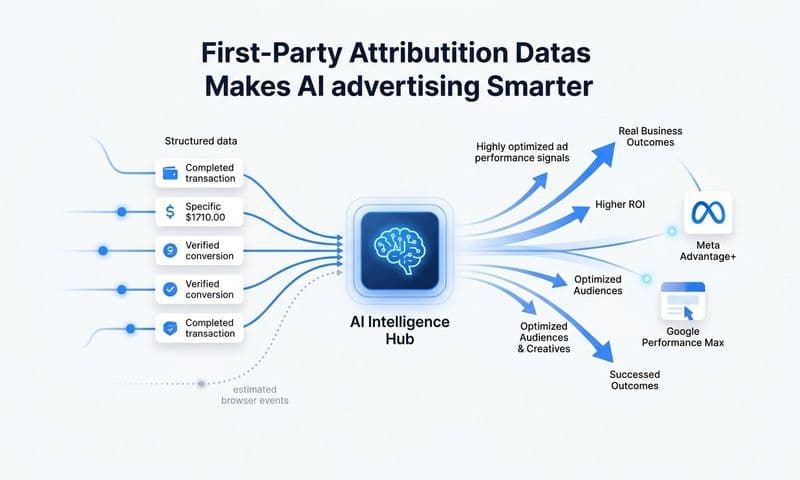
First-party data enrichment takes this a step further. Instead of just sending a conversion event, you can enrich that event with signals from your CRM: lead quality scores, opportunity stage, deal value, or whether a lead eventually became a customer. When ad platforms receive enriched conversion signals, they optimize toward the outcomes that actually matter to your business, not just the surface-level events they can observe on their own.
One critical technical detail that often gets overlooked is event deduplication. When you run both a browser pixel and a server-side Conversion API simultaneously, which is the recommended setup for maximum coverage, both can fire for the same conversion event. Without deduplication logic, the ad platform records two conversions instead of one. This inflates your reported conversion volume, distorts your ROAS, and undermines the accuracy you were trying to build. Proper deduplication, typically implemented using a unique event ID that both the pixel and the server event share, ensures that duplicate events are collapsed into a single conversion record. Following best practices for tracking conversions accurately is essential to getting this right.
Connecting Ad Spend to Pipeline and Revenue
Even with server-side tracking in place and a solid attribution model selected, many B2B SaaS teams are still measuring success at the wrong level. Optimizing toward leads or MQLs is a reasonable starting point, but it's not the finish line. The real question is which campaigns are generating pipeline and closed-won revenue, and what it costs to produce each dollar of that revenue.
The gap between lead-level attribution and revenue-level attribution is significant in B2B SaaS. Two campaigns can generate the same number of leads at the same cost per lead while producing completely different pipeline outcomes. One campaign might attract decision-makers at companies in your ideal customer profile who close at high rates with strong contract values. The other might generate a high volume of leads from small businesses or wrong-fit prospects who churn quickly or never close at all. Lead-level attribution makes both campaigns look identical. Revenue-level attribution reveals the difference immediately.
Closing this gap requires integrating your CRM data with your ad platform data. When a lead is created, it needs to carry the attribution data from the original ad interaction: the campaign, the ad set, the specific creative, and the channel. As that lead progresses through the funnel, each stage transition, including becoming an opportunity, reaching a certain pipeline value, and ultimately closing, feeds back into the attribution system. This creates a closed-loop model where you can calculate cost-per-opportunity and cost-per-revenue by campaign, not just cost-per-lead.
Integrating revenue data from sources like Stripe adds another layer of precision. When subscription revenue, expansion revenue, and churn data flow back into your attribution system alongside CRM pipeline data, you can measure the lifetime value of customers acquired through each channel. This changes how you evaluate channel efficiency entirely. A channel with a higher cost-per-lead but lower churn and higher average contract value might be your most efficient acquisition channel when measured correctly. Exploring B2B revenue attribution software options can help you find the right system to connect these data sources.
Pipeline attribution, the practice of understanding which campaigns and channels are generating qualified pipeline rather than just lead volume, is where B2B SaaS marketing teams gain a genuine competitive advantage. It shifts the conversation from "how many leads did we generate?" to "how much qualified pipeline did we create, and what did it cost?" That's the conversation that connects marketing directly to revenue and earns marketing teams a seat at the table for strategic budget decisions.
Building a Reliable Attribution System with Cometly
Everything described above requires a system that can hold all of these data sources together and surface clear, actionable insights without requiring a team of data engineers to maintain it. That's exactly what Cometly is built to do.
Cometly captures every touchpoint across the customer journey by connecting your ad platforms, CRM, and website data into a single attribution layer. From the first ad click to the closed-won deal, every interaction is tracked and assembled into a complete picture of how your marketing is actually performing. This eliminates the fragmented, platform-specific reporting that leads to the overcounting and conflicting data problems described earlier.
The platform's AI surfaces high-performing ads and campaigns across every channel, identifying which creative, which audiences, and which campaigns are driving the outcomes that matter most to your business. Rather than manually comparing reports across Meta, Google, and LinkedIn, you get a unified view with clear performance signals that show you where to scale and where to pull back. And because Cometly sends enriched, conversion-ready events back to Meta and Google via their respective Conversion APIs, your ad platforms receive better data, which improves their targeting algorithms and makes your campaigns more efficient over time.
For B2B SaaS teams specifically, Cometly's integration with Stripe and CRM platforms means you can connect ad spend directly to pipeline and revenue. You can see cost-per-opportunity, cost-per-revenue, and customer lifetime value by channel and campaign, not just cost-per-click or cost-per-lead. This is the closed-loop attribution system that most teams try to build with a combination of GA4, spreadsheets, and native ad platform reports, and never quite get right because the data never fully connects.
Cometly replaces that fragmented approach with one place to trust your data. Growth teams can compare attribution models side by side, analyze the full customer journey, and make scaling decisions based on what's actually driving revenue rather than what each platform claims to have driven. The result is less time spent reconciling data and more time spent acting on it.
With over 70 native integrations, Cometly fits into the tech stack you already have rather than requiring you to rebuild your infrastructure around it. Whether you're running campaigns on Meta, Google, LinkedIn, or a combination of channels, the attribution data flows into one system and tells one coherent story.
The Bottom Line on Attribution
Accurate conversion attribution is not a reporting feature. It's the operating system for every smart budget decision a B2B SaaS team makes. Without it, you're allocating spend based on platforms reporting their own performance back to you, which is roughly equivalent to asking each employee to grade their own work and then using those grades to decide who gets promoted.
The path to accurate attribution runs through several interconnected layers. First, understanding why data breaks down: platform overcounting, shallow event tracking, and pixel degradation all compromise the foundation. Second, choosing attribution models deliberately and comparing them to understand what each one is actually measuring. Third, implementing server-side tracking and first-party data enrichment to recover signal loss and feed better data back to ad platforms. Fourth, connecting ad spend all the way to pipeline and closed-won revenue so that optimization decisions are made on the metrics that actually matter.
When these layers work together, attribution becomes a competitive advantage. You stop funding channels based on self-reported platform data and start investing based on what's actually driving revenue. You scale with confidence because you can see clearly what's working.
If you're ready to replace fragmented, conflicting attribution data with a single source of truth, Cometly gives you the complete picture from first click to closed revenue. Get your free demo today and start capturing every touchpoint to maximize your conversions.