
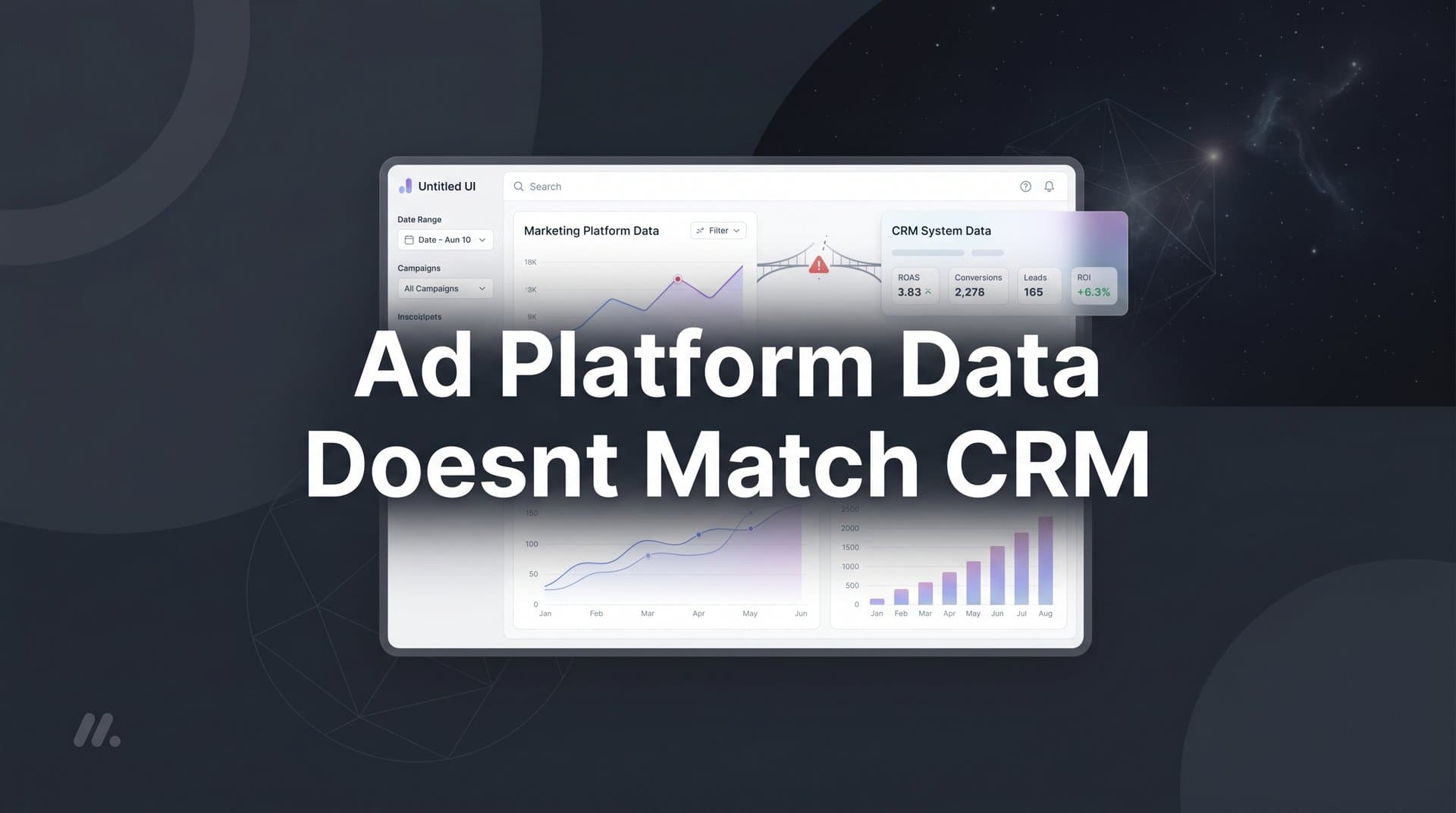
You pull up your Google Ads dashboard and see 80 conversions for the month. Solid numbers. You feel good about the campaigns. Then you open the CRM and find 31 closed deals attributed to those same campaigns. The math does not work, and now you have a budget review meeting in two hours.
This is not a rare scenario. For B2B SaaS marketing teams, the gap between ad platform data and CRM records is one of the most common and costly operational problems in the entire revenue stack. It creates friction between sales and marketing, distorts ROI calculations, and leads to budget decisions built on shaky foundations.
Here is the important thing to understand before you start pointing fingers at your tools: neither your ad platform nor your CRM is broken. They are both doing exactly what they were designed to do. The problem is that they were designed to measure completely different things, at different points in the buyer journey, using different logic. The mismatch is not a bug. It is a structural consequence of running two disconnected systems side by side and expecting them to agree.
This article breaks down exactly why ad platform data does not match your CRM, what technical and methodological gaps drive the discrepancy, and how to build a unified attribution view that actually reflects reality. If you have ever stared at two dashboards wondering which one to trust, this is for you.
Two Systems, Two Completely Different Definitions of a Conversion
The most fundamental reason ad platform data does not match CRM data is that each system is answering a different question. Ad platforms are asking: did someone take an action we can observe on our platform? CRMs are asking: did this person become a real business outcome?
Ad platforms like Google Ads, Meta, and LinkedIn track platform-level events. These are actions that their pixels, SDKs, or server signals can detect: a page visit, a form submission landing page load, a button click. When a user lands on your thank-you page after filling out a demo request form, the pixel fires and the platform records a conversion. That is the end of what the platform knows.
Your CRM tells a different story. A form fill only becomes a CRM record if a human reviews it, qualifies the lead, and moves it through a pipeline stage. Many form fills never make it that far. Spam submissions, unqualified leads, duplicate entries, and contacts who never respond all get filtered out before anything resembling a "conversion" appears in your CRM pipeline.
Attribution windows compound this problem significantly. Google Ads and Meta both apply default attribution windows that claim credit for conversions that happen days or even weeks after a user interacts with an ad. Meta's default window attributes conversions that occur within seven days of a click or one day of a view. For B2B SaaS companies with sales cycles that often run 30 to 90 days or longer, these windows create a fundamental mismatch. The platform claims credit in month one; the deal closes in month three. The CRM records it as a separate, unconnected event.
There is also the issue of multi-platform event inflation. A single buyer might click a LinkedIn sponsored post, later see a Google Display retargeting ad, and then convert through a branded search on Google. Each of those platforms may independently count that user's eventual conversion as their own, depending on how attribution windows overlap. The result is that your combined platform-reported conversions can significantly exceed the single CRM record that represents that one actual buyer.
This is not a conspiracy. It is simply how each system was built. Ad platforms are optimized to demonstrate their own value. CRMs are optimized to track business reality. Without a layer that connects them, you will always be comparing apples to a completely different kind of fruit.
The Technical Gaps That Silently Widen the Discrepancy
Beyond the definitional differences, there are real technical failures happening in the background that make the gap between ad platform data and CRM records even larger. Most marketers are aware of these issues in theory but underestimate how much they affect data quality in practice.
Browser-based pixel tracking is far less reliable than it was even a few years ago. Ad blockers prevent pixels from firing on a meaningful portion of web traffic. Safari's Intelligent Tracking Prevention (ITP) restricts how long cookies can persist, limiting the ability to connect a user's ad click to a conversion that happens days later. Firefox has similar protections built in. On mobile, Apple's App Tracking Transparency framework requires users to explicitly opt in to tracking, which most do not. The result is that ad platforms miss real conversions from privacy-conscious users. Meanwhile, those same users fill out your form, get entered into your CRM by a sales rep, and show up as legitimate pipeline with no ad attribution attached.
UTM parameter tracking introduces its own set of failures. UTM parameters are session-based. They capture the source of a single visit, not the full journey. If a user clicks your LinkedIn ad on their phone during lunch, then returns to your site three days later on their work laptop and converts, the CRM will likely record that lead as "direct" or "unknown." The original LinkedIn ad gets no credit. The lead exists in the CRM, the conversion happened, but the attribution chain is broken.
Email forwards create similar problems. A prospect receives a forwarded email with a tracked link, clicks through, and lands on your site. The UTM parameters from that forwarded link may carry incorrect or irrelevant source data, or they may be stripped entirely, depending on the email client. Cross-device and cross-session journeys are the norm in B2B buying, not the exception, and standard UTM tracking was not built to handle them reliably.
The deepest technical gap is the absence of a reliable handoff point between ad events and CRM outcomes. Without server-side tracking or a Conversion API integration, your data pipeline depends entirely on browser-level signals that are increasingly degraded. There is no mechanism to take a CRM-verified conversion and send it back to the ad platform with the context it needs to understand which campaign actually drove that outcome. This structural gap does not stay static. It grows over time as privacy protections expand and browser-based tracking becomes less viable.
How Attribution Models Turn a Gap Into a Chasm
Even if your tracking were technically perfect, attribution model differences alone would still produce conflicting numbers between your ad platforms and your CRM. This is a layer of the problem that often gets overlooked, but it is one of the most significant drivers of the mismatch.
Ad platforms default to attribution models that favor their own touchpoints. Google Ads uses a data-driven attribution model by default, which sounds objective but still weights Google touchpoints heavily because it is trained on Google's own data. Meta applies its own view-through attribution logic, meaning a user who simply saw an ad without clicking can still be counted as a platform conversion if they later convert within the attribution window. Each platform is essentially its own judge, jury, and scorekeeper.
CRMs take a different approach, and often a simpler one. Many CRM setups default to first-touch attribution, where the original source that brought the lead into the system gets full credit. Others use last-touch, where the most recent interaction before the form fill gets credit. Some use manual attribution, where a sales rep logs whatever they remember or whatever the lead told them. None of these approaches align with how ad platforms assign credit, which means the same deal will be attributed differently depending on which system you are looking at.
Here is where it gets particularly problematic for B2B SaaS teams: when two or more platforms both claim the same conversion using their own attribution models, the total reported conversions across all your ad platforms can exceed your actual CRM deal count by a significant margin. You might have 50 actual deals in the CRM while your combined ad platform dashboards report 120 conversions. Every platform is technically telling the truth according to its own model. But the aggregate picture is deeply misleading.
This makes ROI calculations unreliable at best and dangerously misleading at worst. If you are dividing ad spend by platform-reported conversions to calculate cost per acquisition, you are working with a denominator that may be inflated by double or triple counting. The resulting number will look better than reality, which is exactly the kind of false signal that leads to poor budget allocation decisions.
Why This Mismatch Costs B2B SaaS Teams Real Money
The data discrepancy between ad platforms and CRMs is not just an analytics inconvenience. It has direct financial consequences that compound over time, especially for B2B SaaS companies where customer acquisition costs are high and payback periods matter.
When budget decisions are made based on inflated ad platform data, teams tend to overspend on channels that appear to perform well in the platform dashboard but have weak actual pipeline contribution. A channel might show a strong cost per conversion in the platform while generating leads that rarely qualify, rarely progress through the pipeline, and rarely close. The CRM tells a completely different story, but if no one is reconciling the two data sources, that story goes unheard until the next quarterly review reveals the problem.
Sales and marketing alignment breaks down in a predictable way. Marketing teams point to platform conversions as evidence that campaigns are working. Sales teams point to CRM pipeline as evidence that lead quality is low. Both teams are looking at real data, but they are looking at different slices of reality with no shared frame of reference. This is one of the most common sources of tension between revenue teams in B2B SaaS, and it rarely gets resolved through conversation alone. It requires a structural fix.
The downstream impact on financial modeling is just as serious. Customer acquisition cost, payback period, and true campaign ROI are all metrics that B2B SaaS companies use to make scaling decisions. If the conversion numbers feeding those calculations are unreliable, every downstream metric is distorted. You might believe a campaign has a $400 customer acquisition cost when the real number, based on actual closed revenue, is closer to $1,200. Scaling a campaign based on the wrong number is not a minor error. It is a compounding mistake that gets more expensive the longer it continues.
The opportunity cost matters too. When you cannot accurately identify which channels are genuinely driving pipeline and revenue, you cannot confidently shift budget toward what is working. You end up spreading spend across channels based on intuition or platform-reported metrics that do not reflect business reality, rather than concentrating investment in the campaigns and audiences that demonstrably drive closed deals.
Building a Unified View: How to Close the Data Gap
The good news is that this problem is solvable. Closing the gap between ad platform data and CRM records requires a combination of technical infrastructure improvements, operational discipline, and the right attribution layer sitting between your systems.
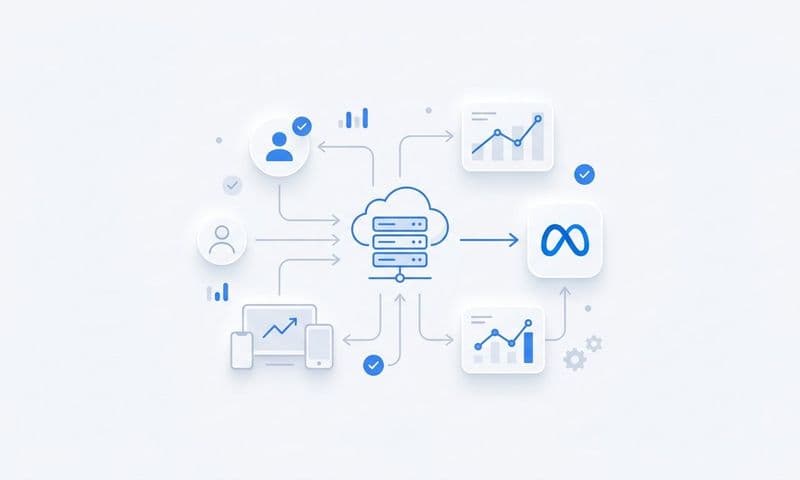
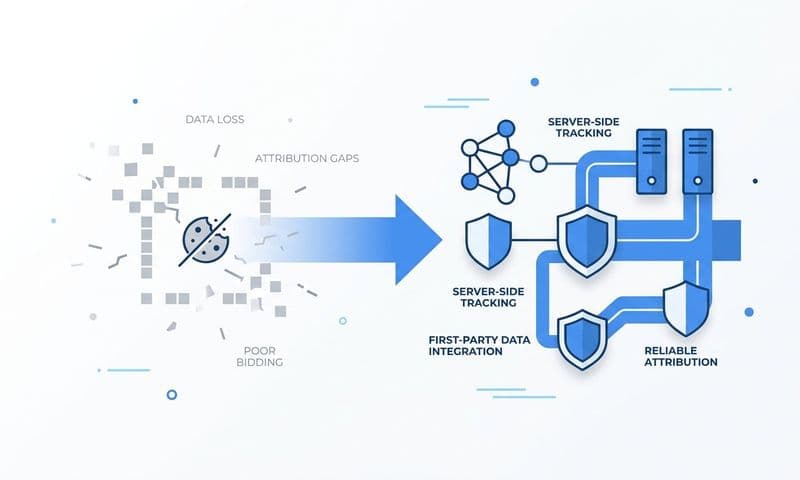
Server-side tracking and Conversion API integration: The most impactful technical change you can make is moving away from reliance on browser-based pixel tracking and implementing server-side event tracking. With a Conversion API (CAPI) integration, enriched conversion events are sent directly from your server to ad platforms like Meta and Google, bypassing the browser entirely. This means ad blockers, ITP restrictions, and cookie limitations no longer degrade your signal quality. The events that reach the platform are more accurate, more complete, and better matched to real user data, which also improves the ad platform's ability to optimize toward genuine conversions rather than noisy browser-fired events.
Standardized UTM conventions and CRM field mapping: UTM parameters only work if they are applied consistently and captured reliably in the CRM. This means establishing a naming convention that every team member and every campaign follows without exception. It also means mapping UTM data to dedicated CRM fields so that source information is preserved from the first ad click all the way through to closed-won status. When UTM data is inconsistently applied or not mapped to CRM fields, source attribution degrades quickly, and the gap between platform data and CRM data widens with every new campaign.
A dedicated attribution platform as the connective layer: Even with clean UTM data and server-side tracking in place, you still need a system that can ingest data from both your ad platforms and your CRM, apply consistent attribution logic, and give you a unified view of the customer journey. This is what a dedicated attribution platform does. Rather than asking your ad platform dashboard and your CRM to agree with each other directly, a purpose-built attribution layer sits between them, normalizes the data, and applies attribution models that you control. This is the structural fix that makes all other improvements meaningful.
The goal is not to make your ad platform and CRM report identical numbers. They measure different things and always will. The goal is to have a single, trusted source of attribution truth that connects ad spend to pipeline and revenue using consistent logic, so that budget decisions are based on what actually drives business outcomes rather than what each platform claims to have influenced.
What Accurate Attribution Looks Like When It Works
When ad platform data and CRM records are reconciled through a unified attribution layer, the picture that emerges is fundamentally different from what either system shows in isolation. And it is almost always more nuanced than either dashboard suggests.
You can see which campaigns generated not just clicks or form fills, but actual qualified pipeline and closed revenue. A campaign that looks mediocre based on platform-reported conversions might turn out to drive a disproportionate share of high-quality pipeline when you connect it to CRM outcomes. Another campaign that looks impressive in the platform dashboard might show almost no contribution to closed deals when you follow the leads through the full funnel. Without the unified view, you would never know the difference.
Multi-touch attribution applied consistently across all channels lets you understand which touchpoints genuinely influence deal progression versus which ones are simply present in the journey without adding meaningful momentum. This is the difference between a channel that assists deals and a channel that drives them. When you can see that distinction clearly, you can allocate budget with a level of precision that is simply not possible when you are working from disconnected dashboards.
This is exactly the problem Cometly was built to solve. Cometly connects your ad platforms, CRM data, and website events into a single attribution view, giving B2B SaaS marketing teams the ability to tie every ad dollar to pipeline and revenue with confidence. It captures every touchpoint from first ad click to closed-won deal, sends enriched conversion data back to ad platforms through server-side integration to improve their optimization signals, and uses AI to surface which campaigns and channels are genuinely driving results. Instead of reconciling two disconnected dashboards manually, you get a single source of truth that reflects the full customer journey.
The result is not just cleaner data. It is the ability to make faster, more confident decisions about where to invest, what to scale, and what to cut, without second-guessing whether the numbers you are looking at reflect reality.
Putting It All Together
The mismatch between ad platform data and CRM records is not a flaw in either tool. It is the predictable result of two systems built for different purposes, measuring different moments in the buyer journey, using different logic to assign credit. Ad platforms count platform-level events. CRMs record business outcomes. Neither is wrong. They are just not designed to agree with each other by default.
Closing that gap requires three things working together: server-side tracking and Conversion API integrations to restore signal quality at the technical level, standardized UTM practices and CRM field mapping to preserve source data through the full funnel, and a dedicated attribution layer that connects both systems and applies consistent logic to the complete customer journey.
When those pieces are in place, you stop choosing between trusting your ad platform and trusting your CRM. You have a unified view that reflects what actually happened, from the first ad impression to the closed deal, with enough clarity to make confident budget decisions and scale what is genuinely working.
If your team is still reconciling two disconnected dashboards and trying to make budget decisions in the gap between them, it is time to change the infrastructure. Get your free demo and see how Cometly connects your ad spend directly to pipeline and revenue, giving you the single source of truth your team needs to grow with confidence.