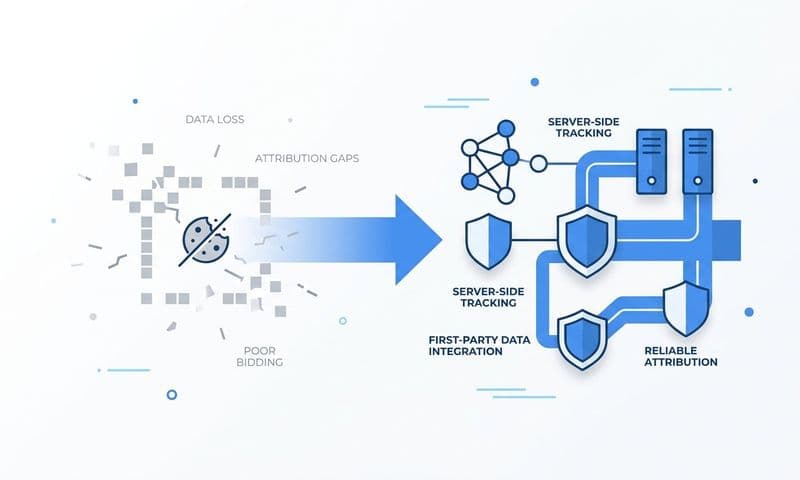
If you've ever looked at your Meta Ads dashboard and thought "these numbers can't be right," you're not alone. The gap between what ad platforms report and what your CRM or payment processor confirms has widened considerably since Apple's App Tracking Transparency framework changed how user data flows across apps and browsers. Layer in cookie deprecation, cross-device browsing, and ad blockers, and you're left with native tracking that often overstates performance, misattributes conversions, or misses touchpoints entirely.
The result is a real budget problem. When you can't trust your data, you can't confidently scale what's working or cut what isn't. Campaigns that look profitable on paper may be cannibalizing each other or riding on organic lift that the platform is claiming credit for.
The tools below address this challenge through server-side tracking, first-party data collection, multi-touch attribution, and conversion data enrichment. Selection criteria include data accuracy methodology, integration depth, ease of setup, and overall value for paid advertising teams. Whether you're running a lean in-house team or managing spend across multiple brands, there's a solution here worth exploring.
1. Cometly
Best for: Marketing teams and agencies needing AI-powered attribution with server-side tracking and conversion sync across all major ad platforms.
Cometly is an AI-powered marketing attribution platform that combines server-side tracking, multi-touch attribution, and conversion data sync to give marketers a complete, accurate picture of what's driving revenue.
 9 Best Tools for Ad Platform Tracking Accuracy in 2026
Where This Tool Shines
Cometly's biggest strength is the combination of accurate data collection and actionable intelligence. Rather than just showing you what happened, its AI layer surfaces which ads and campaigns are actually driving conversions, so you can scale with confidence instead of guesswork. The platform connects your ad platforms, CRM, and website to track the full customer journey in real time.
The Conversion Sync feature is particularly valuable in the current tracking environment. By sending enriched, first-party conversion events back to Meta, Google, TikTok, and other ad platforms, Cometly helps those platforms' machine learning algorithms optimize more effectively. Better data in means better targeting and bidding out, which improves campaign performance beyond just the reporting layer.
Key Features
Server-Side Tracking: Moves data collection off the browser to reduce signal loss from ad blockers, iOS restrictions, and cookie limitations.
Conversion Sync: Sends enriched conversion events back to Meta CAPI, Google Enhanced Conversions, TikTok, and more to improve ad platform optimization.
AI-Powered Recommendations: Identifies top-performing ads and campaigns across every channel and surfaces actionable scaling opportunities.
Multi-Touch Attribution: Supports multiple attribution model comparisons so you can see how credit is distributed across the full customer journey.
AI Chat: Lets you ask natural-language questions about your marketing data and get instant, data-backed answers without digging through dashboards.
Best For
Cometly is built for digital marketers, in-house growth teams, and agencies managing paid advertising across multiple platforms. It's especially well-suited for teams that want to move beyond vanity metrics and connect ad spend directly to revenue, without needing a data engineering team to make it work.
Pricing
Custom pricing based on ad spend and business needs. A demo is available on request through the Cometly website.
2. Triple Whale
Best for: Shopify ecommerce brands wanting centralized ad analytics and creative performance insights in one dashboard.
Triple Whale is an ecommerce-focused analytics and attribution platform built primarily around the Shopify ecosystem, offering first-party pixel tracking and creative performance reporting.
 7 Best Funnel.io Alternatives for Marketing Data Analytics in 2026
Where This Tool Shines
Triple Whale's native Shopify integration makes setup relatively painless for ecommerce brands already on that platform. The creative analytics layer is a standout: you can break down performance by individual ad assets, which is genuinely useful when you're running multiple creative variations across Meta and TikTok and need to know which visuals are actually converting.
The post-purchase survey attribution adds a layer of zero-party data to the mix. Asking customers directly how they found you provides signal that no pixel can capture, and Triple Whale bakes this into its attribution model alongside pixel and platform data.
Key Features
First-Party Pixel: Proprietary pixel for Shopify stores that collects data independently of ad platform tracking.
Creative Analytics: Measures ad performance by individual creative asset across platforms.
Centralized Dashboard: Combines data from Meta, Google, TikTok, and other ad platforms into a single view.
Post-Purchase Survey Attribution: Captures zero-party data from customers about how they discovered the brand.
Best For
Shopify brands with active paid social campaigns who want a unified view of creative and channel performance. Less suited for businesses outside ecommerce or those not on Shopify.
Pricing
Plans start around $100/month for smaller stores and scale based on monthly revenue.
3. Hyros
Best for: High-ticket businesses, info product creators, and sales-call-driven funnels with long conversion windows.
Hyros is an attribution tracking platform designed for businesses where the path from ad click to closed deal spans days, weeks, or even months, and where phone sales play a central role in the conversion process.
 7 Best Northbeam Alternatives for Small Business in 2026
Where This Tool Shines
Most attribution tools struggle with long sales cycles because they lose the thread between an initial ad click and a conversion that happens two weeks later on a different device. Hyros addresses this with its print tracking approach, which ties user identity across sessions and devices over extended windows. This is particularly relevant for coaching programs, high-ticket courses, and B2B services where sales rarely happen in a single session.
The call tracking attribution is another differentiator. For businesses that close deals over the phone, connecting inbound calls back to the original ad source is critical data that standard pixels simply can't provide.
Key Features
Print Tracking: Follows users across devices and extended time windows to attribute long-cycle conversions accurately.
CRM and Phone Sales Integration: Connects offline sales activity back to the originating ad touchpoint.
AI Ad Optimization: Provides recommendations based on actual revenue data rather than platform-reported conversions.
Call Tracking Attribution: Ties inbound phone calls to the specific ad and campaign that generated them.
Best For
High-ticket coaches, consultants, info product creators, and B2B businesses with phone-close sales processes and conversion windows longer than standard attribution allows.
Pricing
Starts around $99/month with higher tiers for larger ad spends and more advanced features.
4. Northbeam
Best for: Scaling brands that want a hybrid attribution approach combining multi-touch attribution and media mix modeling.
Northbeam is an attribution platform that blends multi-touch attribution with media mix modeling to give brands a more complete view of cross-channel performance than either methodology can provide alone.
 8 Best Attribution Platforms vs Google Analytics: Which Tracking Solution Fits Your Marketing Stack in 2026
Where This Tool Shines
The hybrid MTA and MMM approach is Northbeam's core differentiator. Multi-touch attribution is strong at the individual user journey level but can struggle with upper-funnel channels like TV or podcasts. Media mix modeling captures those broader effects but lacks granularity. Northbeam attempts to bridge both, which is particularly useful for brands running diverse channel mixes.
The incrementality testing capabilities add another layer of confidence. Rather than relying solely on attribution models, you can run controlled tests to measure the actual incremental lift a channel is generating, which is a more rigorous way to validate budget decisions.
Key Features
Hybrid MTA and MMM: Combines user-level attribution with statistical modeling for a more complete channel view.
Customizable Attribution Windows: Adjust lookback windows and models to match your actual sales cycle.
Creative Analytics: Performance breakdowns by creative asset across channels.
Incrementality Testing: Built-in tools to measure true incremental lift from campaigns.
Best For
Mid-to-large ecommerce and DTC brands running significant ad spend across multiple channels who need more sophisticated attribution than standard platform reporting provides.
Pricing
Custom pricing; typically positioned for brands with substantial monthly ad budgets. Contact Northbeam directly for a quote.
5. Rockerbox
Best for: Brands running omnichannel campaigns that include TV, podcast, direct mail, and digital ads alongside each other.
Rockerbox is a cross-channel marketing attribution platform that unifies online and offline touchpoints into a single, deduplicated conversion view.
 9 Best Tools for Ad Platform Tracking Accuracy in 2026
Where This Tool Shines
Most attribution tools are built around digital channels and bolt on offline attribution as an afterthought. Rockerbox treats offline channels like TV, direct mail, and podcasts as first-class citizens in its attribution model. If you're a brand that's expanding beyond pure digital and needs to understand how a linear TV buy or a podcast sponsorship contributes to conversion, Rockerbox is built for that use case.
Deduplication is another area where it adds real value. When multiple channels are touching the same customer, accurate conversion counting requires reconciling those overlapping touchpoints rather than letting each platform claim full credit. Rockerbox handles this across both digital and offline sources.
Key Features
Omnichannel Attribution: Covers digital ads, TV, podcast, direct mail, and more in a unified model.
Deduplicated Conversion Tracking: Prevents double-counting conversions across overlapping channels.
Customer Journey Visualization: Maps the full path from first touch to conversion across all channels.
Platform Integrations: Connects with major ad platforms and marketing tools for consolidated data.
Best For
Growth-stage and enterprise brands running true omnichannel campaigns who need attribution that goes beyond digital-only tracking.
Pricing
Custom pricing based on channels tracked and data volume. Request a demo through the Rockerbox website.
6. Segment (by Twilio)
Best for: Technical marketing teams that need a reliable, centralized data pipeline to ensure clean event tracking across all tools.
Segment is a customer data platform that functions as a universal data layer, collecting events once and routing them to hundreds of marketing, analytics, and advertising destinations.
 9 Best Tools for Ad Platform Tracking Accuracy in 2026
Where This Tool Shines
Segment doesn't do attribution itself, but it solves a foundational problem that undermines attribution everywhere else: inconsistent, fragmented event data. When every tool is collecting its own version of events with different naming conventions and schemas, reconciling that data becomes a nightmare. Segment standardizes collection at the source, so every downstream tool gets the same clean, consistent data.
The identity resolution capabilities are particularly relevant for tracking accuracy. Segment can stitch together user behavior across devices and sessions, which gives attribution tools a more complete picture of the customer journey to work with.
Key Features
Universal Data Collection: Single API that captures events and routes them to all connected destinations simultaneously.
Real-Time Data Routing: Sends data to hundreds of tools including ad platforms, CRMs, and analytics systems.
Identity Resolution: Stitches user behavior across devices and anonymous/identified sessions.
Data Governance: Schema enforcement and data quality controls to prevent tracking inconsistencies.
Best For
Technical marketing teams and data-forward organizations that want a reliable, governed data foundation before investing in attribution tooling. Works best when paired with a dedicated attribution platform.
Pricing
Free tier available for lower event volumes. Paid plans start at $120/month and scale with event volume and features.
7. Wicked Reports
Best for: Subscription businesses and lead-gen operations that need lifetime value attribution tied to actual payment data.
Wicked Reports is an attribution platform that connects CRM and payment processor data to ad performance, making it especially valuable for businesses where revenue is recurring or delayed.
 7 Best Northbeam Alternatives for Small Business in 2026
Where This Tool Shines
Standard attribution tools measure conversions at the point of initial purchase or lead submission. For subscription businesses, that's only the beginning of the revenue story. Wicked Reports tracks what happens downstream: which ad-sourced leads actually become paying customers, which ones churn, and which ones generate significant lifetime value. This changes how you evaluate campaign ROI entirely.
The CRM integration depth is a practical strength. By pulling actual payment data from your payment processor and matching it back to the originating ad touchpoint, Wicked Reports gives you revenue-based attribution rather than lead-count-based attribution. That distinction matters enormously when lead quality varies significantly by source.
Key Features
LTV-Based Attribution: Attributes revenue across the full customer lifetime, not just the initial conversion event.
CRM Integration: Connects to CRM and payment systems to tie real revenue back to ad sources.
Cohort Analysis: Tracks how different acquisition cohorts perform over time for recurring revenue businesses.
ROI Reporting: Links actual payment data to campaign performance for true return on ad spend calculation.
Best For
Subscription SaaS companies, membership businesses, and lead-gen operations where the value of a conversion isn't fully realized at the moment it happens.
Pricing
Starts around $250/month and scales with the number of integrations and data volume required.
8. Ruler Analytics
Best for: B2B and lead-gen businesses that need to connect phone calls and form submissions back to the original ad source.
Ruler Analytics is a marketing attribution tool that specializes in offline conversion tracking, connecting phone calls, form fills, and live chat interactions back to the specific ad click and campaign that generated them.
Where This Tool Shines
For businesses where the conversion is a phone call or a form submission rather than an online purchase, standard pixel tracking falls short. Ruler Analytics fills this gap with dynamic number insertion for call tracking and form-level attribution that ties every submission back to its originating source, including the specific keyword or ad that drove the visit.
The revenue attribution push-back to Google Ads and Meta is where it becomes genuinely powerful. Rather than just reporting attribution in its own dashboard, Ruler can send offline conversion data back to your ad platforms so their bidding algorithms can optimize toward leads that actually become revenue, not just any lead.
Key Features
Call Tracking with Dynamic Number Insertion: Assigns unique phone numbers per visitor to attribute calls to their exact source.
Form Submission Tracking: Ties every form fill back to the originating ad, campaign, and keyword.
Revenue Attribution Push-Back: Sends conversion and revenue data back to Google Ads and Meta for smarter optimization.
Multi-Touch Journey Mapping: Visualizes the full lead journey from first ad click to closed deal.
Best For
B2B companies, professional services, and any lead-gen business where conversions happen via phone or form rather than direct online purchase.
Pricing
Starts around $200/month with pricing varying based on call volume and the features and integrations required.
9. Google Tag Manager Server-Side
Best for: Technical teams that want to reduce browser-based tracking loss without replacing their existing tag management setup.
Google Tag Manager Server-Side is Google's server-side tagging framework that moves tracking logic from the user's browser to a cloud server, significantly reducing data loss from ad blockers and browser-level restrictions.
Where This Tool Shines
Browser-based tracking is increasingly unreliable. Ad blockers strip tags before they fire, Safari's Intelligent Tracking Prevention limits cookie lifespans, and iOS restrictions reduce signal across the board. Server-side GTM addresses this by processing tracking events on a server you control, which means data flows more completely and consistently to your analytics and ad platforms.
The compatibility with Google Ads Enhanced Conversions and Meta's Conversions API makes it especially relevant for paid advertising teams. You can use server-side GTM as the infrastructure layer that feeds accurate, first-party conversion data back to both platforms, improving their optimization without requiring a completely separate tracking stack.
Key Features
Server-Side Container: Processes tags on a cloud server rather than in the user's browser, bypassing ad blockers and cookie restrictions.
First-Party Data Collection: Collects data under your own domain, improving cookie persistence and data reliability.
CAPI and Enhanced Conversions Compatibility: Natively supports Meta Conversions API and Google Ads Enhanced Conversions for accurate platform reporting.
Open Tag Template Framework: Community-built templates extend functionality beyond Google's native tags.
Best For
Technical marketing teams and developers comfortable with cloud infrastructure who want to improve tracking accuracy at the infrastructure level without switching attribution platforms.
Pricing
The GTM framework itself is free. Google Cloud hosting for the server-side container typically runs $50 to $150/month depending on traffic volume.
Choosing the Right Tracking Accuracy Tool for Your Stack
The right choice depends less on which tool has the most features and more on where your specific tracking gaps are and what kind of business you're running.
If you're a digital marketing team or agency managing paid campaigns across multiple platforms and you want accurate attribution combined with AI-powered optimization recommendations, Cometly is the most comprehensive starting point. Its server-side tracking, Conversion Sync, and multi-touch attribution work together to both fix your data and improve your actual campaign performance.
For Shopify ecommerce brands focused heavily on paid social and creative performance, Triple Whale offers a purpose-built experience. If your business runs long sales cycles with phone-close funnels, Hyros is built specifically for that scenario. B2B and lead-gen teams dealing with offline conversions will find Ruler Analytics addresses their core attribution gap directly.
If your problem is foundational data quality across your entire marketing stack, Segment is the infrastructure layer worth investing in first. And if you want to improve tracking accuracy without overhauling your existing setup, Google Tag Manager Server-Side is a practical, cost-effective step that complements almost any attribution tool in this list.
The broader trend is clear: native ad platform reporting is no longer sufficient on its own. The gap between what platforms claim and what actually drives revenue is real, and it's growing. The tools above give you the means to close that gap, whether through better data collection, smarter attribution modeling, or feeding cleaner signals back to the platforms themselves.
Ready to see exactly which ads and campaigns are driving real revenue? Get your free demo of Cometly and start capturing every touchpoint with the accuracy your ad spend deserves.