
Small businesses running paid ads face a common problem: spending money without knowing what is actually working. When budgets are tight, every dollar needs to be accountable. Yet many small business owners rely on platform-reported metrics alone, which often paint an incomplete or inaccurate picture of real performance.
Ad tracking for small business is not just a technical exercise. It is the foundation for making smarter decisions, cutting waste, and scaling what works. Without proper tracking in place, you are essentially flying blind across every campaign you run.
This article breaks down seven practical ad tracking strategies that small businesses can implement to gain clarity on their ad performance, understand which channels drive real conversions, and build a reliable data foundation for growth. Whether you are running Google Ads, Meta campaigns, or experimenting with TikTok, these strategies will help you move from guesswork to confident, data-backed decisions.
1. Define Your Conversion Events Before You Spend a Dollar
The Challenge It Solves
Many small businesses launch paid campaigns before establishing what a successful outcome actually looks like. The result is data that accumulates without meaning. Clicks and impressions pile up, but there is no way to connect that activity to business results. Without clearly defined conversion events, optimization becomes guesswork and budget decisions lack any real foundation.
The Strategy Explained
Before a single dollar goes toward ads, map out both your micro-conversions and macro-conversions. Micro-conversions are the smaller actions that indicate intent: a demo request, a pricing page visit, a form submission, or a free trial signup. Macro-conversions are your primary business outcomes: a subscription activated, a deal closed, or a purchase completed.
Each conversion event should be tied to a specific business outcome rather than a vanity metric. Tracking page views or time on site without connecting those signals to revenue-generating actions tells you very little about whether your ads are actually working. Define your events first, then build your tracking setup around them.
Implementation Steps
1. List every meaningful action a prospect can take on your website or landing page, from filling out a contact form to completing a checkout.
2. Categorize each action as a micro-conversion or macro-conversion based on how closely it ties to revenue.
3. Configure these events inside your analytics platform and each ad platform before launching any campaigns, ensuring every conversion is being captured from day one.
Pro Tips
Prioritize quality over quantity when defining events. Tracking too many low-signal actions dilutes your data and makes it harder to optimize. Start with two to three high-intent micro-conversions and one clear macro-conversion, then expand your tracking as your campaigns mature and your data picture becomes clearer. Following best practices for tracking conversions accurately from the start will save you significant rework later.
2. Use UTM Parameters to Track Every Traffic Source
The Challenge It Solves
Without UTM parameters, your analytics platform cannot reliably tell you where your traffic is coming from. Paid clicks get lumped into direct or organic buckets. You lose visibility into which specific campaigns, ad sets, or creatives are driving results. For small businesses running across multiple channels simultaneously, this creates a blind spot that makes budget allocation nearly impossible.
The Strategy Explained
UTM parameters are short tags added to the end of your destination URLs that pass source information into your analytics platform. A well-structured UTM tag captures the traffic source, the medium, the campaign name, the ad set or ad group, and the specific creative or keyword. Understanding what UTM tracking is and how it helps your marketing will give you a strong foundation before you build out your naming conventions.
The key is consistency. A naming convention that varies from campaign to campaign creates fragmented data that is difficult to analyze. Decide on a standard format for each parameter and apply it uniformly across every ad you run. Use lowercase consistently, avoid spaces, and be specific enough that you can identify exactly which ad drove a conversion months later.
Implementation Steps
1. Create a UTM naming convention document that defines how each parameter should be formatted across every channel you run ads on.
2. Build your UTM-tagged URLs using a URL builder tool and store them in a shared spreadsheet so your team applies them consistently.
3. Verify that tagged URLs are passing data correctly into your analytics platform before scaling any campaign, and audit your UTM data regularly for inconsistencies.
Pro Tips
Never rely on auto-tagging alone from ad platforms as your only source of attribution data. UTM parameters give you a portable, platform-agnostic layer of source data that flows into any analytics tool you use. This becomes especially valuable when you consolidate data across channels into a centralized dashboard.
3. Implement Server-Side Tracking to Recover Lost Conversion Data
The Challenge It Solves
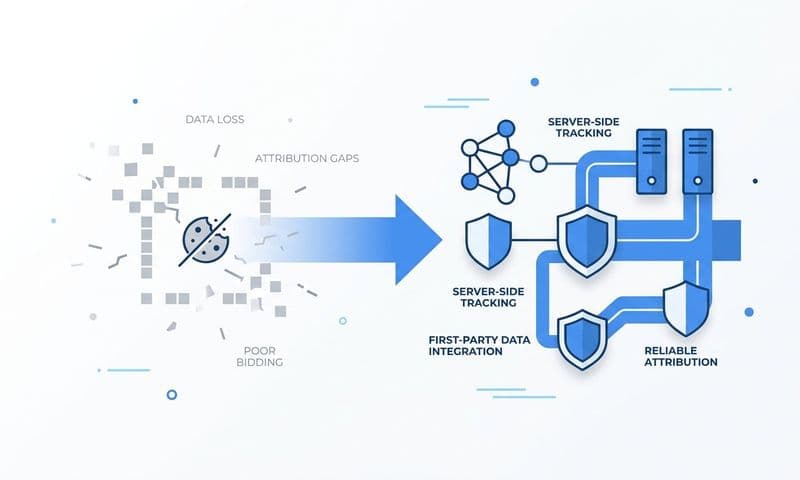
Browser-based pixels have become increasingly unreliable. Apple's App Tracking Transparency framework, ad blockers, and evolving browser privacy restrictions all limit what a client-side pixel can capture. For small businesses, this means a meaningful portion of real conversions may never be reported back to your ad platforms, causing your campaigns to optimize on incomplete data and your reported ROAS to look worse than it actually is.
The Strategy Explained
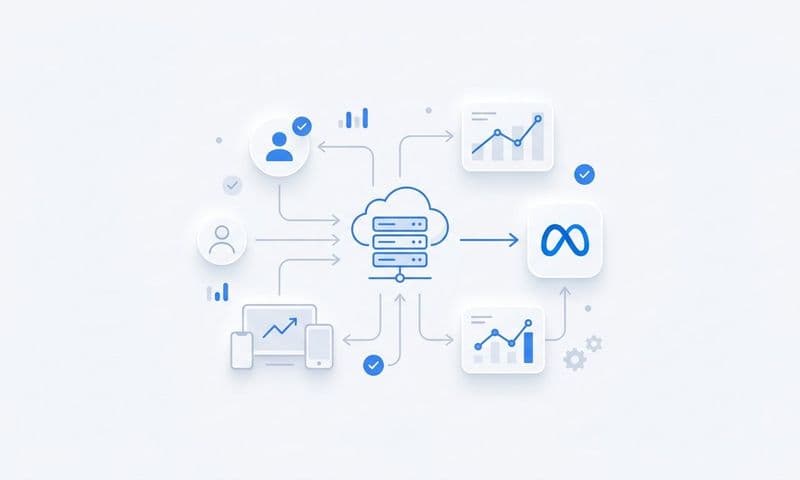
Server-side tracking moves the conversion signal from the user's browser to your own server, then sends that data directly to ad platforms through their Conversion APIs. Meta's Conversion API and Google's Enhanced Conversions are the most widely used implementations. Because the signal originates from your server rather than a user's browser, it bypasses ad blockers and is not affected by browser-level restrictions.
The result is a more complete and accurate conversion data set flowing back to your ad platforms. This improves algorithmic bidding, reduces under-reporting, and gives you a more accurate view of which campaigns are actually performing. For small businesses where every conversion counts, recovering even a fraction of previously lost data can meaningfully change how you allocate budget. Understanding why server-side tracking is more accurate helps clarify exactly what you stand to gain from making this switch.
Implementation Steps
1. Audit your current pixel setup to understand what percentage of conversions may be going untracked due to browser restrictions or ad blockers.
2. Set up server-side event tracking through your ad platforms' Conversion API tools, starting with your highest-value conversion events.
3. Run both your pixel and server-side tracking in parallel initially to compare event match quality scores and confirm the server-side implementation is capturing the conversions your pixel is missing.
Pro Tips
Platforms like Cometly simplify server-side tracking setup by handling the technical integration between your website, CRM, and ad platforms. This removes the engineering complexity that often makes server-side tracking feel out of reach for smaller teams, while still delivering the data accuracy benefits that come with it.
4. Choose the Right Attribution Model for Your Sales Cycle
The Challenge It Solves
Last-click attribution, the default in most ad platforms, assigns all conversion credit to the final touchpoint before a conversion. For businesses with longer sales cycles or multi-step customer journeys, this creates a distorted picture. Awareness campaigns and mid-funnel touchpoints that genuinely influenced the decision appear to contribute nothing, while branded search or retargeting captures all the credit simply for being last in line.
The Strategy Explained
Attribution models determine how credit is distributed across the touchpoints that contributed to a conversion. Last-click is simple but misleading for most customer journeys. First-click over-credits the initial touchpoint. Linear attribution spreads credit equally. Time-decay models weight recent touchpoints more heavily. Data-driven attribution uses algorithmic analysis to assign credit based on actual conversion patterns. Exploring multi-touch attribution models in depth will help you determine which approach fits your specific sales cycle.
For small businesses with sales cycles longer than a day or two, a multi-touch attribution model gives a more accurate view of what is actually working. Understanding which channels introduce prospects versus which channels close them helps you make smarter decisions about where to invest and where to cut.
Implementation Steps
1. Map out your typical customer journey from first ad exposure to conversion, noting how many touchpoints are involved and how long the process typically takes.
2. Compare your current last-click attribution data against a linear or time-decay model to see how credit shifts across channels when you account for the full journey.
3. Select the attribution model that most accurately reflects how your customers actually make decisions, and apply it consistently across your reporting to avoid comparing data across different models.
Pro Tips
Do not switch attribution models mid-campaign and compare the results to previous periods. Attribution model changes affect how historical data is calculated, which can make performance look artificially better or worse. Establish your model before you scale, and document the change clearly if you ever need to switch.
5. Connect Ad Spend Data Directly to Revenue
The Challenge It Solves
Most small businesses optimize their ad campaigns toward leads, clicks, or platform-reported ROAS. These metrics are useful, but they do not tell you whether the leads actually converted into paying customers. A campaign generating a high volume of form submissions may be producing low-quality leads that never close. Without connecting ad data to actual revenue, you risk scaling campaigns that look good on paper but are not driving real business growth.
The Strategy Explained
Closing the loop between ad spend and revenue requires connecting your ad platforms with your CRM and, where possible, your payment or subscription data. When a lead converts into a customer, that revenue event should be tied back to the original ad interaction that started the journey. This gives you true cost-per-acquisition and actual return on ad spend based on closed revenue, not just reported conversions. For B2B companies in particular, reviewing the best marketing attribution tools for B2B SaaS can help you find the right solution for closing this revenue gap.
For B2B SaaS companies and service businesses, this connection is especially important because there is often a significant gap between a lead being generated and a deal being closed. Optimizing on lead volume alone ignores that gap entirely.
Implementation Steps
1. Identify the revenue events in your CRM or payment platform that represent actual closed business, such as a subscription activated, a contract signed, or a purchase completed.
2. Connect those revenue events to the ad interactions that preceded them by passing lead source data from your UTM parameters into your CRM at the point of form submission or signup.
3. Use a platform like Cometly to integrate your ad spend data with Stripe or CRM revenue data, giving you a unified view of which campaigns are generating real revenue rather than just activity.
Pro Tips
Even a basic version of this connection is valuable. If you can tag leads in your CRM with the campaign or channel that sourced them and then filter closed revenue by that tag, you have a meaningful step up from optimizing on lead volume alone. Start simple and build toward a more automated integration over time.
6. Build a Centralized Marketing Dashboard for All Channels
The Challenge It Solves
When you manage Google Ads in one tab, Meta Ads Manager in another, and your analytics platform in a third, you are making budget decisions in silos. Each platform reports its own conversions, often with overlapping attribution windows, making it nearly impossible to understand true cross-channel performance. Small businesses that run multiple channels simultaneously without a unified view regularly misallocate budget because they cannot see the full picture.
The Strategy Explained
A centralized marketing dashboard pulls performance data from every active ad channel into a single view. Instead of logging into multiple platforms and manually reconciling numbers, you see all of your key metrics side by side: spend, conversions, cost per acquisition, and revenue contribution across every channel simultaneously. Using cross-platform analytics tools designed for this purpose eliminates the manual reconciliation work that consumes hours each week.
This unified view makes cross-channel budget decisions faster and more accurate. You can quickly identify which channels are underperforming relative to their spend, where you have room to scale, and how your overall marketing investment is tracking against revenue targets. It also eliminates the double-counting problem that comes from comparing platform-reported conversions across channels with overlapping attribution windows.
Implementation Steps
1. Identify all active ad channels and analytics tools you currently use, and confirm that each one has a clean data feed that can be connected to a centralized platform.
2. Choose a dashboard tool that supports native integrations with your ad platforms, CRM, and analytics tools to minimize manual data work.
3. Define the core metrics you want visible in your dashboard, focusing on business outcomes like revenue and cost per acquisition rather than platform-specific vanity metrics, and set up automated reporting so your data stays current without manual effort.
Pro Tips
Cometly's platform connects more than 70 native integrations, making it straightforward to consolidate data from your ad platforms, CRM, and revenue tools into a single attribution dashboard. For small businesses that want a real-time view of cross-channel performance without building a custom data pipeline, this kind of out-of-the-box connectivity removes a significant operational barrier.
7. Use AI-Driven Insights to Scale What Is Working
The Challenge It Solves
Even with solid tracking in place, identifying performance patterns across multiple campaigns, ad sets, and creatives is time-consuming when done manually. Small business owners and lean marketing teams rarely have the bandwidth to analyze data at the level of granularity needed to catch optimization opportunities before they become missed revenue. The gap between having data and acting on it quickly is where budget gets wasted.
The Strategy Explained
AI-driven analytics tools can surface patterns and performance signals across your campaign data that would take hours to find manually. Rather than reviewing every ad set individually, AI can flag which creatives are outperforming benchmarks, which audiences are showing signs of fatigue, and which campaigns have the highest potential for scaled investment based on current conversion trends. Learning how ad tracking tools help you scale ads using accurate data shows exactly how this optimization loop compounds over time.
Beyond analysis, AI also plays a role in improving the performance of your ad platforms directly. When you feed enriched first-party conversion data back to Meta, Google, and other platforms through server-side integrations, their machine learning algorithms use that data to improve targeting and bidding decisions. The quality of the data you send back directly affects how well the platform optimizes on your behalf.
Implementation Steps
1. Ensure your conversion data is accurate and complete before relying on AI recommendations. AI surfaces patterns from your data, so poor data quality leads to poor recommendations regardless of how sophisticated the tool is.
2. Use an AI-enabled attribution platform to identify your highest-performing campaigns and creatives, then review those recommendations against your revenue data to confirm the signal is tied to actual business outcomes.
3. Set up automated conversion event sharing back to your ad platforms using server-side integrations, ensuring the platforms receive enriched, high-quality signals that improve their algorithmic targeting over time.
Pro Tips
Think of AI-driven insights as a continuous optimization loop rather than a one-time analysis. The more complete your conversion data is, the better the recommendations become. Platforms like Cometly are built around this loop, using AI to identify high-performing ads across every channel and feeding enriched conversion data back to ad platforms to compound the performance gains over time.
Putting It All Together
Ad tracking for small business does not need to be overwhelming. The seven strategies covered here are designed to build on each other progressively, creating a tracking foundation that grows more powerful as each layer is added.
Start by defining your conversion events clearly. Layer in UTM parameters to capture clean source data across every channel. Implement server-side tracking to recover the conversions your pixel is missing. Choose an attribution model that reflects how your customers actually make decisions. Then connect your ad spend data to actual closed revenue so you are optimizing toward real business outcomes rather than platform metrics.
From there, a centralized dashboard gives you a unified view of cross-channel performance, and AI-driven insights help you act on that data faster than manual analysis ever could. Each strategy reinforces the others, and together they create a system where every budget decision is grounded in accurate, complete data.
Tools like Cometly are built to bring all of these capabilities together for businesses that want accurate attribution without the complexity of stitching together multiple tools. When your tracking is solid, every campaign becomes more accountable, every budget decision becomes clearer, and scaling becomes a data-driven process rather than a gamble.
Start with one strategy, implement it fully, and build from there. Ready to put this into practice? Get your free demo today and see how Cometly can help you capture every touchpoint, connect your ad spend to real revenue, and make smarter decisions across every campaign you run.