
You've distributed budget across Google, LinkedIn, Meta, and a handful of other channels. The campaigns are running. The spend is real. But when someone asks which channels are actually driving pipeline, the honest answer is: it's complicated. Most marketing teams are making budget decisions based on incomplete data, outdated reports, and a fair amount of educated guessing.
That's the reality for a lot of B2B SaaS marketing teams right now. Budget allocation still leans heavily on gut feel, last-click attribution, and whatever the native platform dashboards happen to show. The problem is that none of those inputs tell the full story of how a prospect moved from first ad impression to closed-won revenue.
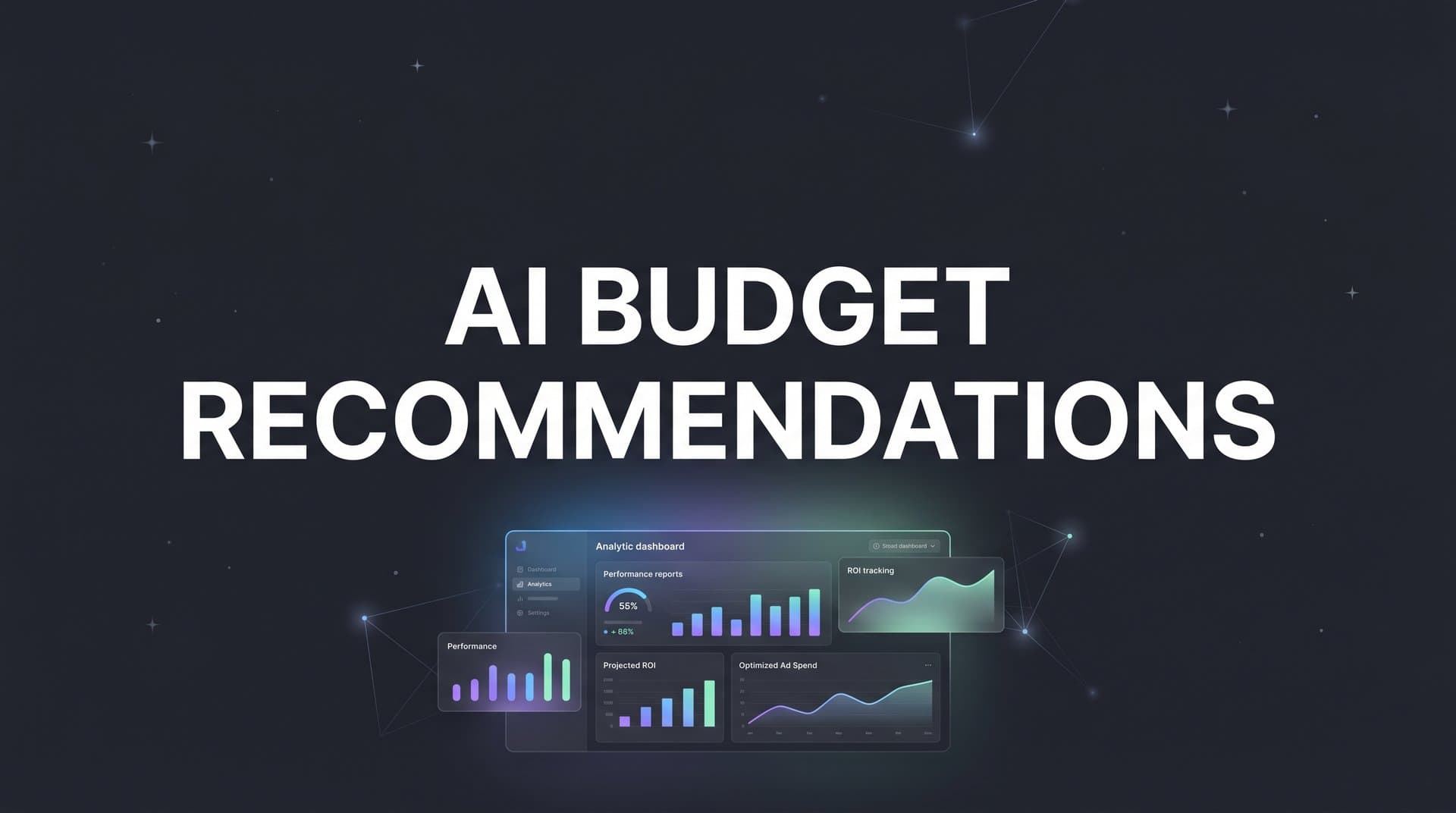
AI budget recommendations change that equation. Instead of waiting for weekly reports and then manually deciding where to shift spend, AI-driven systems analyze performance signals continuously, connect those signals to real revenue outcomes, and surface specific, actionable guidance on where budget should go next. This article breaks down exactly how that works, why it outperforms manual allocation for B2B SaaS marketers, and what you need in place to act on AI recommendations with confidence.
Why Manual Budget Allocation Keeps Marketers Stuck
The core problem with manual budget allocation is not that marketers lack skill. It's that the data they're working with is fragmented, delayed, and often misleading. Most teams rely on a combination of platform-native dashboards, CRM reports, and periodic analytics reviews to decide where to put money. Each of those sources tells a partial story, and stitching them together manually is slow, error-prone, and almost always incomplete.
Platform-native reporting is particularly problematic. Every ad platform has an incentive to show you its own contribution to conversions in the best possible light. Meta counts view-through conversions. Google credits assisted clicks. LinkedIn attributes pipeline to touchpoints that may have happened weeks after the actual decision was made. When you rely on these reports to guide budget decisions, you're essentially letting each channel grade its own homework.
Then there's the lag problem. Ad performance can shift significantly within days. A campaign that was performing well last Tuesday may be burning budget inefficiently by the following Monday. But if your review cadence is weekly or biweekly, you're always making decisions based on data that's already stale. By the time you reallocate, you've already wasted spend on campaigns that stopped working, or worse, pulled budget from campaigns that were quietly compounding.
The deeper issue is fragmentation. Your ad data lives in Google Ads and Meta Ads Manager. Your pipeline data lives in Salesforce or HubSpot. Your revenue data lives in Stripe or your billing system. Without a unified attribution layer that connects all three, you simply cannot answer the question that matters most: which ad spend is actually generating revenue? Understanding marketing budget allocation best practices is the first step toward closing that gap.
This blind spot is especially costly in B2B SaaS, where buying cycles stretch across weeks or months, involve multiple decision-makers, and touch multiple channels before a deal closes. A prospect might click a LinkedIn ad in week one, retarget through Google in week three, and convert through a branded search in week eight. Without full-journey attribution, that entire upstream investment looks like it produced nothing.
Manual allocation in this environment is not just inefficient. It's structurally incapable of reflecting how B2B buyers actually behave. That's the gap AI budget recommendations are built to close.
What AI Budget Recommendations Actually Are
AI budget recommendations are data-driven signals generated by machine learning models that analyze campaign performance, conversion patterns, and revenue attribution to suggest where budget should increase, decrease, or shift. They're not automated rules or simple if-then logic. They're pattern-recognition outputs that improve over time as more data flows through the system.
It's worth distinguishing between two different categories of AI budget tools, because they solve very different problems.
The first category is platform-native AI optimization. Tools like Meta Advantage+ and Google Smart Bidding use AI to optimize bids and placements within a single platform. They're powerful within their own ecosystem, but they operate in isolation. Meta's AI doesn't know what's happening in your Google campaigns. Google's Smart Bidding doesn't factor in the LinkedIn touchpoints that preceded a conversion. Each platform optimizes for its own reported outcomes, which often means optimizing for metrics that don't map directly to revenue.
The second category is independent, attribution-based AI that operates across all channels using first-party data. This is the category that matters most for B2B SaaS teams running multi-channel campaigns. Instead of optimizing within a single platform, these systems ingest data from every channel, connect it to pipeline and revenue events from your CRM and billing tools, and generate recommendations that reflect the full customer journey. Teams looking to evaluate marketing channels accurately need this cross-channel visibility to make confident decisions.
What makes these recommendations reliable is the quality of the inputs feeding the model. The most important inputs include:
Touchpoint data: Every ad interaction across every channel, mapped to individual users or accounts across the entire buying journey.
Pipeline events: CRM-sourced signals like MQL creation, SQL qualification, opportunity opened, and deal closed, tied back to the original ad source.
Revenue signals: Actual subscription or transaction data from billing tools like Stripe, connected to the campaigns that influenced the customer.
Multi-touch attribution models: The logic that distributes credit across touchpoints so the AI understands which channels contributed at which stage of the funnel, not just which channel happened to be last.
When all of these inputs are present and accurate, AI budget recommendations stop being suggestions and start being directional intelligence. The system can tell you that your LinkedIn awareness campaigns are generating a disproportionate share of high-value opportunities, even if they rarely appear as the last touchpoint before conversion. That's the kind of insight that manual allocation simply cannot produce at speed.
The Attribution Foundation That Makes AI Recommendations Trustworthy
Here's the uncomfortable truth about AI budget recommendations: they are only as accurate as the attribution data feeding them. Garbage in, garbage out applies directly to AI-driven budget decisions. If your tracking is incomplete, your attribution model is misaligned, or your conversion data has significant gaps, the AI will optimize confidently toward the wrong outcomes.
Attribution model selection is one of the most consequential decisions you'll make before acting on AI signals. Different models tell fundamentally different stories about which channels deserve budget. Understanding the most common ad attribution models helps you choose the right foundation for your AI-driven recommendations.
A last-click model concentrates credit on the final touchpoint before conversion. For B2B SaaS, this typically means branded search and direct traffic look like your best performers, while the awareness and consideration channels that built the relationship over weeks or months appear to contribute nothing. If your AI is fed last-click data, it will recommend cutting those upstream channels, which often means cutting the pipeline engine that was driving everything downstream.
A linear model distributes credit equally across every touchpoint in the journey. This is more honest about multi-touch contribution, but it can overweight low-intent interactions that happened to occur during a long buying cycle.
A time-decay model gives more credit to touchpoints closer to conversion. This is a reasonable middle ground for B2B SaaS teams where late-stage nurture does carry real weight.
A data-driven attribution model uses statistical analysis to assign credit based on the actual influence each touchpoint had on conversion outcomes. This is generally the most accurate approach for teams with sufficient conversion volume, and it's the model that produces the most reliable inputs for AI budget recommendations.
Beyond model selection, data completeness is the other critical variable. Cookie deprecation, iOS privacy changes, and the widespread use of ad blockers have meaningfully reduced the reliability of pixel-based tracking. When pixels miss conversions, your attribution data develops gaps that distort every downstream analysis.
Server-side tracking and Conversion API integrations address this directly. Instead of relying on a browser-based pixel that can be blocked or degraded, server-side tracking sends conversion events directly from your server to ad platforms like Meta and Google. This restores data completeness and ensures that the conversion signals feeding your AI are as accurate as possible.
Platforms like Cometly are built around this foundation. By combining server-side conversion tracking with multi-touch attribution and CRM integration, Cometly ensures that the data feeding AI budget recommendations reflects the full customer journey rather than the filtered, incomplete view that pixel-based tracking typically produces.
How AI Analyzes Performance Signals to Surface Budget Opportunities
Once the attribution foundation is solid, the AI can do what humans genuinely cannot: process thousands of data points across campaigns, audiences, creatives, and channels simultaneously to identify which combinations are generating pipeline and revenue.
Think about what that actually means in practice. A B2B SaaS marketing team might be running dozens of campaigns across four or five channels, each with multiple ad sets, audiences, and creative variants. The number of performance permutations is enormous. A human analyst reviewing this weekly might catch the obvious outliers, but they will miss the subtle patterns that only become visible when you're analyzing data at scale and in real time.
AI pattern recognition surfaces those hidden signals. It can identify that a specific audience segment on LinkedIn converts to SQL at a rate that justifies significantly higher CPCs. It can detect that a particular creative variant is generating pipeline at a fraction of the cost of the control. It can recognize that a channel that looks expensive on a cost-per-click basis is actually producing the highest-value customers when measured against lifetime revenue. Tracking SaaS marketing metrics at this level of granularity is what separates teams that scale efficiently from those that plateau.
One of the most important distinctions in AI-driven budget analysis is the difference between predictive signals and reactive reporting. Traditional reporting tells you what happened. AI-driven recommendations tell you what's likely to happen next based on current trajectory.
Predictive signals include things like conversion velocity trends, cost-per-opportunity movement over time, and changes in audience engagement patterns that historically precede performance shifts. When the AI detects that a campaign's conversion rate is declining before it shows up as a significant budget waste in your weekly report, it can surface a recommendation to reduce spend or reallocate before the damage compounds. Monitoring pipeline velocity is one of the clearest early indicators that a reallocation decision is warranted.
Granularity also matters significantly for B2B SaaS marketers. There are three levels where AI recommendations can operate:
Channel-level recommendations: Which platforms are generating the best pipeline-to-spend ratio and deserve more budget overall.
Campaign-level recommendations: Within a channel, which specific campaigns are outperforming and which are dragging down overall efficiency.
Creative-level recommendations: Which ad creatives are resonating with high-intent audiences and driving the touchpoints that appear most frequently in won deals.
For B2B SaaS teams running complex, multi-touch buying journeys, creative-level and campaign-level granularity is where the real leverage lives. Channel-level shifts move large amounts of budget but may obscure the specific campaigns or creatives that are actually driving results within a channel.
Turning AI Recommendations Into Confident Budget Decisions
Getting an AI recommendation is only half the equation. Acting on it confidently requires understanding what supporting data to review before moving budget, and building the workflow that makes that review fast and repeatable.
When evaluating an AI budget recommendation, there are three core metrics to examine before making a move:
Pipeline contribution by channel: How many qualified opportunities has this channel sourced or influenced over the past 30, 60, and 90 days? This gives you a baseline for whether the recommendation aligns with what you're seeing in your CRM.
Cost per opportunity: What is this channel actually costing you per qualified pipeline opportunity, not per lead or per click? This is the metric that connects ad spend to sales outcomes and makes budget reallocation defensible to leadership.
Revenue attribution by channel: Which channels appear most frequently in the touchpoint history of closed-won deals? This is the ultimate validation signal, and it's only visible if your attribution layer connects ad data to CRM and revenue data. Investing in B2B revenue attribution software is what makes this level of visibility achievable.
If the AI recommendation aligns with what these three metrics show, act on it. If there's a discrepancy, that's a signal to investigate before moving budget. Sometimes the AI is seeing a pattern that hasn't yet shown up in lagging indicators like pipeline contribution. Sometimes the discrepancy reveals a data quality issue worth addressing.
Building a feedback loop is what separates teams that get incrementally better results from AI recommendations over time from teams that treat each recommendation as a one-off decision. When you act on a recommendation and track the outcome, that outcome becomes new training data. The AI learns which recommendations led to improved pipeline velocity, which led to wasted spend, and which were directionally right but needed adjustment.
The practical workflow for B2B SaaS teams looks like this: connect your ad platforms, CRM, and revenue data into a centralized attribution dashboard. Configure your attribution model to reflect how your buyers actually move through the funnel. Review AI budget recommendations alongside pipeline and revenue metrics on a regular cadence, ideally weekly. Act on high-confidence recommendations, document the outcome, and use that outcome to calibrate your confidence threshold for future decisions.
Cometly is built to support exactly this workflow. Its attribution dashboard surfaces AI-driven insights alongside pipeline contribution, cost per opportunity, and revenue attribution by channel, so every budget decision is grounded in full-funnel data rather than platform-reported metrics alone.
Putting It All Together: From Data to Smarter Spend
AI budget recommendations are not a replacement for marketing judgment. They're a way to make that judgment faster, more accurate, and grounded in full-funnel revenue data rather than fragmented platform reports and intuition.
The core insight is this: the gap between what your ad spend is producing and what you think it's producing is almost always larger than you expect. Manual allocation, platform-native reporting, and weekly review cycles are structurally too slow and too narrow to close that gap in B2B SaaS environments where buying journeys are long and multi-touch.
AI-driven recommendations close that gap by continuously analyzing the signals that matter most: pipeline events, revenue attribution, conversion velocity, and cross-channel touchpoint patterns. But they only work when the attribution foundation beneath them is solid. Accurate tracking, the right attribution model, and complete conversion data are not optional prerequisites. They're the entire basis on which AI recommendations become trustworthy.
Cometly provides the attribution and analytics layer that makes this possible. By connecting your ad platforms, CRM data, and revenue signals into a single source of truth, Cometly ensures that the AI recommendations you're acting on reflect what's actually happening across the full customer journey, not just what each platform wants you to believe.
From capturing every touchpoint with server-side tracking to surfacing AI-driven insights that identify which campaigns are generating real pipeline, Cometly is built for B2B SaaS marketing teams that want to scale what works and stop funding what doesn't.
If you're ready to move from gut-feel budget decisions to AI-driven allocation grounded in real revenue data, Get your free demo today and see how Cometly captures every touchpoint to help your team maximize ad ROI with confidence.