You're running paid campaigns on LinkedIn, Google, and Meta. Deals are closing. Revenue is growing. And yet, when someone asks which channels are actually driving that revenue, you're left piecing together a story from disconnected data points that don't quite add up.
This is the quiet crisis inside most B2B SaaS marketing teams. Not a lack of data, but a lack of connected data. Ad platforms report clicks and conversions. The CRM shows pipeline and closed-won deals. But the bridge between those two worlds is missing, and every budget decision made without it is, at best, an educated guess.
The ability to attribute sales to marketing channels isn't a reporting luxury reserved for enterprise teams with dedicated data engineering resources. It's the foundational capability that separates teams scaling with confidence from teams cycling through channels hoping something sticks. This article breaks down what sales attribution actually means, how attribution models work, what data infrastructure you need to make it real, and how modern platforms have made the whole process dramatically more accessible for B2B SaaS companies.
Why Marketing Teams Struggle to Connect Ads to Closed Revenue
The structural problem is straightforward, even if solving it isn't. Marketing generates leads. Sales works those leads, nurtures them through discovery calls, proposals, and procurement processes, and eventually closes deals. By the time a contract is signed, weeks or months may have passed since the original marketing touchpoint. The connection to the channel that started the whole journey has long since been lost in the handoff.
Most teams aren't ignoring this problem. They're just working with systems that weren't designed to solve it. Ad platforms track what happens on the ad side. CRMs track what happens on the sales side. Without a deliberate layer connecting the two, attribution data simply doesn't exist at the revenue level.
Compounding this is the multi-touch reality of B2B buying behavior. A prospect doesn't click one LinkedIn ad and immediately book a demo. They see a LinkedIn ad, ignore it. They search Google three weeks later, read a blog post, and bounce. They see a retargeting ad on Meta, visit the pricing page, and leave again. Then they get a cold email, finally book a call, and close sixty days later. Which channel gets the credit?
Single-channel views give you a dangerously incomplete answer. Last-touch attribution would credit the cold email. First-touch would credit LinkedIn. Neither tells you that Google search and retargeting played meaningful roles in keeping the prospect engaged during a long consideration period.
The cost of these attribution blind spots is real and compounding. Teams over-invest in channels that look busy in the dashboard but don't close deals. They cut channels that quietly influence pipeline because those channels don't get surface-level credit in a last-touch model. Over time, budgets drift toward vanity metrics and away from revenue drivers, and no one can quite explain why conversion rates are declining even as lead volume stays steady.
Getting this right starts with understanding what attribution at the revenue level actually requires.
Beyond Lead Counts: What Revenue Attribution Really Means
Sales attribution is the process of assigning credit to the marketing channels, campaigns, and touchpoints that contributed to a closed deal. Not a form fill. Not an MQL. A closed deal with a dollar value attached to it.
This distinction matters more than it might initially seem. Lead attribution tells you where contacts came from. Revenue attribution tells you which channels actually produce customers, and at what contract value. These two answers are often very different, and optimizing based on lead attribution while your real goal is revenue is one of the most common and costly mistakes in B2B SaaS marketing.
Picture a scenario where your LinkedIn campaigns generate a steady stream of MQLs that look great in weekly reporting. Your Google Search campaigns generate fewer leads, but those leads close at twice the rate and at a higher average contract value. If you're only looking at lead volume by channel, LinkedIn looks like the winner. If you're looking at pipeline and closed-won revenue by channel, the picture flips entirely.
This is exactly why B2B SaaS companies specifically need revenue-level attribution. The combination of long sales cycles, multiple stakeholders involved in a single purchase decision, and high contract values means that optimizing for anything short of closed revenue is optimizing for the wrong thing. A deal that takes four months to close and involves three decision-makers doesn't look like a direct-response conversion. It requires a different measurement framework.
True sales attribution connects marketing touchpoints to CRM outcomes: pipeline stage, deal value, close date, and customer lifetime value. When you can see that a specific campaign influenced three enterprise deals worth a combined $180,000 in annual recurring revenue, you have a business case for that campaign that no MQL count can match.
Attribution Models: Choosing How Credit Gets Distributed
Once you've decided to measure attribution at the revenue level, the next question is how to distribute credit across multiple touchpoints. This is where attribution models come in, and choosing the right one for your sales motion matters.
Here's a plain-language breakdown of the main models:
First-Touch Attribution: Gives 100% of the credit to the first marketing touchpoint in a buyer's journey. Useful for understanding which channels generate initial awareness, but it ignores everything that happened between the first interaction and the closed deal.
Last-Touch Attribution: Gives 100% of the credit to the final touchpoint before conversion. Simple to implement and understand, but in B2B contexts with long buying cycles, it systematically over-credits bottom-of-funnel activities like branded search or direct traffic while ignoring the channels that built awareness and intent earlier.
Linear Attribution: Distributes credit equally across every touchpoint in the buyer's journey. More representative of multi-touch reality than single-touch models, and a practical starting point for teams new to multi-touch attribution.
Time Decay Attribution: Gives more credit to touchpoints closer to the conversion date. The logic is that recent interactions had more influence on the final decision. This can work well for shorter sales cycles but may undervalue awareness-stage channels in long enterprise deals.
U-Shaped (Position-Based) Attribution: Assigns more weight to the first and last touchpoints, with the remaining credit distributed across the middle. This acknowledges that both the initial awareness moment and the final conversion trigger matter, which aligns reasonably well with B2B buying behavior.
Data-Driven Attribution: Uses machine learning to assign credit based on the actual patterns in your conversion data, rather than a predetermined rule. This is the most accurate model for mature programs with sufficient conversion volume, but it requires enough data to be statistically meaningful.
The practical question for most B2B SaaS teams is where to start. If you're early in building attribution infrastructure, linear or U-shaped models give you a more honest picture than single-touch models without requiring the data volume that algorithmic attribution demands. As your program matures and conversion volume grows, moving toward data-driven attribution gives you the most accurate signal for budget decisions.
The key principle: your attribution model should reflect your actual sales motion. Short sales cycles with direct-response campaigns can tolerate simpler models. Long enterprise cycles with multiple stakeholders require multi-touch frameworks to avoid systematically misleading your budget decisions.
The Data Infrastructure That Makes Channel Attribution Possible
Choosing an attribution model is the conceptual work. Building the infrastructure to actually execute it is where most teams run into trouble. Attribution at the revenue level requires three distinct data layers working together, and a gap in any one of them breaks the whole system.
Layer 1: Ad Platform Data. This is your impressions, clicks, spend, and campaign-level performance data from LinkedIn, Google, Meta, and any other paid channels you're running. This layer is usually the most accessible, but it only tells you what happened on the ad side of the journey.
Layer 2: Website and Conversion Tracking. This is where UTM parameters, tracking pixels, and server-side events live. UTM parameters are the foundation: without consistent, standardized UTM tagging across every paid campaign, channel-level data breaks down before it even reaches your reporting layer. A single inconsistent UTM tag means a portion of your traffic gets misattributed or falls into the "direct" bucket entirely.
Server-side tracking has become increasingly critical as browser-based tracking has grown less reliable. Privacy changes, ad blockers, and iOS updates have eroded the signal quality of client-side pixels. Server-side solutions like Meta's Conversions API and Google's enhanced conversions send event data directly from your server to the ad platform, bypassing browser limitations and recovering attribution signal for B2B campaigns that would otherwise be lost.
Layer 3: CRM Data. This is your pipeline stage, deal value, close date, and customer information. It's where the revenue lives. The challenge is that CRM records are tied to named contacts and companies, while ad click data is tied to anonymous browser sessions. Joining these two data sets is the core technical challenge of B2B attribution.
Bridging the gap between anonymous ad click data and named CRM records requires either a dedicated attribution platform or significant custom engineering. The attribution platform approach captures the click-level data at the moment of the first interaction, stores it, and then matches it to the CRM record when the contact is created. This is what makes it possible to look at a closed-won deal in your CRM and see exactly which campaign, ad set, and ad influenced that deal from the very first touchpoint.
Without this layer, you're left manually trying to reconcile ad platform reports with CRM exports, which is both time-consuming and structurally unable to handle multi-touch journeys accurately.
How to Build a Working Attribution System Step by Step
With the data layers understood, here's how to actually build a working attribution system. The process is sequential: each step creates the foundation for the next.
Step 1: Standardize your tracking. Before anything else, audit your UTM parameter usage across every paid channel. Every campaign should have consistent utm_source, utm_medium, utm_campaign, utm_content, and utm_term values that follow a naming convention your entire team adheres to. This sounds basic, but inconsistent UTM tagging is the single most common reason attribution data is unreliable. Alongside UTM standardization, confirm that your tracking pixel or server-side events are firing correctly on all key conversion pages: demo request pages, sign-up pages, and any other high-value conversion points.
Step 2: Connect your ad platforms to your CRM. This is where an attribution platform earns its value. The goal is to match ad click data to CRM contacts and deals so you can see which campaigns influenced specific pipeline and closed-won revenue. When a prospect clicks a LinkedIn ad, fills out a demo request form, and eventually becomes a closed deal in your CRM, your attribution system should be able to trace that deal back to the original LinkedIn campaign, along with every other touchpoint in between.
Native integrations between your attribution platform and your CRM (Salesforce, HubSpot, and similar) are what make this matching possible at scale without custom engineering. The attribution platform captures the click data, stores it against the contact record, and syncs deal-level outcomes back into the attribution reporting layer. Teams using Salesforce marketing attribution integration can automate this entire matching process without manual reconciliation.
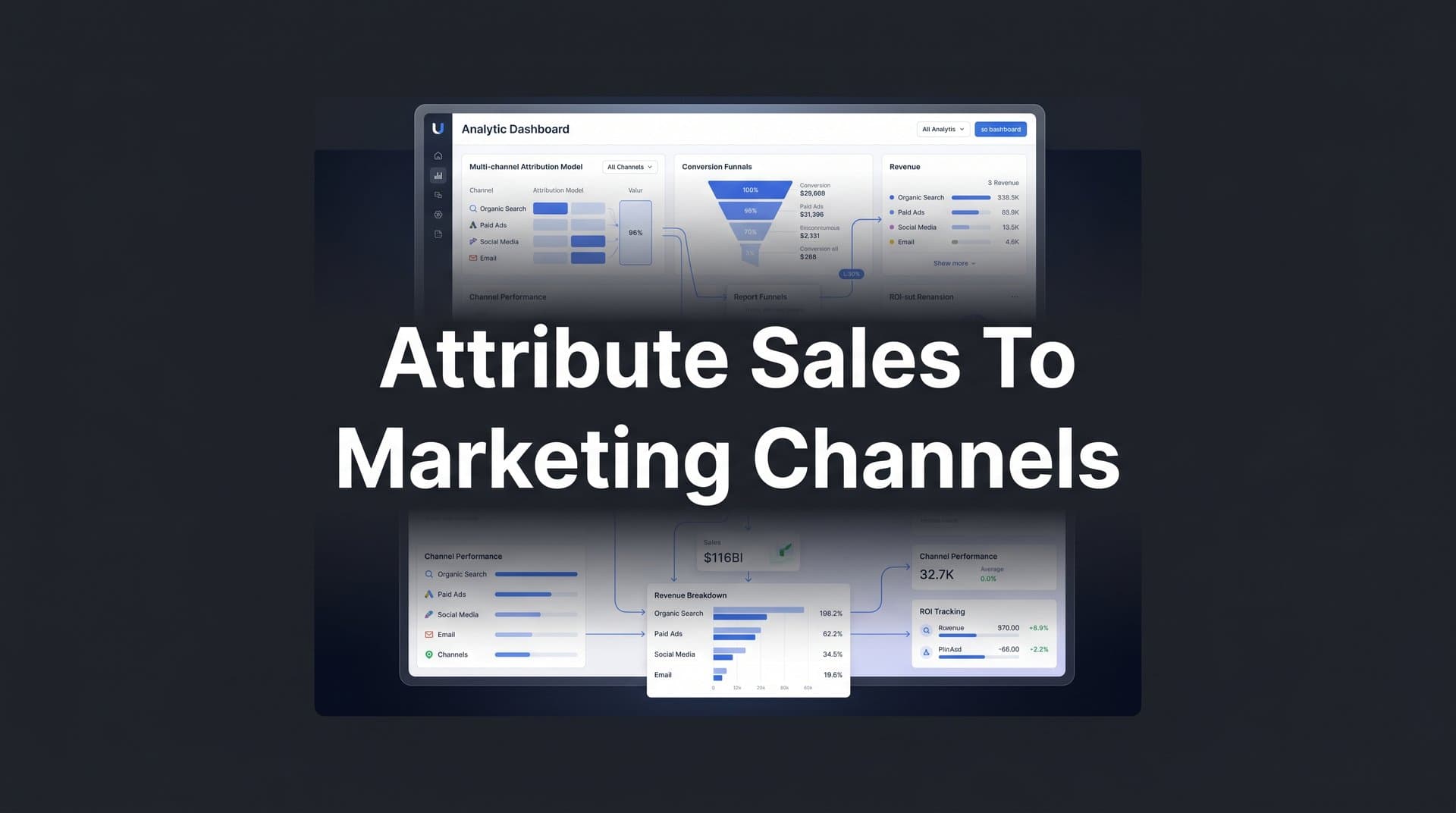
Step 3: Choose your attribution window and model, then report on pipeline and closed-won revenue by channel. Set an attribution window that reflects your actual sales cycle length. If your average deal takes 90 days to close, a 30-day attribution window will miss a significant portion of the influence your campaigns had. Once your window and model are configured, shift your primary reporting metric from leads to pipeline value and closed-won revenue by channel. This is the output that should drive budget decisions, not lead volume alone.
When you can consistently see which channels generate pipeline and which ones close deals, tracking marketing ROI across channels becomes a data-driven conversation rather than an internal negotiation based on whoever has the most compelling anecdote.
Turning Attribution Data Into Smarter Budget Decisions
Attribution data is only valuable if you act on it. The goal isn't a more detailed report. The goal is better budget decisions that compound over time.
Reading attribution reports correctly means understanding that different channels serve different roles in the buyer's journey. A channel that consistently appears as a first touch is building awareness and generating net-new pipeline. A channel that consistently appears as a last touch before close is reinforcing intent and accelerating decisions. Both roles matter, and both deserve budget. The mistake is treating first-touch channels as underperformers because they don't show up at the bottom of the funnel, or over-investing in last-touch channels because they appear to "close" deals that were already well on their way.
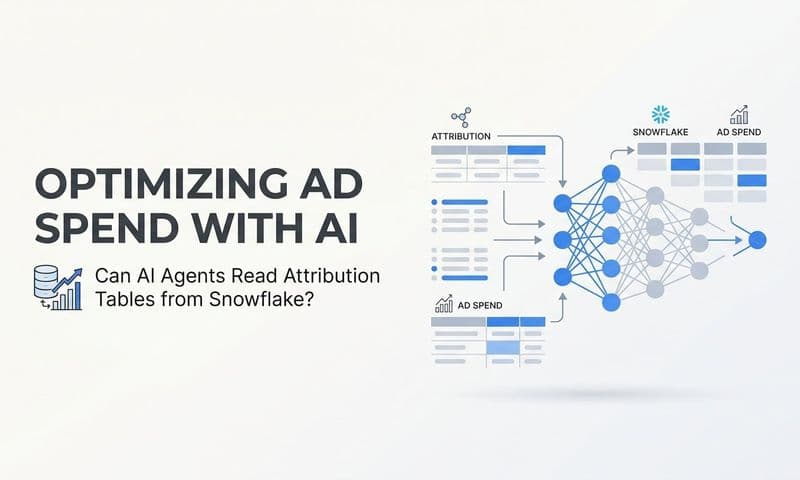
This is where AI-driven insights become a meaningful advantage. Modern attribution platforms can surface patterns across large volumes of touchpoint data that manual analysis would miss. Which combination of channels produces the highest average contract value? Which campaign sequences lead to the fastest sales cycles? Which audiences show high first-touch engagement but low close rates? These are questions that require processing patterns across hundreds or thousands of deals, and AI is far better suited to that task than a spreadsheet.
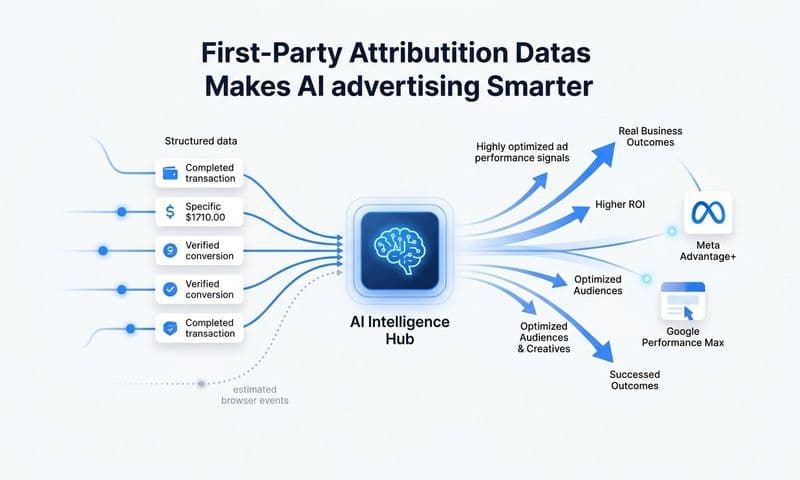
Feeding enriched conversion data back to ad platforms is the third lever. When you send accurate, revenue-linked conversion events back to Meta, Google, and LinkedIn through server-side integrations, you're giving their optimization algorithms better signal to work with. Instead of optimizing toward form fills, the platform can optimize toward the conversion events that actually correlate with closed revenue. Over time, this improves targeting quality, reduces cost per acquisition, and increases the return on every dollar of ad spend. It's a compounding advantage that teams without server-side attribution infrastructure simply can't access.
Putting It All Together
Attributing sales to marketing channels requires three things working in concert: the right attribution model for your sales motion, clean tracking infrastructure that connects ad clicks to CRM outcomes, and a platform that brings all of that data into one place where you can act on it.
Teams that get this right stop making budget decisions based on which channels look active and start making decisions based on which channels drive revenue. That shift compounds. Budgets flow toward high-performing channels. Ad platform algorithms get better signal and improve targeting. AI surfaces patterns that accelerate the feedback loop. Over time, the gap between teams with real attribution and teams without it widens significantly.
This is exactly what Cometly is built to do for B2B SaaS companies. Cometly connects every touchpoint from the first ad click to closed-won revenue, integrating with your ad platforms, website, and CRM to give you a single source of truth for marketing performance. With multi-touch attribution, server-side conversion tracking, and AI-driven recommendations, Cometly helps you see which channels are actually driving pipeline, scale what's working, and feed enriched conversion data back to Meta and Google to improve their optimization. It's attribution built for the way B2B SaaS companies actually sell.
If you're ready to stop guessing and start making budget decisions backed by real revenue data, Get your free demo and see how Cometly connects your entire marketing stack to the revenue outcomes that matter.