
You're running lead gen campaigns across Google, Meta, LinkedIn, and maybe a few other platforms. Leads are flowing in. Your sales team is working them. But when it's time to decide where next quarter's budget should go, everyone has a different answer.
Your Google Ads dashboard says search is crushing it. Meta claims their retargeting drove most conversions. LinkedIn insists their sponsored content started the whole journey. And your sales team? They're convinced most leads came from that webinar last month.
Here's the uncomfortable truth: without proper attribution for lead generation, you're all guessing. And those guesses determine where thousands—sometimes millions—of marketing dollars go next.
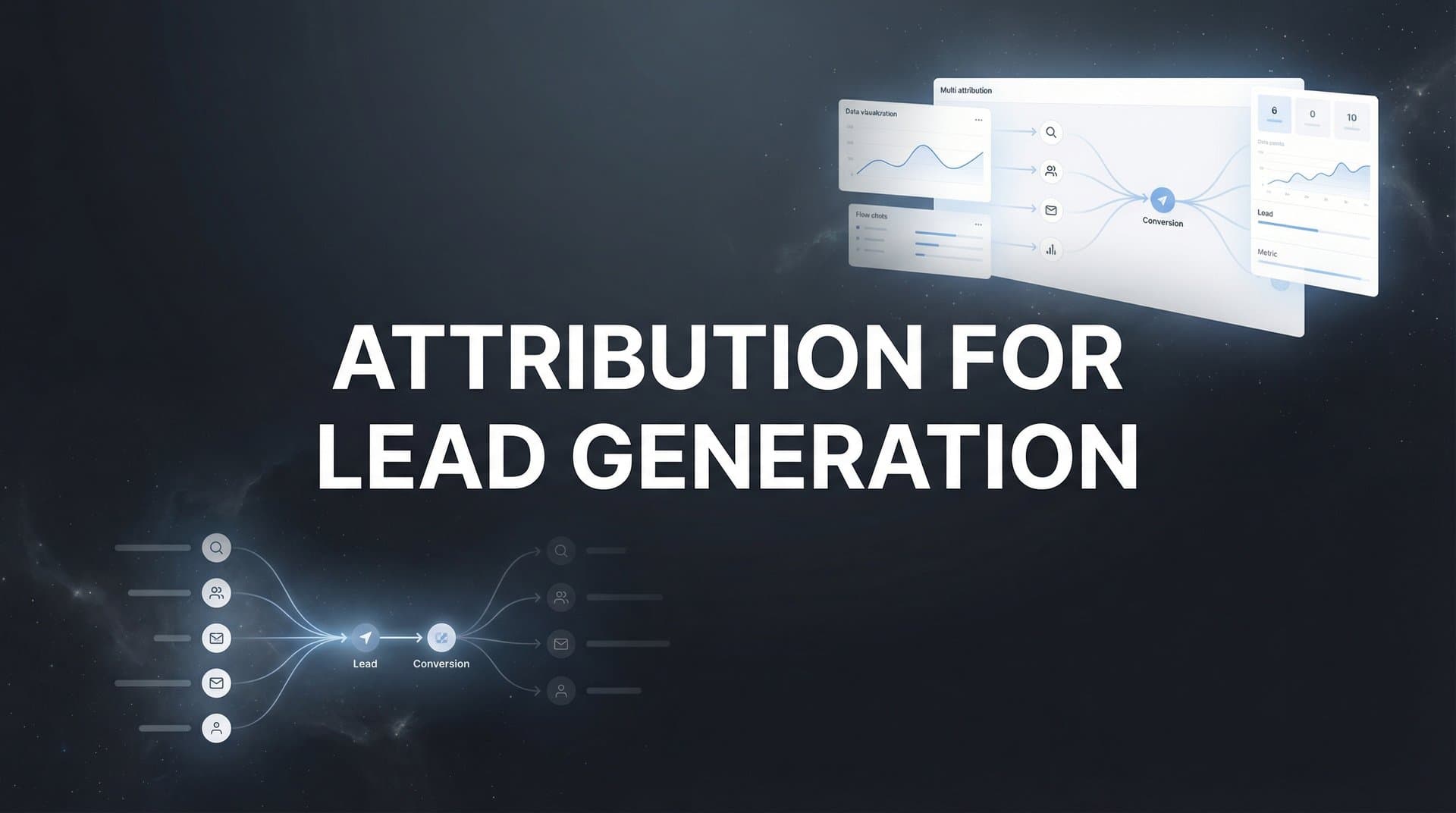
Attribution for lead generation is the system that connects every marketing touchpoint to actual lead outcomes. It tracks the ad click, the website visit, the content download, the email open, and the demo request—then follows that lead all the way through your sales pipeline to see which marketing efforts actually drive revenue.
This isn't about building the perfect tracking system or achieving 100% data accuracy. It's about making better decisions than you did last quarter. It's about knowing which campaigns deserve more budget and which ones are quietly draining resources while producing leads that never convert.
Let's break down how to build attribution that actually works for lead generation.
Why Lead Gen Attribution Isn't Just Ecommerce Tracking With a Different Name
If you've worked in ecommerce, you know attribution there is relatively straightforward. Someone clicks an ad, lands on your site, adds a product to cart, and checks out. The entire journey happens in one session, maybe two. Revenue is immediate and measurable.
Lead generation operates in a completely different reality.
Your prospect clicks a LinkedIn ad on Monday morning during their commute. They visit your site on their phone but don't convert. Wednesday afternoon, they're back on their work laptop after seeing your retargeting ad. They download a whitepaper. Two weeks later, they attend your webinar. A month after that, they finally request a demo. Then your sales team spends another six weeks nurturing them before they close.
That's six weeks to six months between first click and closed deal—with a dozen touchpoints scattered across multiple devices, platforms, and sessions. Every single one of those touchpoints influenced the outcome, but standard analytics tools only see disconnected events.
The complexity multiplies when you factor in the CRM handoff. Marketing platforms track activity up to the form submission. Your CRM tracks everything after. But these systems rarely talk to each other in real time, creating a massive blind spot where leads enter a black box and marketing has no idea which ones actually turn into customers.
This disconnect has real consequences. Marketing celebrates hitting their monthly lead target while sales complains about lead quality. Budgets get allocated to channels that generate high lead volume but terrible conversion rates. High-performing campaigns that drive fewer leads but better customers get cut because no one can prove their value.
Without attribution that follows the complete journey, you're optimizing for the wrong metrics. You're measuring marketing success by form fills instead of revenue contribution. And you're making budget decisions based on incomplete data that tells you what happened but not why it matters.
The Foundation: What You Need Before Attribution Can Work
Attribution doesn't start with choosing a fancy model or buying expensive software. It starts with capturing clean, consistent data at every stage of the customer journey.
Think of it like building a house. You can't install the roof before you pour the foundation. And in attribution, your foundation is first-party data collection—the ability to track every meaningful interaction a prospect has with your brand.
This means implementing tracking pixels on your website that fire when someone takes an action: viewing a key page, downloading content, watching a video, submitting a form. It means ensuring every ad campaign uses properly structured UTM parameters so you know exactly which specific ad, campaign, and platform drove each visit.
UTM parameters are those tagged URLs you see with "utm_source=linkedin&utm_medium=cpc&utm_campaign=q1-demand-gen" at the end. They're not sexy, but they're essential. Without them, your analytics platform can't distinguish between a click from your LinkedIn campaign versus organic LinkedIn traffic versus a LinkedIn message someone shared internally.
But here's where most marketing teams hit a wall: tracking pixels and UTM parameters only work if the same user can be identified across multiple sessions and devices. When someone clicks your ad on their phone during lunch, then returns on their laptop that evening, standard cookie-based tracking sees two different people.
This is where CRM integration becomes non-negotiable. Once someone identifies themselves by submitting a form with their email address, that email becomes the key that unlocks their entire journey. Your attribution system can now look backward and connect all those anonymous sessions to a known lead.
The CRM integration needs to work both ways. Marketing data flows into the CRM so sales can see which campaigns influenced each lead. And crucially, sales outcomes flow back to marketing so you can see which leads actually converted to opportunities and customers.
This closed-loop reporting is what separates real attribution from vanity metrics. It's the difference between knowing "Campaign A generated 200 leads" and knowing "Campaign A generated 200 leads, 40 became qualified opportunities, and 8 closed for $240,000 in revenue."
One more critical piece: server-side tracking. Browser-based tracking has become increasingly unreliable thanks to iOS privacy changes, ad blockers, and cookie restrictions. Server-side tracking captures conversion events on your server instead of relying on browser cookies, maintaining data accuracy even when browser-based tracking fails.
Without these building blocks in place—comprehensive first-party data collection, consistent UTM tagging, bidirectional CRM integration, and server-side tracking—any attribution model you implement is built on quicksand.
Choosing Your Attribution Model: Matching Framework to Funnel
Now that you've got the infrastructure to capture data, you need a framework for distributing credit across touchpoints. This is where attribution models come in.
Let's start with the simplest: first-touch attribution. This model gives 100% of the credit to the first interaction that brought someone into your ecosystem. If a prospect clicked a Google search ad and eventually became a customer three months later, that Google ad gets full credit—regardless of the webinar, email sequence, and retargeting campaign they engaged with along the way.
First-touch makes sense when you're focused on top-of-funnel efficiency and want to understand which channels are best at introducing new prospects to your brand. It's particularly useful for early-stage companies building awareness or for campaigns specifically designed to generate net-new leads.
Last-touch attribution is the opposite. It gives 100% credit to the final interaction before conversion. If someone attended your webinar and requested a demo immediately after, the webinar gets full credit—even if they'd been engaging with your content for months.
Last-touch works well when you're optimizing for conversion rate and want to identify which touchpoints are best at pushing prospects over the finish line. It's valuable for understanding which bottom-of-funnel tactics actually close deals.
But here's the problem with both: they ignore the middle of the journey. And for lead generation with long sales cycles, the middle is where most of the nurturing happens.
This is why multi-touch attribution models exist. Linear attribution distributes credit equally across all touchpoints. If someone had five interactions before converting, each gets 20% credit. It's simple and acknowledges that every touchpoint contributed, but it assumes all touchpoints are equally valuable—which is rarely true.
Time-decay attribution gives more credit to touchpoints closer to conversion. The logic: interactions that happened more recently had more influence on the decision. This model works well for lead gen because it recognizes that the demo request that happened yesterday probably mattered more than the blog post someone read three months ago.
Position-based attribution (also called U-shaped) gives 40% credit to the first touch, 40% to the last touch, and distributes the remaining 20% across middle touchpoints. It acknowledges that introducing someone to your brand and closing them are both critical, while still recognizing the nurturing that happened between.
Then there's data-driven attribution, which uses machine learning to analyze your actual conversion patterns and assign credit based on statistical impact. Instead of applying a predetermined rule, it looks at thousands of customer journeys and identifies which touchpoints actually correlate with higher conversion rates.
Data-driven attribution is powerful because it adapts to your specific business. But it requires significant data volume—generally thousands of conversions—to produce reliable insights. If you're running smaller campaigns or have a longer sales cycle with fewer conversions, simpler models often provide more actionable guidance.
The truth? There's no universally "correct" attribution model. The right choice depends on your sales cycle length, typical number of touchpoints, and what decisions you're trying to make. Many sophisticated marketing teams use multiple models simultaneously, comparing results to get a more complete picture. For a deeper dive into selecting the right approach, explore this comparison of attribution models for marketers.
Bridging the Gap Between Platform Metrics and Real Results
Open any ad platform's dashboard and you'll see impressive numbers. Meta says your campaign drove 247 conversions. Google Ads reports 189 leads. LinkedIn claims 93 form fills. Add them up and you've got 529 conversions this month.
But when you check your CRM, you only see 312 new leads. What happened to the other 217?
This is the platform reporting gap, and it's one of the biggest challenges in lead gen attribution. Ad platforms use their own tracking methods—often cookie-based pixels that fire when someone completes a form. But these methods have blind spots.
Someone might click your ad, then return directly to your site later and convert. The platform claims credit, but it wasn't the direct cause. Multiple platforms might fire their conversion pixels for the same lead, each claiming full credit and inflating your total numbers. And browser-based tracking misses conversions that happen after cookies expire or on different devices.
The result: platform-reported metrics consistently overstate performance. This isn't necessarily malicious—it's a limitation of how browser-based tracking works and how platforms define conversions. But it makes budget decisions nearly impossible when every platform is claiming credit for conversions that don't exist. Understanding multiple ad platforms attribution confusion is essential for cutting through the noise.
Server-side tracking solves this by capturing conversion events on your server instead of relying on browser pixels. When someone submits a form, your server records the conversion and can accurately attribute it based on your chosen model—regardless of what cookies are present or which platform pixels fired.
This gives you a single source of truth. Instead of reconciling conflicting reports from five different platforms, you have one system that tracks the complete journey and distributes credit according to your attribution model.
But here's where it gets interesting: you can feed this enriched conversion data back to the ad platforms through conversion APIs. This process, often called conversion sync, sends accurate conversion events to Meta, Google, LinkedIn, and other platforms—telling them which clicks actually resulted in valuable leads.
Why does this matter? Because ad platform algorithms optimize based on the conversion data they receive. If you're only sending them browser-based conversions with 60% accuracy, their machine learning models are optimizing on incomplete information. They can't distinguish between leads that become customers and leads that go nowhere.
When you sync enriched conversion data—including lead quality scores or revenue outcomes from your CRM—the platforms can optimize for leads that actually convert to opportunities and customers. Their targeting gets smarter. Your cost per qualified lead drops. And your budget goes toward campaigns that drive real business outcomes instead of vanity metrics.
From Data to Decisions: Using Attribution to Allocate Budget
Attribution data is worthless if it doesn't change how you spend money. The entire point of tracking customer journeys is to identify what's working and double down on it while cutting what's not.
Start by shifting your primary metric from cost-per-lead to cost-per-qualified-lead. Not all leads are created equal. A campaign that generates 500 leads at $20 each sounds better than one generating 100 leads at $50 each—until you realize the first campaign's leads have a 5% qualification rate while the second has 40%.
Do the math: Campaign A produces 25 qualified leads at an actual cost of $400 each. Campaign B produces 40 qualified leads at $125 each. Campaign B is three times more efficient, but you'd never know it by looking at cost-per-lead alone.
Attribution lets you track leads through your sales pipeline and calculate cost-per-qualified-lead, cost-per-opportunity, and ultimately cost-per-customer. These metrics tell you which campaigns drive leads that actually convert, not just which campaigns drive the most form fills. Implementing proper lead generation attribution tracking makes this level of analysis possible.
Look for patterns in your attribution data. Maybe LinkedIn drives fewer leads than Google, but LinkedIn leads convert to opportunities at twice the rate. That's a signal to shift budget from volume plays to quality channels. Maybe your retargeting campaigns rarely get first-touch credit but show up in 80% of closed deals as a supporting touchpoint. That's a signal not to cut retargeting just because it doesn't generate many "new" leads.
Use attribution to identify your most efficient customer acquisition paths. If prospects who engage with your webinar content before requesting a demo close at a 35% rate while those who go straight to demo close at 15%, you've found a pattern worth investing in. Create more webinar content. Promote it more aggressively. Build nurture sequences that guide prospects through that high-converting path.
Attribution also reveals when to scale. Many marketers are hesitant to increase spend on winning campaigns because they worry performance will drop. But when your attribution data shows that a campaign consistently drives qualified leads that convert to revenue—and you can track the full ROI—you can scale with confidence. Understanding multi-channel attribution for ROI helps you make these scaling decisions with clarity.
The key is making incremental changes and measuring impact. Don't shift your entire budget overnight. Reallocate 10-15% toward high-performing channels, monitor results for a few weeks, then adjust again. Attribution gives you the feedback loop to make these decisions systematically instead of relying on gut feel.
Putting It All Together: Your Attribution Action Plan
Attribution for lead generation isn't a one-time setup. It's an ongoing practice of capturing better data, analyzing it honestly, and making smarter decisions based on what you learn.
Start with infrastructure. Audit your current tracking setup. Are UTM parameters consistently applied across all campaigns? Do you have tracking pixels capturing key conversion events? Is your CRM receiving marketing data and sending back sales outcomes? If any of these pieces are missing, fix them before worrying about attribution models.
Match your attribution model to your business reality. If you have a short sales cycle with few touchpoints, first-touch or last-touch might provide sufficient insight. If prospects typically engage with multiple channels over weeks or months, you need multi-touch attribution. And if you have the data volume, consider data-driven models that adapt to your specific conversion patterns.
Build the feedback loop between marketing and sales. Attribution only works when you can see which leads actually became customers. This requires regular data syncs between your marketing platform and CRM, and it requires sales to consistently update lead status so marketing can track outcomes. Implementing unified dashboards for marketing and sales attribution streamlines this collaboration.
Review your attribution data regularly—at least monthly, ideally weekly. Look for trends in which channels drive qualified leads. Identify touchpoint combinations that correlate with higher conversion rates. Find the campaigns that are quietly wasting budget while generating leads that never convert.
Then act on what you learn. Reallocate budget toward high-performing channels. Test new approaches based on successful customer journey patterns. Cut or optimize campaigns that consistently underperform. Attribution is only valuable if it changes your behavior.
Moving Forward With Confidence
Perfect attribution doesn't exist. There will always be dark social shares you can't track, offline conversations that influence decisions, and multi-device journeys that blur the lines. That's okay.
The goal isn't perfection—it's progress. It's making better decisions this quarter than you made last quarter. It's knowing with reasonable confidence which marketing efforts drive revenue and which ones just drive activity.
Attribution for lead generation gives you that confidence. It connects the dots between ad spend and revenue outcomes. It reveals which channels deserve more investment and which ones are quietly draining resources. And it provides the data foundation for scaling campaigns that actually work instead of campaigns that just look good in platform dashboards.
The marketers winning in lead generation aren't the ones with the biggest budgets—they're the ones who know where to deploy those budgets for maximum impact. They've built attribution systems that capture every touchpoint, follow leads through the complete journey, and provide clear visibility into what's actually driving business results. Choosing the right attribution platform for lead generation is the first step toward joining them.
Your competitive advantage isn't having more money to spend. It's knowing better than your competitors where to spend it.
Ready to elevate your marketing game with precision and confidence? Discover how Cometly's AI-driven recommendations can transform your ad strategy—Get your free demo today and start capturing every touchpoint to maximize your conversions.