You're spending $10,000 a month on ads to sell a $15,000 coaching program. A deal closes. And then someone asks the question that should have a simple answer: "Which campaign drove that sale?"
The silence that follows is a problem. Not just philosophically, but financially.
High ticket marketers face a tracking challenge that most attribution tools were never designed to solve. Your buyer didn't click one ad and immediately hand over $15,000. They clicked a Facebook ad three weeks ago, read a blog post, watched a webinar, ignored two emails, opened the third, booked a call, got on a Zoom with your sales team, and then decided to buy. That journey touched six different channels across four devices over 21 days. Last-click attribution gives credit to the booking page. Your Facebook dashboard claims the sale. Your Google Ads account claims it too. And you're left with three conflicting stories and no idea where to put your budget next month.
This is the core problem with attribution tracking for high ticket offers. The tools built for tracking a $30 impulse purchase simply cannot handle the complexity of a premium buyer's journey. And when every missed data point represents thousands of dollars in potential revenue, the cost of getting this wrong is enormous.
This article breaks down exactly why standard tracking fails high ticket funnels, what a proper attribution setup looks like, and how to build a system that connects every touchpoint from the first ad click to the final closed deal. If you're selling anything priced at $1,000 or more, and especially if your sales cycle stretches across days, weeks, or months, this is the framework you need.
Why High Ticket Sales Break Standard Tracking Models
Standard attribution tools were built around a simple assumption: someone sees an ad, clicks it, lands on a page, and converts. The whole journey happens in one session, on one device, and inside a browser where a pixel can capture everything. That assumption works reasonably well for low-cost ecommerce. For high ticket offers, it falls apart almost immediately.
High ticket buyers rarely convert in a single session. A prospective client for a $20,000 consulting engagement might interact with your brand a dozen times before they ever book a discovery call. They click a LinkedIn ad, then find you on Google, then watch a YouTube video, then open a nurture email, then finally book through a Calendly link. Each of those touchpoints happened on a different platform, possibly on different devices, and spread across several weeks. A browser-based pixel can only see what happens in a single session on a single browser. It has no memory of what came before, and no visibility into what happens after someone leaves your website.
The platform-level reporting problem makes this worse. When a sale closes, Meta says it drove the conversion. Google says it drove the conversion. Maybe TikTok does too. Each platform attributes the sale to itself because each platform only sees its own touchpoints. There's no shared view of the full journey, so you end up with inflated ROAS numbers across every platform simultaneously, and a total reported attribution that adds up to far more than the actual revenue you generated. This is called attribution overlap, and it's one of the most common reasons high ticket marketers make bad budget decisions. Understanding cross platform attribution is essential for resolving these conflicting reports.
iOS privacy changes and the gradual deprecation of third-party cookies have made browser-based tracking even less reliable. When a prospect clicks a Facebook ad on their iPhone, iOS restrictions can prevent the pixel from firing correctly. Cookie-based tracking can't follow users across browsers or devices. The result is a growing blind spot in your data, and for high ticket marketers, every blind spot is expensive. If a $25,000 deal closes and you can't trace it back to the campaign that started the journey, you might cut that campaign entirely, not realizing it was your most valuable source of new business.
The fundamental issue is that standard tracking models were not built for complexity. They were built for speed and simplicity. High ticket attribution requires a different foundation entirely, one that can handle long sales cycles, multi-channel journeys, and conversions that happen inside CRMs and sales calls rather than on checkout pages.
The Anatomy of a High Ticket Customer Journey
Before you can track a high ticket funnel properly, you need to understand what you're actually tracking. The typical high ticket customer journey looks nothing like a standard ecommerce funnel, and the touchpoints that matter most are often the ones most marketers aren't measuring at all.
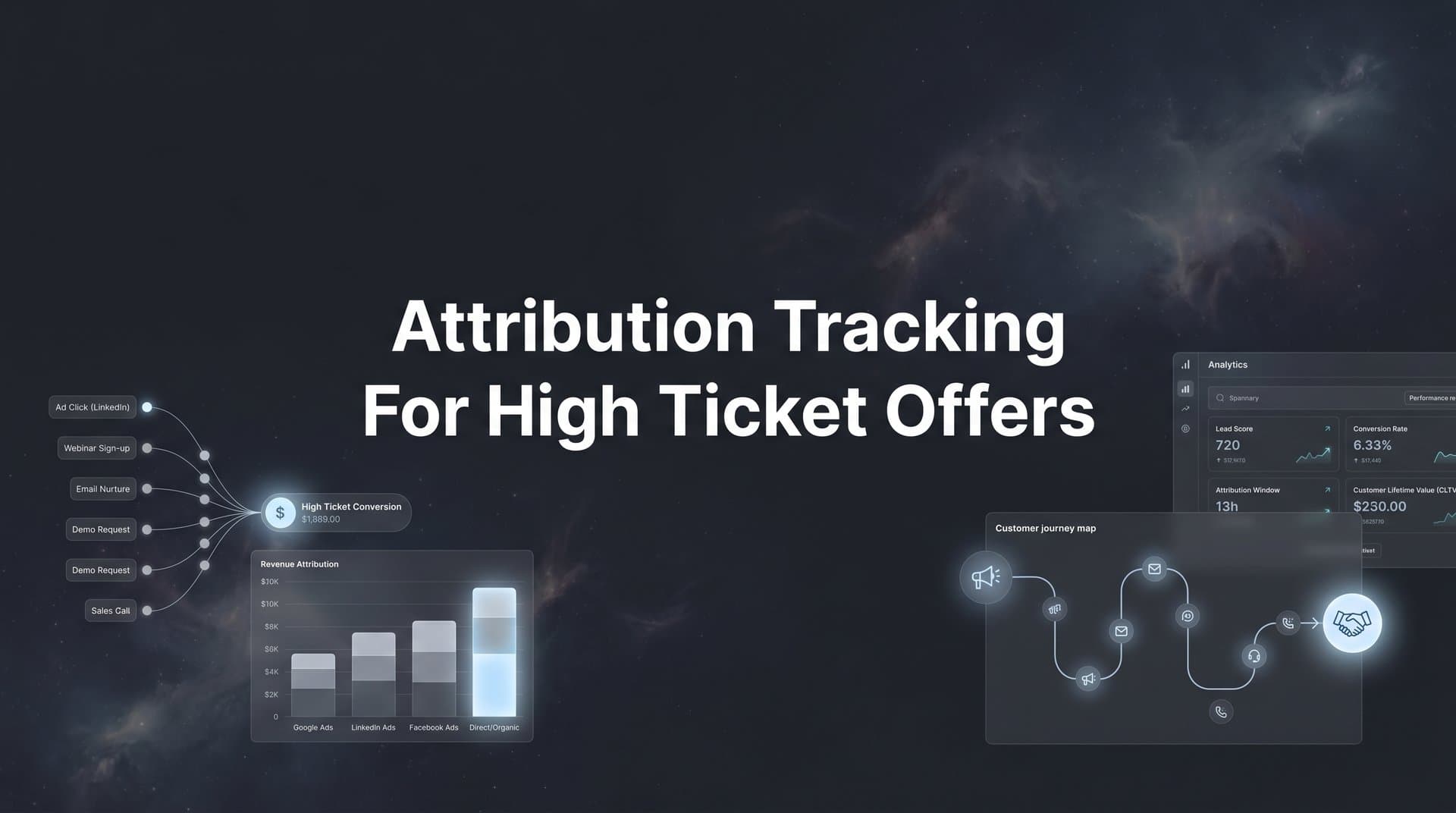
Here's what a realistic high ticket journey often looks like: a prospect sees a paid ad and clicks through to a lead magnet or VSL page. They opt in, enter an email sequence, and receive a series of nurture messages over several days. They click through to a webinar or case study. They eventually reach an application or booking page, submit a form, and schedule a sales call. The sales call happens, and a few days later, after a follow-up email or two, they sign the contract and pay. The deal is closed inside your CRM.
Most marketers are only capturing two moments in that entire journey: the first ad click and the final form submission. Everything in the middle, the email opens, the retargeting ad impressions, the content they consumed, the webinar they attended, is invisible. But those middle touchpoints are often doing the heaviest lifting. They're the ones building trust, overcoming objections, and moving a skeptical prospect from "maybe" to "yes." If you can't see them, you can't optimize for them. Implementing customer attribution tracking across the full journey is what closes this visibility gap.
This is where multi-touch attribution becomes essential for high ticket offers. Instead of assigning all credit to one touchpoint, multi-touch attribution distributes credit across every interaction in the customer journey. This gives you a much more accurate picture of which channels are contributing to revenue, not just which channel happened to be last in line when the conversion finally occurred.
CRM integration is the piece that most high ticket attribution setups are missing entirely. In most high ticket businesses, the conversion that actually matters, the closed deal, the signed contract, the collected payment, doesn't happen on a website. It happens inside a CRM like HubSpot, Salesforce, or GoHighLevel, when a sales rep marks a deal as won. If your attribution system can't see that CRM event and connect it back to the original ad campaign that started the journey, you're measuring the wrong thing. You're optimizing for leads when you should be optimizing for revenue.
Connecting your CRM pipeline events to your ad platform data is the bridge that makes attribution tracking for high ticket offers actually useful. It's the difference between knowing which campaigns generate leads and knowing which campaigns generate revenue.
Choosing the Right Attribution Model for Premium Products
Once you have visibility into the full customer journey, you need to decide how to assign credit across it. Attribution models are the rules that determine which touchpoints get credit for a conversion, and choosing the right one for high ticket offers is more nuanced than most marketers realize.
First-touch attribution gives all the credit to the very first interaction a prospect had with your brand. This is useful for understanding which channels are best at generating new leads and introducing people to your offers. For high ticket marketers, this model helps answer the question: "Where are my best buyers coming from originally?"
Last-touch attribution gives all the credit to the final interaction before conversion. This is the default model used by most ad platforms, and it consistently overstates the value of bottom-of-funnel touchpoints while completely ignoring everything that built trust and intent along the way. Understanding the difference between single source and multi-touch attribution helps clarify why relying on one model alone is risky.
Linear attribution distributes credit equally across every touchpoint in the journey. It's a more balanced view, though it treats a casual email open the same as a high-intent webinar attendance, which isn't always accurate.
Time-decay attribution gives more credit to touchpoints that occurred closer to the conversion. This makes intuitive sense for high ticket offers where recent interactions, like a sales call or a final retargeting ad, often represent the tipping point in a buyer's decision.
Here's the key insight: no single model is universally correct. The real value comes from comparing models side by side. When you look at the same campaign through a first-touch lens and a last-touch lens simultaneously, you start to see which channels are great at generating leads but poor at closing, and which channels are quietly doing the work of converting warm prospects into paying clients. A thorough comparison of attribution models is essential for making these strategic distinctions.
The most sophisticated approach is data-driven or AI-powered attribution. Rather than applying arbitrary rules, this model analyzes your actual conversion data and weights each touchpoint based on its real, measured influence on revenue. For high ticket marketers with enough conversion volume, this approach removes the guesswork and replaces it with evidence.
Server-Side Tracking: The Foundation for Accurate High Ticket Attribution
You can have the best attribution model in the world, but if your underlying data is full of holes, your insights will be wrong. For high ticket funnels, the quality of your conversion data is everything. And browser-based pixels are no longer a reliable way to collect it.
Browser-based tracking relies on JavaScript pixels that fire inside a visitor's browser. The problem is that browsers, devices, and operating systems have become increasingly hostile to this approach. Ad blockers prevent pixels from loading. Safari's Intelligent Tracking Prevention limits cookie lifespans to 24 hours. iOS privacy prompts cause users to opt out of tracking. The result is that a significant portion of your conversion events are simply never recorded. For a $30 product, losing 20% of your conversion data is annoying. For a $20,000 service, it's a serious business problem. Learning why server-side tracking is more accurate explains exactly how these data gaps form and how to close them.
Server-side tracking solves this by moving the data collection process off the browser entirely. Instead of relying on a pixel in the visitor's browser to send conversion data to ad platforms, server-side tracking sends that data directly from your server to the ad platform's API. The browser's limitations, ad blockers, cookie restrictions, and privacy settings, become irrelevant because the data never passes through the browser at all.
For high ticket marketers, this means that when a prospect books a call, submits an application, or triggers any other high-value event in your funnel, that event is captured and recorded accurately, regardless of what browser they're using or what privacy settings they have enabled. The data integrity that server-side tracking provides is the foundation that makes everything else in your attribution stack reliable.
Conversion syncing takes this a step further. Once you have accurate, verified conversion data, you can send it back to ad platforms like Meta and Google to improve their algorithmic targeting. Instead of Meta optimizing for anyone who clicks your ad, it can optimize for people who resemble your actual high ticket buyers, the ones who book calls, show up, and close. This creates a feedback loop where better data produces better targeting, which produces higher quality leads, which produces more closed deals. Platforms like Cometly are built specifically to handle this process, sending enriched conversion events back to ad platforms so their algorithms are working with real revenue data rather than surface-level click behavior.
Setting Up Attribution Tracking for Your High Ticket Funnel
Understanding the theory is one thing. Building the actual system is where most high ticket marketers get stuck. Here's a practical breakdown of what a proper attribution setup looks like for a premium offer funnel.
Step one: Connect your ad platforms. Your attribution software needs to be integrated with every paid channel you're running, including Meta, Google, LinkedIn, TikTok, and any others. This allows it to pull in spend data and match it against conversion events, giving you a true cost-per-outcome calculation for each platform.
Step two: Install server-side tracking. Replace or supplement your browser-based pixels with server-side event tracking. This ensures that conversion events are captured accurately regardless of browser restrictions. Every key action in your funnel should fire a server-side event: page visits, opt-ins, application submissions, call bookings, and especially downstream revenue events.
Step three: Integrate your CRM. This is the most important and most frequently skipped step for high ticket businesses. Connect your CRM, whether that's HubSpot, Salesforce, GoHighLevel, or another platform, so that deal stage changes and closed-won events are captured as attribution events. A lead that converts to a $15,000 client should be traceable all the way back to the original ad that started the journey.
Step four: Define your conversion hierarchy. Not all conversions are equal. Map out the events that matter most to your business: lead generated, qualified lead, sales call booked, sales call completed, proposal sent, deal closed, revenue collected. Tracking all of these gives you visibility into where each campaign is winning and where it's dropping off. The right conversion tracking platforms make this hierarchy easy to implement and monitor.
One of the most common mistakes in high ticket attribution is optimizing for front-end opt-ins. A campaign that generates cheap leads but produces zero closed deals is not a good campaign. A campaign that generates expensive leads but consistently closes at high ticket prices is an excellent campaign. Without downstream revenue tracking, you'll cut the second campaign and scale the first, which is exactly backwards. Knowing how to fix attribution discrepancies in data helps you catch these costly misreadings before they impact your budget.
Finally, implement consistent UTM parameters and naming conventions across all campaigns. Clean, organized UTM data ensures that your attribution software can correctly identify and categorize every traffic source, making your reporting accurate and your analysis actionable.
Scaling High Ticket Campaigns With Attribution Confidence
Here's where accurate attribution tracking for high ticket offers pays off in a concrete, measurable way. When you can see exactly which campaigns, channels, and touchpoints are driving closed deals and actual revenue, budget allocation stops being a guessing game.
Think about what this looks like in practice. You're running campaigns on Meta and Google simultaneously. Meta shows a lower cost per lead. Google shows a higher cost per lead. Without attribution data connected to revenue, you'd logically shift budget to Meta. But when you look at which campaigns are driving closed deals in your CRM, you find that Google leads are closing at a much higher rate and a much higher average deal value. The true cost per closed deal is actually lower on Google. With that clarity, you move budget to Google and your revenue increases. That's the power of multi-channel attribution for ROI that goes all the way to the bottom of the funnel.
Better conversion data also improves the performance of the ad platforms themselves. When you feed Meta or Google enriched conversion signals that include downstream revenue events, not just front-end opt-ins, their algorithms learn to find more people who resemble your actual paying clients. Over time, this improves the quality of your traffic, reduces wasted spend, and increases the ROI of every campaign you run. The platforms' machine learning becomes an asset rather than a liability because it's being trained on the right data.
AI-powered attribution recommendations add another layer of strategic intelligence. Instead of manually analyzing campaign data across multiple platforms, AI can surface patterns and opportunities that would take hours to find manually. It can identify which campaigns are underperforming before you've wasted significant budget, and which campaigns have untapped scaling potential based on their revenue contribution. Leveraging performance marketing attribution at this level is the difference between reactive and proactive optimization for high ticket marketers managing complex multi-channel campaigns.
Your Path to Confident, Revenue-Driven Attribution
Attribution tracking for high ticket offers is not a nice-to-have feature or a technical detail you can figure out later. It is the infrastructure that determines whether your marketing decisions are based on real data or expensive guesswork.
The core takeaway is this: when you're selling premium products or services, connecting every touchpoint from the first ad click to the final closed deal gives you the clarity to scale profitably. You stop cutting campaigns that are quietly driving your best clients. You stop pouring budget into channels that look good on paper but produce nothing downstream. You start making decisions based on revenue, not vanity metrics.
The framework is clear. Build a foundation with server-side tracking. Integrate your CRM so closed deals are visible. Use multi-touch attribution to understand which touchpoints actually influence buyers. Compare attribution models to get the full strategic picture. And feed enriched conversion data back to ad platforms so their algorithms work in your favor.
Cometly provides the complete attribution stack built specifically for this kind of complex, high-value marketing. From server-side tracking and multi-touch attribution to CRM integration and conversion syncing, it gives you everything you need to track the full customer journey and make confident, data-driven decisions at every stage of your funnel. If you're ready to stop guessing and start scaling with real attribution data, Get your free demo today and see exactly which campaigns are driving your revenue.