Most B2B SaaS marketing teams are running campaigns without a clear picture of how their audience actually moves from first awareness to paying customer. They know which ads generated clicks. They know which leads closed. But the connective tissue between those two points is often invisible.
That gap is exactly where budget gets wasted and growth stalls.
Audience journey mapping solves this by giving your team a structured, data-backed view of every stage your buyers move through before they convert. It is not a theoretical exercise. When done correctly, it becomes the foundation for smarter ad targeting, more relevant messaging, and attribution that actually reflects how your pipeline gets built.
This guide walks B2B SaaS marketers through a practical, step-by-step process for building an audience journey map that connects to real conversion data. By the end, you will know how to define your buyer stages, identify the touchpoints that matter, align your attribution model to the journey, and use that intelligence to make better decisions about where to spend and scale.
Whether you are building your first journey map or rebuilding one that no longer reflects how your buyers behave, this process will give you a repeatable framework grounded in your actual marketing data. Let's get into it.
Step 1: Define Your Buyer Stages Before You Map Anything
Before you can map a journey, you need to agree on what the stages actually are. This sounds obvious, but it is where most teams stumble. They borrow generic funnel labels like TOFU, MOFU, and BOFU without anchoring those labels to anything observable in their CRM or attribution platform.
The result is a journey map that looks clean on a whiteboard but has no connection to how buyers actually behave in the real world.
Start by pulling your closed-won deals from your CRM and working backwards. What was the first recorded interaction? What happened between that first touch and the signed contract? Which stages are clearly distinct, and which are actually part of the same moment in the buyer's decision process?
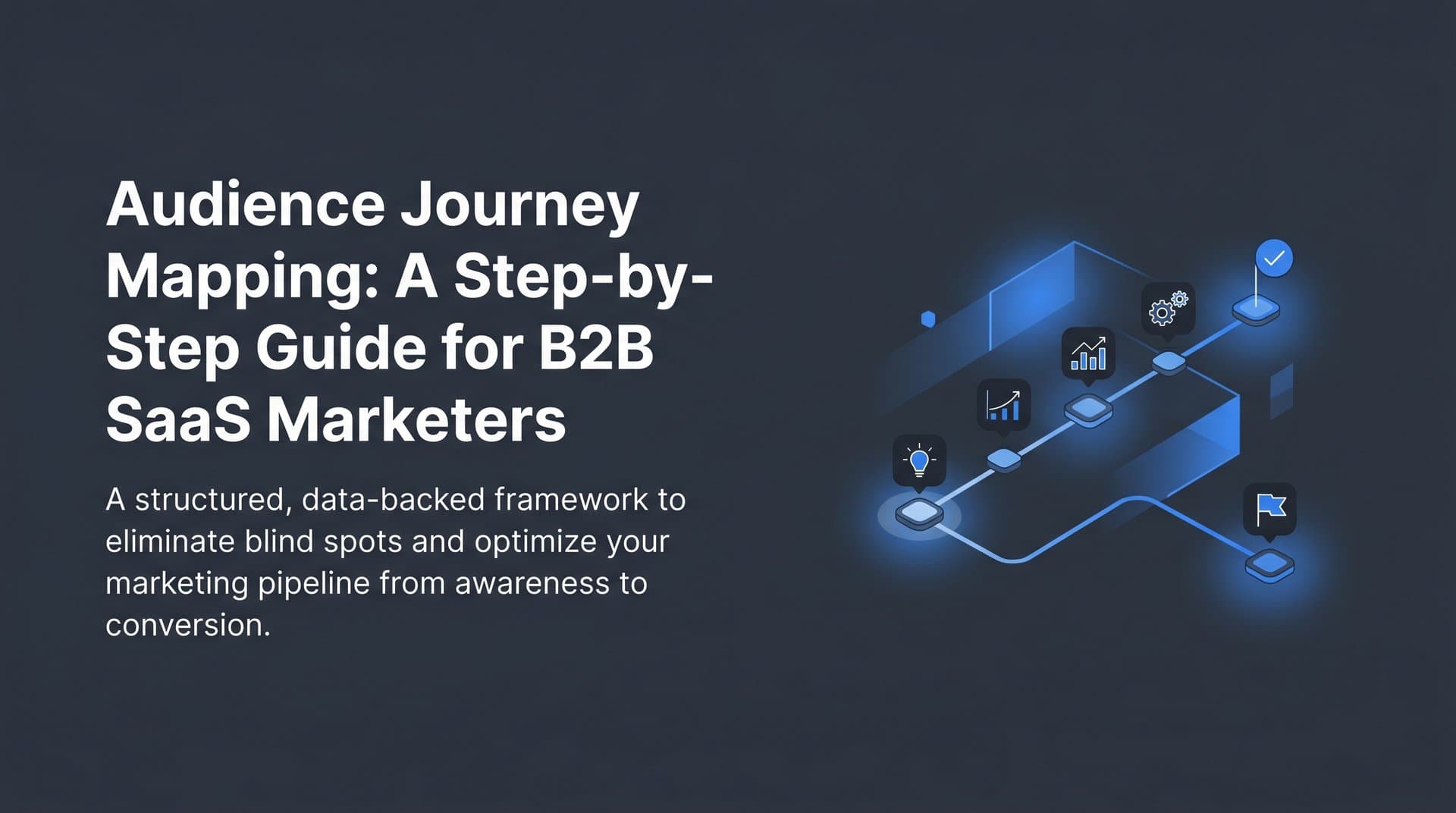
For most B2B SaaS companies, the stages of the customer journey tend to follow a pattern like this:
Problem Awareness: The buyer recognizes a challenge but has not yet identified a solution category. They are consuming educational content, reading industry publications, and searching for context.
Solution Exploration: The buyer understands that tools like yours exist and starts comparing options. They are visiting product pages, reading comparison content, and engaging with demos or webinars.
Evaluation and Validation: The buyer is narrowing their shortlist. They are requesting trials, talking to sales, and seeking proof that your solution will work for their specific situation.
Decision and Commitment: The buyer is ready to purchase. They are reviewing pricing, negotiating terms, and moving toward a signed contract.
The specific labels matter less than the underlying logic: each stage must have a clear entry trigger and a clear exit trigger that can be tracked. A demo request is an observable event. A trial start is an observable event. "Becoming interested" is not.
Align your stage definitions with your sales team before finalizing anything. When marketing and revenue teams use different language to describe the same buyer moments, attribution breaks down and decisions get made on incomplete information.
A common pitfall here is defining too many micro-stages that cannot be tracked, or collapsing important decision points into a single stage because it is easier to manage. Aim for five to seven stages that reflect genuine shifts in buyer intent, each with a trackable signal attached.
Success indicator: Every stage in your map has a named entry trigger, a named exit trigger, and at least one event in your CRM or attribution platform that confirms a buyer has moved from one stage to the next.
Step 2: Identify Every Touchpoint Your Audience Encounters
Once your stages are defined, the next task is documenting every interaction your audience has with your brand across those stages. This is where most journey maps get incomplete, because teams tend to map only the touchpoints they can already see in their dashboards.
The reality is that B2B buyers interact with your brand across a much wider surface area than your ad platforms and CRM capture on their own.
Start with the channels you can track directly. These typically include paid search ads, paid social campaigns on Meta and LinkedIn, organic search traffic, email nurture sequences, retargeting campaigns, webinars, and direct sales outreach. For each of these, document which stages they are designed to reach and which ones they actually appear in when you look at your closed-won deal data.
Then push further into the touchpoints that are harder to track. Review site visits on platforms like G2 or Capterra often happen during the evaluation stage and rarely appear in standard attribution reports. Word-of-mouth referrals from colleagues or community recommendations are real influences on buyer decisions but leave no digital footprint in your stack. Podcast appearances, LinkedIn posts from your team members, and industry events all create brand impressions that shape how buyers perceive you before they ever click an ad.
This is sometimes called the dark funnel, and while you cannot fully attribute revenue to it, acknowledging it prevents you from over-crediting the channels you can measure. Understanding what customer journey touchpoints actually look like across your full funnel is essential before you can accurately assess where attribution gaps exist.
The practical output of this step is a documented touchpoint inventory. For each touchpoint, record the stage it belongs to, the channel it lives on, and whether it is currently being tracked in your attribution platform. That tracking status column is important because it tells you exactly where your attribution data has blind spots.
Use your CRM data and ad platform data together to surface which touchpoints actually appear in the journeys of closed-won deals. If LinkedIn ads consistently show up in the first-touch position for your best customers, that is worth knowing. If email sequences are appearing right before demo requests, that is a signal worth acting on.
Success indicator: You have a documented list of touchpoints organized by stage, with a clear notation of which ones are currently tracked and which ones are not.
Step 3: Connect Attribution Data to Each Stage of the Journey
Defining your stages and identifying your touchpoints gives you the structure of your journey map. Attribution data is what brings it to life by telling you which parts of that structure are actually driving revenue.
The first decision here is choosing an attribution model that reflects how your buyers actually make decisions. For B2B SaaS, this choice matters more than in most marketing contexts because your sales cycles are long, involve multiple stakeholders, and include many touchpoints spread across weeks or months.
Here is a quick breakdown of the most common models and when they apply:
First-touch attribution gives full credit to the channel or campaign that created the initial awareness. It is useful for understanding what is driving top-of-funnel growth, but it ignores everything that happens after that first interaction.
Last-touch attribution gives full credit to the final touchpoint before conversion. It is easy to implement but wildly misleading in B2B contexts where the last click is rarely the most influential moment in the buyer's journey.
Linear attribution distributes credit equally across all touchpoints in the journey. It is a reasonable starting point and avoids the extremes of first or last-touch, though it treats a brand awareness ad the same as a high-intent demo request.
Data-driven attribution uses your actual conversion data to assign credit based on which touchpoints most consistently appear in journeys that result in closed deals. It is the most accurate model when you have enough conversion volume to support it.
For most B2B SaaS teams, multi-touch attribution is the right starting framework. It surfaces which channels and campaigns appear across the full journey, not just at the conversion point, and gives you a more accurate picture of how pipeline actually gets built. Reviewing the best marketing attribution tools for B2B SaaS can help you identify which platforms support the multi-touch models your journey map requires.
The practical challenge is connecting your ad platform data to your CRM. Without that connection, you can see which campaigns generated clicks, and you can see which leads eventually closed, but you cannot see the relationship between the two. That is the gap that leaves marketing teams unable to justify budget decisions or identify which channels are genuinely contributing to revenue.
Cometly addresses this directly by linking ad spend data from platforms like Meta and Google to pipeline and closed-won revenue, giving you a single source of truth across your entire marketing stack. Instead of toggling between disconnected dashboards, you can see which campaigns influenced which deals and at which stages of the journey they appeared.
Success indicator: You can identify which channels and campaigns appear most frequently in the journeys of your closed-won deals, not just which ones generated the most clicks or leads.
Step 4: Segment Your Audience by Journey Behavior, Not Just Demographics
Most B2B SaaS teams segment their audiences by firmographic data: company size, industry, job title, revenue range. These signals are useful for initial targeting, but they tell you almost nothing about where a buyer is in their decision process or how likely they are to convert.
Behavioral segmentation changes that. Instead of grouping buyers by who they are, you group them by how they act at each stage of the journey.
Think about the difference between two prospects who both work at mid-market SaaS companies with similar job titles. One clicked a LinkedIn ad, visited your pricing page twice, and requested a demo within a week. The other clicked a Google search ad, read two blog posts, and then went quiet for three weeks before re-engaging with a retargeting campaign. These two buyers are in very different places, and treating them the same way in your campaigns will produce very different results.
Building behavioral segments requires first-party data from your CRM and tracking platform. The signals to look for include the entry point (which ad or channel brought them in), the content they consumed along the way, and their stage velocity, meaning how quickly they move from one stage to the next. Understanding retargeting audience performance by segment is particularly valuable here, since re-engagement patterns often reveal which behavioral groups are closest to converting.
Start by identifying which segments convert at the highest rates. Then look at which segments tend to stall at specific stages. If a large portion of your trial starts never move to a demo or a sales conversation, that is a segment that needs different messaging or a different nurture sequence, not more of the same.
Behavioral segmentation also improves your ad targeting directly. When you know that buyers who entered through organic search tend to move more slowly but convert at higher rates, you can build retargeting audiences and nurture sequences specifically designed for that path. When you know that LinkedIn-sourced buyers tend to request demos faster, you can allocate more budget there with confidence.
A common pitfall is creating segments that are either too broad to generate actionable insights or too narrow to produce statistically meaningful data. Aim for three to five distinct behavioral segments that each have enough volume to observe patterns and enough differentiation to justify different messaging or creative approaches.
Success indicator: You have at least three distinct behavioral segments with documented journey patterns, conversion rates, and stage velocity differences that you can act on in your campaigns.
Step 5: Map Content and Ad Creative to Each Journey Stage
With your stages defined, your touchpoints documented, your attribution model connected, and your behavioral segments built, you now have everything you need to make intentional decisions about what content and creative to put in front of buyers at each stage.
This is where journey mapping becomes directly actionable for your campaigns.
The core principle is simple: buyers at different stages of the journey need different things from your content. Running the same creative across all stages wastes budget on audiences who are not ready to act on that message, and it dilutes the relevance of your ads for the audiences who are.
Here is how to think about content alignment by stage:
Awareness stage: Buyers here are trying to understand their problem, not evaluate your solution. Thought leadership content, problem-focused ads, and educational resources work well. The goal is to build familiarity and trust, not to drive immediate conversions.
Consideration stage: Buyers here know solutions like yours exist and are starting to evaluate options. Comparison content, product-focused ads, demo invitations, and webinars are appropriate. The goal is to position your solution as the most credible option in their shortlist.
Decision stage: Buyers here are close to committing. ROI-focused messaging, retargeting campaigns with direct calls to action, and content that addresses final objections are most effective. The goal is to remove friction and make the next step obvious.
The important caveat here is that your content assignments should be validated by your attribution data, not just built on assumptions. Look at which content types actually appear in the journeys of your best customers. If your data shows that buyers who attended a webinar during the consideration stage convert at a meaningfully higher rate, that is a signal to invest more in that format and make sure it is showing up consistently for buyers at that stage.
Avoid the common mistake of creating content based on what feels right or what competitors are doing. Your customer journey analytics tells you what your specific buyers respond to, and that is always more reliable than industry assumptions.
Success indicator: Every stage in your journey map has at least two content assets and one ad format assigned to it, with performance benchmarks in place so you can evaluate whether they are actually moving buyers forward.
Step 6: Implement Tracking to Capture the Full Journey in Real Time
A journey map is only as accurate as the data feeding it. If your tracking setup has gaps, your attribution data will have gaps, and the decisions you make based on that data will be built on an incomplete picture.
The most significant tracking challenge facing B2B SaaS marketers right now is the decline of browser-based pixel tracking. Ad blockers, browser privacy restrictions, and the ongoing deprecation of third-party cookies have made client-side tracking increasingly unreliable. Events that should be recorded are being missed, and that missing data directly affects the quality of your attribution.
Server-side conversion tracking is the solution. Instead of relying on a pixel that fires in the browser, server-side tracking sends event data directly from your server to your ad platforms and attribution tools. It is not affected by ad blockers or browser restrictions, and it produces a more complete and accurate event record.
Alongside server-side tracking, Conversion API integrations are essential for feeding enriched, first-party event data back to the ad platforms themselves. Meta's Conversion API and Google's Enhanced Conversions allow you to send customer event data directly from your server, improving match rates and giving the platform's algorithms better signal to optimize your campaigns.
The events you should be tracking across your journey include page views, form submissions, demo bookings, trial starts, and revenue events from your payment processor. That last category is critical and often missing. If your attribution platform cannot see when a lead becomes a paying customer, it cannot connect your ad spend to actual revenue.
Connecting your Stripe or billing data to your attribution platform closes that loop. It means you can trace a closed deal back to the first ad that introduced that buyer to your brand, and you can see every touchpoint in between. A robust approach to customer journey tracking ensures that no meaningful interaction falls outside your attribution window.
Cometly handles this end-to-end by capturing every touchpoint from first ad click to closed-won revenue and syncing conversion-ready events back to Meta, Google, and other platforms. This gives your ad platform algorithms better data to work with, which improves targeting accuracy and reduces wasted spend over time.
A common pitfall is only tracking the final conversion event, typically a form submission or a demo request, and ignoring the intermediate touchpoints that reveal how buyers actually progress through your funnel. Those intermediate events are where the most actionable journey insights live.
Success indicator: Your attribution platform shows a continuous event trail from first touch to revenue for a meaningful percentage of your closed deals, with no major gaps between key stages.
Step 7: Analyze, Refine, and Scale Based on Journey Insights
Building your audience journey map is not a one-time project. It is the beginning of an ongoing process of analysis, refinement, and scaling based on what your data actually shows.
Start by reviewing your journey map data on a regular cadence, at minimum monthly, and look for patterns that signal where your funnel is healthy and where it is breaking down. Where are audiences dropping off? Which stages have the highest exit rates? Which touchpoints appear consistently in journeys that close, and which ones appear in journeys that stall?
Stage velocity is one of the most useful signals to track. Look at which journeys move fastest from first touch to closed-won revenue, and then look at what those buyers have in common. Did they enter through a specific channel? Did they consume a particular piece of content early in their journey? Did they request a demo within a certain number of days? Those patterns are your signals for what to replicate and amplify.
AI-driven insights become especially valuable at this stage. Rather than manually combing through campaign data across multiple platforms, you can use AI analytics software to surface which campaigns and channels are producing the highest quality pipeline, not just the most leads. There is a meaningful difference between a campaign that generates a high volume of leads that rarely convert and a campaign that generates fewer leads that close at a much higher rate. Journey data helps you see that distinction clearly.
Feeding better conversion data back to your ad platforms also compounds your results over time. When Meta or Google receives enriched, accurate conversion signals from your server-side tracking, their algorithms get better at finding buyers who look like your best customers. This is not a one-time benefit. It improves progressively as your conversion data accumulates.
Cometly's AI ads manager identifies high-performing campaigns across channels and provides recommendations for where to scale budget, so you are not making those decisions based on gut instinct or surface-level metrics like cost per click.
The most important mindset shift here is treating your journey map as a living document rather than a finished deliverable. Your product will evolve. Your pricing will change. Your buyers' behavior will shift as the market changes. A journey map that was accurate a year ago may no longer reflect how your audience actually moves through your funnel today.
Success indicator: You can point to specific budget decisions, creative changes, or channel shifts that were driven directly by insights from your journey map data, and you have a documented review cadence to keep the map current.
Putting It All Together
Building an audience journey map is one of the highest-leverage activities a B2B SaaS marketing team can undertake. When you combine clearly defined stages, comprehensive touchpoint tracking, and attribution data that reflects how buyers actually move through your funnel, you stop guessing and start making decisions grounded in evidence.
The seven steps in this guide give you a repeatable process. Use this checklist to confirm you have completed each one:
Buyer stages defined with observable entry and exit triggers tied to your CRM.
All touchpoints documented with a tracking status for each one across paid, owned, and organic channels.
Attribution model selected and connected to your CRM so you can see which campaigns influence pipeline, not just clicks.
Behavioral segments created based on entry point, content consumed, and stage velocity.
Content and ads mapped to each stage with performance benchmarks in place.
Server-side tracking and Conversion API live to capture the full event trail from first touch to revenue.
A review cadence established so your journey map stays current as your audience and market evolve.
Platforms like Cometly make this process significantly more accurate by connecting your ad spend directly to pipeline and revenue, capturing every touchpoint in real time, and sending enriched conversion data back to your ad platforms to improve targeting. Start with the data you have, build from there, and let your journey map evolve as your audience and market do.
Ready to see exactly which ads and channels are driving your pipeline and revenue? Get your free demo today and start capturing every touchpoint to maximize your conversions.