Most B2B marketers have a complicated relationship with Facebook. On one hand, it feels like a consumer platform built for vacation photos and viral videos. On the other hand, the same decision-makers you're trying to reach on LinkedIn are scrolling through their Facebook feed every single day, often in a more relaxed and receptive mindset than when they're actively browsing professional networks.
The skepticism is understandable. B2B buying cycles are long, deals require multiple stakeholders, and the path from ad click to closed revenue is rarely a straight line. But dismissing Facebook as a B2B channel is leaving real pipeline on the table, especially when you consider the depth of its targeting infrastructure and the relatively lower cost-per-click compared to other professional channels.
The challenge isn't whether Facebook works for B2B. It's whether your team is using it correctly. That means targeting the right buyers, choosing ad formats that match where prospects are in the buying journey, structuring campaigns around a proper funnel, and measuring performance in a way that connects ad spend to actual revenue rather than vanity metrics. This article breaks down exactly how to do that.
Why Facebook Remains a Serious Channel for B2B Marketers
Here's something worth sitting with: the VP of Engineering you're trying to reach on LinkedIn is also on Facebook. They're just in a different headspace when they're there. They're not actively looking for work tools, but they are scrolling, engaging, and consuming content. That shift in mindset actually creates an opportunity for B2B brands that know how to show up in a way that's relevant without being disruptive.
Facebook's audience targeting infrastructure is more robust than most B2B marketers give it credit for. You can target by job title, employer, industry, education level, and a range of behavioral signals that give you meaningful leverage when building audiences around your ideal customer profile. While it doesn't have the professional graph depth of LinkedIn, it offers enough signal to build qualified audiences at scale.
The cost efficiency argument is also hard to ignore. LinkedIn CPCs can run significantly higher than Facebook, particularly for competitive B2B audiences. For top-of-funnel awareness campaigns and retargeting, Facebook often delivers reach at a fraction of the cost. That doesn't mean you should abandon LinkedIn, but it does mean Facebook deserves a seat at the table as part of a broader B2B paid media strategy.
Retargeting is where Facebook particularly shines for B2B. Once someone has visited your website, engaged with your content, or been uploaded as a known prospect from your CRM, Facebook becomes a powerful channel for staying in front of them across their personal browsing sessions. This kind of persistent visibility across channels is difficult to replicate at Facebook's scale and price point.
The brands that get the most from b2b ads Facebook campaigns are the ones that treat it as a complementary channel, not a replacement for intent-driven search or professional network targeting. Used strategically alongside other paid channels, Facebook can meaningfully accelerate pipeline by keeping your brand visible throughout a long and complex buying cycle.
Audience Targeting Strategies Built for B2B Buyers
Getting your targeting right is the single most important variable in any B2B Facebook campaign. You can have great creative and a compelling offer, but if you're showing ads to the wrong people, nothing else matters. The good news is that Facebook gives you several powerful levers to pull.
Interest and Job-Based Targeting: Start by layering job titles, industries, and company size filters to build an audience that approximates your ideal customer profile. You can combine targeting parameters to narrow your reach toward decision-makers in specific verticals. For example, targeting people with job titles related to marketing leadership within companies that fall into relevant industry categories. This won't be perfect, but it gets you directionally right on cold audiences.
Custom Audiences from First-Party Data: This is where B2B Facebook targeting gets genuinely powerful. Upload your CRM contact list to build a Custom Audience of known prospects, current pipeline contacts, and past customers. This allows you to run highly personalized retargeting campaigns to people who are already familiar with your brand or actively in a sales conversation. You can also build Custom Audiences from website visitors using the Meta Pixel, segmenting by page visited, time on site, or specific actions taken.
Lookalike Audiences for Expansion: Once you have a strong Custom Audience, you can use it to seed a Lookalike Audience. The key here is the quality of the seed list. A Lookalike built from your closed-won customers will outperform one built from all leads because it signals to Facebook's algorithm the behavioral and demographic traits of people who actually buy, not just people who clicked. Start with a one to two percent Lookalike for tighter targeting, then expand as you gather performance data.
Engagement-Based Audiences: Don't overlook audiences built from people who have engaged with your Facebook page, watched a percentage of your video ads, or interacted with your lead forms. These mid-funnel audiences represent warm prospects who have shown interest but haven't converted yet. They're often more cost-efficient to convert than cold audiences and respond well to more direct, offer-focused creative.
The most effective B2B audience strategies layer these approaches across funnel stages. Cold audiences built from interest and job-based targeting feed the top of the funnel. Custom and engagement audiences power the middle. CRM-based retargeting handles the bottom. Each layer requires different messaging and creative, which brings us to the next piece of the puzzle.
Ad Formats That Work for B2B SaaS Campaigns
Not all ad formats are created equal for B2B, and the right choice depends heavily on where your prospect is in the buying journey. Using the wrong format at the wrong stage is one of the most common mistakes B2B teams make on Facebook.
Lead Generation Ads for Top-of-Funnel Offers: Facebook's native lead forms are purpose-built for reducing friction. When someone clicks your ad, a form pre-populated with their Facebook profile data opens directly in the app. There's no redirect to a landing page, no load time, and minimal effort required to submit. For top-of-funnel offers like demo requests, free trial signups, or gated content downloads, this format can drive high-volume lead capture efficiently. The trade-off is lead quality. Because the barrier to submit is low, you need to monitor lead quality closely and ensure your follow-up process qualifies leads quickly before they go cold.
Video Ads for Mid-Funnel Education: Video is one of the most effective formats for B2B consideration-stage campaigns. A well-produced product explainer, a customer story, or a thought leadership piece gives you the space to communicate value, address objections, and differentiate your solution in a way that a static image simply can't. Video also gives you the ability to build engagement-based retargeting audiences based on how much of the video someone watched, which is a useful signal for identifying high-intent prospects.
Carousel Ads for Multi-Angle Storytelling: Carousel formats work well for walking prospects through multiple use cases, product features, or customer outcomes in a single ad unit. For B2B SaaS, this might mean showing how your platform solves different problems for different roles on the buying committee. Each card can tell a slightly different story, and you can use performance data to see which cards are driving the most engagement.
Retargeting Ads with Social Proof and Dynamic Creative: For warm and hot audiences, the goal is to remove remaining objections and create urgency. This is where testimonial-style creative, case study references, and comparison messaging tend to perform well. Dynamic creative testing lets you combine multiple headlines, images, and copy variations and let Facebook's algorithm serve the best-performing combinations to different audience segments. This reduces the guesswork in creative optimization and often surfaces winning combinations you wouldn't have predicted manually.
Matching format to funnel stage is the principle that ties this all together. Awareness campaigns need formats that stop the scroll and introduce your brand. Consideration campaigns need depth and education. Conversion campaigns need specificity and trust signals that push the prospect across the line.
Structuring Your B2B Facebook Ad Funnel
Running b2b ads Facebook campaigns without a funnel structure is like running a sales process without stages. You might get lucky occasionally, but you're leaving most of the opportunity on the table. A proper three-stage funnel gives every campaign a clear purpose and makes budget allocation much more intentional.
Stage One: Awareness for Cold Audiences: The top of the funnel is about introducing your brand to people who don't know you yet. Campaigns here should use broad interest-based and job-title targeting, with objectives set to reach, video views, or brand awareness. Creative should be educational and value-focused rather than promotional. Think thought leadership content, problem-framing videos, and insight-driven messaging that speaks to the pain points your ideal customer experiences. The goal is not to generate leads yet. It's to build recognition and warm up an audience for the next stage.
Stage Two: Consideration for Engaged Users: The middle of the funnel targets people who have already interacted with your brand in some way. This includes website visitors, video viewers, page engagers, and anyone who has clicked through from a top-of-funnel campaign but hasn't converted. Campaign objectives here should shift toward traffic, engagement, or lead generation. Creative should go deeper on product value, use cases, and differentiation. This is where you start making the case for why your solution is the right one.
Stage Three: Conversion for Pipeline Contacts: The bottom of the funnel is where retargeting of known pipeline contacts happens. These are people who have submitted a form, attended a webinar, or are already in your CRM as active opportunities. Campaigns here should use direct conversion objectives with messaging that addresses specific objections, highlights ROI, and creates a clear reason to act. Offer formats like free trials, live demos, or limited-time incentives work well at this stage.
Budget Allocation Principles: A common starting point for budget distribution is weighting the majority of spend toward the middle and bottom of the funnel where conversion intent is higher, while allocating a meaningful portion to top-of-funnel awareness to keep feeding the pipeline. The right split depends on your audience size, deal cycle length, and how much brand awareness already exists in your target market. Longer sales cycles generally warrant more sustained mid-funnel investment to keep your brand visible across the full consideration period.
Aligning campaign objectives to business outcomes is the final piece. Facebook's objectives should map to real funnel stages, not just what's easiest to track in the platform. Lead generation objectives make sense for demo requests. Traffic objectives work for content consumption. Conversion objectives apply when you have strong enough pixel data to optimize toward qualified leads or CRM events. Understanding B2B SaaS budget optimization helps ensure every dollar is allocated toward the stages that drive the most pipeline impact.
Measuring What Actually Matters: Attribution Beyond the Click
This is where most B2B Facebook campaigns fall apart. Not in the targeting. Not in the creative. In the measurement.
Facebook's native reporting has well-documented limitations for B2B use cases. The platform defaults to attribution windows that include view-through conversions, meaning someone who saw your ad but never clicked can still be counted as a conversion. For B2B buyers with long sales cycles that span weeks or months, this creates serious attribution inflation. The numbers in your Ads Manager often look better than the reality in your CRM. This is one of the most common reasons Facebook ads show wrong data for B2B teams trying to evaluate true campaign performance.
The other problem is the length of the B2B buying cycle itself. A prospect might click a Facebook ad in week one, engage with a sales rep in week three, go through a procurement process in weeks five through eight, and close in week ten. Last-click attribution assigns all credit to whatever touchpoint happened closest to the conversion, which almost certainly wasn't the Facebook ad that started the journey. This systematically undervalues awareness and nurture-stage campaigns.
Tracking Leads Through the Full Pipeline: The most important shift B2B teams can make in Facebook measurement is moving the success metric away from cost per lead and toward cost per qualified lead, cost per opportunity, and ultimately cost per closed-won deal. This requires connecting your Facebook ad data to your CRM so you can see which campaigns are generating leads that actually progress through the pipeline rather than just filling a spreadsheet.
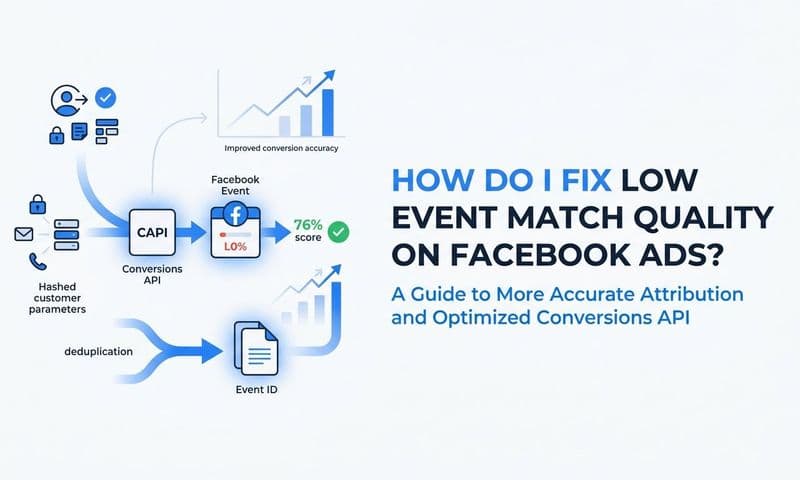
Server-Side Tracking with the Meta Conversion API: The Meta Conversion API (CAPI) addresses a significant technical gap in pixel-based tracking. Browser-side pixels are increasingly blocked by ad blockers, iOS privacy changes, and cookie restrictions, which means a growing percentage of conversion events simply don't get reported back to Facebook. CAPI sends conversion data directly from your server to Meta, bypassing the browser entirely. This improves match rates, captures events that the pixel would have missed, and gives Facebook's optimization algorithm better signal to work with when targeting for high-quality leads.
For B2B SaaS specifically, the most valuable conversion events to send through CAPI are often not purchases. They're demo requests, free trial activations, MQL or SQL milestones from your CRM, and pipeline stage progressions. Configuring these custom events takes more effort than standard pixel setup, but the improvement in data quality and optimization performance is substantial. Teams running B2B SaaS Facebook ads tracking at scale consistently find that CAPI implementation is one of the highest-leverage technical investments they can make.
Offline Conversion Tracking: Facebook also supports offline conversion tracking, which allows you to send pipeline and revenue data back to the platform after the fact. This closes the loop between ad activity and business outcomes and helps Facebook's algorithm optimize toward the kinds of leads that actually convert to revenue, not just any lead that submits a form.
Connecting Facebook Ad Data to Revenue With Attribution
Even with CAPI configured and CRM events flowing, most B2B teams are still missing a critical piece: a unified attribution layer that connects all of this data into a coherent picture of which campaigns are actually driving revenue.
Facebook's Ads Manager shows you what Facebook wants you to see. Your CRM shows you deal data without ad context. Your website analytics show traffic without revenue outcomes. None of these tools, on their own, can tell you that a specific Facebook campaign contributed to a specific closed-won deal that generated a specific amount of revenue. That gap is where attribution platforms for Facebook ads do their most important work.
Multi-Touch Attribution for B2B Journeys: B2B buyers rarely convert from a single touchpoint. They might see a Facebook awareness ad, click a Google search ad a week later, read a blog post, attend a webinar, and then respond to a sales outreach email before becoming a customer. A multi-touch attribution model distributes credit across all of these interactions rather than assigning everything to the last click. This gives you a much more accurate picture of how Facebook is contributing to pipeline across the entire customer journey, including the early touchpoints that often go unrecognized in last-click models.
Attributed Conversions vs. Actual Revenue Contribution: There's an important distinction between attributed conversions and actual revenue contribution. An attributed conversion means a lead or deal was associated with a Facebook touchpoint at some point in the journey. Revenue contribution means you can quantify how much closed-won revenue can be traced back to Facebook campaigns, weighted by the attribution model you're using. B2B SaaS teams need both metrics to make confident budget decisions. Attributed conversions tell you Facebook is working. Revenue contribution tells you how much it's worth.
This is exactly where Cometly provides a meaningful advantage for teams running b2b ads Facebook campaigns. Cometly connects your Facebook ad data to your CRM events, pipeline stages, and closed-won revenue in real time, giving you a single source of truth for marketing performance. Instead of reconciling numbers across three different platforms, you can see which campaigns generated leads, how those leads progressed through the pipeline, and what revenue they ultimately produced.
Cometly's server-side tracking and Conversion API integration ensure that the data flowing between your ad platforms and your attribution layer is as complete and accurate as possible, capturing events that pixel-based tracking misses. Its AI-driven recommendations surface which campaigns are driving real pipeline impact, so you can scale what's working and cut what isn't based on revenue outcomes rather than platform-reported metrics.
For B2B SaaS marketing teams that are serious about scaling Facebook as a revenue channel, having this attribution layer in place isn't optional. It's the difference between optimizing for clicks and optimizing for customers.
Putting It All Together
Facebook is a legitimate and often underutilized channel for B2B SaaS companies. The targeting infrastructure is deeper than most marketers assume, the cost efficiency is real, and the ability to reach decision-makers in a different context than LinkedIn or search creates genuine strategic value. But none of that matters if you're not structured for success from the start.
The teams that win with b2b ads Facebook are the ones who build proper audience layers, match ad formats to funnel stages, and measure performance in terms of pipeline and revenue rather than clicks and impressions. They use CAPI to close the tracking gap, send CRM events back to Meta to improve optimization, and connect all of that data to a multi-touch attribution model that reflects how B2B buyers actually make decisions.
The biggest gap most teams face isn't the ads themselves. It's the inability to connect ad activity to downstream revenue in a way that's accurate, actionable, and trustworthy. That's the problem Cometly is built to solve.
Ready to see which Facebook campaigns are actually driving pipeline and revenue? Get your free demo and start connecting every ad touchpoint to real business outcomes with Cometly's attribution platform.