Most B2B SaaS marketing teams are not losing because of bad creative or insufficient budget. They are losing because their campaigns generate activity without generating revenue, and they have no reliable way to tell the difference until it is too late.
You have probably seen this pattern before. A campaign drives solid lead volume, CPL looks reasonable, and the dashboard shows healthy engagement. But when you ask sales how the pipeline looks, the answer is underwhelming. Somewhere between the ad click and the closed deal, the signal disappears.
This is the core tension in B2B SaaS marketing: the gap between campaign activity and revenue outcomes. And it is not a creative problem. It is a structural one. Most campaigns are built to generate clicks and conversions without a system that connects those clicks to actual pipeline and revenue. The result is a marketing team optimizing for the wrong things, reallocating budget based on incomplete data, and struggling to prove their impact to leadership.
This guide is for marketers who want to close that gap. Whether you are building a B2B SaaS marketing campaign from scratch or auditing an existing one, the principles here will help you design a campaign that does not just generate leads but creates a measurable system from first touch to closed deal. Let's get into it.
Why B2B SaaS Campaigns Operate by Different Rules
If you have ever tried to apply B2C marketing playbooks to a B2B SaaS campaign, you already know it does not translate cleanly. The dynamics are fundamentally different, and understanding those differences is what separates campaigns that generate pipeline from campaigns that generate noise.
The first major difference is the buying cycle. B2B SaaS purchases rarely happen on impulse. A single deal might involve a champion who discovers your product, a manager who evaluates it, a finance team that reviews the pricing, and an executive who signs off. That process can take weeks or months, and it almost always involves multiple touchpoints across multiple channels before anyone raises their hand to talk to sales.
This means a campaign designed around a single click or a single conversion event is structurally incomplete. You are not marketing to a person making a quick decision. You are marketing to a buying committee moving through a deliberate process. Your campaign needs to be designed to stay relevant and persuasive across that entire journey, not just capture attention once.
The second difference is the nature of the product itself. SaaS products are largely invisible until someone uses them. You cannot photograph them, you cannot demonstrate them in a 15-second video the way a physical product can be shown. Campaigns must do more than promote features. They need to educate, build trust, and help prospects understand what life looks like after they adopt your solution. This shifts the creative and content strategy considerably.
The third difference is how success should be measured. In B2C, impressions, clicks, and conversion rates are meaningful proxies for business outcomes. In B2B SaaS, they are not. The metrics that actually matter are marketing qualified leads, pipeline contribution, opportunity creation rate, and ultimately revenue attribution. A campaign that drives thousands of clicks but zero pipeline is not a success, regardless of what the ad platform dashboard says.
This shift in measurement philosophy is not just an analytics preference. It changes how you structure campaigns, how you allocate budget, and how you evaluate creative. When pipeline and revenue are your north star, every decision looks different.
The Core Components Every Campaign Needs Before Launch
A B2B SaaS marketing campaign that lacks foundational structure will underperform regardless of how well-crafted the ads are. Before you write a single piece of copy or set a single budget, three components need to be locked in: audience definition, a goal hierarchy, and a conversion infrastructure.
Audience Definition Tied to Your ICP: Generic targeting produces generic results. Your campaign audience should be built around your ideal customer profile, which means going beyond job titles to include firmographics like company size and industry, specific pain points your product addresses, and the funnel stage the audience is likely in. A VP of Marketing at a 50-person SaaS company who has never heard of you needs completely different messaging than a Director of Revenue Operations at a 200-person company who is actively comparing attribution tools. Treating them the same way is a common and costly mistake.
A Campaign Goal Hierarchy: Not all conversions are equal, and your campaign structure should reflect that. Top-of-funnel activity, like content downloads or webinar registrations, serves a different purpose than a demo request or a free trial signup. The mistake many teams make is treating every conversion event as equivalent, which leads to optimizing for volume rather than quality. Build your campaign with a clear hierarchy: awareness activity feeds consideration campaigns, which feed bottom-of-funnel pipeline creation. Each stage has its own goal, its own success metric, and its own budget logic.
Conversion Infrastructure: This is where most campaigns quietly fail. You can have the right audience and the right message, but if your tracking is broken, you will never know what is actually working. Every campaign needs properly configured tracking events, landing pages tied to specific UTM parameters, and a CRM integration that captures source data from the very first touchpoint. Without this, your attribution data stops at the lead level. You can see which campaigns generated leads, but you cannot see which campaigns generated pipeline or revenue. That is a blind spot that will cost you budget and credibility.
Getting these three components right before launch is not glamorous work, but it is the difference between a campaign that builds compounding intelligence over time and one that generates data you cannot act on.
Choosing the Right Channels for Your B2B SaaS Audience
Channel selection in B2B SaaS is not about being everywhere. It is about being present in the right places at the right funnel stages, with the right message for each context. The three channels that consistently matter most for B2B SaaS campaigns are LinkedIn, Google Search, and Meta, and each plays a distinct role.
LinkedIn: LinkedIn is the dominant paid channel for B2B SaaS for one clear reason: targeting precision. You can reach prospects by job title, seniority, company size, industry, and even specific companies. No other platform gives you that level of professional targeting. However, LinkedIn requires a different approach than other channels. CPCs are higher, audiences are more skeptical of direct sales messaging, and content that educates or challenges a perspective tends to outperform content that promotes a product. Use LinkedIn primarily for top-of-funnel awareness and mid-funnel nurture, and invest in content that earns attention rather than demands it.
Google Search: Google Search captures buyers who are already in motion. When someone searches for "marketing attribution software for SaaS" or "best B2B analytics platform," they are actively researching a solution. This makes Google Search highly effective for bottom-of-funnel campaigns targeting comparison keywords, category keywords, and branded terms. The intent signal is strong, and the conversion rates from well-structured search campaigns tend to be higher than awareness channels. The tradeoff is that search volume for niche B2B SaaS categories can be limited, so you cannot rely on it alone to fill the top of your funnel.
Meta: Meta often gets overlooked in B2B SaaS because the targeting is less precise than LinkedIn. But it plays a valuable role in two specific scenarios: top-of-funnel awareness campaigns where broad reach matters more than precision, and retargeting campaigns that re-engage people who have already visited your website or interacted with your content. Meta's retargeting capabilities, combined with its lower CPCs compared to LinkedIn, make it a cost-effective channel for keeping your brand visible to warm audiences throughout a long buying cycle.
The natural question is: which channel should get the most budget? The honest answer is that it depends on your funnel stage priorities, your ICP, and your attribution data. A multi-channel approach is often necessary because B2B buyers rarely convert on a single touchpoint. But without cross-channel attribution data, you are guessing at which combinations are actually driving pipeline. This is where having a unified view of the customer journey becomes essential, not just a nice-to-have.
How to Structure Your Full-Funnel Messaging Strategy
Channel selection gets you in front of the right people. Messaging strategy determines whether they pay attention, engage, and eventually convert. In a B2B SaaS marketing campaign, messaging needs to evolve as prospects move through the funnel, because what resonates at the awareness stage is very different from what drives a demo request.
Top of Funnel: At this stage, your prospect may not even know your product exists, and they are not ready to hear about it. They are experiencing a problem and looking for context, perspective, or validation. Your messaging should focus on the pain, not the solution. Thought leadership content, problem-focused ads, and educational resources work well here because they meet the prospect where they are. A LinkedIn post that articulates a common frustration your ICP faces will earn more trust than a feature-focused ad that leads with your product name.
Mid Funnel: By the time a prospect reaches the middle of the funnel, they are aware of the problem and starting to evaluate solutions. This is where social proof, use case content, and comparison messaging become powerful. Retargeting campaigns work well here because you are reaching people who have already shown interest. Show them customer stories, explain how your product solves the specific problem they are researching, and address the objections that typically slow down buying decisions. The goal is not to close the deal at this stage. It is to build enough confidence that they are willing to take the next step.
Bottom of Funnel: At the bottom of the funnel, your prospect is close to a decision. They know the category, they have evaluated options, and they are looking for a reason to commit. Your messaging here should be specific, direct, and action-oriented. Demo requests, free trial signups, and direct sales conversations are the conversion goals. Use urgency where it is genuine, lead with your clearest value proposition, and remove as much friction from the conversion path as possible. This is not the place for educational content. It is the place for a clear, compelling reason to act now.
The mistake many teams make is running all three messaging types simultaneously without a clear audience segmentation strategy. When your bottom-of-funnel ad reaches someone who has never heard of you, it lands flat. Structure your campaign so messaging matches the prospect's stage, and your conversion rates across the funnel will improve meaningfully.
Tracking Campaign Performance Across the Entire Revenue Cycle
Here is where most B2B SaaS marketing campaigns hit a wall. The campaign is live, leads are coming in, and the ad platform dashboard looks healthy. But when someone asks which campaigns are actually contributing to pipeline and revenue, the answer is silence. This is the attribution gap, and it is one of the most expensive problems in B2B SaaS marketing.
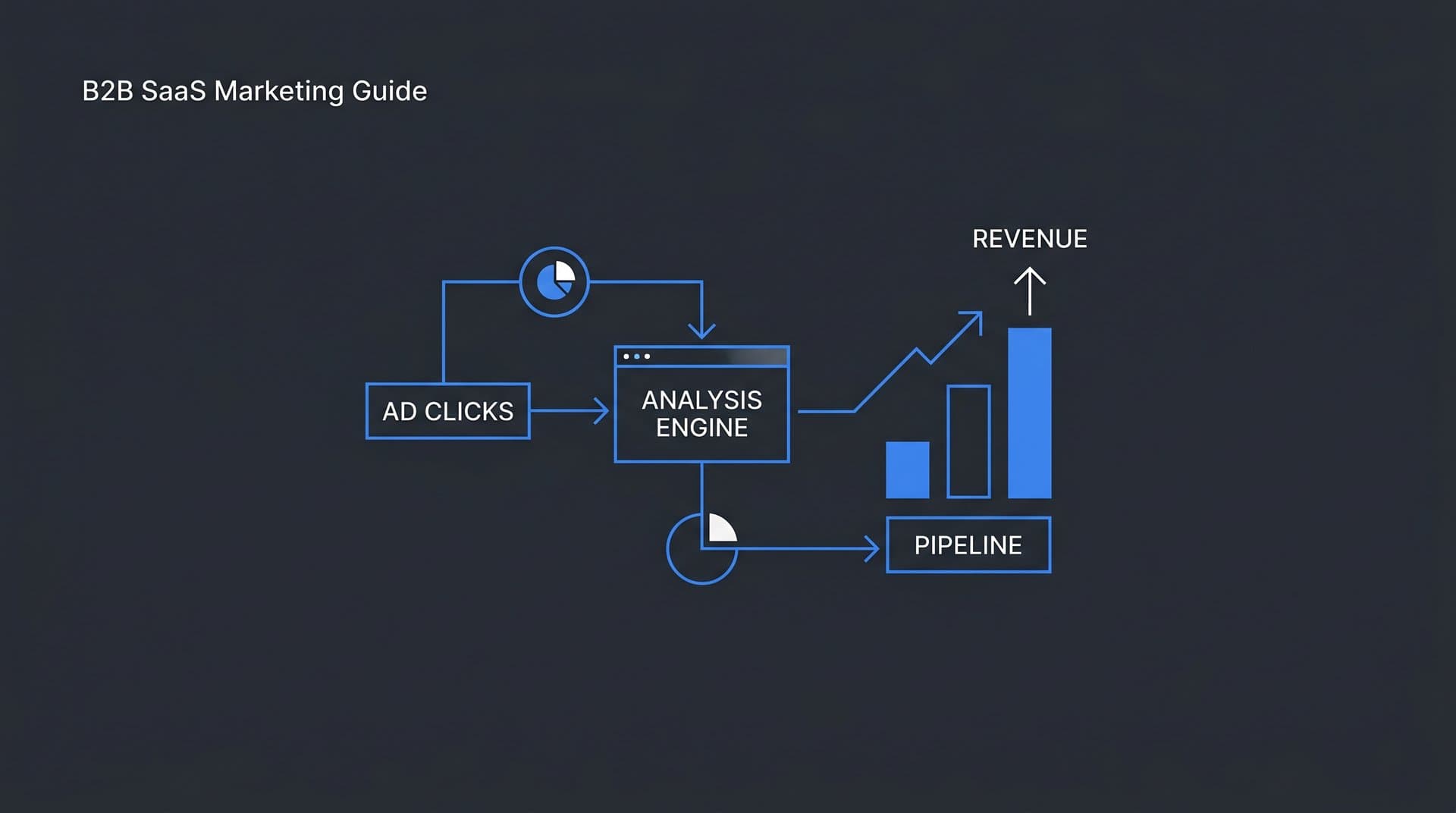
The root cause is almost always the same: tracking infrastructure that stops at the lead level. Ad platforms report clicks and conversions. CRMs track opportunities and deals. But without a system that connects those two worlds, you are left with two separate data sets that do not talk to each other. Marketing optimizes for leads. Sales works the pipeline. And no one has a clear view of which marketing activity actually drove revenue.
Vanity metrics make this worse. Impressions, click-through rates, and cost per lead are easy to measure and easy to report, but they do not tell you whether a campaign is generating pipeline. A campaign with a high CPL that consistently produces qualified opportunities is more valuable than a campaign with a low CPL that generates leads sales never converts. Without revenue-level attribution, you cannot see that distinction.
Multi-touch attribution is the framework that makes this visible. In B2B SaaS, deals involve multiple touchpoints across multiple channels over an extended period. A prospect might first encounter your brand through a LinkedIn post, visit your website after a Google Search, download a piece of content after seeing a retargeted ad, and then request a demo after receiving an email. Crediting only the first or last touch in that journey gives you a distorted picture of what is actually working. Multi-touch attribution distributes credit across the full journey, giving you a more accurate view of each channel's contribution.
Connecting ad spend data to pipeline and closed revenue requires a system that can track the customer journey from ad click through lead creation, opportunity stage, and closed deal. This is exactly what a platform like Cometly is built to do. By integrating with your ad platforms, CRM, and revenue data, Cometly creates a single source of truth that shows you not just which campaigns are generating leads, but which ones are generating revenue. That visibility changes how you allocate budget, how you evaluate creative, and how you report marketing's impact to the business.
It is also worth noting the growing importance of first-party data and server-side tracking. As third-party cookie signal loss continues to affect ad platform accuracy, Conversion API integrations like Meta CAPI and Google Enhanced Conversions help restore signal fidelity by sending conversion data directly from your server to the ad platform. This improves measurement accuracy and helps ad platform algorithms optimize toward the conversions that actually matter to your business.
Scaling With Confidence: What to Expand and What to Cut
Scaling a B2B SaaS marketing campaign is not the same as increasing your budget. Increasing budget without the right data behind it is just a faster way to waste money. Real scaling means identifying which specific campaigns, audiences, and channels are contributing to pipeline and revenue, and then reallocating spend toward those with precision.
The challenge is that most teams try to scale based on ad platform metrics alone. They look at which campaigns have the lowest CPL or the highest click-through rate and push more budget there. But in B2B SaaS, low CPL does not always mean high pipeline contribution. A campaign that generates a high volume of low-quality leads can look excellent in the ad platform dashboard while quietly draining budget that could be funding campaigns that actually move deals forward.
Scaling decisions need to be grounded in pipeline and revenue data. Which campaigns are generating opportunities that sales is actually working? Which audiences are producing prospects with the highest close rates? Which channels are appearing consistently in the journeys of your best customers? These are the questions that drive smart scaling, and they can only be answered with attribution data that extends beyond the ad platform.
AI-driven insights are increasingly valuable here. Modern attribution platforms can surface patterns in your campaign data that are difficult to detect manually, flagging underperforming spend before it compounds and identifying high-performing campaign combinations that deserve more investment. Rather than relying on intuition or lagging indicators, AI recommendations give marketing teams the confidence to act on data in real time.
There is also a compounding benefit to feeding enriched, first-party conversion data back to ad platforms. When Meta or Google receives accurate signals about which clicks are leading to real pipeline and revenue, their machine learning algorithms get better at finding more of those prospects. This creates a positive feedback loop: better data leads to better targeting, which leads to better results, which generates better data. Teams that invest in this infrastructure early tend to see their campaign efficiency improve over time in ways that teams relying on platform-level tracking simply cannot replicate.
Cutting what does not work is equally important. Budget that is not contributing to pipeline is budget that could be scaling what is. A disciplined approach to campaign auditing, supported by revenue-level attribution data, allows teams to make those cuts with confidence rather than defensiveness.