

If you're running paid search, paid social, content, and outbound simultaneously, you already know the frustration. Budget decisions get made based on gut feel, last-click data, or whoever argued most convincingly in the last planning meeting. Meanwhile, pipeline numbers fluctuate and nobody can say with confidence which channels are actually driving revenue.
This is the core problem marketing attribution solves. At its most basic level, attribution is the practice of assigning credit to the marketing touchpoints that contributed to a conversion or revenue event. In B2B SaaS, where a single deal might involve eight touchpoints across three months and four stakeholders, understanding which interactions actually moved the needle is not optional. It is foundational to running a scalable marketing operation.
The benefits of marketing attribution go well beyond cleaner reporting. Done right, attribution reshapes how you allocate budget, how you communicate with the CFO, how sales and marketing collaborate, and how your ad platforms learn to find better customers. This article breaks down each of those benefits in practical terms, so you can understand exactly what attribution unlocks for a B2B SaaS team and how to start building that capability.
From Guesswork to Clarity: What Attribution Actually Unlocks
Most B2B SaaS marketing teams are operating with fragmented data. Google Ads reports one set of conversions. Meta reports another. Your CRM shows something different entirely. And your website analytics tells a third story. When every platform claims credit for the same deal, you end up with inflated numbers that bear little resemblance to actual pipeline performance.
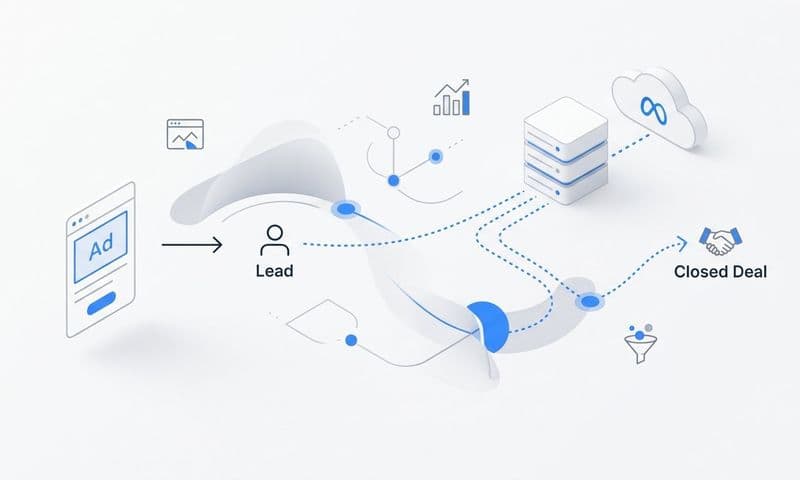
Attribution replaces this fragmentation with a single source of truth. By connecting your ad platforms, CRM data, and website behavior into one unified view of the customer journey, attribution gives you channel-level evidence instead of platform-level spin. You stop asking "which channel looks best in its own dashboard?" and start asking "which channels are actually generating qualified pipeline?"
This distinction matters more than it might seem. Vanity traffic, high click-through rates, and low-cost form fills can all look impressive in isolation. But if those leads never progress past the first sales call, the channel generating them is not contributing to revenue. Attribution surfaces this reality by connecting marketing activity all the way through to closed-won outcomes, not just top-of-funnel events.
One of the most common patterns attribution reveals is the undervaluation of top-of-funnel campaigns. Without attribution, teams tend to over-invest in last-touch channels because those are the ones that get credit in simple reporting models. A prospect might have discovered your product through a LinkedIn thought leadership post, engaged with a retargeting ad, read a comparison page, and then clicked a branded search ad before converting. In a last-click model, search gets all the credit. The LinkedIn campaign looks like it produced nothing.
This misattribution leads to a predictable and damaging cycle: teams cut top-of-funnel spend, demand generation dries up, and pipeline suffers weeks or months later. Attribution breaks that cycle by showing each touchpoint's actual contribution to the journey, so you can make investment decisions based on evidence rather than recency bias.
The clarity attribution provides also changes how marketing leaders communicate internally. Instead of defending spend with engagement metrics, you can show leadership exactly which campaigns contributed to which deals. That shift from anecdote to evidence is what separates marketing teams that earn budget from those that constantly have to justify it.
Smarter Budget Allocation Across Every Channel
Budget allocation is where the benefits of marketing attribution translate most directly into business outcomes. When you know which channels and campaigns contribute to closed-won revenue, you can shift spend toward what works and reduce investment in what does not. This sounds obvious, but it is genuinely difficult to do without reliable attribution data.
The challenge is that different attribution models tell very different stories about where credit belongs. First-click attribution gives all credit to the channel that initiated the journey. Last-click gives it all to the final touchpoint before conversion. Both models are simple to implement and easy to understand, but both are also deeply misleading for B2B SaaS buying cycles that span weeks or months.
Multi-touch attribution models distribute credit across the full journey, which is a much more accurate reflection of how B2B deals actually close. Common multi-touch models include linear attribution, which spreads credit equally across all touchpoints, time-decay attribution, which weights recent touchpoints more heavily, and data-driven attribution, which uses machine learning to assign credit based on actual conversion patterns in your data.
Each model has tradeoffs, and the right choice depends on your sales cycle length, deal complexity, and data volume. The important thing is moving away from single-touch models that systematically distort your understanding of channel performance.
With multi-touch attribution in place, B2B SaaS teams can compare performance across paid search, paid social, content, and outbound in a single view rather than juggling siloed dashboards. This cross-channel visibility is particularly valuable when you are trying to understand the interplay between channels. For example, you might find that paid social rarely closes deals on its own but consistently appears early in the journeys of your highest-value accounts. That insight changes how you think about social's role and budget, even if its last-touch conversion numbers look weak.
Attribution also enables more disciplined experimentation. When you can measure the downstream revenue impact of a campaign, not just its click or lead volume, you can run more meaningful tests. You can increase spend on a campaign that is generating high-quality pipeline and pause one that looks busy but produces little closed revenue. Over time, this evidence-based approach to budget allocation compounds into significantly better marketing efficiency without necessarily increasing total spend.
The teams that get this right are the ones that treat attribution data as a continuous input into planning, not a quarterly reporting exercise. Budget allocation decisions happen faster, with more confidence, when the data is always current and always connected to revenue outcomes.
Connecting Marketing Activity to Pipeline and Revenue
There is a persistent gap in how many marketing teams report their results. Impressions, clicks, leads, and cost-per-acquisition are all useful metrics, but they are not the metrics that drive board conversations or budget approvals. The numbers that matter at the executive level are pipeline generated, deal velocity, and closed revenue. Revenue attribution is what bridges that gap.
When attribution is connected to your CRM and billing data, you gain the ability to calculate true customer acquisition cost by channel. Without this connection, CAC is typically blended across all channels, which masks enormous variation in efficiency. One channel might be generating customers at a fraction of the blended average. Another might be wildly inefficient but hidden within the aggregate number. Attribution surfaces these differences so you can act on them.
Payback period calculations become similarly meaningful when tied to specific acquisition sources. If customers acquired through one channel convert faster, expand more, or churn less, that information should influence how you invest. Attribution makes it possible to track these patterns at the channel level, giving you a much richer picture of long-term marketing ROI than aggregate metrics allow.
Pipeline attribution also helps teams distinguish between two fundamentally different types of campaign value. Some campaigns are excellent at sourcing net-new opportunities, bringing accounts into the funnel that had no prior engagement. Others are better at accelerating deals already in progress, appearing as touchpoints that help move prospects from consideration to decision. Both types of campaigns are valuable, but they serve different purposes and should be evaluated differently.
Without attribution, this distinction is invisible. Campaigns that accelerate existing pipeline often look like they produce few leads, because the leads were already in the CRM. Attribution reveals their actual contribution by showing where they appear in the customer journey relative to pipeline stage progression.
This level of insight is what allows marketing leaders to have genuinely strategic conversations with sales and finance. Instead of reporting that a campaign generated a certain number of leads, you can show that it influenced a specific portion of the pipeline that closed at a certain rate and contributed to a measurable revenue outcome. That is the language of business, and attribution is what makes it possible for marketing to speak it fluently.
Better Ad Performance Through Richer Conversion Data
Ad platforms like Meta and Google do not optimize toward your business goals by default. They optimize toward whatever conversion signals you send them. If you are sending weak, incomplete, or delayed conversion data, the platform's machine learning algorithm is working with a distorted picture of what a valuable customer looks like. The result is inefficient targeting, higher costs, and campaigns that optimize toward the wrong outcomes.
This is where server-side tracking and Conversion API integrations become a direct performance lever, not just a data quality improvement. Browser-based tracking through pixels has become increasingly unreliable. Ad blockers, iOS privacy changes, and the ongoing deprecation of third-party cookies all reduce the volume and accuracy of conversion signals that reach ad platforms through the browser. When those signals are lost, the platform's optimization engine suffers.
Server-side tracking solves this by sending conversion events directly from your server to the ad platform, bypassing the browser entirely. Meta's Conversion API and Google's Enhanced Conversions are the primary implementations of this approach. When configured correctly, they dramatically improve event match rates, meaning the platform can more accurately connect conversion events to the ads and audiences that drove them.
The downstream effect on campaign performance is significant. Better match rates mean better audience modeling. Better audience modeling means the algorithm finds more people who resemble your actual customers. Over time, this creates a compounding improvement in campaign efficiency. You are not spending more; you are getting more from what you spend because the platform is learning from richer, more accurate data.
Attribution plays a central role in this loop. When your attribution system captures the full customer journey and feeds enriched, first-party conversion events back to ad platforms, you are closing a feedback loop that improves performance continuously. The data you collect informs your attribution analysis. Your attribution analysis identifies your highest-value conversion events. Those events get sent back to ad platforms as optimization signals. The platforms improve their targeting. Better targeting generates better data. The cycle reinforces itself.
For B2B SaaS teams running significant paid media budgets, this feedback loop is one of the most compelling reasons to invest in proper attribution infrastructure. The performance gains compound over time in ways that are difficult to achieve through creative or bidding optimizations alone.
Aligning Marketing and Sales Around Shared Data
The tension between marketing and sales is a familiar story. Marketing believes it is generating quality leads. Sales believes the leads are not ready to buy. Both teams are working from different data sources, and neither has a complete picture of the customer journey. Attribution changes this dynamic by giving both teams access to the same evidence.
When sales teams can see which marketing touchpoints a prospect engaged with before entering the pipeline, outreach becomes more informed and more relevant. A sales rep who knows that a prospect attended a webinar, read a product comparison page, and clicked a retargeting ad can tailor their approach accordingly. That context is valuable, and attribution is what makes it visible.
Shared attribution data also reduces the internal friction that comes from competing narratives. When marketing and sales are looking at the same customer journey data, conversations about lead quality, pipeline contribution, and campaign effectiveness are grounded in evidence rather than anecdote. This does not eliminate all disagreement, but it shifts the conversation from "whose numbers are right" to "what do we do with what we know."
Account-based marketing programs benefit particularly directly from attribution. In ABM, you are targeting specific accounts over long buying cycles, often with multiple contacts from the same company engaging with different content and ads at different times. Understanding which touchpoints influenced key stakeholders within a target account, and at what stage of the buying process, is essential for measuring ABM effectiveness.
Without attribution, ABM programs are difficult to evaluate. You might know that a target account eventually became a customer, but you cannot easily connect that outcome to the specific campaigns and content that moved them through the funnel. Attribution makes those connections visible, enabling teams to refine their ABM playbooks based on what actually works with high-value accounts rather than what seems to be working based on activity metrics alone.
The alignment benefit extends to planning as well. When marketing and sales share a common view of pipeline contribution by channel and campaign, joint planning conversations become more productive. Both teams can agree on which sources are generating the best opportunities and coordinate their efforts accordingly, rather than operating in parallel with misaligned priorities.
Building an Attribution-First Marketing Operation
The benefits described throughout this article do not arrive independently. They compound. Better attribution data leads to smarter budget allocation. Smarter allocation drives stronger pipeline. Stronger pipeline, connected to clear attribution evidence, builds marketing's credibility with leadership and justifies continued investment. Each benefit reinforces the others, and the effect accelerates over time.
If you are new to attribution or looking to upgrade your current approach, the practical starting point is straightforward: connect your ad platforms, CRM, and website tracking before you worry about which attribution model to use. The model question matters, but it is secondary to having clean, connected data flowing through a unified system. You cannot build a reliable attribution analysis on fragmented inputs.
Once your data sources are connected, you can begin evaluating attribution models relative to your sales cycle and business objectives. Multi-touch models will generally serve B2B SaaS teams better than single-touch models, but the right configuration depends on your specific context. Start with a model that reflects how your deals actually close, and refine it as you accumulate more data.
This is where Cometly is built to help. Cometly unifies multi-touch attribution, server-side conversion tracking, AI-driven recommendations, and revenue-connected reporting in a single platform designed specifically for B2B SaaS teams. It connects your ad platforms, CRM, and website into one view of the customer journey, so you can see exactly which campaigns are driving pipeline and closed revenue. The AI layer identifies high-performing ads and surfaces recommendations for scaling what works, while the Conversion API integrations ensure that enriched conversion data flows back to Meta, Google, and other ad platforms to improve targeting over time.
For growth leaders who are tired of defending marketing spend with engagement metrics, attribution is the foundation that changes that conversation entirely.
The Bottom Line on Marketing Attribution
Marketing attribution is not a reporting luxury reserved for large teams with dedicated analytics resources. It is a growth lever that any B2B SaaS marketing operation can and should be using. The teams that implement it gain something genuinely valuable: the ability to scale what works, cut what does not, and communicate marketing's contribution in the revenue terms that matter to leadership.
The benefits of marketing attribution span budget efficiency, pipeline visibility, ad performance, and organizational alignment. None of these benefits require perfect data or a sophisticated data science team to get started. They require a commitment to connecting your data sources and making decisions based on what the evidence shows rather than what feels right.
The longer you wait, the longer you are making budget decisions without the information you need to make them well. And in a competitive B2B SaaS market, that gap compounds against you over time just as attribution compounds in your favor when you invest in it.
Get your free demo and see how Cometly connects your ad spend to pipeline and closed revenue, so you can build a marketing operation that proves its impact and earns the budget to grow it.