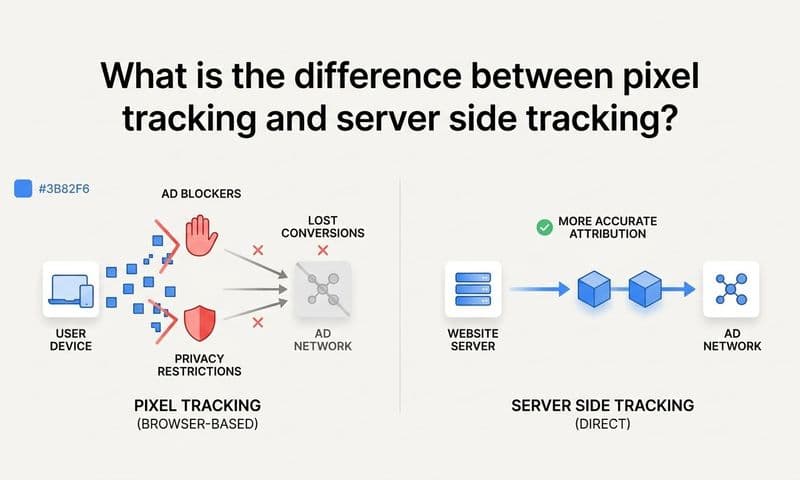
Third-party cookies are on their way out, and the tracking methods marketers relied on for years are no longer dependable. Safari's Intelligent Tracking Prevention has been limiting cookie lifespans for years, Firefox's Enhanced Tracking Protection follows suit, and Chrome's Privacy Sandbox changes have pushed the entire industry toward first-party data strategies. The result: growing gaps between what ad platforms report and what's actually driving your revenue.
First-party tracking solutions close that gap by collecting data directly from your own domain, giving you accurate, durable signal that holds up regardless of browser restrictions. But choosing the right solution isn't straightforward. Do you need full attribution across paid channels, a customer data platform to route data downstream, or a lightweight server-side setup to recover lost conversions? Your tech stack, ad platforms, and team resources all factor in.
The tools below were evaluated on data accuracy, integration depth, server-side capabilities, ease of setup, and value for paid media teams. Here are the top first-party tracking solutions worth comparing in 2026.
1. Cometly
Best for: Multi-platform paid media teams that need accurate attribution tied to real revenue.
Cometly is an AI-powered marketing attribution platform built around server-side first-party tracking, connecting your ad platforms, CRM, and website to show exactly which ads drive revenue.
 9 Best First-Party Tracking Solutions to Compare in 2026
Where This Tool Shines
Cometly's core strength is its combination of server-side tracking and multi-touch attribution in a single platform. Rather than patching together a data pipeline and a separate analytics tool, you get both working together from day one. Server-side tracking means your conversion data bypasses browser restrictions entirely, so you're not losing signal to ITP, ad blockers, or cookie expiration.
What sets Cometly apart is how it closes the loop between ad spend and revenue. It doesn't just collect first-party data: it feeds enriched conversion events back to Meta, Google, TikTok, and other ad platforms through Conversion Sync, improving the quality of data those platforms use for targeting and optimization. Add in AI-powered recommendations and an AI Chat interface for instant reporting, and you have a platform built for marketers who want to act on data quickly.
Key Features
Server-Side Tracking: Collects first-party conversion data from your own domain, bypassing browser-level restrictions for more complete and accurate signal.
Multi-Touch Attribution: Tracks customer journeys across Meta, Google, TikTok, and other ad platforms to show which touchpoints actually contribute to conversions.
Conversion Sync: Sends enriched first-party events back to ad platform algorithms, improving targeting, bidding, and overall ad ROI.
AI-Powered Recommendations: Surfaces actionable insights on which campaigns and ads to scale or cut based on real revenue data, not vanity metrics.
AI Chat for Reporting: Lets you query your marketing data in plain language for instant analysis without digging through dashboards.
Best For
Cometly is best suited for growth-stage businesses, marketing agencies, and in-house teams running paid campaigns across multiple ad platforms who need accurate attribution and clear visibility into which ads are generating real revenue. It's particularly valuable for teams frustrated by discrepancies between ad platform reporting and actual business results.
Pricing
Custom pricing based on ad spend and business needs. A demo is available on request through the Cometly website.
2. Segment (by Twilio)
Best for: Teams that need a centralized hub to collect, clean, and route first-party data across their entire marketing and analytics stack.
Segment is the leading customer data platform for unifying first-party event data and routing it to hundreds of downstream tools.
 8 Best Attribution-Focused Platforms vs Segment: Which Approach Fits Your Marketing Stack in 2026
Where This Tool Shines
Segment operates as the connective tissue of your data infrastructure. Instead of implementing separate tracking for every tool in your stack, you instrument once through Segment's API and route data wherever it needs to go: analytics platforms, ad platforms, CRMs, data warehouses, and more. This single-source approach means cleaner, more consistent first-party data across your organization.
Segment's identity resolution capabilities are particularly strong, stitching together anonymous and known user profiles across devices and sessions. This gives you a more complete view of the customer journey without relying on third-party identifiers.
Key Features
Unified Data Collection: A single API to capture first-party events from web, mobile, and server-side sources in one place.
400+ Integrations: Pre-built connections to analytics tools, ad platforms, CRMs, and data warehouses for flexible data routing.
Identity Resolution: Merges anonymous and identified user profiles across sessions and devices for a unified customer view.
Real-Time Audiences: Build and activate audience segments from first-party event data without waiting for batch processing.
Protocols: Data governance and quality enforcement to ensure consistent event naming and structure across your team.
Best For
Segment is ideal for mid-market and enterprise teams with complex data infrastructure needs, multiple downstream tools, and engineering resources to handle implementation. It's a strong fit for organizations that want a single source of truth for customer data across their entire stack.
Pricing
Free tier available for up to 1,000 monthly tracked users. Team plan starts at $120/month. Business plan is custom pricing.
3. Stape
Best for: Marketers who want server-side GTM hosting with first-party cookie capabilities without managing their own cloud infrastructure.
Stape is a managed server-side tagging platform that hosts Google Tag Manager server containers and enables first-party data collection through custom domain setups.
 9 Best First-Party Tracking Solutions to Compare in 2026
Where This Tool Shines
Stape removes the biggest barrier to server-side tagging: infrastructure management. Setting up a server-side GTM container on Google Cloud or AWS requires technical knowledge and ongoing maintenance. Stape handles all of that, giving you a managed environment with global infrastructure and a straightforward setup wizard that non-developers can navigate.
The custom loader feature is where Stape delivers real first-party tracking value. It routes tracking requests through your own domain, so cookies are set as first-party and aren't subject to the same browser restrictions that limit third-party cookies. This can meaningfully improve data completeness for teams running Meta CAPI, Google Ads conversions, and TikTok Events API.
Key Features
Managed Server-Side GTM Hosting: Fully managed infrastructure for server-side Google Tag Manager containers with global availability.
Custom Loader: Routes tracking through your own domain to set first-party cookies and bypass browser-level restrictions.
Ad Platform Support: Pre-built support for Meta CAPI, Google Ads, TikTok Events API, and other major platforms.
Power-Ups: Built-in data enrichment and transformation tools to improve event quality before sending to ad platforms.
Simple Setup Wizard: Guided onboarding designed for marketers without deep technical backgrounds.
Best For
Stape is a great fit for digital marketing agencies, small to mid-size businesses, and technically capable marketers who are already using Google Tag Manager and want to move to server-side tagging without the infrastructure overhead.
Pricing
Free plan for up to 10,000 requests per month. Paid plans start at around $20/month, scaling with request volume.
4. Elevar
Best for: Shopify and Shopify Plus merchants who need reliable, server-side conversion tracking across multiple ad platforms.
Elevar is a server-side tracking and data layer solution built specifically for Shopify, ensuring accurate conversion data reaches your ad platforms and analytics tools.
 9 Best Conversion Tracking Tools for Ecommerce in 2026
Where This Tool Shines
Elevar was built from the ground up for e-commerce, and it shows. The platform comes with a pre-built Shopify data layer that covers every meaningful e-commerce event out of the box, from product views and add-to-cart through checkout and purchase. This eliminates the custom development work that typically makes server-side tracking painful for Shopify stores.
Consent-aware tracking is another area where Elevar stands out. It has built-in consent mode support, so your data collection respects user preferences while still maximizing the signal you send to ad platforms. Real-time data quality monitoring with alerts means you know immediately if something breaks in your tracking setup.
Key Features
Pre-Built Shopify Data Layer: Complete e-commerce event coverage for Shopify and Shopify Plus without custom development.
Server-Side Event Forwarding: Sends conversion events to Meta, Google, TikTok, Pinterest, and more via server-side connections.
Consent Mode Support: Built-in consent-aware tracking that balances compliance requirements with data completeness.
Real-Time Data Quality Monitoring: Alerts and dashboards that flag tracking issues before they compound into data gaps.
No-Code Setup: Designed for Shopify merchants without engineering resources to handle implementation.
Best For
Elevar is purpose-built for Shopify and Shopify Plus merchants running paid campaigns across multiple ad platforms who want accurate conversion data without a custom development project. It's particularly valuable for DTC brands scaling ad spend across Meta and Google.
Pricing
Plans start at around $150/month, with pricing that scales based on order volume and feature requirements.
5. Ruler Analytics
Best for: B2B and lead generation teams that need to connect marketing touchpoints to CRM revenue for closed-loop attribution.
Ruler Analytics is a marketing attribution platform that uses first-party tracking to tie anonymous website visitors to CRM revenue, closing the loop between ad clicks and actual sales.
 8 Best Attribution Tools with Onboarding Support in 2026
Where This Tool Shines
Ruler Analytics solves a problem that's particularly acute for B2B marketers: understanding which marketing touchpoints led to a deal that closed weeks or months later. It tracks visitors at the individual level across multiple sessions and devices using first-party data, then matches those visitors to CRM records when they convert. This means you can see which campaigns, keywords, and channels are generating real pipeline and revenue, not just form fills.
Offline conversion tracking is a genuine differentiator. Ruler captures phone call conversions and form submissions and maps them back to the original marketing touchpoints, giving you a more complete picture of what's driving leads in industries where phone calls still matter.
Key Features
First-Party Visitor-Level Tracking: Tracks individual visitors across sessions and devices using first-party data for accurate journey mapping.
Closed-Loop Attribution: Connects marketing touchpoints directly to CRM revenue data to show true return on ad spend.
Multi-Touch Attribution Models: Supports first click, last click, linear, and other models so you can compare attribution approaches.
Ad Platform Integrations: Sends attribution data back to Google Ads, Meta, and Microsoft Ads to improve automated bidding.
Offline Conversion Tracking: Captures phone calls and form submissions and ties them back to originating marketing touchpoints.
Best For
Ruler Analytics is best suited for B2B companies, agencies, and lead generation businesses where the sales cycle is long and conversions happen offline or in a CRM. It's especially useful for teams running Google Ads or Meta campaigns where offline conversion data can improve bidding performance.
Pricing
Plans start at around $200/month, with pricing that scales based on features and traffic volume.
6. Tracedock
Best for: Teams that want to recover lost tracking data through DNS-level proxying without changing their existing tag setup.
Tracedock is a DNS-based first-party tracking solution that proxies tracking requests through your own domain to extend cookie lifespans and recover data lost to browser restrictions.
 9 Best Server Side Tracking Providers for Accurate Ad Data in 2026
Where This Tool Shines
Tracedock takes a different approach from most tools on this list. Rather than requiring you to rebuild your tracking infrastructure, it works with what you already have. By configuring a DNS record to route tracking requests through your domain, Tracedock makes your existing analytics and ad platform tags behave as first-party, extending the cookie lifespans that ITP and other browser restrictions would otherwise shorten.
The appeal is simplicity. There are no new tracking scripts to implement, no major tag management changes, and no developer sprints required. For teams that have a solid existing setup but are losing data to browser restrictions, Tracedock offers a low-friction path to recovery with built-in reporting to quantify how much data has been restored.
Key Features
DNS-Level Proxying: Routes third-party tracking requests through your own domain, making them appear first-party to browsers.
Cookie Lifespan Extension: Overcomes ITP and other browser restrictions that cap third-party cookie duration.
No Code Changes Required: Works with your existing analytics and ad platform tags without modifying your implementation.
Simple DNS Configuration: Setup is handled through a DNS record change rather than a full technical implementation.
Data Recovery Reporting: Shows how much tracking data has been recovered compared to your baseline before implementation.
Best For
Tracedock is a strong fit for businesses that have an existing tracking setup they're happy with but are experiencing data loss due to browser privacy restrictions. It's particularly useful for teams without significant engineering bandwidth who need a quick, low-disruption solution.
Pricing
Pricing is available on request and is typically based on traffic volume. Contact Tracedock directly for a quote.
7. JENTIS
Best for: Enterprise teams that need full control over server-side data collection with their own tag management system independent of Google.
JENTIS is an enterprise server-side tracking platform with a proprietary tag management system, giving marketing teams complete ownership over first-party data collection and distribution.
Where This Tool Shines
JENTIS stands out because it doesn't rely on Google Tag Manager. Its proprietary server-side tag management system gives enterprises complete independence from third-party tag infrastructure, which matters for organizations that want to maintain full control over their data pipeline. This is a meaningful distinction for teams with strict data governance requirements.
The platform's Synthetic User feature is technically sophisticated: it models data in consent-restricted environments by creating synthetic representations of user behavior, allowing for more complete analytics even when a significant portion of visitors decline consent. Essential Mode further supports privacy-first data collection by reducing the personal identifiers captured while still enabling meaningful analytics.
Key Features
Proprietary Server-Side Tag Management: Full-featured tag management system that operates independently of Google Tag Manager.
Essential Mode: Collects analytics data with reduced personal identifiers for privacy-respecting tracking without consent barriers.
Synthetic User Tracking: Models user behavior in consent-restricted environments to maintain data completeness.
Ad Platform Integrations: Direct server-side connections to major ad platforms and analytics tools.
Data Quality Dashboards: Real-time monitoring of data quality and completeness across your tracking setup.
Best For
JENTIS is designed for enterprise organizations, particularly those in markets with strict privacy regulations, that need full data ownership, independent tag infrastructure, and sophisticated consent-aware tracking capabilities.
Pricing
Enterprise pricing with custom quotes based on traffic volume and specific requirements. Contact JENTIS for a detailed proposal.
8. Littledata
Best for: Shopify merchants who need accurate GA4 tracking and server-side connections to ad platforms with minimal technical setup.
Littledata is an automated tracking solution for Shopify that ensures accurate first-party data flows into GA4, Meta, Google Ads, and other platforms.
Where This Tool Shines
Littledata's primary value is accuracy. Shopify's native GA4 integration is notoriously unreliable, often missing transactions, misattributing revenue, or failing to track subscription orders and refunds properly. Littledata fixes this by establishing a server-side connection between Shopify and GA4 that captures every e-commerce event accurately, including subscription orders through ReCharge and headless commerce setups.
For merchants running paid campaigns, the server-side forwarding to Meta Conversions API and Google Ads adds another layer of value. You're not just getting better analytics data: you're feeding more complete conversion signal back to the ad platforms that are optimizing your campaigns.
Key Features
Automated Shopify-to-GA4 Connection: Server-side integration that ensures complete and accurate e-commerce event tracking in GA4.
Subscription and Refund Tracking: Accurately captures subscription orders via ReCharge and refund events that native integrations often miss.
Server-Side Ad Platform Forwarding: Sends conversion data to Meta Conversions API and Google Ads via server-side connections.
Headless Commerce Support: Compatible with headless Shopify setups where standard tracking implementations typically break.
Data Accuracy Audits: Built-in monitoring and audit tools to verify that your tracking is capturing data correctly.
Best For
Littledata is ideal for Shopify merchants who rely on GA4 for analytics and need reliable data flowing to their ad platforms. It's especially valuable for subscription-based stores or brands using headless commerce architecture where standard tracking implementations fall short.
Pricing
Plans start at $99/month for Shopify Basic stores, with pricing that scales based on store size and feature requirements.
9. Piwik PRO
Best for: Organizations that need a full analytics suite built entirely on first-party data with complete ownership and no data sharing with third parties.
Piwik PRO is a privacy-focused analytics platform that operates entirely on first-party data, offering a comprehensive alternative to Google Analytics with full data ownership.
Where This Tool Shines
Piwik PRO is built for organizations that want analytics without handing their data to Google. It includes an analytics suite, tag manager, consent manager, and customer data platform in a single platform, so you're not stitching together multiple tools to get a complete picture. The self-hosted and private cloud deployment options mean your data never leaves your infrastructure if that's a requirement.
The built-in consent management is genuinely useful, offering granular user preference handling that integrates directly with your analytics setup. This makes it easier to maintain data collection across a consenting user base while respecting the preferences of those who opt out, all within the same platform.
Key Features
First-Party Analytics: Full analytics suite that collects and processes data entirely on first-party infrastructure with no third-party data sharing.
All-in-One Platform: Includes analytics, tag manager, consent manager, and CDP in a single integrated solution.
Deployment Flexibility: Available as self-hosted or private cloud to give organizations complete control over their data environment.
Custom Dashboards and Raw Data Access: Flexible reporting with access to raw event data for advanced analysis.
Built-In Consent Management: Granular user preference handling integrated directly with the analytics and tag management layers.
Best For
Piwik PRO is best suited for organizations that prioritize data ownership and privacy, including publishers, government entities, and businesses in markets with strict data protection regulations. It's also a strong choice for any team looking to move away from Google Analytics without losing analytics capability.
Pricing
Free Core plan available with essential analytics features. Enterprise plan includes advanced capabilities and is priced on a custom basis.
Choosing the Right First-Party Tracking Solution for Your Stack
The right tool depends entirely on what problem you're trying to solve. First-party tracking isn't one-size-fits-all, and the solutions above serve meaningfully different needs.
If your primary goal is accurate multi-platform attribution tied to real revenue, Cometly is the strongest choice. It combines server-side first-party tracking with multi-touch attribution, Conversion Sync to feed better data back to ad platforms, and AI-powered analysis in a single platform built specifically for paid media teams. For growth-focused marketers who need to know which ads are actually working, it's the most direct path from data to decision.
For teams building out data infrastructure that feeds multiple tools, Segment is the foundation to consider. It's not an attribution platform, but it's the best way to ensure consistent first-party data flows across your entire stack. If you're running Shopify and need reliable conversion tracking with minimal setup, Elevar is the most purpose-built solution for that environment, while Littledata is the better choice if GA4 accuracy is your primary concern.
Teams that want server-side GTM hosting without managing their own infrastructure will find Stape to be a practical, affordable starting point. And for organizations that need complete data ownership with a privacy-first analytics suite, Piwik PRO offers a compelling alternative to Google Analytics with no third-party data sharing.
Before committing to any tool, map your requirements: Which ad platforms are you running? Do you need attribution or just data collection? How much engineering support do you have for implementation? The answers will point you toward the right category, and from there, the right tool.
If you're running paid campaigns across Meta, Google, TikTok, or other platforms and want to see exactly which ads are driving revenue with accurate first-party data behind every number, Get your free demo of Cometly and see how server-side tracking and AI-powered attribution can change how you make marketing decisions.