

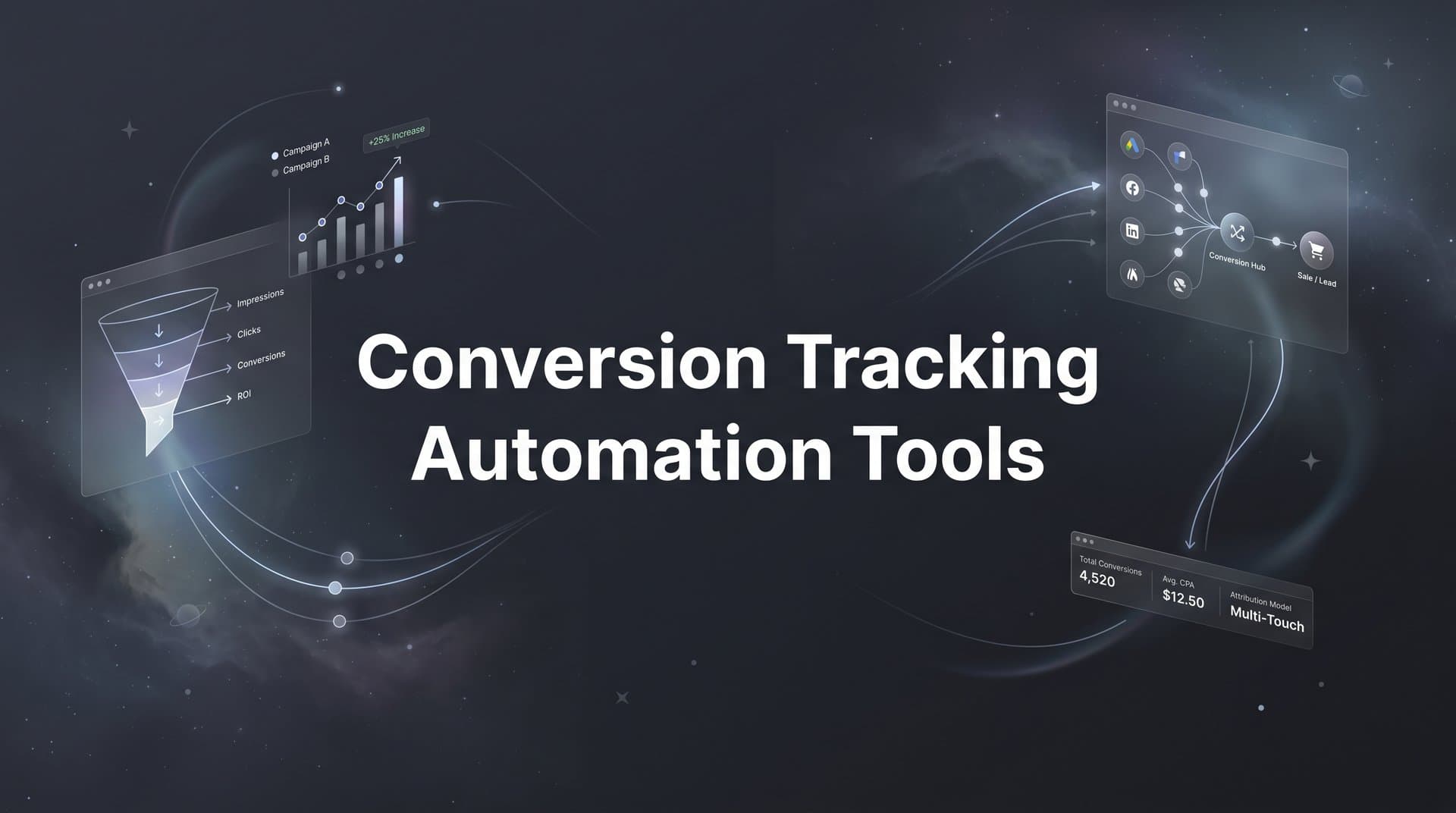
Manual conversion tracking is killing your ad performance. Every platform wants its own pixel. iOS privacy changes block half your data. And you're left guessing which campaigns actually drive revenue.
Conversion tracking automation tools solve this by centralizing your data collection, maintaining accuracy despite privacy restrictions, and syncing enriched conversion data back to your ad platforms so their algorithms can optimize better. The best solutions combine server-side tracking, multi-touch attribution, and automated data routing to eliminate manual work while improving data quality.
We evaluated these tools based on integration depth with major ad platforms, data accuracy in a privacy-first world, automation capabilities that reduce manual tracking setup, and cross-platform support for unified reporting. Here are the top conversion tracking automation tools that marketers are using in 2026.
1. Cometly
Best for: Multi-platform paid advertising teams wanting AI-powered attribution and optimization
Cometly is an AI-powered marketing attribution platform that tracks conversions across all ad channels and syncs enriched data back to improve campaign performance.
 9 Best Conversion Tracking Automation Tools in 2026
Where This Tool Shines
Cometly addresses the core challenge that's plagued marketers since iOS 14.5: getting accurate conversion data when traditional pixels fail. Its server-side tracking captures conversion events that browser-based pixels miss, giving you a complete view of what's actually driving revenue.
The platform's real differentiator is its conversion sync feature. It doesn't just track your data—it feeds enriched, first-party conversion events back to Meta, Google, and other ad platforms. This improves their algorithm training, leading to better targeting and optimization over time.
Key Features
Server-Side Tracking: Captures accurate conversion data despite iOS restrictions and ad blockers that break traditional pixels.
Multi-Touch Attribution: Shows every touchpoint in the customer journey across all marketing channels, not just last-click.
AI Ads Manager: Provides AI-powered recommendations on which ads and campaigns to scale based on true revenue impact.
Conversion Sync: Sends enriched conversion data back to ad platforms to improve their algorithm optimization and targeting.
Real-Time Analytics: Tracks campaign performance and attribution data in real time with customizable dashboards.
Best For
Cometly works best for marketing teams and agencies running paid advertising across multiple platforms who need accurate attribution despite privacy changes. It's particularly valuable if you're spending heavily on Meta and Google ads and want to feed better conversion data back to those platforms for improved performance.
Pricing
Custom pricing based on your monthly ad spend volume. Contact their sales team for a quote tailored to your campaign scale.
2. Google Tag Manager
Best for: Technical teams wanting free, flexible tag management with version control
Google Tag Manager is a free tag management system that centralizes all your tracking codes in one container with built-in version control and collaboration features.
 9 Best Server Side Tracking Solutions for Accurate Marketing Data in 2026
Where This Tool Shines
Google Tag Manager removes the bottleneck of waiting for developers every time you need to add or modify a tracking tag. Marketers can deploy tags through a visual interface, preview changes before publishing, and roll back if something breaks.
The platform's server-side tagging option (available through Google Cloud) provides a way to implement first-party tracking that's more resilient to privacy restrictions. This makes GTM a solid foundation for teams building their own tracking infrastructure.
Key Features
Unlimited Tags: Deploy unlimited tracking tags from any platform without code changes to your website.
Built-In Templates: Pre-configured templates for Google Analytics, Meta Pixel, LinkedIn Insight Tag, and hundreds of other platforms.
Version Control: Track every change with full version history and the ability to roll back to previous configurations.
Preview Mode: Test tag firing in real time before publishing changes to your live site.
Server-Side Tagging: Optional server-side container for first-party data collection that's more privacy-compliant.
Best For
Google Tag Manager is ideal for technical marketing teams or those with developer support who want full control over their tracking setup. It's particularly valuable if you're already invested in the Google ecosystem and want a free solution that scales.
Pricing
Completely free for the client-side container. Server-side tagging requires Google Cloud Platform, which costs approximately $50-200/month depending on traffic volume.
3. Segment
Best for: Enterprise teams building unified customer data infrastructure across hundreds of tools
Segment is a customer data platform that collects, cleans, and routes event data to hundreds of marketing and analytics tools through a single API.
 8 Best Attribution-Focused Platforms vs Segment: Which Approach Fits Your Marketing Stack in 2026
Where This Tool Shines
Segment solves the integration nightmare that comes with modern marketing stacks. Instead of implementing separate tracking code for every tool, you implement Segment once and route data to any destination through their platform.
The platform's identity resolution capability is particularly powerful. It stitches together user behavior across devices and sessions, creating unified customer profiles that flow to all your connected tools. This means your email platform, CRM, and ad platforms all work from the same customer data.
We compare the leading options in our AI ad creative platform roundup.
Key Features
Single API Integration: Implement one tracking library that sends data to all your marketing tools simultaneously.
300+ Integrations: Pre-built connections to marketing platforms, analytics tools, data warehouses, and business intelligence systems.
Identity Resolution: Automatically merges user activity across devices and sessions into unified customer profiles.
Data Governance: Built-in privacy controls, consent management, and data quality monitoring for compliance.
Real-Time Streaming: Events flow to destinations in real time, not batch processing that creates delays.
Best For
Segment is best for enterprise marketing teams or fast-growing companies that use many tools and need a central data infrastructure. It's particularly valuable if you're building a data warehouse or need sophisticated identity resolution across your customer journey.
Pricing
Free tier available for up to 1,000 monthly tracked users. Team plan starts at $120/month. Business and enterprise plans require custom quotes based on data volume.
4. Triple Whale
Best for: Shopify stores needing ecommerce-specific attribution with profit tracking
Triple Whale is an ecommerce attribution platform built specifically for Shopify with first-party pixel tracking and real-time performance dashboards tailored to online stores.
 7 Best Funnel.io Alternatives for Marketing Data Analytics in 2026
Where This Tool Shines
Triple Whale was built from the ground up for ecommerce, and it shows. The platform understands metrics that matter to online stores: contribution margin, customer acquisition cost, lifetime value, and true profitability after accounting for returns and fulfillment costs.
Their first-party pixel captures conversion data that traditional third-party pixels miss post-iOS 14.5. For Shopify stores struggling with attribution accuracy on Meta and Google ads, Triple Whale provides a clearer picture of what's actually driving sales.
Key Features
First-Party Pixel: Shopify-native tracking that captures more accurate conversion data than third-party pixels.
Profit and Loss Tracking: Real-time P&L dashboard that accounts for COGS, shipping, returns, and ad spend.
Creative Analytics: Track performance at the ad creative level to identify winning visuals and copy.
For a deeper dive into this space, see our AI ad creative generator guide.
Customer Journey Maps: Visualize the complete path from first touch to purchase across all channels.
Automated Reports: Daily performance summaries delivered to Slack or email without manual report building.
Best For
Triple Whale is purpose-built for Shopify store owners and ecommerce brands running paid advertising. It's especially valuable if you're scaling on Meta and Google ads and need to understand true profitability, not just revenue.
For a deeper dive, see our guide to AI ad generator for ecommerce.
Pricing
Plans start at $129/month for Shopify stores. Pricing scales based on monthly revenue and number of connected ad accounts.
5. Northbeam
Best for: Data-driven brands wanting machine learning attribution and predictive spend optimization
Northbeam is an attribution platform that uses machine learning to provide predictive analytics and media mix modeling for sophisticated marketing spend optimization.
 9 Best Attribution Tools for Small Marketing Budgets in 2026
Where This Tool Shines
Northbeam goes beyond simple last-click or even multi-touch attribution. Its machine learning models analyze historical performance to predict future outcomes and recommend budget allocation across channels.
The platform's media mix modeling capability is particularly valuable for brands spending across both digital and traditional channels. It can isolate the incremental impact of each channel, helping you understand true effectiveness rather than just correlation.
Key Features
Machine Learning Attribution: AI models that learn from your data to provide more accurate attribution than rules-based systems.
Media Mix Modeling: Statistical analysis that shows how each marketing channel contributes to overall performance.
Predictive Analytics: Forecasts that predict campaign performance and recommend optimal budget allocation.
Incrementality Testing: Built-in experimentation framework to measure true lift from marketing activities.
Cross-Channel Comparison: Unified view of performance across paid social, search, display, and offline channels.
Best For
Northbeam works best for established brands with significant marketing budgets who want sophisticated analytics beyond basic attribution. It's particularly valuable if you're spending across multiple channels and need data-driven guidance on budget allocation.
Pricing
Custom pricing based on monthly ad spend and data complexity. Contact their sales team for enterprise quotes.
6. Rockerbox
Best for: Omnichannel brands tracking both digital and offline marketing including TV and podcast
Rockerbox is an attribution platform that unifies measurement across digital and offline channels including TV advertising, podcast sponsorships, and direct mail campaigns.
 9 Best Attribution Software Options by Monthly Pricing in 2026
Where This Tool Shines
Most attribution platforms focus exclusively on digital channels. Rockerbox extends measurement to offline channels that are notoriously difficult to track, giving brands a complete view of their marketing mix.
The platform's approach to TV and podcast attribution uses statistical modeling combined with digital touchpoint data to estimate the impact of offline campaigns. This helps brands running integrated campaigns understand how traditional media drives online conversions.
Key Features
Offline Channel Attribution: Track the impact of TV, podcast, radio, and direct mail campaigns on digital conversions.
Digital Touchpoint Tracking: Standard pixel-based and server-side tracking for all digital marketing channels.
Customer Journey Analysis: Visualize how offline and online touchpoints work together in the conversion path.
Incrementality Measurement: Test frameworks to isolate the true lift from each marketing channel.
Marketing Data Warehouse: Centralized storage of all marketing data for custom analysis and reporting.
Best For
Rockerbox is ideal for established brands running integrated campaigns across digital and traditional media. It's particularly valuable if you're investing in TV, podcast, or other offline channels and need to justify that spend with data.
Pricing
Custom enterprise pricing based on marketing spend and number of channels tracked. Contact their team for quotes.
7. Ruler Analytics
Best for: Lead generation businesses connecting marketing touchpoints to closed revenue in CRM
Ruler Analytics is an attribution platform focused on B2B and lead generation businesses that connects marketing touchpoints to closed revenue tracked in your CRM.
 8 Best Attribution Tools with Onboarding Support in 2026
Where This Tool Shines
Most attribution tools stop at the lead or form submission. Ruler Analytics extends attribution all the way to closed revenue by integrating with your CRM to track which marketing touchpoints led to actual sales.
The platform's call tracking integration is particularly valuable for businesses where phone calls are a primary conversion point. It captures the marketing source of inbound calls and connects them to CRM deals, closing the attribution loop for offline conversions.
Key Features
Marketing to Revenue Attribution: Connects marketing touchpoints to closed deals in your CRM, not just leads.
Call Tracking: Dynamic number insertion and call recording to attribute phone conversions to marketing sources.
Form Submission Tracking: Captures the full customer journey for every form fill, not just the last click.
Multi-Touch Attribution Models: Choose from first-click, last-click, linear, time-decay, or position-based attribution.
Google Analytics Integration: Sends revenue data back to GA4 to see closed deals alongside website analytics.
Best For
Ruler Analytics is best for B2B companies and lead generation businesses with longer sales cycles where understanding marketing's impact on closed revenue is critical. It's especially valuable if phone calls are an important conversion point.
Pricing
Plans start at approximately $200/month for basic features. Advanced attribution and call tracking features require higher-tier plans with custom pricing.
8. Funnel.io
Best for: Marketing teams and agencies needing automated data collection from 500+ sources
Funnel.io is a marketing data hub that automates the extraction and transformation of data from over 500 marketing platforms for unified reporting and analysis.
Where This Tool Shines
Funnel.io solves the data aggregation problem that plagues marketing teams using many platforms. Instead of manually exporting CSVs or building custom API connections, Funnel automatically pulls data from all your sources on a schedule.
The platform's data transformation capabilities are particularly powerful. It can normalize naming conventions across platforms, calculate custom metrics, and prepare data for analysis without requiring technical skills or custom code.
Key Features
500+ Data Connectors: Pre-built integrations with major ad platforms, analytics tools, social media, and more.
Automated Data Collection: Scheduled data pulls that keep your reporting up to date without manual exports.
Data Transformation: No-code rules engine to clean, normalize, and calculate custom metrics from raw data.
Multi-Destination Export: Send transformed data to Google Sheets, Data Studio, Tableau, or your data warehouse.
Agency Features: Multi-client management with separate data spaces and customizable reporting per client.
Best For
Funnel.io is ideal for marketing teams and agencies managing campaigns across many platforms who spend too much time on manual data collection. It's particularly valuable if you need to create unified reports that combine data from multiple sources.
Pricing
Plans start at $399/month for basic features and a limited number of data sources. Pricing scales based on number of connectors and data volume.
9. Improvado
Best for: Enterprise marketing teams building comprehensive data warehouses with ETL automation
Improvado is an enterprise marketing analytics platform that extracts, transforms, and loads marketing data from all sources into your data warehouse or business intelligence tools.
Where This Tool Shines
Improvado is built for enterprise scale and complexity. The platform handles massive data volumes across hundreds of marketing sources while maintaining data quality and governance standards required by large organizations.
Unlike simpler aggregation tools, Improvado provides sophisticated ETL capabilities including data validation, quality monitoring, and automated error handling. This makes it suitable for enterprises where data accuracy and reliability are non-negotiable.
Key Features
300+ Marketing Connectors: Deep integrations with ad platforms, social media, email, CRM, and analytics tools.
No-Code Transformation: Visual interface for mapping, cleaning, and transforming data without SQL or coding.
Pre-Built Dashboards: Template dashboards for common marketing use cases that work with your data immediately.
Data Quality Monitoring: Automated alerts for data anomalies, missing values, or integration failures.
Enterprise Security: SOC 2 compliance, role-based access control, and audit logging for regulated industries.
Best For
Improvado is designed for enterprise marketing teams with complex data needs and large budgets. It's particularly valuable if you're building a marketing data warehouse or need enterprise-grade security and compliance features.
Pricing
Custom enterprise pricing based on data volume, number of sources, and required features. Contact their sales team for quotes.
Making the Right Choice
The right conversion tracking automation tool depends on your specific needs and marketing infrastructure. If you're running multi-platform paid advertising and want AI-powered attribution with conversion sync that improves your ad performance, Cometly provides the most comprehensive solution with server-side tracking that works despite privacy restrictions.
For technical teams on a budget who want full control over their tracking setup, Google Tag Manager offers powerful flexibility at no cost. Shopify stores should look at Triple Whale for ecommerce-specific features like profit tracking and creative analytics. Enterprise teams building unified customer data infrastructure across hundreds of tools will find Segment's CDP approach most valuable.
Lead generation businesses tracking revenue in a CRM benefit from Ruler Analytics' closed-loop attribution, while brands running integrated campaigns across digital and offline channels need Rockerbox's omnichannel measurement. Teams spending time on manual data aggregation can eliminate that work with Funnel.io or Improvado, depending on enterprise requirements.
The most important factor is choosing a tool that not only tracks conversions but actively improves your marketing performance. Look for platforms that sync enriched data back to your ad platforms, provide actionable optimization recommendations, and maintain accuracy despite ongoing privacy changes.
Ready to elevate your marketing game with precision and confidence? Discover how Cometly's AI-driven recommendations can transform your ad strategy—Get your free demo today and start capturing every touchpoint to maximize your conversions.


