

You've done everything right. You set up your campaigns, defined your audiences, and watched the traffic roll in. But the conversion numbers look off. Your ROAS seems lower than it should be. You're starting to question whether that LinkedIn campaign is actually working, or whether you should reallocate budget to a channel that appears to be performing better.
Here's the uncomfortable truth: your data might be lying to you. Not because of a platform bug or a tracking setup error, but because of something happening silently in your prospects' browsers every single day. Cookie blocking has quietly become one of the most disruptive forces in modern marketing attribution, and most B2B SaaS teams are only beginning to understand the full scope of the problem.
Cookie blocking attribution problems don't announce themselves. They don't throw errors or trigger alerts. They simply erase touchpoints, drop conversion events, and fragment customer journeys until your attribution data reflects a distorted version of reality. Budget decisions get made on that distorted data. High-performing campaigns get cut. Underperforming channels get scaled. And the gap between what's actually driving revenue and what your dashboard shows keeps widening.
This article breaks down exactly what cookie blocking does to your attribution data, why it's a particularly acute problem for B2B SaaS growth teams, and what modern solutions exist to restore the accuracy you need to make confident decisions.
How Cookie Blocking Quietly Corrupts Your Attribution Data
To understand the problem, you need to understand what's happening at the browser level. When a user clicks your ad and lands on your website, a traditional attribution setup relies on cookies to remember that interaction. Those cookies are small data files stored in the browser that allow your analytics tools and ad platforms to connect a future conversion back to the original click.
The problem is that modern browsers have become increasingly aggressive about blocking or limiting these cookies, and they've been doing so for years. Apple's Intelligent Tracking Prevention, known as ITP, was first introduced in Safari and has gone through multiple iterations. In its current form, ITP severely limits the lifespan of first-party cookies set via JavaScript and blocks third-party cookies entirely. For a B2B buyer who clicks an ad on Monday and converts two weeks later, that original touchpoint may already be invisible by the time the conversion happens.
Firefox takes a similar stance with Enhanced Tracking Protection, which blocks known third-party tracking scripts by default. These aren't niche browsers. Safari and Firefox together account for a meaningful share of professional web traffic, and that share is even higher among the technical and enterprise audiences that B2B SaaS companies typically target.
Then there are ad blockers. Tools like uBlock Origin don't just block ads. They block the tracking scripts that fire when a user visits your site, which means your pixel never executes, your conversion event never gets recorded, and that session simply disappears from your data. Among developers, product managers, and technical decision-makers, ad blocker usage is significantly higher than in general consumer populations. This is precisely the audience many B2B SaaS companies are trying to reach.
It's worth clarifying the distinction between first-party and third-party cookies, because both are at risk in different ways. First-party cookies are set by the domain the user is actively visiting. Third-party cookies are set by external domains, typically ad platforms and analytics tools, to track users across different websites. Third-party cookies have been the backbone of cross-site attribution for years, but they are now blocked by default in Safari and Firefox, and have been progressively phased out in Chrome as well.
The downstream effect on attribution is direct and damaging. Touchpoints go unrecorded. Conversion events get dropped. A customer who engaged with your brand five times across three channels appears in your data as a single anonymous session that converted out of nowhere. The journey looks fragmented because it is, at least from your tracking system's perspective.
The Real Cost to B2B SaaS Marketing Teams
Let's make this concrete. Picture a prospect who discovers your SaaS product through a LinkedIn ad. They click through, spend a few minutes on your pricing page, and leave without converting. A week later, they remember your product and search for it directly on Google. They visit again, read a case study, and sign up for a demo.
In a world with intact cookie tracking, your attribution tool would record both touchpoints and give appropriate credit to the LinkedIn ad that started the journey. In a world where ITP has cleared that original cookie, your attribution tool sees only the organic search visit. LinkedIn gets zero credit. Your ROAS for that LinkedIn campaign looks worse than it actually is, and you start questioning whether to cut the budget.
This is not a hypothetical edge case. This is a structural reality of the modern B2B buying journey, and it plays out across every channel where cookie blocking is active. The result is systematically underreported conversions across paid channels, which distorts every ROAS calculation you make.
When ROAS looks artificially low, the natural response is to reduce spend on those channels or reallocate budget toward channels that appear to be performing better. But if those "better performing" channels are only appearing stronger because they happen to be the last touchpoint before conversion, and therefore less affected by cookie expiration, you're not actually optimizing. You're misallocating.
The compounding problem for B2B SaaS teams is the length of the sales cycle. Consumer purchases might happen within hours or days of an initial ad click. B2B SaaS deals often take weeks or months to close. Safari's ITP, for example, can limit cookie lifetimes to as little as seven days in certain configurations. If your average sales cycle is thirty, sixty, or ninety days, cookie-dependent attribution tools will structurally fail to connect early-funnel touchpoints to closed-won revenue.
This means multi-touch attribution, the approach that assigns credit across all the channels that influenced a conversion, becomes nearly impossible to execute accurately with traditional cookie-based tools. The touches are there. The prospect engaged with your LinkedIn ad, your retargeting campaign, your blog post, and your Google ad. But your attribution model can only see the ones that weren't blocked, expired, or stripped. The model then draws the wrong conclusions, and those conclusions drive real budget decisions that affect pipeline and revenue.
Why Traditional Pixel Tracking Can No Longer Be Trusted Alone
Browser-based pixels work by embedding a small JavaScript snippet on your website. When a user visits a page or completes a conversion action, that script fires and sends data back to the ad platform or analytics tool. The entire mechanism depends on the browser executing the script and storing the associated cookie.
This architecture has a fundamental vulnerability: it relies entirely on the browser cooperating. Ad blockers intercept and block pixel scripts before they execute. Browser privacy settings prevent cookies from being written or read. Script-blocking extensions, which are common among technical users, stop the pixel from firing at all. For a B2B SaaS audience that skews toward developers, engineers, and technically sophisticated buyers, these tools are not rare. They are the norm.
The impact extends beyond your own reporting. When conversion signals are missing at the browser level, the data that reaches Meta and Google is degraded. These platforms rely on conversion feedback to train their optimization algorithms. When they receive fewer conversion events, or when the events they do receive are incomplete, their ability to identify and target users who are likely to convert diminishes.
This creates a compounding problem. Fewer conversions reported means the algorithm has less signal to work with. Less signal means worse audience optimization. Worse optimization means higher cost-per-acquisition. Higher CPA makes your campaigns look even less efficient, which may lead you to reduce spend further, which gives the algorithm even less data to optimize on. It's a downward spiral that starts with a blocked cookie.
Signal loss is not just a missing data point in a spreadsheet. Each blocked conversion event is a missed opportunity for the ad platform's AI to learn who is actually converting and to find more people like them. At scale, this degraded feedback loop translates directly into wasted spend and missed revenue opportunities. The platforms are only as smart as the data you feed them, and cookie blocking is quietly starving them of the information they need.
Server-Side Tracking and Conversion APIs: The Modern Fix
The solution to browser-level blocking is to move the tracking mechanism out of the browser entirely. That's the core idea behind server-side tracking. Instead of relying on a pixel in the user's browser to fire and send data to an ad platform, server-side tracking sends event data directly from your server to the ad platform's API. The browser's privacy settings, ad blockers, and cookie restrictions become irrelevant because the data never passes through the browser in the first place.
Meta's Conversions API, commonly referred to as CAPI, is the most prominent example of this server-to-server approach. When a user completes a conversion action on your site, your server sends that event directly to Meta's API. It doesn't matter whether the user is running uBlock Origin or whether Safari's ITP has already cleared the browser cookie. The conversion is recorded, the signal reaches Meta's algorithm, and your campaign optimization continues with accurate data.
Google offers a parallel solution called Enhanced Conversions. It works by capturing first-party data, such as a hashed email address submitted through a form, and sending that data server-side to Google Ads. This allows Google to match the conversion back to an ad click even when browser-based tracking would have failed. Both CAPI and Enhanced Conversions are well-documented, production-ready solutions that are increasingly considered table stakes for serious B2B SaaS marketing teams.
The foundation that makes server-side tracking possible is first-party data. When a user fills out a form, logs into your platform, or completes any action that involves sharing identifiable information, your server captures that data directly. You own it. It lives in your environment, not in a third-party cookie that a browser can delete. This first-party data layer is what allows you to send accurate, enriched conversion events to ad platforms regardless of what is happening in the user's browser.
Owning your conversion data at the server level is no longer just a technical option for advanced teams. It has become a competitive advantage. Companies that have made this architectural shift are feeding their ad platforms better data, getting better optimization, and making more accurate attribution decisions. Companies that haven't are operating on an increasingly distorted view of their marketing performance.
Multi-Touch Attribution in a Cookie-Blocked World
Multi-touch attribution is built on a simple premise: give credit to every channel that played a role in a conversion, not just the last one. Linear models distribute credit equally. Time-decay models weight recent touchpoints more heavily. Data-driven models use algorithmic analysis to assign credit based on actual conversion patterns. All of these models share one critical dependency: they need to see every touchpoint.
Cookie blocking makes that dependency a liability. When ITP clears a cookie after seven days, that early-funnel touchpoint disappears. When an ad blocker prevents a pixel from firing, that mid-funnel visit never gets recorded. The attribution model receives a partial picture and draws conclusions based on what it can see, not what actually happened. Channels that tend to appear later in the journey, like branded search or direct traffic, appear to be driving more conversions than they actually are. Channels that appear earlier, like paid social or display, appear to be driving fewer.
The way to rebuild accurate multi-touch attribution in a cookie-blocked environment is to combine multiple data sources. Server-side event data captures conversions that browser pixels would have missed. CRM data provides the ground truth for what happened after a lead entered the funnel, including deal stage progression, opportunity creation, and closed-won revenue. First-party tracking captures on-site behavior tied to known user identities rather than anonymous cookies.
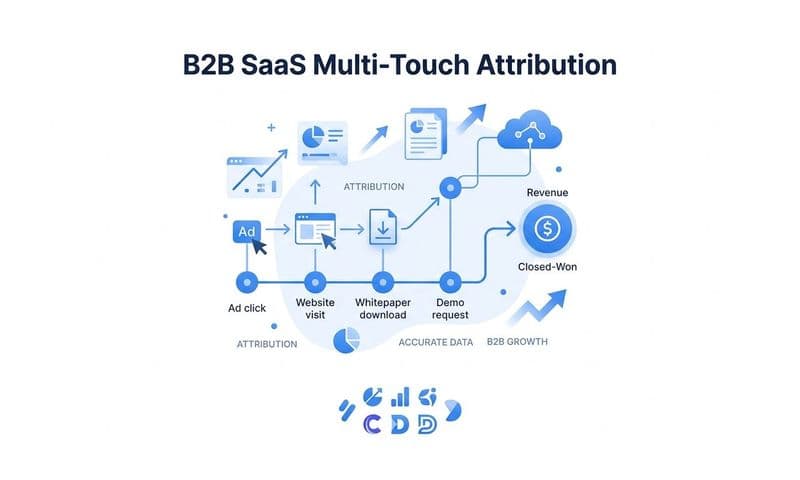
When these data sources are unified in a single attribution platform, the system can reconstruct customer journeys even when browser cookies are absent. A user who clicked a LinkedIn ad, visited the site under ITP restrictions, and later converted through organic search can have their full journey reconstructed because the CRM recorded the lead source, the server captured the conversion event, and the attribution platform connected the dots.
Two technical capabilities make this reconstruction reliable: identity resolution and event deduplication. Identity resolution is the process of connecting multiple data points, such as an email address from a form submission, a user ID from your CRM, and a hashed identifier from a server-side event, to a single user profile. This allows the attribution system to stitch together a complete journey even when individual touchpoints were tracked through different mechanisms.
Event deduplication is equally important. When you run both browser-based pixels and server-side tracking in parallel, which is recommended during any transition period, you risk recording the same conversion event twice. Deduplication logic ensures that each unique conversion is counted once, preventing inflated conversion numbers that would create a different kind of data distortion. Accurate attribution requires both capturing what was previously invisible and ensuring you don't overcount what you can now see.
Building an Attribution Stack That Survives Cookie Blocking
Solving cookie blocking attribution problems isn't about finding a single tool or flipping a switch. It requires building a measurement infrastructure that doesn't depend on any single browser behavior or third-party cookie. Here's what that infrastructure looks like in practice.
Server-Side Tracking Implementation: This is the foundation. Your server needs to capture conversion events and send them directly to ad platforms via their APIs. This means implementing Meta's Conversions API and Google's Enhanced Conversions at minimum, and ensuring your server is configured to pass the right event parameters, including match keys like hashed emails that allow platforms to connect server events back to ad clicks.
CRM Data Sync: For B2B SaaS teams, the conversion that matters most is rarely the form fill. It's the qualified opportunity, the closed deal, the expansion revenue. Syncing your CRM data with your attribution platform allows you to connect ad spend to pipeline and revenue rather than just leads. This creates a measurement framework that is durable because it's grounded in business outcomes, not just browser events.
First-Party Data Collection: Build your tracking around data you own. Encourage actions that generate identifiable first-party data points, such as form submissions, account creation, and product usage events. These signals can be captured server-side and used to reconstruct journeys that cookie-based tools would have missed entirely.
A Unified Attribution Dashboard: Combining server-side data, CRM data, and ad platform data in separate tools creates its own kind of fragmentation. A single attribution dashboard that unifies all signals gives your team one source of truth for evaluating campaign performance, comparing attribution models, and making budget decisions.
This is the approach Cometly is built around. Rather than relying on browser pixels alone, Cometly captures every touchpoint from the first ad click to closed-won revenue by combining server-side event tracking, Conversion API integration with major ad platforms, and direct CRM sync. It feeds enriched, conversion-ready data back to Meta, Google, and other platforms so their algorithms can optimize effectively. And it gives growth teams a single attribution dashboard that reflects complete customer journeys, not the fragmented version that cookie blocking produces.
The shift from click-level metrics to revenue-level attribution also makes your measurement framework inherently more resilient. When you're connecting ad spend directly to pipeline and closed deals, you're working with data that lives in your CRM and your server, not in a browser cookie that can be deleted at any moment. That's the kind of measurement foundation that holds up as privacy controls continue to tighten.
Your Next Steps in a Cookie-Restricted World
Cookie blocking attribution problems are not going away. If anything, they will intensify. Browser vendors are continuing to tighten privacy controls, ad blockers are becoming more sophisticated, and the third-party cookie, already deprecated in Safari and Firefox, is on a long-term path toward obsolescence across the web. The measurement infrastructure that worked reliably five years ago is no longer sufficient for the environment marketers operate in today.
The key shift is straightforward to describe, even if it takes real work to implement: stop relying on browser-based pixels as your primary conversion signal, and start building a server-side, first-party data foundation. Implement Conversion APIs. Sync your CRM. Unify your data in a single attribution platform. Connect your ad spend to revenue, not just clicks.
When you make that shift, you stop making budget decisions based on distorted data. You start seeing which channels are actually driving pipeline. Your ad platforms receive better conversion signals and optimize more effectively. And your attribution model reflects the full customer journey, including the touchpoints that cookie blocking would have made invisible.
If you're ready to stop guessing and start working from complete, accurate attribution data, explore how Cometly can help you capture every touchpoint and restore conversion signal accuracy across every channel. Get your free demo today and see what your marketing data looks like when nothing is being left out.