You're running campaigns across paid search, paid social, LinkedIn, and organic. Deals are closing. Pipeline is growing. But when your CFO asks which channels are actually driving revenue, you're left staring at a dashboard that tells a different story depending on which report you open.
This is the reality for most B2B SaaS marketing teams. The buying journey is long, involves multiple stakeholders, and touches dozens of channels before a deal ever closes. Yet most teams are still relying on attribution models that were designed for a consumer clicking an ad and buying a pair of shoes ten minutes later.
Standard models like last-click or first-touch are not just imprecise for B2B SaaS, they are structurally misleading. They force a complex, multi-month buying journey into a framework that cannot accommodate it. The result is misallocated budget, inflated credit for bottom-funnel channels, and a persistent inability to connect ad spend to closed revenue.
A custom attribution modeling service solves this by letting your team define how credit is assigned based on your actual funnel, your actual buyer behavior, and your actual business goals. Not a generic formula built for someone else's customer journey. This guide explains what custom attribution modeling is, why it matters specifically for B2B SaaS teams, and how to evaluate a service that fits your growth model.
Why Standard Attribution Models Break Down for B2B SaaS
First-touch, last-click, and linear attribution models were built for a world where the path from awareness to purchase is short and straightforward. A user sees an ad, visits a website, and converts within a single session or a few days at most. In that context, assigning all credit to the first or last touchpoint is a reasonable approximation.
B2B SaaS buying journeys are fundamentally different. A prospect might discover your product through a LinkedIn ad, read a few blog posts over the following weeks, attend a webinar, see a retargeting ad on Google, and then request a demo after a colleague mentions the product in a Slack channel. That journey might span three months and involve a dozen touchpoints across five channels. Assigning 100% of the credit to the last click before the demo request is not just inaccurate, it actively misleads your budget decisions.
The multi-stakeholder problem compounds this further. A single B2B SaaS deal rarely involves one decision-maker. A VP of Marketing might engage with thought leadership content. A CFO might interact with a pricing page and a competitor comparison article. A technical evaluator might read your documentation and watch a product walkthrough. Each of these people is part of the same buying group, but they are touching different content at different stages. Any single-touch model is structurally incapable of capturing this reality because it can only assign credit to one person's one interaction.
This leads to what you might call attribution drift. When your team optimizes campaigns based on inaccurate credit assignment, budget flows toward the channels that look best in the report, not the channels that actually influence pipeline and revenue. Branded search, for example, tends to get over-credited under last-click because it is often the final touchpoint before a conversion, even though the prospect was already deep in evaluation before they typed your brand name into Google.
Over time, attribution drift compounds. You scale the channels that look good in reports, underinvest in the channels that actually generate awareness and demand, and wonder why pipeline quality is declining even as conversion rates hold steady. The model is not measuring your funnel. It is distorting it. Understanding the attribution challenges in marketing analytics is the first step toward building a more accurate measurement framework.
Custom attribution modeling is the corrective. It allows you to build a credit assignment framework that reflects the actual structure of your buying journey, the actual weight of different touchpoints, and the actual stages that matter most to your business.
What a Custom Attribution Modeling Service Actually Does
A custom attribution modeling service is a platform or managed service that allows marketing teams to configure how conversion credit is distributed across touchpoints. Instead of applying a fixed formula, teams can define rules, assign weights, or use data-driven algorithms that reflect their specific funnel and business model.
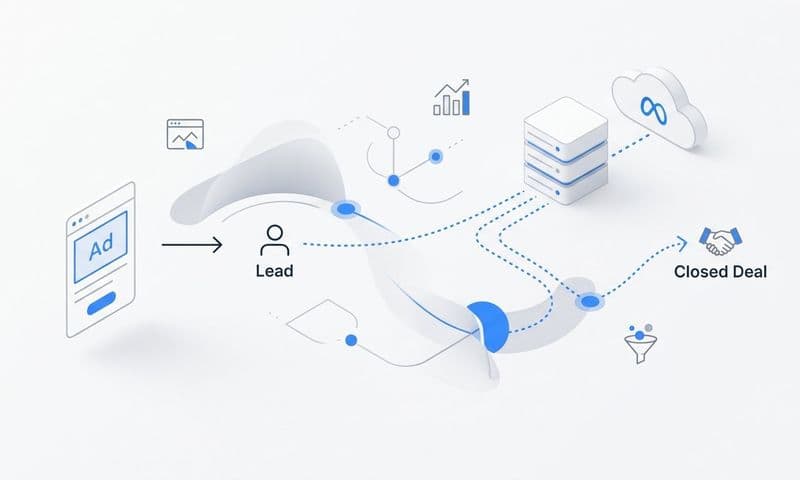
At its core, the service has three layers working together. The first is data collection. The service ingests touchpoint data from every relevant source: ad platforms like Meta, Google, and LinkedIn; CRM systems like HubSpot or Salesforce; and website behavior data that captures how prospects interact with your content across sessions and devices. The quality of this data layer determines everything downstream. If touchpoints are missing or duplicated, no attribution model can produce accurate results.
The second layer is the attribution engine itself. This is where customization happens. Depending on the service, you might configure a rules-based model that assigns specific credit percentages to defined touchpoints, a position-based model that weights first touch and lead conversion more heavily, or a fully data-driven attribution model that uses statistical analysis to assign fractional credit based on observed conversion patterns. The key distinction from standard models is that you are not locked into a preset formula. You can iterate the model as your funnel evolves.
The third layer is reporting. This is where the attribution data becomes actionable. A well-built service surfaces channel-level revenue attribution, pipeline contribution by stage, and ideally AI-driven recommendations that tell you not just what happened but what to do about it. The reporting layer should answer questions like: Which channels are generating the highest-value pipeline? Which campaigns are contributing to late-stage acceleration? Where is budget being wasted on touchpoints that do not correlate with closed revenue?
It is worth clarifying the difference between a configurable software platform and a fully managed attribution service, because these represent different levels of involvement and customization. A software platform gives your team the tools to build and manage attribution models directly, typically with integrations, a flexible rules engine, and a reporting interface. A managed service adds a layer of expert configuration and ongoing optimization, which is useful for teams that lack the internal resources to manage attribution infrastructure themselves.
For most B2B SaaS marketing teams, a configurable platform with strong native integrations and a marketer-friendly interface is the right starting point. The goal is to get accurate, actionable attribution data without requiring a dedicated data engineering team to maintain it.
The Building Blocks of a Reliable Custom Attribution Model
Before you can configure a meaningful attribution model, you need a reliable data foundation. This is where many teams underestimate the complexity. The model itself is only as accurate as the touchpoint data feeding it, and browser-based tracking has become increasingly unreliable over the past few years.
Ad blockers, iOS privacy changes, and the gradual deprecation of third-party cookies have created significant gaps in client-side tracking. A user who clicks a LinkedIn ad on their iPhone, visits your pricing page, and then books a demo three days later on their work laptop may generate only a partial touchpoint record if you are relying solely on browser pixels. That missing data does not disappear from your funnel. It just disappears from your attribution model, which means credit gets misassigned to whatever touchpoints did get captured.
Server-side tracking addresses this by sending conversion event data directly from your server to ad platforms and your attribution system, bypassing the client-side limitations that cause data loss. Combined with first-party data collected from your own properties, server-side tracking gives you a much more complete picture of the touchpoints that actually occurred. This is not a nice-to-have for B2B SaaS teams. It is foundational to customer attribution tracking accuracy.
Once you have reliable touchpoint data, the next building block is weighting logic. Not all touchpoints carry equal strategic weight in a B2B buying journey. A prospect visiting your pricing page or requesting a demo is expressing significantly higher intent than someone reading a top-of-funnel blog post. A well-configured custom attribution model reflects this by assigning higher fractional credit to high-intent interactions and lower credit to early awareness touchpoints.
This weighting can be rule-based, where your team explicitly defines the credit percentages for different touchpoint types, or it can be algorithmically derived from your conversion data. Either approach is more accurate than a default model that ignores intent signals entirely.
The third building block is CRM integration. This is what elevates attribution from a traffic metric to a revenue metric. When your ad platform data connects to your CRM pipeline stages and closed-won revenue, you can answer the question that actually matters to your CFO: which marketing channels are generating revenue, not just leads. This is the foundation of effective SaaS revenue attribution for growth-stage teams.
Without this connection, attribution stops at the MQL or demo request level. You know which channels are driving top-of-funnel activity, but you cannot tell whether those leads are converting to pipeline, progressing through stages, or closing at a meaningful rate. CRM integration closes this loop and makes attribution genuinely useful for budget decisions.
Comparing Attribution Models: Choosing the Right Starting Point
One of the advantages of a custom attribution modeling service is access to multiple model types that you can compare, test, and iterate. Understanding the trade-offs of each model helps you choose a starting point that aligns with how your buyers actually move through the funnel.
Position-based (U-shaped): This model typically assigns higher credit to the first touch and the last touch before conversion, with the remaining credit distributed across middle interactions. It reflects the strategic importance of both awareness and conversion moments, making it a strong starting point for teams that care about measuring both demand generation and bottom-funnel performance.
W-shaped: The W-shaped model adds a third high-credit position at the lead creation stage, in addition to first touch and conversion. This makes it well-suited for B2B SaaS funnels where the transition from anonymous visitor to identified lead (the MQL moment) is a critical milestone that deserves its own attribution weight.
Time-decay: This model assigns more credit to touchpoints that occur closer to the conversion event. It is useful when you want to emphasize the channels and campaigns that influenced a prospect in the final stages of evaluation. The trade-off is that it can undervalue early awareness channels that initiated the buying journey in the first place.
Data-driven: Data-driven attribution uses statistical modeling to assign credit based on the actual observed influence of each touchpoint on conversion outcomes. It is the most accurate approach when you have sufficient data volume, because it is not constrained by preset rules. The limitation is that it requires a meaningful number of conversion events to produce reliable results. Teams with lower conversion volume may find that data-driven models produce unstable outputs.
The goal here is not to find the objectively correct model. There is no universally correct model for B2B SaaS attribution. The goal is to find the model that most accurately reflects how your specific buyers move through your specific funnel, and then iterate as your business evolves. A detailed comparison of attribution models can help your team evaluate the trade-offs before committing to a starting configuration. Custom attribution services allow you to run multiple models simultaneously and compare the outputs, which is far more valuable than committing to a single model and assuming it is right.
A practical approach is to start with a position-based model that reflects your most important funnel milestones, validate it against your CRM data, and then introduce data-driven modeling once your conversion volume supports it.
How to Evaluate a Custom Attribution Modeling Service
Not all attribution services are built for B2B SaaS complexity. When evaluating options, it helps to think across three dimensions: technical capability, operational fit, and measurement quality.
On the technical side, the most important criteria are native integrations and tracking infrastructure. The service should connect natively to the ad platforms you actually use: Meta, Google Ads, LinkedIn, and any others that are part of your channel mix. It should also integrate with your CRM so that pipeline and revenue data can flow into the attribution model without manual exports. Equally important is support for server-side tracking and Conversion API integrations with Meta and Google. These are not optional features for B2B SaaS teams. They are prerequisites for accurate touchpoint data in a privacy-first environment.
Deduplication is another technical requirement that separates mature attribution services from basic tracking setups. When the same conversion event is tracked by multiple sources, such as a browser pixel, a server-side event, and a CRM record, the service needs logic to prevent that conversion from being counted multiple times. Without deduplication, your attribution reports will overcount conversions and misrepresent channel performance. This is one of the most common causes of attribution discrepancies in data that marketing teams struggle to resolve.
On the operational side, consider how quickly the service can be implemented and whether it requires significant engineering resources. Some attribution platforms require weeks of technical setup and ongoing data engineering support. Others are designed to be marketer-friendly, with guided onboarding and integrations that connect in hours rather than weeks. For most B2B SaaS marketing teams, the latter is the right fit. Attribution should be a marketing function, not an engineering project.
Transparency in the attribution logic is also critical. If your team cannot understand how credit is being assigned, you cannot trust the outputs or explain them to stakeholders. The service should make the attribution logic visible and configurable, not treat it as a black box.
On the measurement side, look for channel-level revenue attribution, pipeline attribution broken down by funnel stage, and AI-driven recommendations that surface actionable insights. The difference between a good attribution service and a great one is whether it helps your team make better decisions, not just generate better reports. Reviewing the best marketing attribution tools for B2B SaaS can help you benchmark what strong measurement quality actually looks like in practice.
Putting Custom Attribution Into Practice With Cometly
Cometly is built specifically for B2B SaaS teams that need to connect ad spend to pipeline and closed revenue across complex, multi-channel buying journeys. It functions as a custom attribution modeling service by bringing together ad platform data, CRM records, and website behavior into a single source of truth, giving your team the ability to compare attribution models side by side and understand which channels are actually driving revenue.
The platform connects natively to Meta, Google, LinkedIn, and more than 70 other integrations, including major CRM systems. This means your attribution data is not siloed by platform. You can see the full customer journey from the first ad click to the closed-won opportunity, with pipeline and revenue data flowing in from your CRM to give every touchpoint its proper context.
Server-side tracking and Conversion API integration are central to how Cometly ensures data completeness. Rather than relying on browser pixels that can be blocked or interrupted, Cometly sends enriched first-party event data directly to Meta and Google server-side. This serves a dual purpose: it gives your internal attribution model accurate, complete touchpoint data, and it feeds better conversion signals back to the ad platforms themselves, improving their targeting and optimization algorithms. You get more accurate attribution and better ad performance from the same data.
The AI layer is where Cometly moves beyond reporting into decision support. Instead of requiring your team to manually interpret complex attribution outputs across multiple models and channels, Cometly uses AI to surface which ads and campaigns are driving the highest-value pipeline, which channels are underperforming relative to spend, and where budget reallocation would have the greatest impact. Growth teams can act on these recommendations directly rather than spending hours in spreadsheets trying to derive the same insights manually.
For B2B SaaS teams that want to scale campaigns with confidence, the combination of complete touchpoint data, flexible attribution modeling, CRM-connected revenue attribution, and AI-driven recommendations makes Cometly a practical and powerful starting point for custom attribution at any stage of growth.
The Bottom Line
Standard attribution models are not just imprecise for B2B SaaS teams. They are a liability. When credit is misassigned, budget follows the wrong signals, pipeline quality suffers, and growth leaders lose the ability to make confident channel investment decisions. The complexity of B2B buying journeys demands a more sophisticated approach.
A custom attribution modeling service gives your team the ability to define credit assignment based on your actual buyer journey, connect ad spend to closed revenue through CRM integration, and iterate your model as your funnel evolves. It transforms attribution from a reporting exercise into a genuine decision-support function.
The trajectory is clear: AI-assisted attribution is becoming the standard for growth teams that want to scale efficiently. Teams that continue to rely on last-click or first-touch models will increasingly find themselves making budget decisions based on data that does not reflect reality. Teams that invest in custom attribution now will build a compounding advantage in how they allocate spend, optimize campaigns, and demonstrate marketing's contribution to revenue.
If you are ready to move beyond generic attribution models and connect your marketing activity to actual pipeline and revenue, explore what Cometly can do for your team. Get your free demo and see how Cometly maps your specific funnel to revenue, giving you the clarity to scale with confidence.