Most B2B SaaS marketing teams can tell you how many visitors came to their website last month. They can pull up lead counts, cost per click, and maybe even their MQL-to-SQL conversion rate. But ask them which specific ad campaign influenced the deal that closed last Tuesday, and the room goes quiet.
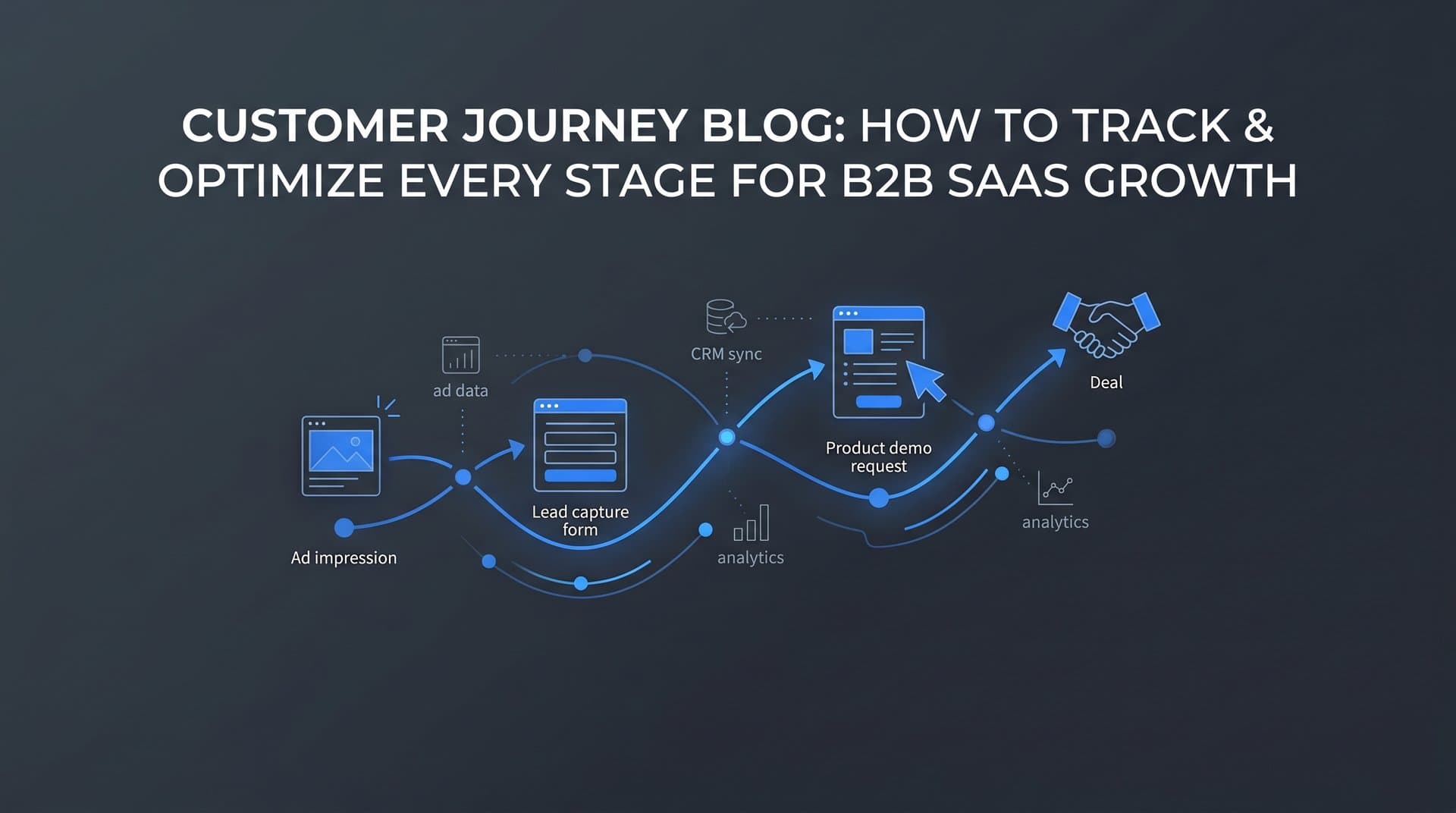
That gap between visible activity and proven revenue impact is one of the most persistent challenges in modern B2B marketing. You have data everywhere, but it lives in silos. Your ad platforms report one set of numbers. Your CRM tells a different story. Your website analytics show something else entirely. Connecting those dots, tracing the path from the very first ad impression to a closed-won deal, requires a fundamentally different approach to measurement.
This customer journey blog exists to help you build that approach. Whether you are a growth marketer trying to justify ad spend, a demand gen leader looking to optimize your funnel, or a founder who wants to understand what is actually driving pipeline, this guide will walk you through how to map, track, and optimize every stage of the B2B SaaS customer journey. Not with surface-level metrics, but with the kind of attribution intelligence that connects marketing activity directly to revenue outcomes.
Why the Customer Journey Defies a Simple Funnel
The classic marketing funnel is a useful mental model. Awareness flows into consideration, which flows into decision. Clean, logical, easy to draw on a whiteboard. The problem is that B2B software buyers do not behave that way in practice.
Think about how a typical SaaS purchase actually unfolds. A VP of Marketing at a mid-sized company sees a LinkedIn ad for your product. She clicks, reads a blog post, and closes the tab. Two weeks later, she searches Google for a comparison between your tool and a competitor. She reads three review sites. She downloads your pricing guide. One of her colleagues gets retargeted on Facebook and mentions your product in a Slack channel. She requests a demo. The sales cycle runs for six weeks, involving multiple stakeholders who each do their own research independently.
How many touchpoints influenced that deal? Dozens, easily. Which one deserves credit? That depends entirely on how you measure it, and most teams are not measuring it accurately.
Modern B2B SaaS buyers interact with paid ads, organic search results, email sequences, social content, review platforms, and direct sales outreach, often over a period of weeks or months. Research consistently shows that enterprise software purchases involve multiple decision-makers and a lengthy evaluation process, meaning the journey is rarely linear and never short.
This complexity creates real problems for marketing teams that rely on single-touch attribution or platform-native reporting. If you only credit the last click before a form fill, you systematically undervalue the awareness campaigns that started the conversation. If you only look at first touch, you miss the retargeting and nurture content that pushed the buyer across the finish line.
Understanding journey complexity is not just an academic exercise. It is the foundation of a measurement strategy that can actually connect marketing activity to pipeline and revenue. Without that foundation, you are optimizing for the metrics you can see rather than the outcomes that actually matter. And in a world where ad budgets are scrutinized and growth targets keep climbing, that distinction is the difference between scaling confidently and guessing your way forward.
Mapping the Core Stages of a B2B SaaS Buyer's Path
Even though the journey is not perfectly linear, it does follow recognizable stages. Understanding what buyers are doing at each stage, and what marketing activities are most relevant, helps you build a measurement framework that captures the right signals at the right time.
Awareness: This is where buyers first encounter your brand. Paid social ads, organic content, search ads, and thought leadership all play a role here. The goal is not conversion yet; it is relevance. Someone at this stage might click an ad, read a blog post, or watch a short video. The micro-conversion to track is engagement: time on site, content downloads, or a return visit within a short window.
Consideration: The buyer knows their problem and is actively researching solutions. They are reading comparison pages, visiting G2 or Capterra, consuming case studies, and engaging with retargeting ads. Your job here is to demonstrate credibility and differentiation. Track micro-conversions like newsletter signups, gated content downloads, and repeat site visits from known traffic sources.
Evaluation: This is where intent becomes explicit. Demo requests, free trial signups, and pricing page visits are the signals that matter. The buyer is now comparing your product directly against alternatives. Sales is likely involved. Marketing's role shifts to enablement: providing the right content to support the sales conversation and staying visible through targeted retargeting.
Decision: The buyer is ready to commit. They are reviewing proposals, negotiating terms, and getting final sign-off from stakeholders. The closed-won event in your CRM is the ultimate conversion here, but it is the culmination of everything that came before it. This is the stage where most attribution models focus all their attention, which is exactly why they miss so much of the picture.
Post-Purchase Retention: The journey does not end at the contract. Onboarding experience, product adoption, expansion opportunities, and renewal conversations are all part of the customer lifecycle. For B2B SaaS companies with subscription revenue models, retention and expansion often drive more long-term growth than new acquisition. Tracking post-purchase touchpoints helps you understand what keeps customers engaged and what signals churn risk before it becomes a problem.
The key insight here is that treating all leads the same leads to wasted budget. A lead who just saw your first awareness ad needs completely different messaging than someone who has visited your pricing page three times. Segmenting your journey stages and mapping specific tracking events to each one gives you the granularity to optimize intelligently rather than broadcasting the same message to everyone.
How Attribution Models Shape What You See
Attribution models are the lens through which you interpret journey data. Choose the wrong lens and you will draw the wrong conclusions, even if your underlying data is solid. Understanding how each model works, and where each one falls short, is essential for any B2B SaaS marketer who wants to make confident budget decisions.
First-touch attribution gives all credit to the first interaction a buyer had with your brand. It is useful for understanding which channels are best at generating initial awareness, but it completely ignores everything that happened between that first click and the closed deal.
Last-click attribution does the opposite: it credits the final touchpoint before conversion. This model is still the default in many ad platforms and analytics tools, which means it systematically overvalues bottom-of-funnel channels like branded search while undervaluing the awareness and nurture activity that created the demand in the first place.
Linear attribution distributes credit equally across all touchpoints in the journey. It is more balanced than single-touch models, but it treats a quick bounce from a display ad the same as a 20-minute product demo session, which is not a realistic reflection of influence.
Time-decay attribution gives more credit to touchpoints that occurred closer to the conversion event. This makes intuitive sense for short sales cycles, but for B2B SaaS deals that take three to six months to close, it can still undervalue early-stage awareness campaigns that planted the seed.
Data-driven attribution uses machine learning to assign credit based on the actual patterns in your conversion data. It is the most sophisticated option available in platforms like Google Ads, but it requires significant conversion volume to produce reliable results, which many B2B SaaS companies with smaller deal counts cannot always provide.
The honest answer is that no single model tells the complete story. Each one creates blind spots. Relying on last-click attribution in a world where B2B buyers interact with dozens of touchpoints before deciding is like judging a basketball player's contribution by only watching the final minute of the game.
Multi-touch attribution is the approach that gives growth teams a more accurate, complete view of which touchpoints actually influenced revenue. By distributing credit across the full journey based on meaningful interaction signals, multi-touch attribution helps you understand the true contribution of each channel, campaign, and ad creative, so you can allocate budget toward what is actually working rather than what looks good in a single-platform report.
Solving the Cross-Channel Tracking Problem
Even if you understand attribution models conceptually, implementing accurate tracking across channels and devices is where many teams hit a wall. The technical landscape has shifted significantly, and the tools that marketers relied on for years are no longer reliable enough to build a measurement strategy on.
Browser-based pixel tracking, which has been the foundation of digital marketing measurement for over a decade, is increasingly unreliable. Safari's Intelligent Tracking Prevention, Firefox's enhanced privacy protections, and the gradual deprecation of third-party cookies have all eroded the accuracy of pixel-based data. Ad blockers compound the problem further. The result is that a meaningful portion of conversion events never get recorded by traditional tracking methods, which means your platform-reported numbers are likely undercounting real conversions.
Server-side tracking and Conversion API integrations are the modern answer to this problem. Instead of relying on a browser-based pixel to fire correctly, server-side tracking sends conversion event data directly from your server to the ad platform's API. Meta's Conversion API (CAPI) and Google's Enhanced Conversions are the two most important implementations for most B2B SaaS teams running paid social and paid search.
The practical benefit is significant. Server-side events are not blocked by ad blockers or affected by browser privacy restrictions. They capture conversions that pixel-based tracking would miss entirely. And because they send first-party data that you collect directly from your own systems, they are more accurate and more durable as privacy regulations continue to evolve.
But accurate event capture is only part of the solution. The other piece is connecting your ad platform data with your CRM events and website behavior into a single, unified view. When those data sources remain separate, you end up with a situation where your Facebook Ads dashboard claims credit for 40 conversions, your Google Ads account claims 35, and your CRM shows 25 closed deals for the month. They all measure different things and none of them agree.
A unified attribution platform resolves this by pulling all of those data sources together and applying consistent attribution logic across the full journey. The result is a real-time picture of the customer journey from first ad click to closed-won deal, without the manual reconciliation that consumes hours of analyst time every month. Cometly is built specifically to solve this problem for B2B SaaS teams, connecting ad platforms, CRM data, and website behavior into one source of truth so you always know which campaigns are actually driving revenue.
Turning Journey Data Into Decisions That Move the Needle
Collecting journey data is only valuable if it changes how you make decisions. The goal is not a more impressive dashboard; it is smarter budget allocation, better creative strategy, and more efficient campaigns. Here is how journey analytics actually translate into action.
The most immediate insight journey data provides is the difference between lead volume and lead quality. Many campaigns that generate high lead counts produce deals that rarely close, while lower-volume campaigns might consistently source your highest-value customers. When you can trace individual leads from their first touchpoint all the way through to closed-won revenue, you can identify which channels and campaigns generate pipeline that actually converts, not just pipeline that looks good in a weekly report.
This changes how you think about cost per lead as a metric. A campaign with a higher cost per lead might still be your most efficient channel if the leads it generates have a significantly higher close rate and average contract value. Without journey-level data connecting ad spend to revenue outcomes, you would never know. You might even cut that campaign to hit a cost-per-lead target, inadvertently eliminating your best source of high-quality pipeline.
AI-powered insights add another layer of value here. Modern attribution platforms can surface patterns in your journey data that would be impossible to identify manually at scale. Which ad creative combinations correlate with shorter sales cycles? Which audience segments show the highest lifetime value? Which campaigns are generating demo requests that consistently convert to paid accounts? These are the questions that AI can answer by analyzing patterns across thousands of touchpoints simultaneously.
There is also a direct performance benefit to feeding enriched conversion data back to your ad platforms. When you send accurate, first-party conversion events back to Meta and Google through their Conversion APIs, you improve the quality of the data their algorithms use for targeting and optimization. Better input data means better algorithmic decisions, which typically results in lower cost per acquisition over time. It is a compounding advantage: the more accurate your conversion data, the smarter the platform's targeting becomes, which improves campaign performance, which generates more conversion data to learn from.
Cometly's AI ads manager is designed to surface exactly these kinds of insights, helping teams identify high-performing ads across every channel and make reallocation decisions with confidence rather than intuition.
Building a Measurement Framework That Grows With You
Understanding the customer journey conceptually is one thing. Building a measurement framework that actually captures it accurately, at scale, across every channel your team uses, is where the real work happens. The good news is that you do not need to build everything at once. A scalable framework starts with the right foundation and adds sophistication progressively.
The foundation is a single source of truth for attribution data. This means one platform where your ad spend, CRM pipeline data, and website conversion events all live together and are reconciled against each other consistently. Without this, every conversation about marketing performance turns into a debate about whose numbers are right. With it, your entire growth team works from the same data, which makes alignment faster and decisions cleaner.
Consistent event naming is the next critical piece. If your CRM records a demo request as "Demo Booked" but your ad platform tracks it as "Lead Form Submit" and your website analytics calls it a "Goal Completion," you will spend more time translating between systems than actually analyzing the data. Establishing a clear, shared taxonomy for conversion events across all platforms before you scale your tracking is far easier than cleaning up inconsistencies later.
Clear KPIs mapped to each journey stage give your team a shared language for measuring progress. Awareness campaigns should be evaluated on reach, engagement, and new audience growth. Consideration campaigns should be measured on content engagement and retargeting conversion rates. Evaluation-stage campaigns should be tracked on demo requests and trial signups. And all of it should ultimately roll up to pipeline contribution and closed revenue, so every marketing activity is connected to a business outcome.
As your business scales, you can layer in more sophisticated capabilities: multi-touch attribution modeling, AI-driven spend recommendations, cohort analysis by acquisition channel, and revenue attribution by campaign or creative. Cometly is built to support this progression, with 70-plus native integrations that connect your existing stack and a platform architecture designed to grow with your business from early-stage tracking through enterprise-level attribution.
The teams that build this framework early create a durable competitive advantage. They make faster decisions, waste less budget, and can prove the value of marketing investment in terms that resonate with finance and leadership. Those that delay end up spending months trying to retrofit measurement onto a system that was never designed for it.
Putting It All Together
The B2B SaaS companies that scale efficiently are not the ones with the biggest ad budgets. They are the ones that understand their customer journey well enough to invest in what actually works and cut what does not. That requires moving beyond traffic dashboards and lead counts to a measurement approach that connects every touchpoint to revenue in real time.
The path forward is clear: map your journey stages, implement reliable cross-channel tracking with server-side event capture, choose attribution models that reflect the complexity of your actual sales process, and use journey analytics to make budget decisions based on revenue impact rather than volume metrics. Then feed that enriched data back to your ad platforms to improve algorithmic targeting and compound your performance gains over time.
Cometly is built specifically for B2B SaaS teams who want to do exactly this. It connects your ad platforms, CRM, and website into a single attribution platform, captures every touchpoint from first click to closed deal, and uses AI to surface the insights that help you scale with confidence. Whether you are just starting to build your measurement foundation or ready to move to sophisticated multi-touch attribution, Cometly gives your team the complete view of the customer journey that modern growth requires.
Ready to stop guessing and start knowing what is actually driving your revenue? Get your free demo today and see how Cometly can give your team a real-time, end-to-end view of every stage in your customer journey.